
Supermoon Meaning: Dates, Distance and Signs
What Supermoon Meaning Is
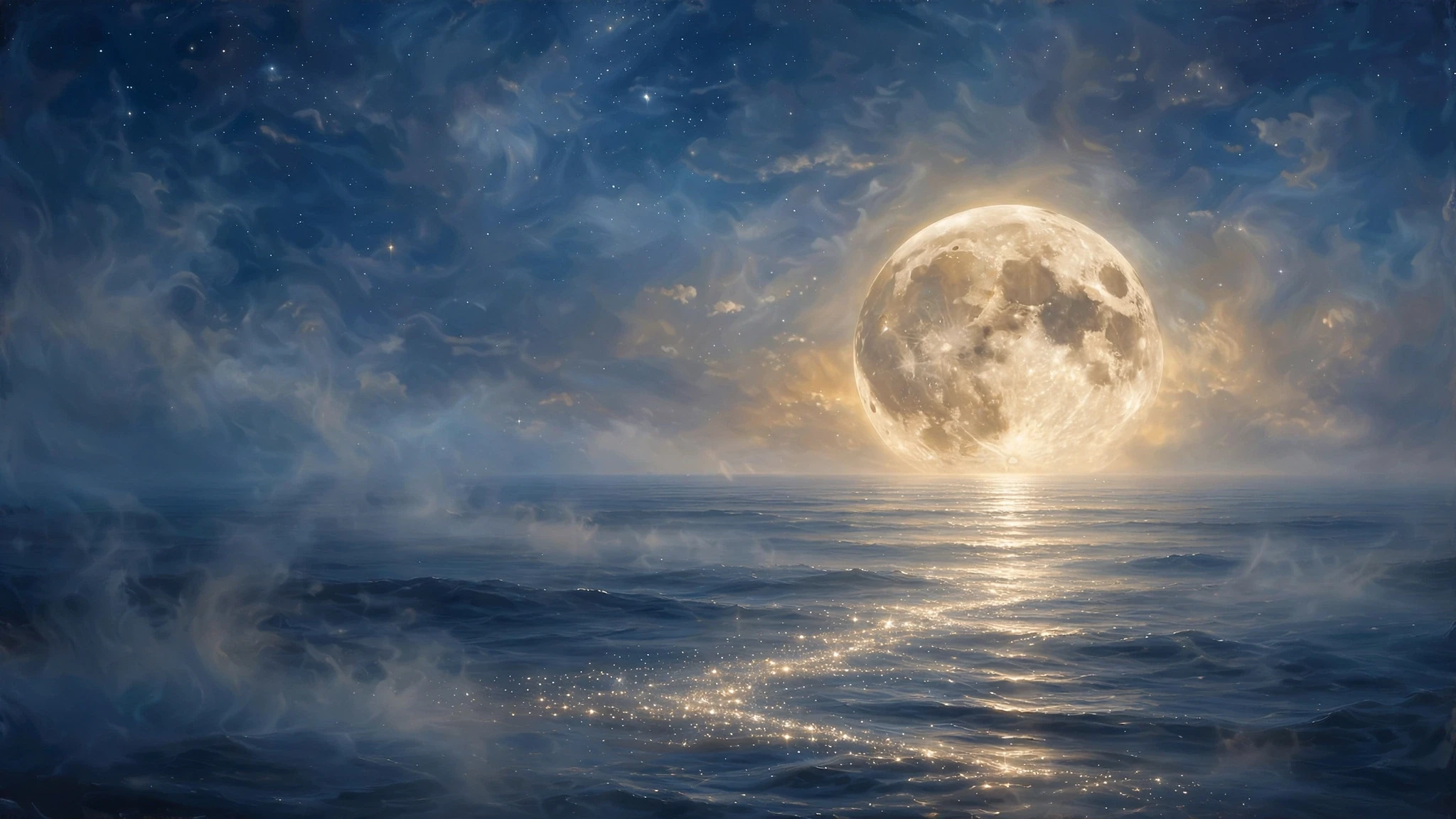
Supermoon meaning starts with a date worth staying up for: Thursday, December 24, 2026, when the full moon will be closer to the Earth than at any other time that year, just 356,740 kilometres away, and will look bigger and brighter than any other full moon of 2026. A supermoon happens when a full moon lines up with the Moon's closest approach to the Earth, its perigee. The Moon looks about 14 percent larger and about 30 percent brighter than a full moon at its farthest point. In astrology, a supermoon is read as a full moon with the volume turned up: the same themes as a normal full moon, felt more strongly. In astronomy, it is a matter of distance. This page keeps the two separate: the distances and the dates are fact, the astrology is interpretation.
The Moon does not circle the Earth in a perfect circle. Its orbit is an ellipse, so its distance changes through the month. At perigee, its closest point, the Moon is about 356,500 kilometres from the Earth. At apogee, its farthest point, it is about 406,700 kilometres away. The average distance is about 384,400 kilometres. A full moon that falls within a day or so of perigee is a supermoon. A full moon that falls near apogee is sometimes called a micromoon, and it looks about 14 percent smaller and 30 percent dimmer than a supermoon. The difference is real, and it is visible, but it is not dramatic: a supermoon is not twice as big, and it does not look like a science fiction movie. It looks like a full moon that is a little larger, a little brighter, and a little harder to ignore.
The Distance Ladder
The three numbers to remember are 356,500, 384,400 and 406,700. The first is the closest the Moon ever gets. The second is the average. The third is the farthest it ever gets. The gap between the closest and the farthest is about 50,000 kilometres, roughly four times the width of the Earth. A supermoon sits near the bottom of that ladder, and a micromoon sits near the top. The Moon's apparent size in the sky changes by about 14 percent between the two, and its brightness changes by about 30 percent, because brightness falls with the square of the distance.
The word supermoon is new. It was coined by the astrologer Richard Nolle in 1979, who defined it as a new or full moon that falls within 90 percent of its closest approach to the Earth. Astronomers use a stricter definition, usually a full moon within a day of perigee, but the idea is the same: a full moon that arrives when the Moon is near. The term caught on because it is a good name for a real effect, and because a supermoon is one of the few astronomical events that anyone can see without a telescope, a dark sky, or a ticket.
The Three Supermoons of 2026
Three supermoons fall in 2026, and the last is the best. Saturday, January 3, 2026 brings the first, at 362,312 kilometres, a bright start to the year. Tuesday, November 24, 2026 brings the second, at 360,768 kilometres, closer than the first. Thursday, December 24, 2026 brings the third, at 356,740 kilometres, the closest full moon of the year and one of the closest of the decade. The December supermoon is special for two reasons: it is the closest, and it falls on Christmas Eve, when millions of people will be outside anyway, looking up.
The year 2026 is generous with full moons. It has 13 full moons and 12 new moons, which means one month has two full moons. That second full moon in a month is called a Blue Moon, and in 2026 it falls on Sunday, May 31. The Blue Moon is not blue, and it is not a supermoon. It is a calendar quirk, and it is a different event entirely. The moon phases explained page gives the full cycle from new moon to full moon and back, and the lunar eclipse meaning page covers what happens when the Earth's shadow falls on the Moon.
The Moon Illusion: Why It Looks Huge
The most common supermoon experience is not the supermoon itself. It is the Moon illusion: the Moon looks enormous when it is near the horizon, and normal when it is high in the sky, even though its actual size in the sky has not changed. The illusion is psychological, not optical. When the Moon is near the horizon, your brain compares it with trees, buildings and hills, and judges it as large. When the Moon is high in the sky, there is nothing to compare it with, and your brain judges it as small. Photographs prove the point: the Moon measures the same number of pixels at the horizon and at the zenith.
A supermoon near the horizon is the strongest version of the illusion, because the Moon is genuinely a little larger and the horizon comparison makes it look much larger. That is why the best time to watch a supermoon is at moonrise, when it clears the horizon and looks huge against the rooftops and the trees. The December 24, 2026 supermoon rises in the early evening, and the effect will be strongest in the first hour after moonrise.
Tides: The Real Effect
A supermoon does have a real effect on the Earth, and it is the tides. The Moon's gravity pulls the oceans toward it, and the Sun's gravity adds to the pull. When the Moon is closest, the pull is strongest, and the tides run higher than usual. A supermoon brings perigean spring tides, which can be a few centimetres higher than a normal spring tide. That is a small difference, and it matters only in low lying coastal areas, where a high tide plus a storm surge can push water over a sea wall. The effect is real, measurable, and small, and it has nothing to do with the Moon's appearance in the sky.
The tides also explain why the Moon is drifting away from the Earth. The Moon's gravity creates a tidal bulge in the Earth's oceans, and the bulge pulls the Moon forward in its orbit, adding energy and pushing it outward by about 3.8 centimetres a year. In the far future, the Moon will be too far away to cover the Sun completely, and total solar eclipses will end. The solar eclipse meaning page covers that geometry, and the retrograde meaning page covers a different kind of timing signal.
The Earthquake Myth
The most persistent supermoon myth is that supermoons cause earthquakes. The claim appears after every large earthquake that happens to fall near a full moon, and it is easy to see why it feels true: a big Moon in the sky and a big earthquake on the ground feel connected. The evidence says otherwise. Earthquakes happen every day, and full moons happen every month, so the two will coincide often by chance alone. Studies of large earthquakes, including a 2016 study of more than 10,000 earthquakes, found no link between the Moon's phase or distance and the timing of large quakes. The tidal stress the Moon puts on the Earth's crust is tiny compared with the tectonic stress that causes earthquakes, and the Moon's distance changes that tiny stress by a tiny amount. A supermoon does not cause earthquakes, and it does not predict them.
The same is true of the other supermoon myths: that supermoons cause floods, storms, or strange behavior. The tides are real and small. The rest is coincidence, and the test is the same as the test for any claim: count all the supermoons, not just the ones that happened to fall near a disaster, and the pattern disappears.
The Three Supermoons by Sign
Each of the three supermoons of 2026 falls in a different sign, and the sign gives the astrological reading its flavour. The January 3 supermoon falls in Cancer, with the Sun in Capricorn opposite it. A Cancer full moon is read as a culmination in the area of home, family and emotional safety. The November 24 supermoon falls in Gemini, with the Sun in Sagittarius opposite it. A Gemini full moon is read as a culmination in the area of communication, learning and short journeys. The December 24 supermoon falls in Cancer again, with the Sun in Capricorn opposite it, so the year opens and closes with a Cancer supermoon, and the theme of home and family runs through both.
Supermoons usually arrive in runs of three or four months in a row. The reason is that the Moon's closest approach and the full moon stay in step for a few months, then drift apart. The time from one perigee to the next is about 27.55 days, and the time from one full moon to the next is about 29.53 days, so perigee moves about two days earlier against the full moon each month. After three or four months the two have drifted too far apart, and the supermoons stop until the cycle lines up again. That is why 2026 has a single supermoon in January and then a pair in November and December, with a long gap in between.
How Many Supermoons a Year
Most years have three or four supermoons. Some years have two, and some have five, depending on how the two cycles line up. A year with five supermoons is rare, and a year with two is a quiet year. The number is not a sign of anything. It is the result of two cycles, one of 27.55 days and one of 29.53 days, drifting against each other. The December 2026 supermoon is notable not because it is one of three, but because it is the closest of the three, at 356,740 kilometres, and because it falls on Christmas Eve, when the Moon will be high in the sky for most of the night and visible to anyone who steps outside.
What a Supermoon Means in Astrology
In astrology, a supermoon is read as a full moon with the volume turned up. A full moon marks a culmination, a moment when something that has been building comes to a head. A supermoon marks the same culmination, felt more strongly, because the Moon is closer and its pull is stronger. A supermoon at the December 2026 position, in the sign the full moon falls in, is read as a culmination in the area of life that sign's house covers in your birth chart. The reading is the same as a normal full moon reading, with more emphasis. The orb most astrologers use is the same as for any full moon: the Moon's position in your chart, and the planets it touches, decide how strongly it reads.
A supermoon is also read as a good time for a release. The full moon is the traditional time to let go of what is finished, and a supermoon, being closer and brighter, is read as a stronger time to let go. Take none of this as a prediction. It is a way of reading timing, and the test is whether the days after the supermoon bring a visible culmination or release in the area the full moon touched.
To talk through what the December 2026 supermoon means in your own chart, a psychic can help. First 3 minutes FREE — every time, for every reading, with all advisors.
For a good next step, take a One-Card Tarot reading. Reflect on one thing that has been building all year, and whether the December supermoon is the right time to bring it to a close.
Frequently Asked Questions
What is a supermoon in simple terms?
A supermoon is a full moon that happens near perigee, the closest point of the Moon's orbit around the Earth. At perigee the Moon sits about 356,500 kilometers away, compared with about 406,700 kilometers at apogee, so it looks about 14 percent larger and about 30 percent brighter than a full moon at apogee.
When are the supermoons in 2026?
Under the widely used 90 percent of perigee rule, 2026 has three supermoons: the Wolf Moon on Saturday, January 3, the Beaver Moon on Tuesday, November 24, and the Cold Moon on Thursday, December 24 in UTC, which is Wednesday, December 23 in the evening in the Americas. The December supermoon is the closest full moon of the year at about 356,740 kilometers.
Does a supermoon affect people?
Physically, a supermoon raises tides by a few centimeters and makes the night brighter. There is no reliable evidence that it causes earthquakes, disasters or changes in human behavior. In astrology, a supermoon is read as a full moon with extra emphasis, and that reading is traditional interpretation, not physical fact.
Why does the Moon look so big near the horizon?
Two effects combine. The real effect is perigee: a supermoon is genuinely about 14 percent larger in the sky than a full moon at apogee. The second effect is the Moon illusion, a trick of the visual system that makes any low Moon look huge next to trees and buildings. A supermoon at moonrise combines both.
What is the difference between a supermoon and a Blue Moon?
A supermoon is about distance: a full moon near perigee. A Blue Moon is about the calendar: the second full moon in a calendar month. The two can overlap, but they are different things. In 2026, May 31 is a Blue Moon, and January 3, November 24 and December 24 are supermoons.
Last updated: November 11, 2026
