
Solar Eclipse Meaning: Astrology and Astronomy
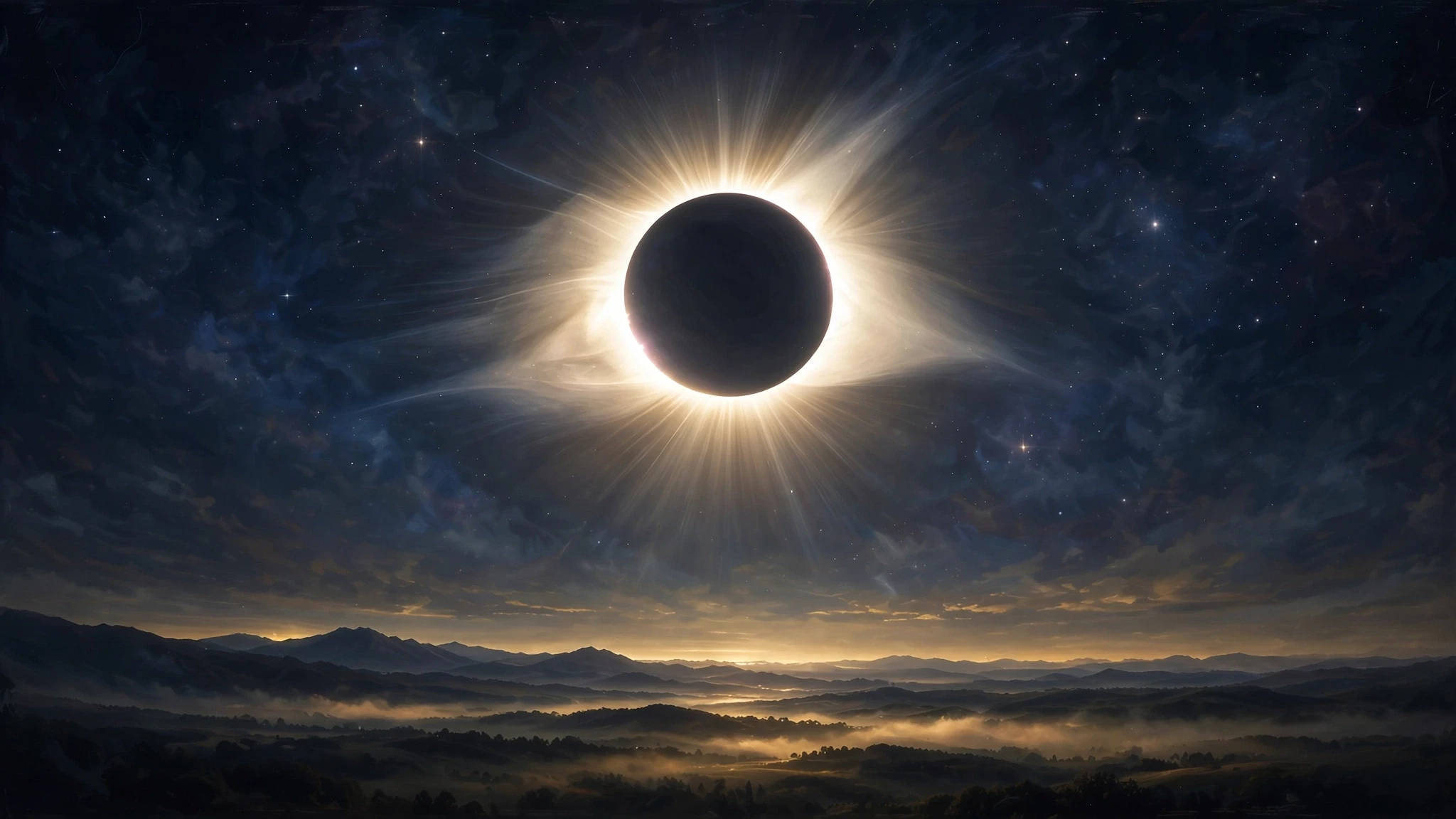
What Solar Eclipse Meaning Is
Solar eclipse meaning starts with a date worth circling: Wednesday, August 12, 2026, when the Moon will pass directly in front of the Sun and turn day into twilight across a narrow path through the Arctic, Greenland, Iceland and Spain. The eclipse reaches totality at 20 degrees and 2 minutes into Leo, and it is the first total solar eclipse visible from mainland Europe since 1999. A solar eclipse happens when the new moon lines up exactly between the Earth and the Sun, so the Moon's shadow falls on the Earth. In astrology, a solar eclipse is read as a new beginning, a reset, a door opening. In astronomy, it is a shadow. This page keeps the two kinds of meaning clearly labeled: the astronomy is fact, the astrology is interpretation, and you can use either without the other.
A solar eclipse can only happen at a new moon, when the Moon sits between the Earth and the Sun. But most new moons do not produce an eclipse, because the Moon's orbit is tilted about 5 degrees from the Earth's orbit around the Sun. Most months the Moon passes above or below the Sun from our point of view, and no shadow falls on the Earth. An eclipse happens only when the new moon arrives while the Moon is near one of the two points where its orbit crosses the Earth's orbit, the nodes. Those windows are called eclipse seasons, and they come about 173 days apart, twice a year.
The Shadow: Umbra and Penumbra
The Moon's shadow has two parts. The umbra is the dark inner cone where the Sun is fully blocked. The penumbra is the lighter outer cone where the Sun is only partly blocked. If you stand in the umbra during a total eclipse, the sky goes dark, the stars come out, the temperature drops and the Sun's corona, its outer atmosphere, becomes visible as a white crown around a black disc. If you stand in the penumbra, you see a partial eclipse: the Sun looks like a bite has been taken out of it. The umbra is narrow, about 100 to 250 kilometres wide on the Earth's surface, and it races across the planet at more than 1,000 kilometres an hour. Totality at any one spot lasts a few minutes at most. That is why eclipse chasers travel: the shadow is small, fast and worth the trip.
The geometry also explains why the Moon can cover the Sun at all. The Sun is about 400 times wider than the Moon, but it is also about 400 times farther away, so the two look almost the same size in the sky. The Moon is slowly drifting away from the Earth, about 3.8 centimetres a year, so in the far future it will look too small to cover the Sun completely and total eclipses will end. For now, the fit is exact, and that exact fit is what makes a total eclipse possible.
The Four Kinds
A total solar eclipse happens when the Moon is close enough to the Earth to cover the Sun completely. The sky goes dark, the corona appears, and the eclipse is total for a few minutes along a narrow path. The August 12, 2026 eclipse is total. A total eclipse is the rarest and most dramatic kind, and the one eclipse chasers cross the world to see.
An annular solar eclipse happens when the Moon is farther from the Earth, near its apogee, and looks too small to cover the Sun. A ring of sunlight remains visible around the Moon's dark disc, the ring of fire. The February 17, 2026 eclipse is annular, at 28 degrees and 50 minutes into Aquarius. An annular eclipse never goes fully dark, and it is never safe to look at without proper eclipse glasses.
A partial solar eclipse happens when the Moon covers only part of the Sun, because the alignment is off center. The Sun looks bitten, and the sky dims slightly but never goes dark. Partial eclipses are the most common kind, and they are visible over a wide area.
A hybrid solar eclipse is the rarest kind. It starts as an annular eclipse, becomes total for part of its path, and ends as annular again, because the curve of the Earth changes the Moon's apparent size along the way. The last hybrid eclipse was in April 2023. The next is in November 2031.
The Dated Log: 2026 and 2027
Four solar eclipses fall in 2026 and 2027, and each one has its own character. Tuesday, February 17, 2026 brings an annular eclipse at 28 degrees and 50 minutes into Aquarius, visible as a ring of fire over Antarctica and parts of South America and Africa. Wednesday, August 12, 2026 brings the total eclipse at 20 degrees and 2 minutes into Leo, crossing the Arctic, Greenland, Iceland and Spain. Saturday, February 6, 2027 brings an annular eclipse at 17 degrees and 38 minutes into Aquarius, visible over South America and the South Atlantic. Monday, August 2, 2027 brings a total eclipse at 9 degrees and 55 minutes into Leo, crossing Morocco, Egypt and Saudi Arabia, with totality lasting more than six minutes in Egypt, one of the longest of the century.
The moon phases explained page walks through the whole cycle from new moon to full moon and back, and the lunar eclipse meaning page takes up the other kind of eclipse, when the shadow of the Earth falls on the Moon. A supermoon meaning happens when a full moon lines up with the closest approach of the Moon to Earth, and it is a different event entirely.
Saros 126: The 2008 Echo
Eclipses repeat in families called Saros cycles. Each Saros cycle lasts about 18 years, 11 days and 8 hours, and each eclipse in the family is separated from the next by that interval. The August 12, 2026 total eclipse belongs to Saros 126, and it is the 48th eclipse of 72 in that family. The family began on March 10, 1179 and will end on May 3, 2459. The previous eclipse in the family fell on August 1, 2008, a total eclipse visible across Russia, Mongolia and China. The next will fall on August 23, 2044, a total eclipse visible across North America. If you saw the 2008 eclipse, the 2026 eclipse is its echo, shifted by 18 years, 11 days and 8 hours, and falling on a similar part of the world.
Saros 131 holds the February 6, 2027 annular eclipse, and Saros 136 holds the August 2, 2027 total eclipse. Each family has its own character: Saros 126 produces long total eclipses, Saros 131 produces annular eclipses, Saros 136 produces the longest total eclipses of all. The cycle is not magic. It is the result of three lunar cycles lining up: the time from one new moon to the next, the time from one node crossing to the next, and the time from one perigee to the next, all coming back into step after 18 years, 11 days and 8 hours.
How to Watch Safely
A solar eclipse is safe to watch only with the right protection. Ordinary sunglasses are not enough, and looking at the Sun through binoculars or a telescope without a proper solar filter will damage your eyes in seconds. The safe way is eclipse glasses that meet the ISO 12312-2 standard, or a pinhole projector: a card with a small hole that projects the Sun's image onto a second card, so you watch the image and never the Sun itself. The one exception is totality. During the few minutes when the Moon fully covers the Sun, it is safe to look directly, and that is the moment to take the glasses off and see the corona. The moment the first bead of sunlight returns, the diamond ring effect, the glasses go back on. An annular eclipse never goes fully dark, so the glasses stay on for the whole event.
Three Eclipses That Changed History
The solar eclipse of May 29, 1919 is the most famous in history. Arthur Eddington led an expedition to the island of Principe, off West Africa, and another team went to Sobral in Brazil, to photograph the stars near the Sun during totality. Einstein's general theory of relativity predicted that the Sun's gravity would bend starlight, and the photographs showed the stars shifted by the amount Einstein predicted. The result made Einstein a household name and confirmed a new theory of gravity.
The solar eclipse of August 11, 1999 was the last total eclipse visible from mainland Europe before 2026, and it drew millions of people outside across England, France, Germany and Eastern Europe. It was also one of the most watched eclipses ever, because it crossed densely populated countries and fell in the middle of the summer holidays.
The solar eclipse of August 21, 2017 was the Great American Eclipse, the first total eclipse to cross the United States from coast to coast since 1918. Its path ran from Oregon to South Carolina, and millions of people traveled to stand inside the umbra. It was the most photographed, most shared and most watched eclipse in history, and it set the pattern for the 2024 eclipse that followed it.
What a Solar Eclipse Means in Astrology
In astrology, a solar eclipse is read as a new beginning. The Sun stands for identity, purpose and the conscious self, and when the Moon covers it, the conscious self goes dark for a moment and something new can begin. A solar eclipse at 20 degrees Leo, like the August 2026 eclipse, is read as a new beginning in the area of life the Leo house covers in your birth chart: creativity, children, romance, performance, or the courage to be seen. A solar eclipse at 28 degrees Aquarius, like the February 2026 eclipse, is read as a new beginning in the Aquarius area: friendship, community, technology, or a cause bigger than yourself.
The traditional rule is that an eclipse affects the places where it is visible, and the people whose charts it touches. A solar eclipse that lands within a few degrees of a planet or an angle in your birth chart is read as a stronger signal than one that lands in an empty part of the chart. Most astrologers use an orb of 3 to 5 degrees. The effect is usually read as lasting around six months, until the next eclipse season arrives. None of this counts as a prediction. It is a way of reading timing, and the proof is whether the six months after the eclipse bring a visible new beginning in the area the eclipse touched.
A solar eclipse is also read as a reset for the sign it falls in. The February 2026 eclipse at 28 degrees Aquarius closes a chapter of Aquarius themes that started with the earlier eclipse in the same sign, and the August 2026 eclipse at 20 degrees Leo opens a chapter of Leo themes that will run until the next Leo eclipse. The retrograde meaning page covers the other kind of timing signal, when a planet seems to move backwards and the themes of that planet get reviewed.
To work through what the August 2026 eclipse means for your own chart, a psychic can help. First 3 minutes FREE — every time, for every reading, with all advisors.
A One-Card Tarot reading can help you decide. Reflect on one new beginning you have been putting off, and whether the August eclipse is the right time to start it.
Frequently Asked Questions
What is a solar eclipse in simple terms?
A solar eclipse happens when the Moon moves directly between the Earth and the Sun and throws its shadow onto the Earth. It can only happen at a new moon. Inside the narrow path of the shadow, the Sun is fully covered for a few minutes. Outside that path, people see a partial eclipse.
When is the next total solar eclipse?
The next total solar eclipse after the August 12, 2026 event falls on Monday, August 2, 2027, with a maximum totality of 6 minutes and 23 seconds. Its path crosses Morocco, southern Spain, Algeria, Libya, Egypt, Saudi Arabia, Yemen and Somalia. The next annular solar eclipse falls on Saturday, February 6, 2027.
What does a solar eclipse mean in astrology?
In astrology, a solar eclipse is read as a powerful new moon and a turning point for the house it falls in, since the house rules the life area it touches. The sign sets the theme: the February 2026 and 2027 eclipses fall in Aquarius, and the August 2026 and 2027 eclipses fall in Leo. This is traditional interpretation, not physical fact.
Is it safe to look at a solar eclipse?
Only with certified eclipse glasses, except during the few minutes of totality when the Sun's bright disc is fully covered. Never look directly at the Sun during a partial or annular eclipse, or during the partial phases before and after totality, and never look through a camera, phone, binoculars or telescope without a proper solar filter.
How often do solar eclipses happen?
Most years bring two or three solar eclipses somewhere on Earth, arriving in seasons about six months apart. A total solar eclipse happens somewhere on Earth roughly every 18 months, but the same town sees one only once every few centuries on average, because the path of totality is narrow.
Last updated: November 11, 2026
