
Moon Phases Explained: Meanings for Each Phase
What Moon Phases Really Are
The moon phases are the changing shapes of light we see on the Moon as it travels around the Earth. The Moon itself does not change shape, and it does not make its own light. What changes is how much of the sunlit side faces us from Earth. When the Moon sits between the Earth and the Sun, its dark side faces us and we see a new moon. When the Earth sits between the Sun and the Moon, the full sunlit face turns toward us and we see a full moon. Every other phase falls somewhere between those two points.
One full round of moon phases takes about 29 and a half days. That round is called a lunar month, and it is the reason our calendar months are roughly the same length. The cycle repeats again and again, which makes the Moon one of the easiest sky rhythms to follow without any special tools. You only need a clear evening and a little patience.
In astrology, the moon phases are read as a cycle of beginning, growth, fullness, and release. The Moon is linked with feelings, habits, memory, and the quiet inner life, so its phases are often used as a gentle timetable for reflection. A new moon suggests a fresh start. A full moon suggests a moment of clarity or completion. The phases in between suggest the slow work of building or letting go. None of this is a rule about what must happen. It is a language for noticing where you are in a cycle and choosing what to do next with a little more awareness.
If you are new to astrology, the Moon is a kind place to start. It moves quickly enough that you can watch a whole cycle in a single month, and its meaning is close to everyday life.
The Eight Phases in Order
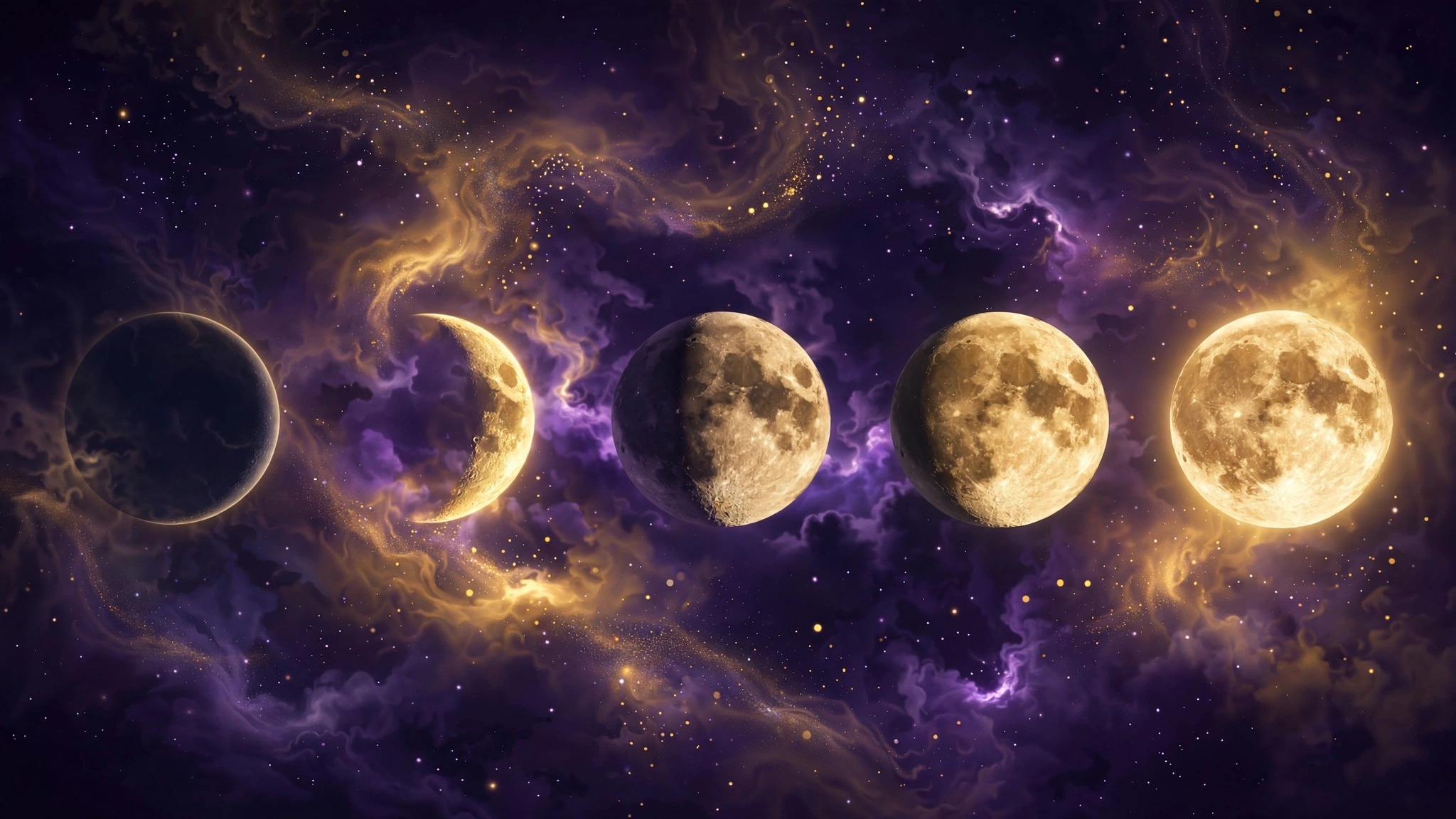
There are eight named moon phases, and they always run in the same order. The cycle begins with the new moon, when the Moon is dark from our view. Then comes the waxing crescent, a thin sliver of light on the right side in the Northern Hemisphere. The first quarter follows, when exactly half of the Moon is lit. After that comes the waxing gibbous, when more than half is lit and the light keeps growing toward full.
The full moon is the midpoint of the cycle, when the whole face is lit. Then the light begins to shrink. The waning gibbous comes next, still mostly lit but slowly fading. The last quarter shows half the Moon lit again, this time on the opposite side. Finally comes the waning crescent, a thin sliver of light that shrinks until the sky goes dark again and a new moon begins.
The word waxing means the light is growing. The word waning means the light is shrinking. A simple way to remember the difference is that waxing builds toward the full moon and waning moves away from it. Each phase lasts about three and a half days, though the exact timing shifts a little from month to month.
New Moon: A Quiet Beginning
The new moon is the darkest point of the cycle, when the Moon is invisible or nearly so. In astrology, this darkness is read as a blank page. It is a time for setting intentions, starting something small, or simply resting before a new round begins. Many people use the new moon to write down one or two hopes for the month ahead, not as a demand to the universe but as a way of naming what matters to them.
If you want to mark the new moon in a simple way, pick one intention and write it in a single sentence. Keep it honest and small enough to act on. For a deeper look at this phase on its own, read our guide to the new moon meaning.
Waxing Crescent and First Quarter: Building Momentum
After the new moon, a thin crescent of light appears. This is the waxing crescent, and it is linked with gathering energy and taking the first visible steps. The intention you set at the new moon now needs a small action. Send the message, open the document, make the call, or take the walk. The step does not need to be large. It only needs to be real.
The first quarter arrives about a week after the new moon, when half the Moon is lit. This phase is often linked with challenge and decision. The early excitement of a new start meets the first obstacle, and something has to give. You may need to adjust your plan, ask for help, or simply keep going when the work feels harder than expected. Astrologers often describe the first quarter as a turning point, a moment when commitment is tested in a small, practical way.
Waxing Gibbous and Full Moon: Fullness and Clarity
The waxing gibbous is the phase just before the full moon, when the Moon is nearly fully lit. It is linked with refining and fine tuning. The shape of your effort is mostly visible now, and the work shifts from starting to improving. You might review what you have done, fix what is not working, and prepare for the moment when the result becomes clear.
The full moon is the brightest and most famous phase. It is linked with fullness, emotion, and revelation. Feelings often run stronger around the full moon, and situations that have been building for two weeks may come to a head. Something becomes visible that was hidden before: a truth in a relationship, a result at work, or a feeling in yourself that you had been setting aside. For a fuller picture of this phase, see our guide to the full moon meaning.
The full moon is also linked with release. What has reached its peak can now be let go, celebrated, or completed, and some people mark the moment with a quiet ritual, such as the full moon ritual for letting go. The common thread is honesty. The full moon lights up what is there, and the invitation is to look at it plainly.
Waning Gibbous, Last Quarter, and Waning Crescent: Rest and Letting Go
After the full moon, the light begins to shrink. The waning gibbous is a time for gratitude and review. What went well in the last two weeks? What did you learn? What would you do differently? This is not a phase for starting big new things. It is a phase for sorting through what the full moon showed you and keeping what is useful.
The last quarter comes about a week after the full moon, when half the Moon is lit again. It is linked with release and forgiveness, including forgiving yourself. Old habits, old arguments, and old expectations often loosen their grip now, if you let them. This can be a good time to end something that has run its course, to tidy up loose ends, or to have a calm conversation that closes a chapter rather than opening a new one.
Moon Phases in Love and Relationships
The moon phases can be a useful way to think about love, because relationships also move in cycles. A new moon can be a good time to start a fresh chapter together, to have an honest talk about what you both want, or to begin dating with a clear head. The waxing moon suits building closeness: spending time together, making plans, and letting trust grow step by step.
The full moon often brings feelings to the surface in relationships. A small tension may suddenly feel bigger, or a quiet affection may finally be spoken aloud. This is not a sign that something is wrong. It is a sign that the light is strong and things are easier to see. If a full moon conversation feels intense, slow down, listen fully, and wait a day before making a big decision. Clarity and calm do not always arrive at the same moment. If you want to understand how the Moon shapes your emotional needs, our guide to what your moon sign means is a good next step.
Moon Phases, Work, and Daily Life
At work, the moon phases offer a simple rhythm for planning a month. Use the new moon to set a goal or start a project. Use the waxing phases to build, meet, and push the work forward. Use the full moon to present, launch, or review results while attention is high. Use the waning phases to finish tasks, clear your desk, and rest before the next round. This is not a rule that guarantees success. It is a structure that helps you pace yourself instead of trying to do everything at full speed all month long.
In daily life, the Moon can also help you notice your own energy. Some people feel more social and awake as the Moon waxes and more tired and inward as it wanes. Others notice no change at all, and that is fine too. The point is not to blame the Moon for a bad day. The point is to use the cycle as a mirror. If you feel low during the waning crescent, the Moon gives you permission to rest without guilt. If you feel bright at the full moon, it gives you a reason to enjoy that brightness fully.
Common Misunderstandings About Moon Phases
One common misunderstanding is that the Moon controls behavior. It does not. Astrology describes the Moon as a symbol of emotion and rhythm, not as a force that makes people act in a certain way. A full moon does not cause an argument. It may coincide with strong feelings, but the choice of what to say and do stays with you.
Another misunderstanding is that only the full moon matters. In truth, the full moon is only one night in a cycle of about 29 and a half days. The quieter phases, the new moon, the crescents, the quarters, carry just as much meaning, and many people find them more useful because they match the slow pace of real change. Our introduction to what astrology is explains how the Moon fits alongside the Sun, the planets, and the houses.
A Simple Monthly Practice and a Closing Thought
Here is a simple way to work with the moon phases without any special tools. At the new moon, write down one intention. During the waxing moon, take one small step toward it each day. At the full moon, look honestly at how far you have come and what you have learned. During the waning moon, release one thing that is getting in the way and rest. Then begin again. Four small habits, repeated monthly, can quietly change how a year feels.
If you would like to talk through what the current moon phase might mean for your own life, a live reading can help you reflect on it with a real advisor. First 3 minutes FREE — every time, for every reading, with all advisors. If you would like a quiet moment of guidance first, try a One-Card Tarot reading and sit with the card for a few minutes before you decide what to do next.
Frequently Asked Questions
What are the moon phases in order?
The eight moon phases in order are new moon, waxing crescent, first quarter, waxing gibbous, full moon, waning gibbous, last quarter, and waning crescent. The full cycle takes about 29 and a half days, and then it begins again with a new moon.
What does a new moon mean in astrology?
A new moon is read as a fresh start. It is linked with setting intentions, beginning something new, and resting before a new cycle of growth. Many people use it to name one or two hopes for the month ahead.
What does a full moon mean in astrology?
A full moon is linked with fullness, strong feelings, and clarity. Situations that have been building may come to a head, and something hidden may become visible. It is also seen as a good time to release what has reached its peak.
How long does each moon phase last?
Each of the eight phases lasts about three and a half days. The four main phases, new moon, first quarter, full moon, and last quarter, are about a week apart from each other.
Can I follow the moon phases without knowing my birth chart?
Yes. The moon phases are visible in the sky and follow the same cycle for everyone. You can watch the Moon, note its phase, and use it as a simple monthly rhythm for reflection, planning, and rest without any chart at all.
Last updated: November 11, 2026
