
Lunar Eclipse Meaning: Astrology and Astronomy
What Lunar Eclipse Meaning Is
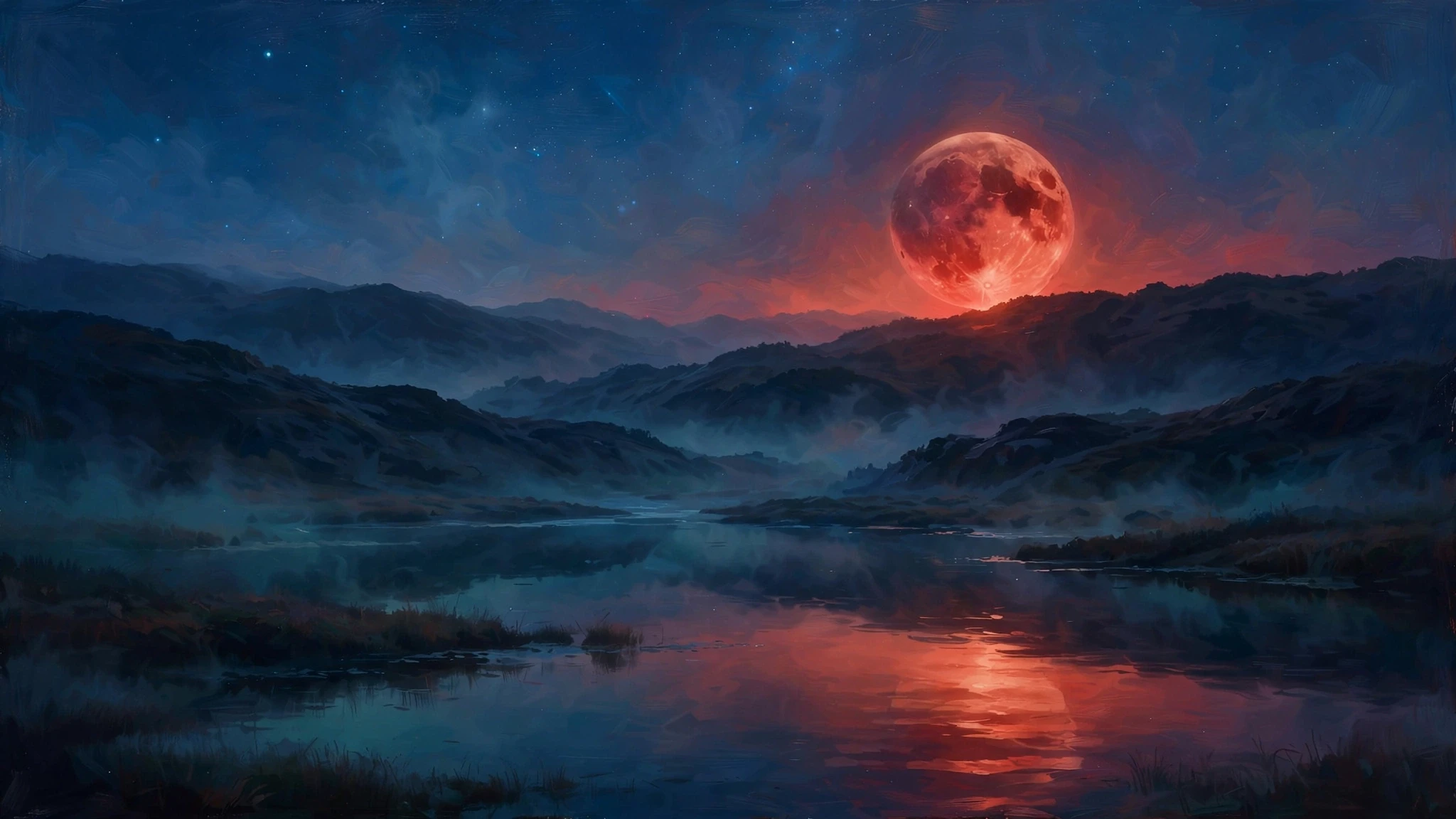
Lunar eclipse meaning starts with a sight worth staying up for: Tuesday, March 3, 2026, when the full moon will turn red. The eclipse, a total lunar eclipse at 12 degrees and 52 minutes into Virgo, will be visible across the Americas, East Asia and Australia, and for about 58 minutes the Moon will hang in the sky as a deep copper disc. A lunar eclipse happens when the Earth passes directly between the Sun and the Moon, so the Earth's shadow falls on the Moon. Astrologers read it as a culmination and a release, an ending that makes room for something new. Astronomers read it as a shadow. The astronomy below is fact. The astrology is interpretation, and the two are kept separate so you can use either on its own.
A lunar eclipse needs a full moon, but a full moon alone is not enough. The Moon's path is tilted about 5 degrees against the Earth's path around the Sun, so in most months the full moon slips above or below the Earth's shadow and nothing happens. An eclipse needs the full moon to arrive while the Moon is close to one of the two crossing points of the two orbits, the nodes. Those windows are the eclipse seasons, about 173 days apart, twice a year.
Why the Moon Turns Red
The most striking thing about a total lunar eclipse is the color. The Moon does not go black. It turns red, copper, orange, or sometimes a deep dark brown. The reason is the Earth's atmosphere. When the Moon sits inside the Earth's shadow, the only sunlight that reaches it has passed through the Earth's atmosphere, and the atmosphere filters out the blue light and lets the red light through. It is the same physics that makes a sunset red: the blue light is scattered away, and the red light is bent around the Earth and onto the Moon. Every sunrise and sunset on Earth, happening at once, is projected onto the Moon's face.
The exact shade depends on the state of the atmosphere. A clean atmosphere, after a quiet year, gives a bright copper Moon. A dusty atmosphere, after a large volcanic eruption, gives a dark, almost invisible Moon. The Danjon scale, named after the French astronomer Andre Danjon, grades the color from 0 to 4. A Danjon 0 eclipse is very dark, and the Moon is almost invisible. A Danjon 1 eclipse is dark gray or brown. A Danjon 2 eclipse is deep red or rust. A Danjon 3 eclipse is brick red. A Danjon 4 eclipse is bright copper or orange, with a bright rim. The March 3, 2026 eclipse is expected to be a Danjon 2 or 3, a deep red Moon, though the final shade will depend on the dust in the atmosphere that night.
A total lunar eclipse lasts much longer than a total solar eclipse. The Moon takes about an hour to cross the Earth's shadow, and totality itself can last more than an hour. The March 3, 2026 eclipse will have totality of about 58 minutes. That is why lunar eclipses are easier to watch: you do not need to travel to a narrow path, you do not need special glasses, and you have an hour to look.
The Three Kinds
A total lunar eclipse happens when the whole Moon passes into the Earth's umbra, the dark inner shadow. The Moon turns red, and the eclipse is visible from the entire night side of the Earth. The March 3, 2026 eclipse is total. A total lunar eclipse is the most dramatic kind, and the one people stay up to watch.
A partial lunar eclipse happens when only part of the Moon enters the umbra. The covered part goes dark and red, and the rest stays bright. The August 28, 2026 eclipse is partial, with about 97 percent of the Moon covered, so close to total that it will look almost like a blood moon with a bright sliver left at the edge.
A penumbral lunar eclipse happens when the Moon passes only through the Earth's penumbra, the lighter outer shadow. The Moon dims slightly, as if a gray veil had fallen over it, and the change is subtle enough that many people miss it. Three penumbral eclipses fall in 2027: Saturday, February 20, Sunday, July 18, and Tuesday, August 17. A penumbral eclipse is the most common kind, and the least dramatic.
When to Look: 2026 and 2027
The first of the five is the total eclipse of Tuesday, March 3, 2026, at 12 degrees and 52 minutes into Virgo. It is visible across the Americas, East Asia and Australia, with totality of about 58 minutes. The second is the partial eclipse of Friday, August 28, 2026, at 4 degrees and 51 minutes into Pisces, with about 97 percent of the Moon covered, visible across the Americas, Europe and Africa. The third is the penumbral eclipse of Saturday, February 20, 2027, visible across the Americas and Europe. The fourth is the penumbral eclipse of Sunday, July 18, 2027, visible across Australia, Asia and Africa. The fifth is the penumbral eclipse of Tuesday, August 17, 2027, visible across the Americas, Europe and Africa.
The moon phases explained page walks the full cycle from new moon to full moon and back. The solar eclipse meaning page covers the other kind of eclipse, when the Moon's shadow falls on the Earth. A supermoon meaning is a different event: a full moon that lines up with the Moon's closest approach to Earth.
Watching a Lunar Eclipse
A lunar eclipse is the easiest eclipse to watch. No glasses, no filters, no travel, no special equipment. You need a clear sky, a view of the Moon, and patience. The whole event takes about three hours from the first dimming to the last, with totality in the middle. The best time to look is during totality, when the Moon is at its reddest, but the partial phases are worth watching too: you can see the Earth's curved shadow creeping across the Moon's face, which is the same curve the ancient Greeks used to prove the Earth is round.
Photography is simple. A camera on a tripod, a long lens, and a slow shutter will catch the red Moon. A phone held steady against a wall will catch it too, though the color may come out duller than what your eye sees. The most common mistake is to watch only the first ten minutes and go inside. The color deepens as totality goes on, and the Moon at the end of totality looks different from the Moon at the start.
A lunar eclipse and a solar eclipse usually arrive about two weeks apart, in the same eclipse season, because the Moon crosses one node at the new moon and the other node at the full moon. The March 3, 2026 lunar eclipse follows the February 17, 2026 solar eclipse by two weeks, and the August 28, 2026 lunar eclipse follows the August 12, 2026 solar eclipse by two weeks. That pairing is why astrologers read eclipse seasons as a single period of change, with the solar eclipse opening the chapter and the lunar eclipse closing it.
The Eclipse Columbus Used
The most famous lunar eclipse in history happened on February 29, 1504. Christopher Columbus was stranded in Jamaica, his ships rotting, his crew hungry, and the local people had stopped bringing food. Columbus knew from the astronomer Regiomontanus's ephemeris that a total lunar eclipse was coming that night, and he told the local leaders that his god would take the Moon away as a sign of anger. When the Moon turned red, the food arrived. The story is probably polished in the telling, but the eclipse itself is a matter of record, and it shows how a lunar eclipse, visible to a whole hemisphere at once, could change the course of a voyage.
The blood moon tetrad of 2014 and 2015 was the most recent run of four total lunar eclipses in a row, with no partial eclipses in between, falling on April 15, 2014, October 8, 2014, April 4, 2015 and September 28, 2015. Tetrads are rare, and the next one does not arrive until 2032. The 2026 and 2027 eclipses are not a tetrad, but the March 2026 total eclipse and the August 2026 near-total partial eclipse make 2026 one of the better years of the decade for watching the Moon turn red.
Reading a Lunar Eclipse in a Chart
The Moon stands for feeling, habit, home and the unconscious. When the Earth's shadow covers it, the feeling that has been building comes to a head and something is let go. That is the core of the astrological reading: a lunar eclipse marks a culmination and a release, not a beginning. A lunar eclipse at 12 degrees Virgo, like the March 2026 eclipse, points at the area of life the Virgo house covers in your birth chart: work, health, routine, or the habit that needs to change. A lunar eclipse at 4 degrees Pisces, like the August 2026 eclipse, points at the Pisces area: the dream, the ending, the boundary that needs to be drawn, or the feeling that needs to be felt and released.
Where the eclipse lands in your chart decides how strongly it reads. An eclipse that falls within a few degrees of a planet or an angle in your birth chart reads as a stronger signal than one that falls in an empty part of the chart. Most astrologers use an orb of 3 to 5 degrees. The effect is usually read as running about six months, until the next eclipse season. That is not a prediction. It is a timing read, and the test is whether the six months after the eclipse bring a visible ending or release in the area the eclipse touched.
An eclipse also closes a chapter for the sign it falls in. The March 2026 eclipse at 12 degrees Virgo closes a chapter of Virgo themes that began with the previous eclipse in the same sign, and the August 2026 eclipse at 4 degrees Pisces closes a chapter of Pisces themes that will run until the next Pisces eclipse. The retrograde meaning page covers a different timing signal: a planet that appears to move backwards while its themes get reviewed.
To talk through what the March 2026 eclipse means in your own chart, a psychic can help. First 3 minutes FREE — every time, for every reading, with all advisors.
For the next step, try a One-Card Tarot reading and think about one thing you have been carrying that is ready to be released, and whether the March eclipse is the right time to let it go.
Frequently Asked Questions
What is a lunar eclipse in simple terms?
A lunar eclipse happens when the Earth passes directly between the Sun and the Moon and casts its shadow onto the Moon. It can only happen at a full moon. The Moon dims or turns red, and the eclipse is visible from the entire night side of the Earth at once. It is safe to watch with the naked eye.
What is a blood moon?
A blood moon is a total lunar eclipse, described by its color. During totality, the only sunlight reaching the Moon has passed through the Earth's atmosphere, which filters out blue light and lets red light through, so the Moon glows copper red. There is no separate blood moon event beyond the total lunar eclipse itself.
When is the next total lunar eclipse?
The most recent total lunar eclipse fell on Tuesday, March 3, 2026, in Virgo, with totality lasting about 58 minutes. The three lunar eclipses of 2027, on February 20, July 18 and August 17, are all penumbral, which means they will only slightly shade the Moon rather than turning it red.
What does a lunar eclipse mean in astrology?
In astrology, a lunar eclipse is read as a powerful full moon and a turning point of ending, release or revelation in the life area ruled by the house it falls in. The sign gives the theme: the March 2026 eclipse fell in Virgo, and the August 2026 eclipse fell in Pisces. This is traditional interpretation, not physical fact.
How often do lunar eclipses happen?
Two or three lunar eclipses happen somewhere on Earth in most years, arriving in seasons about six months apart. A total lunar eclipse is visible from the entire night side of the Earth, so any one person sees more lunar eclipses than solar eclipses, even though the two kinds happen at similar rates.
Last updated: November 11, 2026
