Crystals for Heartbreak and Letting Go
People look up crystals for heartbreak and letting go in a particular kind of week. The messages have been reread, the belongings sit in a bag by the door, and the apartment sounds different in the evening. In that week, a small object with a steady presence can feel like company that asks for nothing. This guide treats that season honestly. It names the stones practitioners keep nearby after a breakup, explains what each one symbolizes in tradition, and offers a simple letting go practice built around an unsent letter. It also says clearly, in its own section below, what no stone can do.
Nothing here is medical, and heartbreak is not described on this page as a condition to be treated. It is an emotional season that people reflect through, at their own pace, with support from friends, family, work, rest and time. The stones are companions for reflection. That is the whole claim, and it is enough for the people who use them well.
The Short Answer
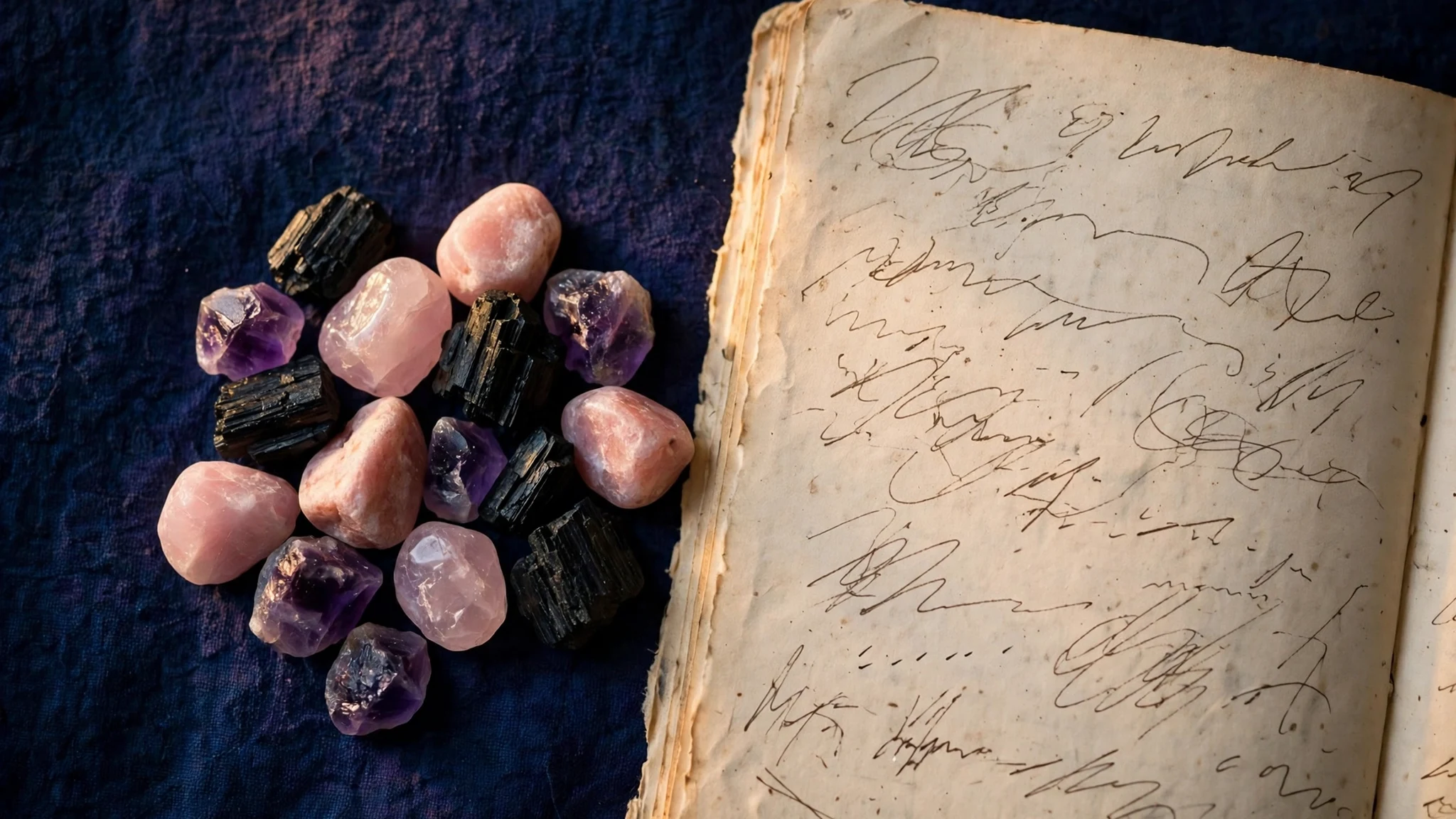
Practitioners reach for a small set of stones in the weeks after a breakup, each chosen for a different part of the season. Rose quartz stands for self kindness first. Black obsidian stands for honesty taken gently. Amethyst stands for steadiness of mind. Malachite stands for change already in motion. Garnet stands for the return of energy and appetite for life. The table below gives the map, and the entries that follow give each stone its own short account written for this season alone.
| Stone | What tradition asks it to hold |
|---|---|
| Rose quartz | Kindness toward yourself before anything else |
| Black obsidian | A truthful look, taken in small doses |
| Amethyst | A steady mind while feelings run loud |
| Malachite | Movement, the sense that change is underway |
| Garnet | Warmth, energy and the wish to rejoin life |
Rose Quartz, for Self Kindness First
Most experienced practitioners start here, and the order matters. Rose quartz, the pink quartz of gentle regard, is assigned in tradition to love turned inward, the basic friendliness toward your own life that a breakup tends to knock sideways. Its entry on this page is deliberately plain. Keep a piece where you make tea or coffee in the morning. Let it mark the first minutes of the day as yours, before any checking of a phone or a profile.
The practice attached to it is small on purpose. Each morning for the first month, name one ordinary kindness you will actually do, a real lunch, a walk with a neighbor, an early night with a book. Grand gestures belong to a later season. Rose quartz in this context is not about attracting anyone new. It is about rebuilding the relationship with the person who will be present for every future chapter.
Black Obsidian, for Honesty in Small Doses
Sooner or later the season asks a truthful question, usually some version of what was actually happening in that relationship, including your own part in it. Black obsidian, the volcanic glass of unflinching looks, is the tradition's stone for that hour, and every responsible account adds the same instruction. Work with it briefly and deliberately, the way you would open a difficult letter, read it once, and set it down.
A common pattern is twenty minutes with a notebook, the stone on the desk, writing answers to one question only, such as what did I know earlier than I admitted. When the timer ends, the notebook closes and the stone goes back in its pouch or drawer. Containment is the skill being practiced. The stone's dark surface suits people who want one honest mirror in the house and are wise enough not to live in front of it.
Amethyst, for Steadiness of Mind
The middle weeks of a breakup often bring a noisy head. Conversations replay at kitchen counters and on buses. Amethyst, the violet quartz of composed attention, is kept by practitioners for steadiness, a symbol of the mind allowed to finish one thought before starting the next. Its color alone explains part of its following, since violet sits at the quiet end of the visible spectrum and reads as dusk rather than noon.
The practice here is a closing ritual for the day. Hold the stone while you write three lines, what happened today, what you felt, what tomorrow asks. No analysis, no verdicts on the relationship, just a ledger. People who keep this up for a month often report, in ordinary language, that the pages get duller in the best way, as the same storm starts taking up less room on the paper.
Malachite, for Change in Motion
At some point the season turns from enduring to moving, and that is where malachite, the banded green stone of turning points belongs in this list. Its entry here is about momentum rather than comfort. Practitioners set a polished piece near the practical work of a new chapter, the updated resume, the lease search, the rearranged room, as a green flag planted in the territory of next.
Handle it the way its own page instructs, polished, dry, with hands washed afterward, since the mineral contains copper. Within this guide its role is simple symbolism. The bands on its surface were laid down one layer over another, and a person rebuilding a life is doing the same thing in public, week by week, whether or not anyone applauds the progress.
Garnet, for Getting Your Energy Back
The last stone in the set answers the flattest part of the season, the stretch when nothing is acutely wrong anymore and nothing feels interesting either. Garnet, the deep red stone of warmth and drive, is assigned in tradition to vitality and appetite for life, to the return of wanting things, food cooked properly, music played loud again, plans made with friends and kept.
Its practice is social, which distinguishes it from every other entry here. Put the stone in your pocket on the first evening you go out again in company, not on a date, just among people. Let it stand for the decision to rejoin the table. Owners often say the object matters less than the errand it marks, and that is a healthy thing to say about any stone on this page.
A Simple Letting Go Practice
This practice is the heart of the guide, and it needs one evening, one stone from the list above, paper, and a drawer with a key or a box with a lid. Choose the stone that matches the part of the season you are in. Many people choose rose quartz for a first round and obsidian for a later, more candid one.
Begin by writing a letter to your former partner that you will not send. Readers who want the symbolism spelled out can revisit the rose quartz page on inward kindness before they pick up the pen. Say the things the relationship never found a room for, gratitude where it is honest, anger where it is honest, and the plain facts as you lived them. Hold the stone in your non writing hand or keep it on the page as a paperweight while you write. Give the letter a real ending, sign it, and date it.
Then read it once, aloud if the walls allow, at a normal pace. Fold the paper around the stone, or set the stone on top of the folded letter, and place both in the drawer or box. Close it. That closing gesture, putting the stone away with the words, is the ritual's whole point, a physical sentence that says this story has been told and filed by its author. Wash your hands, make a warm drink, and do something ordinary and kind for the rest of the evening.
The letter can stay in its drawer for a month, a season, a year. Some people burn it later in a safe, deliberate ceremony outdoors. Some shred it during a move. Some keep it and reread it on an anniversary of the breakup to measure how far the weather has traveled since. There is no correct ending, only an ending you choose on purpose, which is what separates a practice like this from mere rumination.
An Honest Word About What Stones Cannot Do
Here is the paragraph this guide owes you. No stone shortens grief. No arrangement of quartz or garnet on a shelf changes the timeline of a heart learning to live in a new shape. Time does the heavy lifting, helped by rest, food, work, friendship, family, faith for those who hold it, and professional support when the season grows heavier than a person can carry alone. If low mood stops lifting at all, a doctor or a counselor is the right next conversation, and seeking one is a strength, not a failure of attitude.
What the stones and the letter practice offer is smaller and real. They give the season structure, a morning object, an evening ledger, a drawer that closes. Ritual is how humans have always marked transitions that have no official ceremony, and a breakup is one of the largest transitions adult life contains. Used that way, with claims kept modest, a small stone earns its place on the shelf without pretending to be a remedy. For readers who like marking a season by the sky, the companion guide to charging crystals under the full moon times this kind of practice to the brightest night of the month, and the roundup of stones carried through Scorpio season covers the weeks when endings and honesty are in the air for everyone.
Ready, or Not Yet
Letting go has its own timing, and forcing it rarely works. If you are wondering whether you are ready to clear the drawer, delete the thread, or say the final goodbye, ask the free Yes/No Oracle and watch your own reaction to its answer. Relief and protest are both honest readings of where you stand.
Take the Question Further
A drawer can hold a letter and a stone can hold a place on a shelf, but the story of a relationship usually needs one hearing by a person who was never in it. A live love reading gives you that hearing. You can ask what the pattern was, what your own heart is ready for, and whether the door you keep checking is truly closed. Readers at PsychicSmile take these questions every day, gently and without judgment. First 3 minutes FREE, every time, for every reading, with all advisors.
Frequently Asked Questions
Which single stone should I buy first after a breakup?
Rose quartz is the usual first answer from practitioners, because its assigned theme is kindness toward yourself, which the earliest weeks need most. Buy one modest polished piece you like touching, keep it where your morning starts, and let one stone be enough while you learn what you actually use.
I feel worse after writing the unsent letter. Did I do it wrong?
Probably not. A candid letter often surfaces feelings that were queued behind the daily effort of coping, and a heavier evening after writing is common. The practice includes closing the drawer and turning to ordinary kindness for a reason. If heaviness settles in and stays, talk with a trusted person or a professional.
Should I return or throw away stones my former partner gave me?
Follow the rule that serves your peace. Some people return gifted stones with the other belongings and feel the account is closed. Some keep a beautiful piece, clean it in their usual way, and let it become simply a stone again. Either choice is legitimate, and neither carries any obligation in tradition.
How long should I keep doing the evening ledger with amethyst?
A month is a useful first span, long enough for the habit to show you its pattern and short enough to stay honest. Many people continue on difficult days only. Let the ledger end when the pages have become routine reports rather than weather bulletins, which is itself a sign of the season turning.
Is it too soon to ask a reader about new love while I am still sad?
Readers hear this question often, and a good one will meet it without rushing you. A session can look at what the past relationship taught and what readiness actually feels like, long before it looks at anyone new. Bring the question as it is. Sorting the story is the work, and it does not require you to feel finished first.
Last updated: November 9, 2026