Malachite Meaning
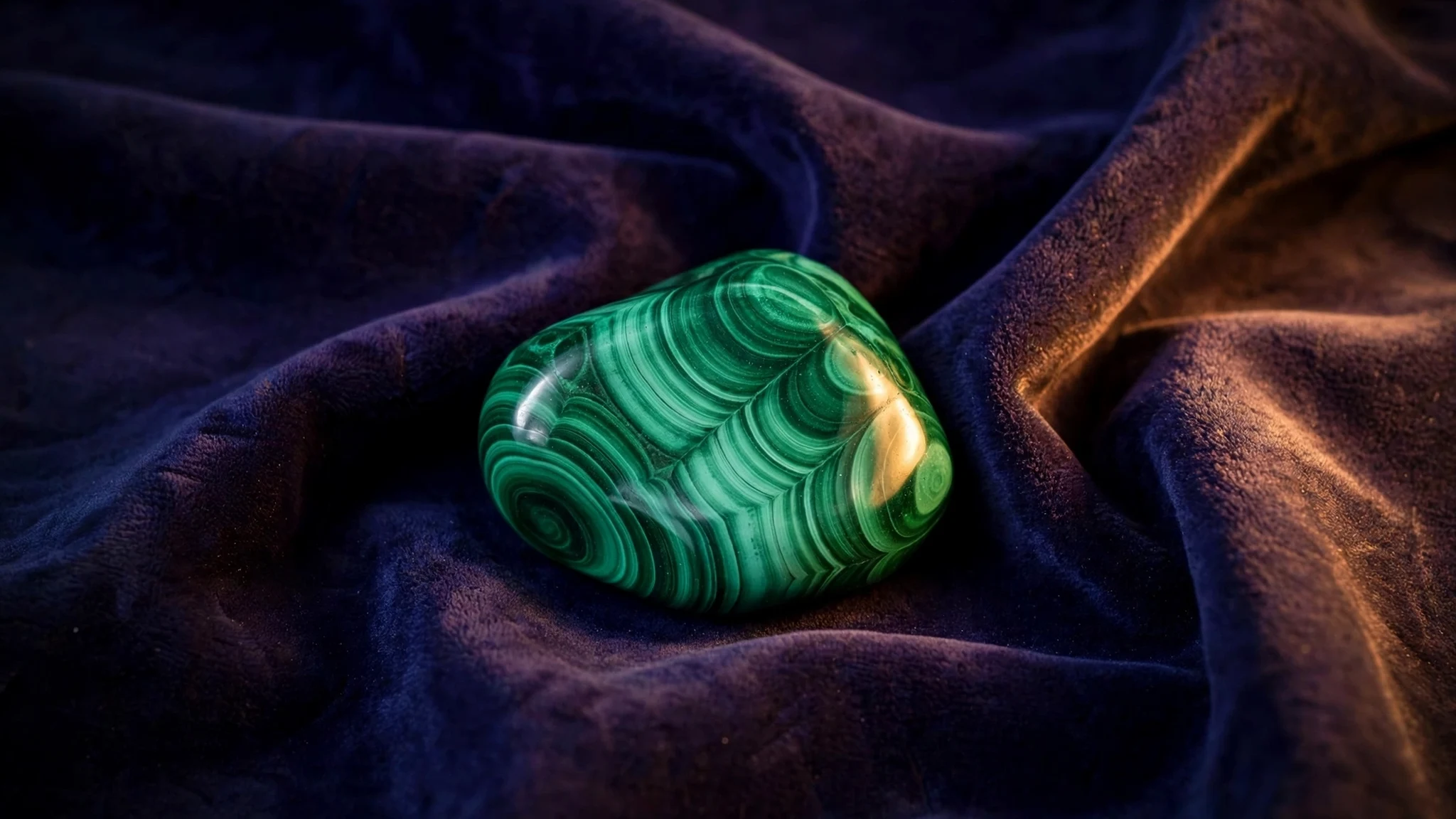
The malachite meaning is written across its surface before anyone explains a word of it. Few stones announce themselves the way this one does, with band after band of green rolling through the polished face like contour lines on a map of hills. Every piece carries a pattern no other piece repeats, light green folding into deep forest tones in waves, rings and bullseyes. Practitioners in the crystal tradition took that restless surface as a signature. Malachite became their emblem for a life in motion, for change that does not ask permission and protection that travels with the person rather than waiting at home.
That reputation has a serious side, and this page will not hide it. Malachite contains copper, and its dust is not something to breathe or swallow. The tradition around the stone developed alongside a working respect for its chemistry, and any honest account has to hold both truths at once. What follows covers the mineral as geology, the long human history of grinding it for pigment, the meanings assigned to it in belief, and the handling rules that let a modern owner enjoy a polished piece safely.
The Short Answer
Tradition treats malachite as a stone of transformation, protection and heart led change. It is recommended in crystal lore for the moment a person stops negotiating with a situation and starts moving, and it is linked in chakra based practice with the heart. Its beauty comes with instructions, because the copper that gives the stone its green also demands dry hands, dry storage and common sense.
| Point | Detail |
|---|---|
| What it is | A green copper carbonate mineral with swirling bands in many shades of green |
| Color | Layered greens, from pale mint tones to deep bottle green |
| Tradition links it with | Transformation, protection and heart led change |
| In practice | Kept polished on a desk or shelf as a marker for a decision already made |
| Care note | Wash hands after handling rough pieces, keep it dry, never use it in drink elixirs |
What Malachite Actually Is
Malachite is a copper carbonate mineral that forms where copper deposits meet air and water near the surface of the Earth. The copper explains the color completely. As mineral rich water moves through cracks and cavities, malachite grows in rounded masses layer by layer, and each layer records slightly different conditions. Slice one of those masses and polish the cut, and the growth history appears as bands.
The banding is the feature every buyer learns to read. Tight, wavy lines suggest slow, steady growth. Bold rings around a center point, sometimes called peacock eye patterns in the trade, form where the mineral built outward from a single starting spot. No two polished slabs share a pattern, which is one reason carvers through history have loved the stone for boxes, inlay, tabletops and ornaments where a large patterned surface can be shown off.
Human use runs deep into antiquity. Malachite was ground into pigment for paint, and in ancient Egypt it was ground for eye paint, a fact of art and custom recorded here as history rather than as any kind of health practice. The green that outlines eyes in Egyptian tomb painting often came from this mineral. Mines in the Sinai and the eastern desert supplied material thousands of years ago, and the stone later became just as prized in Russia, where enormous pieces were cut for palace decoration.
Two physical traits shape everyday ownership. First, malachite is soft compared with quartz family stones, so it scratches and dings more easily and belongs in separate storage. Second, and more important, the mineral contains copper in significant proportion. Rough, unpolished pieces can leave dust on the fingers during handling. The safe everyday form is the polished piece, sealed by its own smooth surface, and even then the rules below are worth following as a habit.
The Meaning in Tradition
Transformation stands first in every traditional account of this stone. The lore pictures malachite as the mineral of the turning point, the one carried when a person leaves a job, a city or a version of life that has finished teaching its lessons. Writers in the tradition connect that role to the banding itself. A stone visibly built from successive layers becomes a natural symbol for a self built the same way, each season laid over the last without erasing it.
Protection is the second theme, and it is an old one. Across several cultures, malachite was worn or carried by travelers and set near doorways, in the belief that a conspicuous green guardian drew the eye and stood watch. Modern practitioners repeat the older framing as belief, keeping a piece near an entrance or in a bag during a commute, less as a shield with powers than as a declared intention to move through the world awake.
The heart connection gives malachite its third theme. In chakra based practice the stone is linked with the heart chakra, the center that system associates with love, grief in the sense of an emotional season, and the courage to choose kindly. Green is the color assigned to that center, and malachite, the greenest stone in most collections, was placed there by color logic as much as by lore. Practitioners describe heart led change as the stone's specialty, the kind of decision that feelings have already made while the mind is still drafting objections.
It is worth stating plainly what this tradition does not claim on this page. The meanings above are beliefs held by a community of practice, useful as ritual, reflection and symbolism. They are not medical statements, and the stone is not presented here as a remedy for any condition of body or mind.
Working With Malachite
The most common modern practice is also the most grounded. A polished palm stone or a small slab sits where decisions get signed, on the desk, beside the household budget book, near the phone used for difficult calls. Its job in the practice is to be a visible marker of a choice already taken. People who work this way describe glancing at the bands before a hard conversation, as a reminder that they picked this road on purpose.
Because of the copper content, malachite is a look and hold stone rather than a wear all day stone for most owners. Brief handling of a polished piece with dry hands is the standard pattern in careful practice, followed by a quick hand wash if the session was long or the piece is rough. Many collectors keep their malachite as a display stone entirely, letting it work as scenery for a room where change is being planned, and there is no rule in the tradition that says a stone must touch skin to hold meaning.
In reflective practice, the banding invites a particular exercise. Choose one band on the surface and let it stand for one chapter of your life. Move outward band by band, naming each chapter in a journal as you go, until you reach the rim, which stands for the chapter now being written. Writers who use this exercise say its value lies in seeing a whole life as layers rather than as a verdict, a view that pairs naturally with the guidance in crystals for heartbreak and letting go when the newest layer is a difficult one.
Readers sometimes place malachite near the door of a reading room during weeks when many clients arrive mid transition. Beside black tourmaline for grounding and protection, it forms the active half of a well known pairing, one stone for moving and one stone for staying steady while you move.
Cleansing, Charging and Care
Care for malachite begins with a rule that outranks every ritual consideration. Keep it dry. Water left sitting on the surface can dull the polish, and soaking is worse. The stone must never be used in drink elixirs, a warning repeated across responsible crystal writing because the copper that colors the mineral does not belong in anything swallowed. If a piece needs dust removed, a dry or barely damp soft cloth does the job, and hands get washed after handling, always after handling rough material.
For the ritual reset that practitioners call cleansing, dry methods suit this stone best. Resting it on a shelf near a window for an evening of moonlight is a favorite, a practice expanded in the guide to charging stones through a Scorpio season. A short pass through the smoke of dried herbs, kept brief so soot does not settle into the polish, is another traditional option. Salt beds and salt water, sometimes suggested for hard quartz stones, are a poor match here and can damage the surface.
Heat and chemicals deserve the same respect. Keep malachite away from household cleaners, vinegar, lemon juice and ultrasonic baths, since acids react with carbonate minerals and can etch the face. Store each piece wrapped or in its own compartment, because its softness means neighboring stones will win any collision. A polished egg or sphere kept in a padded box will outlast a handful of tumbles rattling loose in a drawer.
Pairing Malachite With Other Stones
Malachite pairs by contrast, and the tradition has favorite counterweights for its forward push. With rose quartz and its emphasis on self kindness, the pairing reads as change undertaken gently, motion that does not require being hard on yourself to prove it is real.
With black obsidian for honest shadow work, the combination turns inward and gets candid. Obsidian in the lore asks what is true, while malachite asks what happens next, and practitioners who use the two together usually schedule the pairing for a writing day rather than for a social one. With black tourmaline, already noted above, the pairing becomes the traveler set of the tradition, movement plus steadiness, carried by people in the middle of a relocation or a career change.
One caution from experienced collectors closes the section. Malachite is visually loud, and it can dominate a group of stones on a shelf or in a photograph. Pair it with pieces that hold their own in color or in symbolic weight, and let it sit alone when the decision at hand deserves an undivided symbol.
Before the Big Change
Malachite is a stone of strong change, and strong change deserves one clear checkpoint first. Frame the decision as a single question and ask the free Yes/No Oracle. If the answer unsettles you, that feeling is worth a day of thought before anything irreversible gets signed, sent, or thrown away.
Take the Question Further
A banded stone can sit beside a decision and remind you why you made it, but it cannot talk through the road that follows. If you are in the middle of a real turning point, a job change, a move, the end of one chapter and the uncertain start of another, a live reading offers a conversation partner for the map you are drawing. Ask about timing, about the layer you are in now, about what the next band might reasonably hold. First 3 minutes FREE, every time, for every reading, with all advisors.
Frequently Asked Questions
Is malachite safe to handle every day?
A polished piece handled briefly with dry hands is the standard safe pattern, and washing your hands afterward is a simple habit worth keeping. Rough or raw pieces deserve more caution because they can leave mineral dust on the skin. Nobody should use malachite in water meant for drinking.
Why does my malachite have rings in some places and wavy lines in others?
Both patterns record how the mineral grew. Wavy bands form as layers settle one over another on a surface, while rings grow outward from a central point inside a cavity. A single polished slab often shows both, because the original mass grew under changing conditions.
Can malachite get wet when I clean it?
A quick wipe with a barely damp cloth is fine, followed by immediate drying. Soaking, salt water baths and long rinses are not recommended, since standing water can dull the polish and the mineral reacts poorly to acids and many cleaning chemicals. Dry care is the safer routine for this stone.
Is green malachite ever confused with other stones?
Yes, most often with banded agate dyed green, with chrysocolla, and with plastic imitation sold in gift shops. Real malachite shows bands that follow the natural shape of the piece and vary in tone, and it feels cool and fairly heavy in the hand. Imitations often repeat a pattern too evenly.
What is a good first malachite piece for a beginner?
A single polished palm stone or a small freeform with a pattern you genuinely enjoy looking at is the best start. Choose polish over raw material for easy handling, buy from a seller who states the mineral name plainly, and plan a separate soft place to store it from the first day.
Last updated: November 9, 2026