Opal Meaning
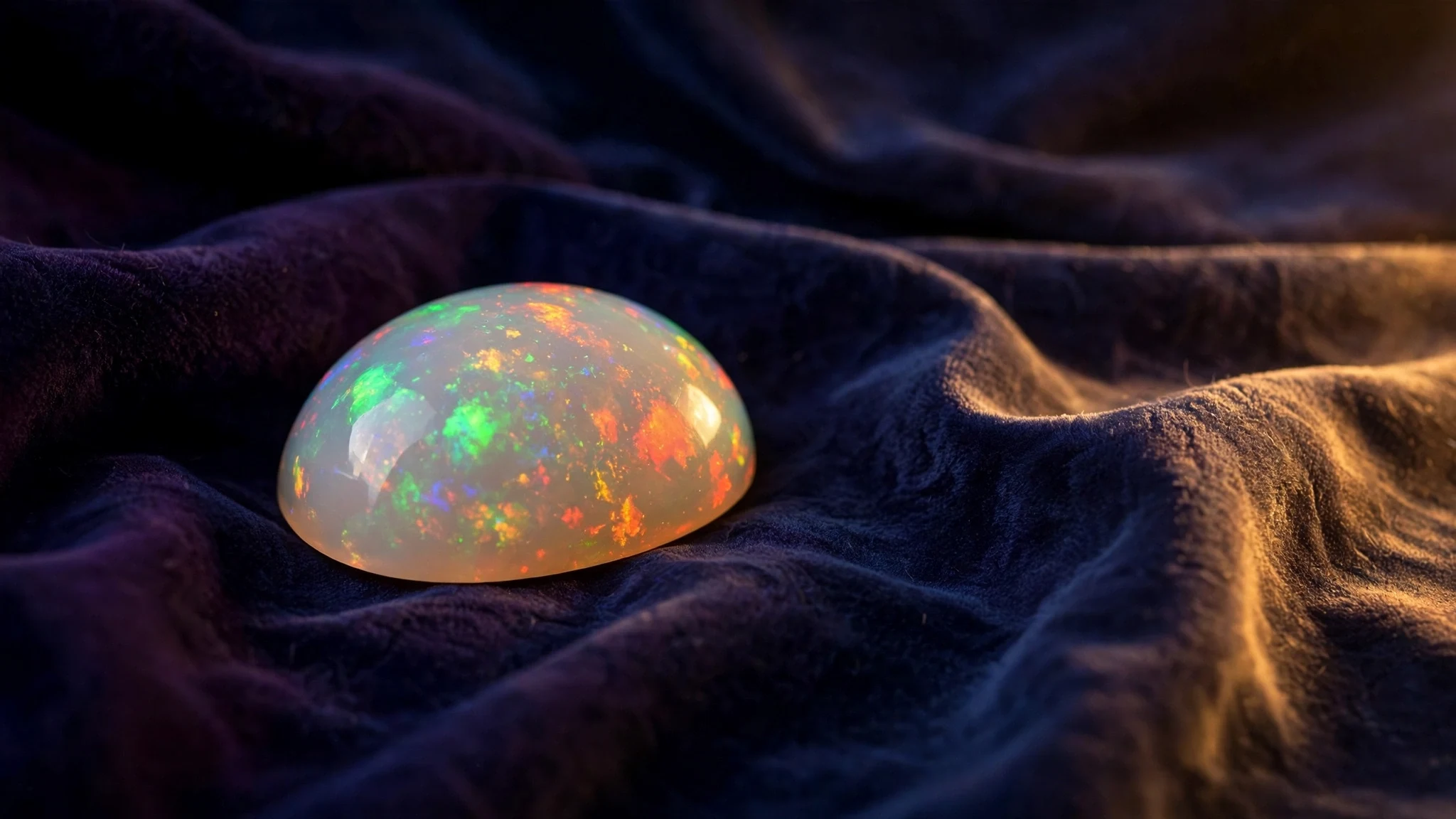
Opal meaning starts with a stone that will not hold still for its portrait. Precious opal shows play-of-color, flashes of spectral color that shift as the stone moves in the light, so a single gem can suggest green at one angle, fire at the next and a wash of blue as it turns in the hand. People who search for opal meaning have usually just watched that happen and want words for it, along with the practical facts about a beautiful, delicate October birthstone that asks for gentler handling than most gems in a jewelry box.
The Short Answer
In crystal tradition, opal is linked with inspiration, emotional honesty and the amplification of whatever a person already feels, which makes it a stone practitioners choose with a certain respect. As a material, it is hydrated silica rather than a crystal, relatively soft, and it holds water inside its own structure, so its care rules are stricter than its beauty suggests. People tend to reach for it when they want to look at a feeling plainly, write or make something truer than their first draft, or mark an October birthday with a stone that behaves like weather instead of like furniture.
| At a glance | Opal in fact and tradition |
|---|---|
| What it is | Hydrated silica with no crystal structure |
| Color | Milky white base with shifting play-of-color in precious opal |
| Tradition links it with | Inspiration, emotional honesty and amplification |
| In practice | A reflection stone for writing, candor and creative work |
| Care note | Soft and water bearing, keep it from heat and very dry air |
What Opal Actually Is
Opal is not a crystal at all in the mineral sense, and the difference explains most of its behavior. It is hydrated silica, silica combined with water inside its structure, formed without the ordered internal lattice that defines a true crystal. That water content is part of the stone rather than an accident of storage, which is why opal's care instructions sound so unlike those for quartz or garnet. Heat and very dry air can draw moisture out over time, and a dried opal can craze, developing fine cracks across its surface. The stone literally keeps a small amount of the water from its own formation, and it asks its keeper to respect that inheritance.
Precious opal, the kind the name usually celebrates, adds one more structural trick. Microscopic spheres of silica, stacked in orderly layers, split light into spectral color as it passes through, producing the play-of-color that makes a fine opal look lit from inside by several fires at once. Common opal lacks that ordered stacking and appears milky or opaque without the flashes. Both are the same mineral family in material terms, but the tradition and the trade have always prized the precious form, and nearly everything written about opal meaning assumes a stone with fire in it.
Australia is the classic source, the country most associated with fine precious opal in the modern trade, and its pale stones from dry country taught the market both the beauty and the fragility of the gem. Opal is relatively soft as gems go, softer than quartz and much softer than sapphire, so it scratches and chips more readily in rings that take daily knocks. Roman writers praised opal long before any of that was understood, describing it as a stone that held the colors of many gems in one body, ruby fire and emerald green and amethyst violet together. That praise is part of the record because it explains the stone's reputation for containing multitudes, an idea the later tradition kept and built upon.
The Meaning in Tradition
In crystal practice, opal is traditionally used for work that involves seeing the self clearly. Its oldest traditional thread is inspiration. Practitioners reach for it when they sit down to write, compose, paint or think in a new direction, treating the shifting color as a reminder that a single subject can hold more angles than the first flat look reveals. The stone does not supply talent in that account. It accompanies a practice, the way a good window accompanies a room, by changing the light in which familiar things are seen.
Emotional honesty is the second thread, and it follows naturally from the Roman description. A stone praised for holding many colors at once became, in the tradition, a stone for holding many feelings at once without flattening them into a single official version. Practitioners describe choosing opal when they want to admit a complicated truth in a journal or in a conversation: that a happy event also carries grief, that a loved person also frustrates them, that relief and guilt can arrive in the same hour. The tradition regards that kind of candor as the stone's home ground.
The third thread is the one that gives opal its cautious reputation. Tradition links it with amplification, the idea that it intensifies whatever a person already feels or brings to it. Practitioners therefore tend to advise choosing opal on purpose rather than by accident, in a season when looking closely at the inner weather is the actual goal. Read in that light, the old superstitions about opal and luck look like the amplification belief wearing dramatic clothing: a stone said to magnify the wearer's state will collect both grateful and wary stories across centuries, and it has.
Working With Opal
Working with opal, as the phrase is used here, means reflective practice only. The stone is a companion to attention, and nothing in this page suggests it can change a mood, a mind or a circumstance on its own. Within that honest frame, practitioners describe a few steady uses. The first is the writing stone practice: opal placed beside a journal or a keyboard during a session set aside for candor, its shifting color serving as the session's small rule, which is to let the second and third true sentences onto the page instead of polishing the first one.
A second use is conversational. Some people keep a small opal in a pocket on a day when a difficult and honest talk is scheduled, not as a charm that scripts the other person, but as a private reminder to say the whole thing once, kindly and without the usual edits. A third use belongs to makers. Painters, songwriters and cooks who work with the tradition describe setting opal where they can see it during the draft stage of a project, as a token for range: more than one color, more than one attempt, permission for the work to change its mind about what it is.
October gives the stone its social season. As the October birthstone, opal is given for birthdays in that month and for anniversaries that fall inside it, and givers often choose it for people they regard as many sided, since the stone's whole character is a refusal to be one color. If you keep a practice of refreshing the stones you work with under the moon, our guide to charging crystals under the full moon describes the custom and its timing in detail, and opal keepers often fold their stone's evening out into that same gentle routine.
Cleansing, Charging and Care
Opal care begins with its two material facts: it holds water in its structure, and it is relatively soft. Store it away from heat sources and from very dry air, and do not leave it for long periods in a hot car, on a sunny sill or beside a radiator. Avoid long soaking in water, which can affect some opal, in particular doublets and composite material, and clean it instead with a soft cloth and, when needed, a brief pass of lukewarm water with the mildest soap, followed by gentle drying. Ultrasonic and steam cleaners, standard for harder gems, are poor ideas for opal and are best skipped entirely.
Scratch protection matters as much as moisture. Keep opal in its own soft pouch, apart from harder stones that can score its surface in a shared box, and think twice about wearing an opal ring for gardening, lifting or gym work, since a single knock on a hard edge can chip what a century of careful drawers preserved. Jewelers who set opal often recommend bezel settings for rings worn daily, because the metal rim guards the stone's edge, its most vulnerable geography.
Cleansing and charging customs, in crystal practice, are rituals of intention rather than physical maintenance, and opal's fragility shapes how practitioners adapt them. Brief moonlight rests suit it better than long sun exposure, water rituals are kept short or replaced with rest on a dry cloth beside other stones, and the point of the custom, as practitioners describe it, is the pause it creates: the stone taken up, looked at honestly, and returned to its place with the next stretch of work in mind. Take the ritual as punctuation for your practice and the physical rules above as the actual care, and the stone can keep its fire for decades.
Pairing Opal With Other Stones
Pairing in crystal practice is a conversation between traditional meanings, and opal, the amplifier, tends to be paired with stones whose traditions steady, soften or aim it. Beside moonstone meaning, the pairing is read as weather with a moon over it: moonstone's tradition of cycles, patience and the feminine tide set against opal's flashes, so the pair is often chosen by people who want inspiration that arrives in phases rather than in lightning. The two pale stones also simply look like relatives, milk and fire sharing a drawer.
A bolder conversation pairs opal with labradorite meaning, a stone whose own flash, a blue and green sheen across a dark gray body, meets opal's spectrum head on. Practitioners describe that pairing as one for deep creative dives and for people who think in images, with the shared understanding that both stones reward a second look and punish a hasty one. Where the aim is clarity instead of range, the partner is usually found in clear quartz meaning, the tradition's plain glass window of a stone, chosen to give opal's amplification a single subject to work on rather than the whole weather system at once.
The softest common pairing sets opal beside amethyst meaning, whose tradition centers on calm, sobriety of mind and a violet kind of quiet. Practitioners who find opal intense on its own often describe amethyst as its governor, not muting the color but slowing the tempo at which feelings are examined. As with every pairing on this site, those are the tradition's sentences about the stones, not the stones' properties, and the right pair is the one whose story matches the reflection you mean to practice.
One Answer, Many Colors
Opal shows a different color at every angle, which is beautiful in a stone and exhausting in a decision. When a question has too many angles, cut it down to one: ask the free Yes/No Oracle for a single plain answer, then notice which of opal's colors, relief, doubt, or resolve, rises first in you.
Take the Question Further
Some questions suit a stone on the desk, and some deserve a voice on the other side of them, especially the honest ones opal season tends to raise about what you feel and what you are making. If a piece of writing, a decision or a candid conversation has been circling you, a live reading at PsychicSmile lets you lay the whole spectrum out with a real reader and choose which color to act on first. First 3 minutes FREE, every time, for every reading, with all advisors.
Frequently Asked Questions
What is opal the birthstone for?
Opal is the traditional birthstone for October. The custom belongs to the birthstone calendar tradition, and it is a large part of why the stone is given so often in that month, chosen for people whose character is as many sided as the gem itself.
Why does opal change color in the light?
Precious opal contains microscopic silica spheres stacked in orderly layers, and that structure splits light into spectral colors as it passes through. Turn the stone and the angles change, so different colors flash in turn. That effect is called play-of-color, and common opal, which lacks the orderly stacking, does not show it.
Can opal be soaked in water to clean it?
Long soaking is best avoided. Opal holds water in its structure, and extended soaking can harm some material, especially doublets and composite stones. Clean it with a soft cloth and, if needed, a brief rinse in lukewarm water with mild soap, then dry it gently and store it away from heat and very dry air.
What does opal mean in crystal tradition?
Tradition links it with inspiration, emotional honesty and amplification of what a person already feels. Practitioners reach for it during writing and candid reflection. Those are beliefs and customs, reported here as tradition. The stone is a companion to reflection, not a cause of results.
Is opal too fragile to wear every day?
It asks for more care than harder gems, since it is relatively soft and can chip or scratch with knocks. Many people wear it daily in pendants or in bezel set rings and keep rings off for rough work. Stored in its own pouch and kept from heat, an opal can be worn and kept well for a long time.
Last updated: November 9, 2026