
Labradorite Meaning
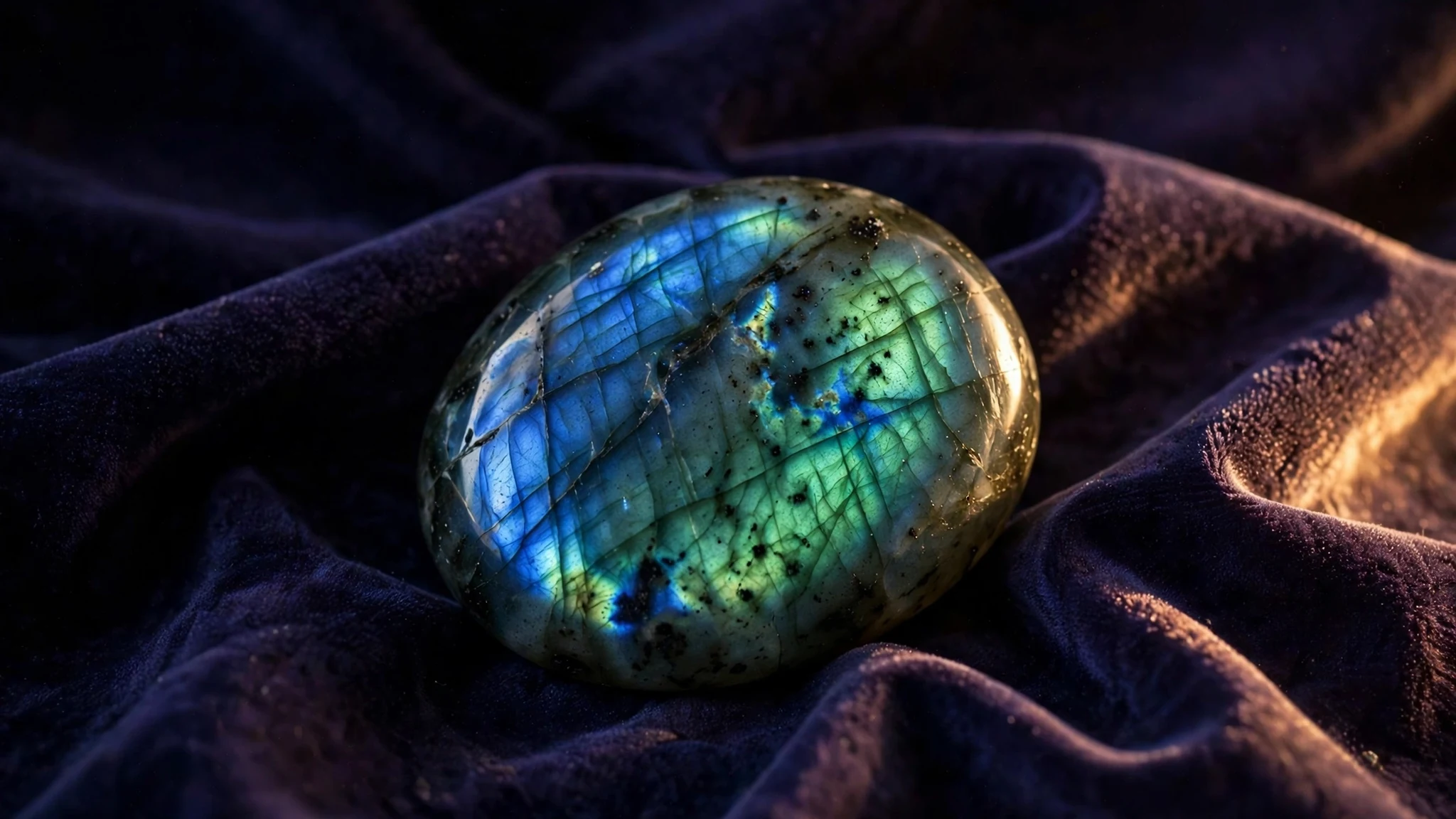
The labradorite meaning begins with a flash that refuses to sit still. Turn a polished piece in ordinary daylight and the gray green surface looks quiet, almost plain. Tilt it a fraction further and blue fire moves across the stone, joined by green and gold, then it is gone again. Practitioners who work with this feldspar say that disappearing act is the whole lesson. Some truths only show themselves at an angle, and a season of change rarely announces what it is carrying until you are already standing inside it.
People usually meet labradorite in a shop, drawn by a cabochon that lit up from across the room and then seemed to switch off when picked up. That small surprise sets the tone for everything tradition claims about it. This page covers what the stone physically is, where its colors come from, what Inuit lore says about lights trapped in rock, and how the crystal tradition uses it during periods of transformation. Every property described here belongs to belief and practice, passed down through crystal lore rather than measured in a laboratory.
The Short Answer
In tradition, labradorite stands for transformation, intuition and protection while life is rearranging itself. It is the stone practitioners reach for when an old pattern has cracked open and the new shape has not yet formed. The flash, called labradorescence, does the teaching: nothing about the surface changes, yet everything about what you can see in it does.
| Point | Detail |
|---|---|
| What it is | A feldspar mineral first identified on the coast of Labrador, Canada |
| Color | Gray green base with flashes of blue, green and gold |
| Tradition links it with | Transformation, intuition and protection during change |
| In practice | Held or kept nearby while journaling, planning or sitting with a decision in motion |
| Care note | Moderately hard yet able to cleave, so handle it with care and store it apart |
What Labradorite Actually Is
Labradorite is a member of the feldspar family, the group of minerals that makes up a large share of the rock in the crust of the Earth. It was first identified on the coast of Labrador in Canada, and the place name stayed with the stone. Specimens from that cold shoreline carried the play of color that made collectors pay attention, and material is now found in several other countries as well, though the name still points back to its first home.
The base stone, before any flash appears, is a muted gray green. Cut flat and left unpolished, it can look like an ordinary pebble from a northern beach. The magic trick has a plain physical explanation. Inside the mineral, thin layers formed as the rock cooled, and light entering the stone bounces between those layers. Certain wavelengths cancel and others strengthen, so the eye receives sudden sheets of blue, green and gold. Gemologists gave that effect its own name, labradorescence, because this mineral shows it more dramatically than its relatives.
Quality varies in ways a buyer can learn to read. Strong pieces show a broad flash that covers much of the face rather than a single bright corner. Blue is the most common color in the display, green appears often, and gold or orange tones show up less frequently and are prized. A piece that only flashes in one narrow position is not fake. It simply has layers aligned for a smaller window, and many practitioners prefer exactly that kind of stone for focused work, since finding the flash requires slowing down and paying attention.
One practical fact deserves emphasis before any talk of meaning. Labradorite is moderately hard, which sounds reassuring, yet it can cleave along internal planes if it takes a sharp knock. A dropped tumble stone may survive, while a thin pendant that strikes a counter edge can split along a line you could not see. Treat it as sturdy glass rather than as a pebble, and it will keep its fire for decades.
The Meaning in Tradition
Crystal tradition reads the flash as a picture of intuition itself. Intuition, in that framing, is not a voice shouting answers. It is a brief brightening at the edge of awareness, easy to miss if you are moving too fast and impossible to force by staring straight at it. Practitioners who keep labradorite during a reading or a meditation describe the practice as training in peripheral sight, a reminder to notice what glances back at them while they attend to something else.
Transformation is the second theme, and it follows from the stone's double nature. The gray surface and the hidden fire exist in the same object at the same time, which makes labradorite a natural emblem for a person mid change. The tradition does not claim the stone rearranges a life. It offers the stone as a companion object for the stretch when the old arrangement no longer fits and the replacement is still mostly guesswork, the months of applications, endings, drafts and false starts that real change involves.
Protection, the third thread, is framed in this tradition as protection during change rather than protection from it. The image is of a cloak worn on a road, not a wall built around a house. People carry labradorite when they travel between homes, jobs or versions of themselves, treating it as a small steadying weight in a pocket, a reminder that they chose the crossing and can keep their footing on it.
Inuit lore gives the stone its most beloved story. The tale tells that the northern lights once fell from the sky and became frozen inside the rocks along the Labrador coast. A warrior found the imprisoned lights and struck the stone with his spear, freeing most of them to return to the sky. The colors that remained trapped in the rock became labradorite. The story is told here as lore, exactly as it has been retold by generations of storytellers, and it explains why so many people feel the aurora when they watch the flash travel across a polished face.
Within chakra based practice, labradorite is linked with the third eye chakra, the point associated in that system with insight and inner seeing. Writers in the tradition place it there because its colors sit at the cool end of the spectrum and because its whole character rewards indirect attention.
Working With Labradorite
Start with the simplest practice the tradition offers, which is also the most honest one. Hold the stone near a window in the morning and turn it slowly until the flash appears. Note the first thought that surfaces while you are looking for the angle. Many journal keepers write that thought down without editing it, then return to the page a week later to see whether the note reads differently in hindsight. The stone functions here as a metronome for attention, giving the hands something patient to do while the mind settles.
During a period of active change, some people keep labradorite on the desk where plans get made. It sits beside the list of phone calls, the draft resignation, the spreadsheet of a new budget. The practice is deliberately ordinary. No ceremony is required, only the repeated sight of a surface that hides its best color until viewed with patience. People who use it this way often say the stone earned its place during a season of Scorpio weather, when endings and beginnings tend to arrive in the same envelope.
Readers at PsychicSmile sometimes set a piece near their cards when a client is describing a life in motion and cannot yet name the destination. Paired stones matter in that setting. Labradorite beside moonstone and its quieter glow suits questions about cycles and timing, since one stone flashes and the other softens. Set against fluorite for focus and order, it becomes the intuitive half of a working pair, the hunch checked against the list.
A short evening practice closes the section. Before bed, place the stone on top of a notebook open to a blank page. In the morning, before any screen, write three lines about whatever the night left behind, a dream fragment, a worry, a small plan. The tradition treats dreams as one more angle of light, and the stone on the page simply marks the appointment.
Cleansing, Charging and Care
Cleansing in crystal practice means resetting an object for a new round of use, and practitioners apply the idea to labradorite in gentle ways. A rinse under lukewarm water with a soft cloth is enough for physical dust, followed by careful drying. Because the stone can cleave, skip ultrasonic cleaners, hard brushes and any method that involves dropping it into a bowl of salt where other stones can strike it.
For the ritual side of care, moonlight is the classic companion to this stone. Many owners rest labradorite on a sill overnight, a habit shared with the broader full moon charging practice that treats the bright night as a monthly reset point. Smoke from a small bundle of dried herbs, passed around the stone a few times, is another traditional option for people who prefer not to use water at all.
Storage decides how long the polish lasts. Keep labradorite in a soft pouch or in a compartment of its own, away from harder stones like quartz that can scratch its face and dull the very layers that produce the flash. If a piece is worn as jewelry, put it on after perfume and hairspray, and take it off before lifting, gardening or any work where a knock against metal or stone is likely.
Pairing Labradorite With Other Stones
Pairing, in this tradition, means choosing stones whose symbolic themes comment on each other. Labradorite pairs first with the dark protectors. Next to black obsidian and its mirror like honesty, the flash reads as the hopeful half of a hard conversation, intuition standing beside a willingness to look at what is actually true.
With moonstone, already mentioned above, the pairing turns lunar and cyclical, suited to people tracking a change that moves in phases rather than in a straight line. With fluorite, the pairing turns practical, the stone of hunches set beside the stone of sorted thinking. With clear quartz, the common amplifier of the tradition, labradorite is used when a person wants one clear question held steadily for a month of journaling, though beginners are usually advised to learn each stone alone before building combinations.
The rule practitioners repeat is simple. A pairing should answer a question you can state in one sentence. If you cannot say what the combination is for, you have a collection, not a practice, and the stones deserve the honesty of being enjoyed as a collection instead.
Catch the Flash With One Card
Labradorite rewards a second look, and so does a single well chosen card. Draw with the free Tarot One Card tool when a situation feels flat at first glance, and sit with the image until its less obvious detail surfaces. The flash in the stone and the detail in the card tend to arrive the same way, sideways.
Take the Question Further
A stone that hides its fire until the angle is right makes a fine companion for journaling, yet some questions deserve a second pair of eyes. If you are standing inside a change and want help reading the shape of it, a live reader can walk through the timing, the sticking points and the part of the story only you can decide. Bring the question you keep circling, and let a conversation do what a quiet object cannot. First 3 minutes FREE, every time, for every reading, with all advisors.
Frequently Asked Questions
Why does my labradorite only show color from one angle?
The flash comes from light bouncing between thin internal layers, so it appears only when the stone, the light and your eye line up. Turning the piece slowly near a window usually finds the window of color, and a narrow display is a normal feature of the mineral rather than a defect.
Is labradorite the same stone as spectrolite?
Spectrolite is a trade name used for high color labradorite material, first popularized from Finland, known for showing a wider sweep of the spectrum. The mineral underneath the name is the same feldspar, graded by how much of the rainbow its layers return.
Can labradorite go in water?
A brief rinse in lukewarm water is generally fine for a polished piece, followed by thorough drying with a soft cloth. Long soaks are a poor idea because water can work into tiny surface openings, and the greater risk is mechanical, since a wet stone is a slippery stone above a hard sink.
Which hand should I hold labradorite in during meditation?
Tradition varies by school, and most practitioners say the honest answer is whichever hand keeps you comfortable and attentive. Some place it in the non dominant hand to symbolize receiving impressions. Others rest it on the notebook instead. Comfort and consistency matter more than the choice itself.
How can I tell whether a piece offered to me is real labradorite?
Real material shows its color as shifting sheets that move when the stone turns, set in a gray green base with natural variation. Plastic imitations tend to show glitter fixed in place or color that looks painted on the surface. Buying from a seller who names the mineral family and origin is the most reliable protection.
Last updated: November 9, 2026
