
What Is Divination? Methods and Meanings
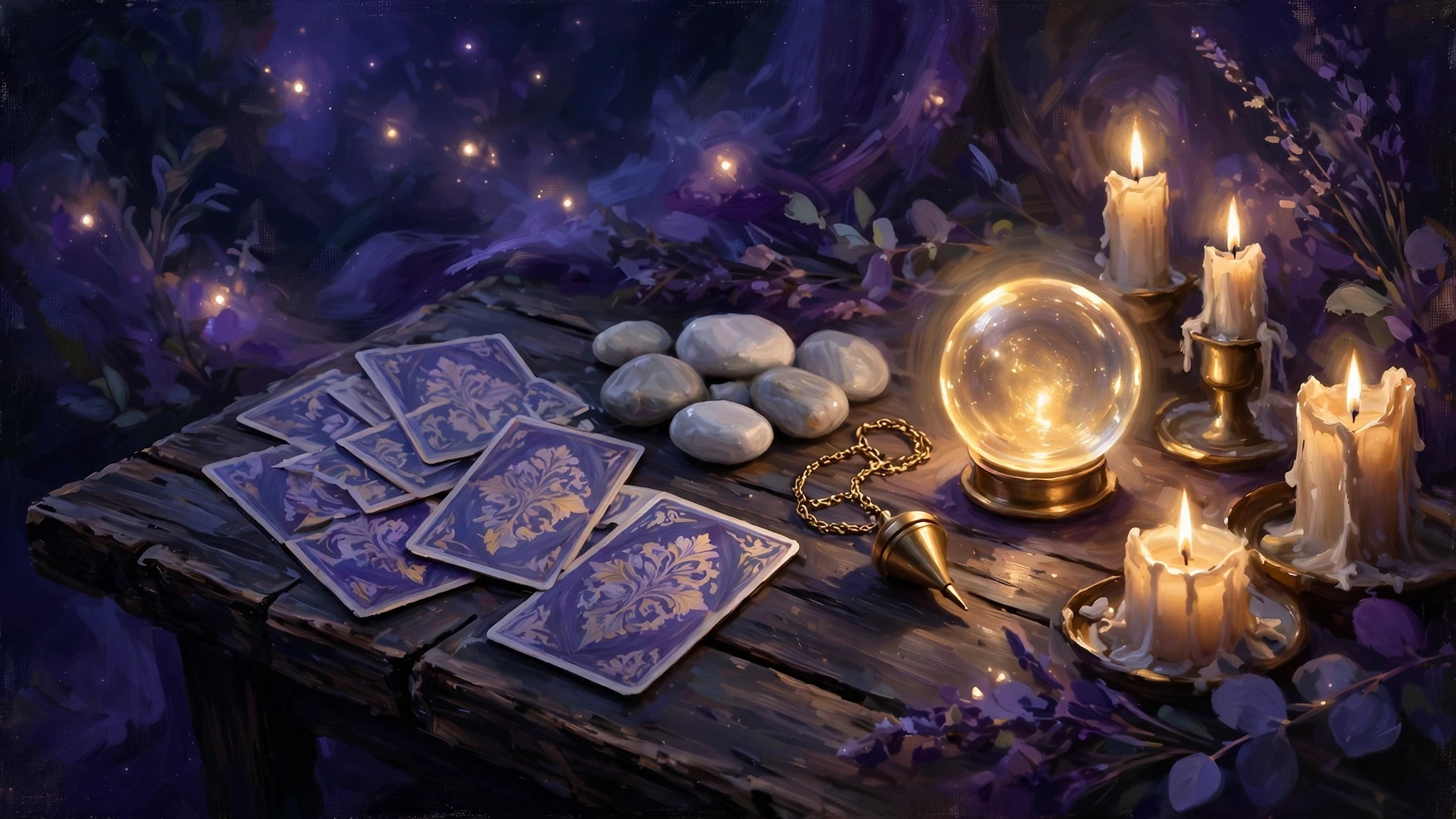
What Is Divination, and Why People Have Always Practiced It
The question what is divination has a simple answer, and a long history behind it. Divination is the practice of seeking guidance, insight, or a clearer view of a situation through a structured method that uses symbols, chance, or focused attention, rather than through ordinary reasoning alone. The word comes from the Latin divinare, to foresee or to be inspired by a god, and it covers a wide family of practices, from tarot cards and runes to pendulums, scrying, and the I Ching. What those practices share is not a single belief. It is a shared shape. A question, a method, a pattern, and a moment of reflection on what the pattern might mean.
People have practiced divination in almost every culture we have records for, and for similar reasons. A decision is hard, the future is unclear, or a feeling is difficult to name, and a structured method gives the mind something to work with. A card, a stone, or a line of text does not make the decision for you. It gives you a new angle on the decision, a picture or a phrase that helps you notice what you already think, or what you have been avoiding. This page is the umbrella. It explains the main methods in one line each, with their real history, and it points you to the detailed pages for each method, without re-teaching any of them.
A Short History: From Oracle Bones to Tarot Cards
Divination is old, and its history is worth knowing because it keeps the modern practice honest. In China, the I Ching, or Book of Changes, is one of the oldest divination texts in the world, with roots in the Western Zhou dynasty, around 1000 BCE, and a system of 64 hexagrams, each made of six lines, that are consulted by casting coins or yarrow stalks. In ancient Greece, the oracle at Delphi was consulted by rulers and ordinary people alike, and the priestess, called the Pythia, gave answers that were famously ambiguous, which is part of why they lasted. In Rome, augurs read the flight of birds, and haruspices read the entrails of sacrificed animals, practices that were part of public life, not private superstition.
Runes, the letters of the Germanic peoples, are another old method. The Elder Futhark, the oldest form of the runic alphabet, has 24 runes, arranged in three groups of eight, and inscriptions in it are found from the 2nd to the 8th centuries, on jewelry, weapons, tools, and stones. The earliest known listing of the whole alphabet in order is on the Kylver Stone in Gotland, Sweden, dated to around 400 CE. Runes were first a writing system, and their use for divination came later, as the letters took on symbolic meanings.
Tarot is much younger than most people think. The earliest references to tarot date to the 1440s and 1450s, in northern Italian cities like Venice, Milan, Florence, and Urbino, and the cards were first a trick taking game, not a divination tool. A complete deck has 78 cards, 56 suited cards and 21 trump cards plus the Fool. The association with fortune telling gained currency only in the 19th century, and it has nothing to do with the medieval game. That history does not make tarot less meaningful. It makes it more interesting, because it shows how a game became a mirror, through centuries of reinterpretation.
Tarot: The Most Widely Used Method Today
Tarot is the method most people meet first, and it is the one this site covers in the most depth. A tarot reading starts with a question, then a shuffle, then a spread, a pattern of cards laid out in positions that each mean something, like past, present, and future, or situation, obstacle, and advice. The reader interprets the cards in their positions, in relation to each other, and in relation to the question. The images on the cards, a tower struck by lightning, a figure walking off a cliff, a sun rising over a wall, give the mind something concrete to work with, and the interpretation is a conversation between the image, the position, and the question.
If you want to learn tarot properly, start with tarot for beginners, which explains the deck and the basic spreads, and then read how to read tarot cards, which walks through a reading step by step. If you are choosing between tarot and oracle cards, our page on oracle cards vs tarot explains the difference in plain terms. Oracle cards are a looser system, with no fixed structure, while tarot has a fixed deck of 78 cards and a shared set of meanings. Both are valid. They are different tools, and the right one is the one you enjoy using.
Runes, Pendulums, and Scrying: Three Quiet Methods
Runes are small stones, pieces of wood, or tiles, each marked with one of the 24 letters of the Elder Futhark. A rune reading usually involves drawing one rune, or three, from a pouch, and interpreting the letters in relation to the question. Each rune has a name and a meaning, Fehu for wealth and cattle, Uruz for strength, Ansuz for a god or a message, and the reading is a conversation between those meanings and the question you asked. Runes suit people who like short, direct answers, and who prefer a method with a clear historical root. They do not suit people who want a long, detailed story, because a single rune gives you a word, not a chapter.
A pendulum is a small weight, often a crystal or a metal point, hung on a chain or a string. The reader holds the chain still, asks a yes or no question, and watches the direction of the swing. A swing in one direction is read as yes, and the other as no, after the reader has first established which is which by asking a question they already know the answer to. The movement is small, and it is driven by tiny, unconscious movements of the hand, a phenomenon psychologists call the ideomotor effect. That does not make the pendulum useless. It makes it a tool for noticing what your hand, and your mind, already lean toward, which is useful information if you treat it as a reflection, not as a verdict.
Scrying is the practice of gazing into a reflective surface, a crystal ball, a bowl of water, a mirror, or a flame, and noticing the images or feelings that come to mind. It is one of the oldest forms of divination, and it is also one of the quietest. The scryer does not look for a clear picture, like a photograph. They look for a shift in attention, a shape, a color, or a feeling that suggests a direction. The Elizabethan scholar John Dee, who lived from 1527 to 1609, is one of the most famous scryers in history, and his work with a crystal ball and a medium is documented in his own journals. Scrying suits people who are comfortable with silence and ambiguity, and who can sit still for ten minutes without needing a clear answer.
The I Ching, Astrology, and Numerology: Systems, Not Just Tools
The I Ching is a system, not a single tool. It has 64 hexagrams, each with a name, an image, and a text that describes a situation and a way through it. To consult it, you cast three coins six times, or divide yarrow stalks, to build a hexagram line by line, from the bottom up. The resulting hexagram, and any changing lines, point to a passage in the book, which you read as advice for your situation. The I Ching is less about prediction and more about timing and attitude, when to act, when to wait, and how to approach a difficulty. It suits people who like to read and reflect, because the text is the heart of the method.
Astrology is the largest divination system in the world, and it is the hub for this page. It reads the positions of the Sun, Moon, and planets at a given moment, usually the moment of birth, and interprets them as a map of character and timing. Our page on what is astrology explains the system in plain terms, including the signs, the planets, and the houses. Numerology is a smaller system that works with numbers, usually derived from a birth date or a name, and interprets them as patterns of character and life direction. Our page on what is numerology covers that system, including the life path number. Both are systems with their own rules, their own history, and their own language, and both are best learned as systems, not as single tricks.
How Divination Works, in Honest Terms
There are three honest accounts of how divination works, and they are not in conflict. The first is psychological. A card, a rune, or a hexagram gives your mind a random prompt, and your mind responds by connecting it to your situation. That connection reveals what you already think, or what you have been avoiding, in a way that a direct question might not. Psychologists call this projection, and it is a useful tool when it is done consciously. The second account is symbolic. Symbols carry meanings that have built up over centuries, and a good symbol can hold several meanings at once, which lets you see a situation from more than one angle. The third account is spiritual. Many practitioners believe that a higher power, a guide, or the universe itself speaks through the method, and that belief is part of the practice for them.
None of those accounts requires you to believe that a card can predict the future with certainty. Divination does not predict the future in the way a weather forecast predicts rain. It reflects the present, it clarifies a question, and it suggests a direction. A reading that tells you what will happen, with a date and a certainty, is not a good reading. A reading that helps you see your situation more clearly, and choose your next step with more confidence, is a good reading, whatever account of how it works you hold.
Choosing a Method, and Using It Well
Choose a method by trying it, not by reading about it. Spend a week with one method, and see how it feels. Do you enjoy tarot, with its rich images and long stories. Do you prefer runes, with their short, direct words. Do you like the quiet of scrying, or the structure of the I Ching. There is no right answer, and there is no method that suits everyone. The right method is the one you return to, because it helps you think, not because someone told you it was the most powerful.
Use any method with three rules. First, ask a good question, open and focused on your own choices, not a closed question about what someone else will do. Second, take notes, so you can read the reading back later and see what was useful and what was not. Third, act on what you learned, in a small way, within a few days. A reading without action is entertainment. A reading with action is a practice. If a method stirs bigger questions about your inner life, spiritual awakening signs can help you place them in context, and a conversation with a reader can help you sort a question that feels tangled.
If you would like to talk through a question with a reader, a live reading can help you see it from a fresh angle. First 3 minutes FREE — every time, for every reading, with all advisors.
For a simple next step, try a One-Card Tarot reading and reflect on what the card brings up about your question.
Frequently Asked Questions
What is divination in simple terms?
Divination is the practice of seeking guidance or insight through a structured method that uses symbols, chance, or focused attention, rather than ordinary reasoning alone. Tarot, runes, pendulums, scrying, the I Ching, astrology, and numerology are all forms of divination. A reading reflects your present situation and clarifies a question, rather than predicting the future with certainty.
Is divination the same as fortune telling?
Not quite. Fortune telling usually means predicting specific future events, often with a claim of certainty. Divination is wider, and in its best form it is about reflection, insight, and guidance for a decision. A good reading helps you see your situation more clearly and choose a next step, rather than telling you what will happen on a date.
Which divination method is best for beginners?
Tarot is the easiest to start with, because the images are rich, the meanings are widely documented, and a one card draw is a complete practice in itself. Runes are a good second choice if you prefer short, direct answers. Pendulums suit yes or no questions. Try one method for a week and see which one you return to, because the right method is the one you enjoy using.
Can divination predict the future accurately?
No method of divination has been shown to predict specific future events reliably. What divination can do is clarify a present situation, reveal what you already think or feel, and suggest a direction. Treat a reading as a mirror and a prompt for reflection, not as a forecast, and be wary of any reader who promises a certain outcome by a certain date.
Do I need to believe in divination for it to work?
No. You do not need to believe that a card or a rune has supernatural power for a reading to be useful. The psychological account, that a random symbol prompts your mind to connect it to your situation, works whether or not you hold a spiritual belief. If you do hold a spiritual belief, that is part of the practice for you. Either way, the value is in the reflection and the action that follows.
Last updated: November 11, 2026
