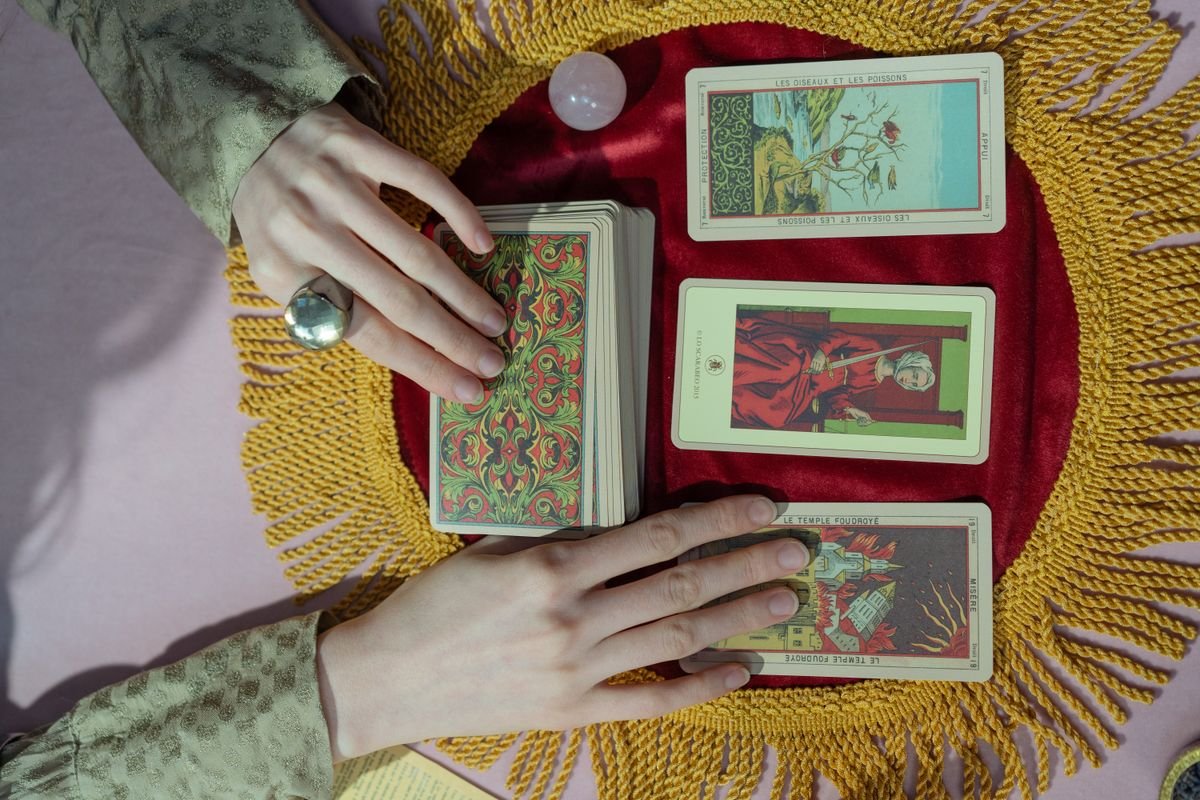
Tarot for Beginners: What a Reading Is Really Like
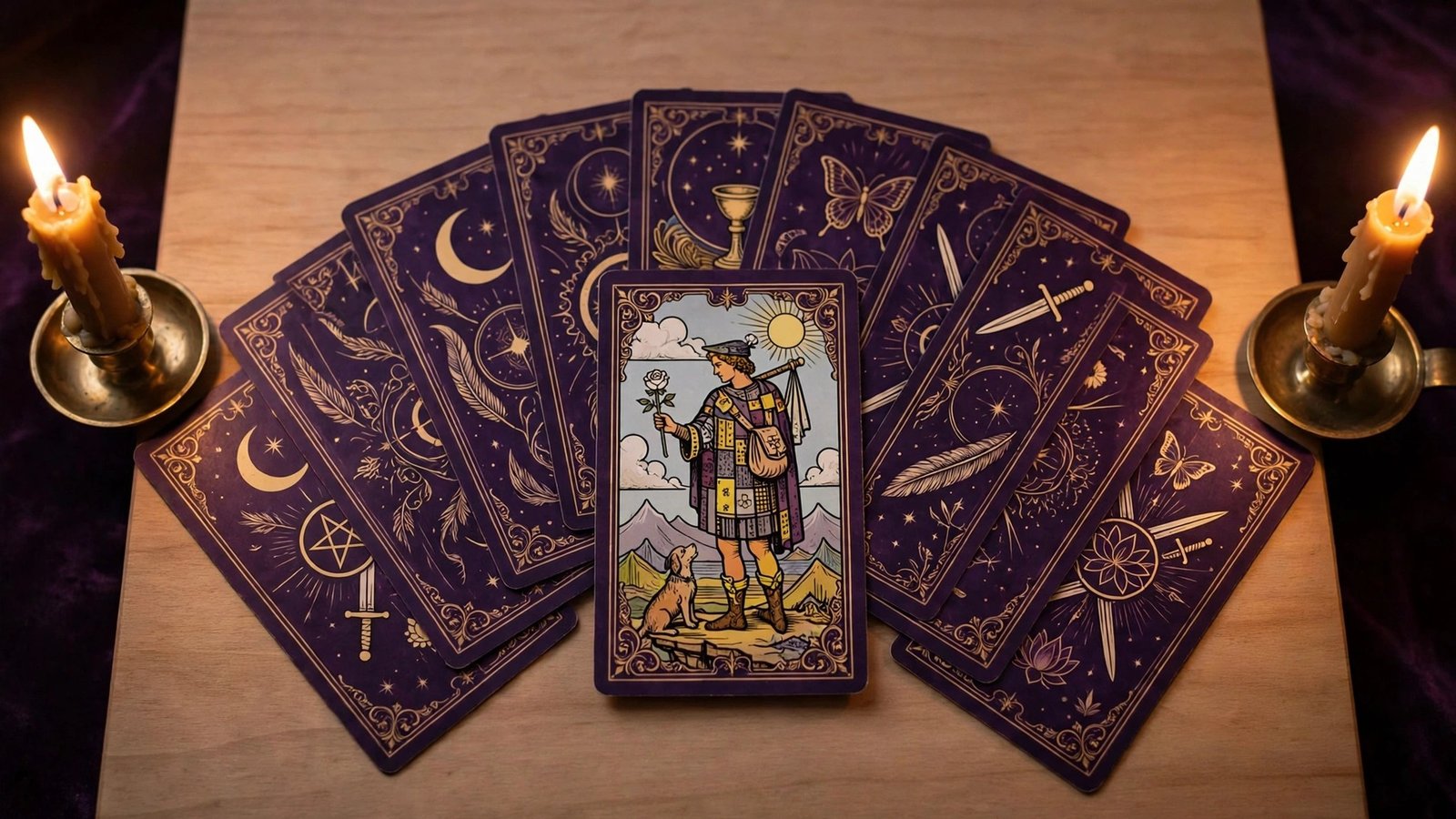
If you have never had a tarot reading, it is easy to picture something theatrical: a dim room, candles guttering, a stranger in a velvet shawl delivering ominous pronouncements about your future. The reality is much more ordinary, in the best way. A reader shuffles 78 cards, lays out a few in a pattern called a spread, and talks through what the cards suggest about your question. That is the whole ceremony. What makes it feel extraordinary is not the props it is the strange experience of seeing your own situation reflected back at you with a clarity you could not reach alone. Practice with a free tarot card reading no experience needed.
The cards aren't magic in the way movies suggest. Think of them as 78 mirrors. Each one captures a human situation: new beginnings, hard endings, temptation, patience, heartbreak, celebration. A good reader isn't predicting so much as reflecting your situation back to you with unusual clarity, plus the intuitive impressions that come with years of practice. You don't need to believe anything in advance. You do need a real question, though. "Tell me about my life" gives you a scattered reading. "I have two job offers and I'm torn; what should I be weighing?" gives you something useful. The quality of your question decides the quality of your answer.
This guide is everything I wish someone had told me before my first reading: what tarot is, how the cards work, what the common spreads mean, how to prepare, what to ask, how to pick a reader, and how to spot the scams. By the end, you'll walk into your first reading calm, curious, and ready to get something real out of it.
What Tarot Actually Is (and What It Isn't)
Tarot is a deck of 78 illustrated cards that readers use as a conversation tool. The images are symbolic a figure standing at a crossroads, a tower struck by lightning, a star pouring water into a pool and each one has centuries of accumulated meaning attached to it. When a reader lays cards out in response to your question, they're combining those traditional meanings with your story to help you see angles you were missing.
Here is what tarot isn't: it's not a crystal ball. It doesn't show a fixed future. It can't tell you the name of the person you'll marry, the exact day you'll get a promotion, or next week's lottery numbers. Anyone who claims that level of precision is selling theater, not tarot. What tarot does well is subtler and, honestly, more useful. It surfaces patterns. It names the thing you've been avoiding. It shows you how a situation looks from an angle you had not considered. Think of it less as a weather forecast and more as a really perceptive friend who asks exactly the right question.
A useful way to think about it: the cards provide the vocabulary, you provide the story, and the reader provides the translation. None of the three works without the other two. That's why two people can draw the same card and get completely different readings. The card is a mirror, and it reflects whoever is standing in front of it.
The 78 Cards, Explained Simply
Seventy-eight sounds like a lot until you realize the deck is organized into two clean groups. Once you understand the structure, the whole thing stops feeling mysterious and starts feeling like a filing system for human experience.
The Major Arcana: 22 big life themes
The Major Arcana are the heavy hitters the cards people recognize even if they have never touched a deck. The Fool, The Magician, The Lovers, Death, The Tower, The Star, The World. These 22 cards represent the major archetypes and turning points of a human life: beginnings, choices, upheaval, healing, completion.
When a Major Arcana card shows up in your reading, pay attention. Readers generally treat these as the load-bearing cards of a spread they point to the bigger forces at work rather than day-to-day details. If your three-card pull about a job decision contains The Tower, that's not about your Tuesday meeting. That's about a structural shake-up. The Majors speak in themes; the rest of the deck speaks in specifics.
One note for beginners: Death almost never means literal death. It means endings and transformation the end of a chapter, a relationship, a version of yourself. The Tower doesn't mean disaster is coming to punish you; it means something built on a shaky foundation is coming down, which is usually information you needed. The scary-looking cards are rarely the bad news. They're the honest news.
The Minor Arcana: 56 everyday situations
The remaining 56 cards are divided into four suits of 14, and they work a lot like a regular deck of playing cards in fact, playing cards descended from these. Each suit covers a domain of daily life:
Cups deal with emotions, relationships, and intuition. Lots of Cups in a reading means feelings are running the show for better or worse. Swords deal with thoughts, communication, and conflict. Swords point to mental activity: decisions, arguments, anxiety, clarity. Wands deal with energy, ambition, and action. Wands are about what you are building and how much fire you have for it. Pentacles deal with the material world: work, money, health, the practical stuff. Pentacles ground the reading in reality.
Each suit runs from Ace (new beginnings in that domain) through Ten (completion), plus four court cards Page, Knight, Queen, King which often represent people in your life or facets of your own personality. You don't need to memorize any of this before your first reading. But knowing the structure helps you follow along when the reader says something like "a lot of Swords here," which is reader shorthand for "your head is very loud right now."
How a Reading Actually Works, Step by Step
Whether it happens in person, over the phone, or through a chat window, the mechanics are the same. First, you bring your question or situation. A good reader will ask you to say a little about what is going on not your whole life story, just enough context for the cards to land. "I'm deciding between two jobs" is plenty.
Then the reader shuffles and draws cards into a spread a specific layout where each position has a meaning, like "the heart of the matter" or "what you're not seeing." They turn the cards over and start talking. This is the part beginners misunderstand. The reader isn't decoding a secret message from the universe. They're looking at symbolic images, connecting them to what you told them, and telling you what they see including impressions and hunches that come from experience. The best moments in a reading often sound like this: "This card is about avoiding a hard conversation. Does that land anywhere for you?" And suddenly you're talking about the thing you came in refusing to discuss.
A reading is a dialogue, not a monologue. You can ask follow-up questions. You can say "that doesn't resonate" a good reader will recalibrate rather than insist. You can take notes. The whole thing usually lasts anywhere from ten minutes for a single question to an hour for a deep dive into your life. There's no incense requirement.
The Spreads You'll Encounter
A spread is just the layout the reader uses which cards go where, and what each position means. You'll run into three constantly. Knowing them in advance means you'll not spend your first reading confused about why the reader keeps pointing at the middle card.
The one-card pull: your daily compass
One card, one question or theme. This is the simplest spread in tarot and the best place for a beginner to start, either in a reading or on your own. "What should I focus on today?" Pull one card. The answer is rarely a command; it's a lens. Pull the Four of Swords and the suggestion is rest. Pull the Eight of Pentacles and the suggestion is craftsmanship put your head down and do the work well. One-card pulls are low-stakes, quick, and surprisingly grounding as a morning habit.
The three-card spread: past, present, future
Three cards in a row, most commonly read as past, present, and future or situation, obstacle, and advice, depending on the reader. This is the workhorse of tarot. It is enough cards to tell a story with a beginning, middle, and direction, but few enough that the message stays clear. Most of your early readings will use some version of this. When a reader says "let's do a three-card," they are saying "let's keep this focused." If you want to build the habit yourself, our daily tarot ritual guide walks through a simple morning practice.
The Celtic Cross: the deep dive
Ten cards in a specific cross-and-staff layout, each position with a role: the heart of the matter, the challenge, the distant past, the recent past, your aspirations, the near future, how you see yourself, how others see you, hopes and fears, and the likely outcome. It sounds elaborate, and it's this is the spread for "I need to understand my whole situation," not "should I text him back." Don't be intimidated if a reader lays out ten cards on your first visit. You don't need to track every position. That's the reader's job. Your job is to listen for the thread that connects them and notice which cards make your stomach tighten. That is usually where the real reading lives.
How to Prepare for Your First Reading
Preparation is simple, but it matters more than most beginners expect. Start with your question. Write it down before the reading the actual version, not the polite one. "Should I stay in this relationship?" is better than "tell me about my love life." Specific questions get specific answers. Vague questions get horoscopes.
Second, bring brief context. The reader doesn't need your autobiography, but they do need the basics: the situation, the people involved, where things stand. Readers aren't mind readers (despite the job title). Honest context lets the cards go deeper, so bring as much of it as you can. Withholding information to "test" the reader just produces a shallow reading, you are paying for insight, not a magic trick.
Third, arrive open but grounded. Arrive open, meaning willing to hear something unexpected. Grounded means remembering that you're the authority on your own life. If something the reader says feels wrong, say so. A reading is a collaboration, and your pushback is data, not rudeness.
Practical notes: if it is an online chat reading, find a quiet spot where you will not be interrupted. Have water nearby. Give yourself ten unscheduled minutes afterward readings have a way of continuing to unfold in your head once they end, and rushing straight into errands wastes that.
What Good Questions Look Like
This deserves its own section because it is the single highest-leverage skill a tarot client can learn. The cards respond to the shape of your question. Here is the difference:
Weak: "Will I be happy?" Strong: "What is blocking my happiness right now, and what would shift it?" The first asks for a fortune. The second asks for a map.
Weak: "Does he love me?" Strong: "What is the real dynamic between us, and what do I need to see clearly?" The first outsources your judgment to the cards. The second uses the cards to sharpen it.
Weak: "When will I get the job?" Strong: "What should I be weighing between these two offers?" The first wants a date the cards cannot reliably give. The second wants wisdom they can.
The pattern: good questions ask about understanding and agency what is happening, what you are missing, what your options are, what your next wisest step looks like. They keep you in the driver's seat. Bad questions ask for predictions about things outside your control, which turns you into an audience member in your own life. You can always ask the burning yes-or-no question too just ask the useful one first. (Our yes-or-no tarot guide covers how readers actually handle those.)
What to Expect During the Reading
Expect a conversation, not a performance. The reader will turn over cards, talk through what they see, and check in with you "does this resonate?" is the most common sentence in tarot. Expect some of it to feel startlingly accurate and some of it to miss. Both are normal. The hits feel like being seen; the misses are just the reader calibrating, and an honest reader will adjust rather than bulldoze past your "no."
Expect to do some of the work. The reader brings the cards and the interpretive skill; you bring the life the cards are about. When the reader says "this card suggests a conflict you are avoiding," your job is to search your life for the conflict, not to wait for them to name it. Readings go deepest when the client is an active participant, not a passive recipient.
Expect emotions. Good readings touch tender places. That is the point. You might feel exposed, relieved, tearful, or annoyed. All of it is information. The reading that unsettles you a little is often the one you needed most. Give it 24 hours before deciding what you think of it. First reactions shout; second thoughts are usually wiser.
Do not expect: exact dates, lottery numbers, medical diagnoses, or legal advice. A reader who offers any of those is operating outside what tarot can responsibly do. And do not expect the reader to make your decisions for you. "Should I quit?" will get you perspective, not a verdict. The verdict is yours. It was always yours.
How to Choose Your Reader
Not all readers are equal, and the difference matters more than the deck they use or the spread they prefer. Start with reviews, but read them like a detective. Look for specifics "she named the exact dynamic with my mother-in-law" over generic praise. A few detailed reviews tell you more than a wall of emoji.
Look for a specialty that matches your situation. A reader focused on "relationship patterns and self-worth" will give you a different (usually more useful) reading than one focused on "predicting your future in vivid detail." Match the reader's lens to what you actually need.
Start small. Do not book an hour with a stranger. Ten or fifteen minutes tells you everything about a reader's style: do they listen, do they ask questions, do they tell you hard truths kindly, do they rush? A short trial reading is the cheapest quality filter in the industry. Many platforms let you try a few minutes free. First 3 minutes FREE — every time, for every reading, with all advisors
And if you are usually the one friends turn to for a reading, that trial cuts both ways experienced readers can apply to become a psychic advisor and be the reader someone else starts small with.
Green flags
They ask about your situation before touching the cards. A good reader explains what the cards mean instead of just declaring outcomes. Good readers own their uncertainty: this could mean X or Y. That is honesty, not weakness. They redirect you toward your own judgment. They end with something actionable. And they do not create dependency: a good reader wants you to need them less over time, not more.
Red flags: readers to avoid
Walk away if a reader tells you that you are cursed, hexed, or surrounded by dark energy that only they can remove for an extra fee. This is the oldest scam in the psychic world. The curse always shows up mid-reading, the cleansing always costs more, and the curse is never real. No honest reader diagnoses a spiritual affliction mid-reading as a way to sell extra work. Ever.
Also walk away from guaranteed outcomes ("I guarantee he will return in 21 days"), manufactured urgency ("the spirits show something urgent but we are out of time extend the session"), and readers who only tell you what you want to hear. If every card is sunshine, you are not getting a reading. You are getting a very expensive pep talk. Our full breakdown of the curse scam covers exactly how that fraud works and how to protect yourself.
Tarot Myths, Debunked
"You have to be gifted your first deck." No. Buy your own deck. This superstition has kept more beginners waiting than any other. Pick one whose artwork you actually like looking at. You will be staring at these images a lot.
"You must be psychic to read tarot." No. Plenty of excellent readers describe themselves as intuitive or interpretive rather than psychic. Reading tarot is a skill built on symbolism, pattern recognition, and listening all learnable. The "gift" narrative mostly serves people selling courses.
"The cards predict a fixed future." No. Tarot shows trajectories based on current patterns, not certainties carved in stone. If a reading shows a difficult outcome, that is information you can act on which is the entire point. A useful reading changes the future it describes. That is a feature, not a bug.
"Reversed cards are always bad." No. Many readers do not read reversals at all. Those who do treat an upside-down card as a nudge blocked energy, an internal version of the theme, something needing attention not a doom flag. Do not panic at an inverted Tower. Ask what it is pointing at.
"Tarot is against my religion" or "tarot is evil." Tarot is a tool, and tools take the shape of their user's hands. Plenty of readers integrate tarot with their faith, their therapy, or their journaling practice. If it conflicts with your beliefs, that is a valid personal boundary but the cards themselves are ink on paper. The meaning comes from the conversation, not the cardboard.
Getting the Most From Your Reading: The Short Version
Before: write down your real question, gather brief honest context, decide what a useful outcome looks like, and set a budget and time limit before you start rather than during.
During: be honest, especially about the parts that make you look bad the reader can only work with what you give them. Ask "can you say more about that?" whenever something does not land. Take notes or screenshot the chat; you will forget the specifics within days. Notice defensiveness in yourself it usually means they hit something true.
After: sit with the reading for at least 24 hours before acting on anything. Look for an insight you can act on, not just a prediction. Resist booking a second reading straight away to confirm the first; if confirmation is what you need, the issue is trust, not the cards. And remember the thing the cards keep trying to tell everyone: the most important voice in the reading is still your own.
You do not need to believe in anything supernatural to benefit from tarot. You only need a real question, an honest reader, and the willingness to look at what the mirrors show you. That is the whole secret, and it was never very secret at all.
Our guide to Cups Tarot Card Meaning covers the meaning and the practical side, side by side.
Our guide to Wands Tarot Card Meaning brings the topic together in one clear, complete guide.
Our guide to Swords Tarot Card Meaning explains it in plain language, with examples you can follow.
Our guide to Pentacles Tarot Card Meaning covers the key ideas and the questions readers ask most.
Our guide to What Is Cartomancy? Card Reading History and Methods sets out the meaning, the signs to look for, and what to do next.
Our guide to How to Ask Tarot Questions explains it in plain language, with examples you can follow.
Our guide to Tarot Birth Card Meaning covers the key ideas and the questions readers ask most.
Frequently Asked Questions
I have never had a tarot reading. What will actually happen?
It is simpler than most people expect. You share a question or an area of your life you want to look at. The reader shuffles and lays out a small number of cards in a pattern called a spread, where each position has a meaning for example, what is influencing the situation, or what you are not seeing. Then they talk you through the cards: the traditional symbolism, how the images connect to your circumstances, and what it might be pointing to. You can respond, ask questions, and steer the conversation. It feels less like a ceremony and more like a focused, insightful chat.
Does the Death card mean someone is going to die?
Almost never, in practice. Despite its film reputation, Death in tarot is about endings and transitions a chapter closing so something else can begin: the end of a job, a phase, a way of living. The Tower, the other card beginners fear, is about a sudden shake-up that clears away something unstable. Readers generally treat the Major Arcana as markers of life's larger themes beginnings, choices, upheaval, healing rather than as literal predictions about events.
How many cards are in a tarot deck, and do I need to learn them all?
A standard deck has 78 cards, split into two groups. The 22 Major Arcana cover the big archetypes and turning points of a life. The 56 Minor Arcana handle everyday territory feelings, work, conflict, money organized into four suits. You do not need to learn any of them to have a reading; that is the reader's job. And if you later want to read for yourself, start with single-card pulls and your own first impressions of the images. Nobody memorizes 78 meanings before their first useful reading.
What questions work best in a tarot reading?
Open questions that keep you in the picture. "What do I need to understand about this situation?" or "I am torn between two offers what should I be weighing?" will give you far more than "Tell me everything about my future," which tends to scatter the reading. Yes-or-no questions can work for something small, but tarot's real strength is the layer underneath: why things are unfolding this way, and what your options actually are.
Can tarot tell me exactly what will happen?
That is not really what it does, whatever the movies suggest. Tarot reflects the situation as it stands, the patterns in play, the angle you have not considered, where the current path appears to lead. Because your choices feed into that path, the future it sketches is a direction, not a sentence. Think of a reading as entertainment and perspective: a perceptive friend asking exactly the right question at the right moment, with pictures.
Last updated: November 12, 2026