
Spiritual Growth Tarot Spread: A Quiet Layout
What a Spiritual Growth Tarot Spread Is
A spiritual growth tarot spread is a five card layout that maps where you are in your inner life and where you are being called next. It is not a fortune telling tool, and it does not predict a single event. It is a way of listening: you lay out five cards in a fixed pattern, read each one in its position, and then read the pattern as a whole. The spread suits a quiet evening, a new season, or a moment when you sense that something inside you has changed and you want words for it. It works best when you come to it with one honest question rather than a long list of worries.
Beginners can follow this layout, and seasoned readers still find depth in it. A set of five cards shows a genuine pattern yet stays small enough to hold in mind at once. The cards come from a full tarot deck of 78, split into 22 Major Arcana and 56 Minor Arcana. The deck most learners start with is the one Waite planned and Smith illustrated. Rider of London published it in December 1909, and its pictures fit this spread because they speak plainly and need no guidebook beside them. Every deck can serve here, though a newcomer does best with the deck already familiar.
The Five Positions, and What Each One Asks
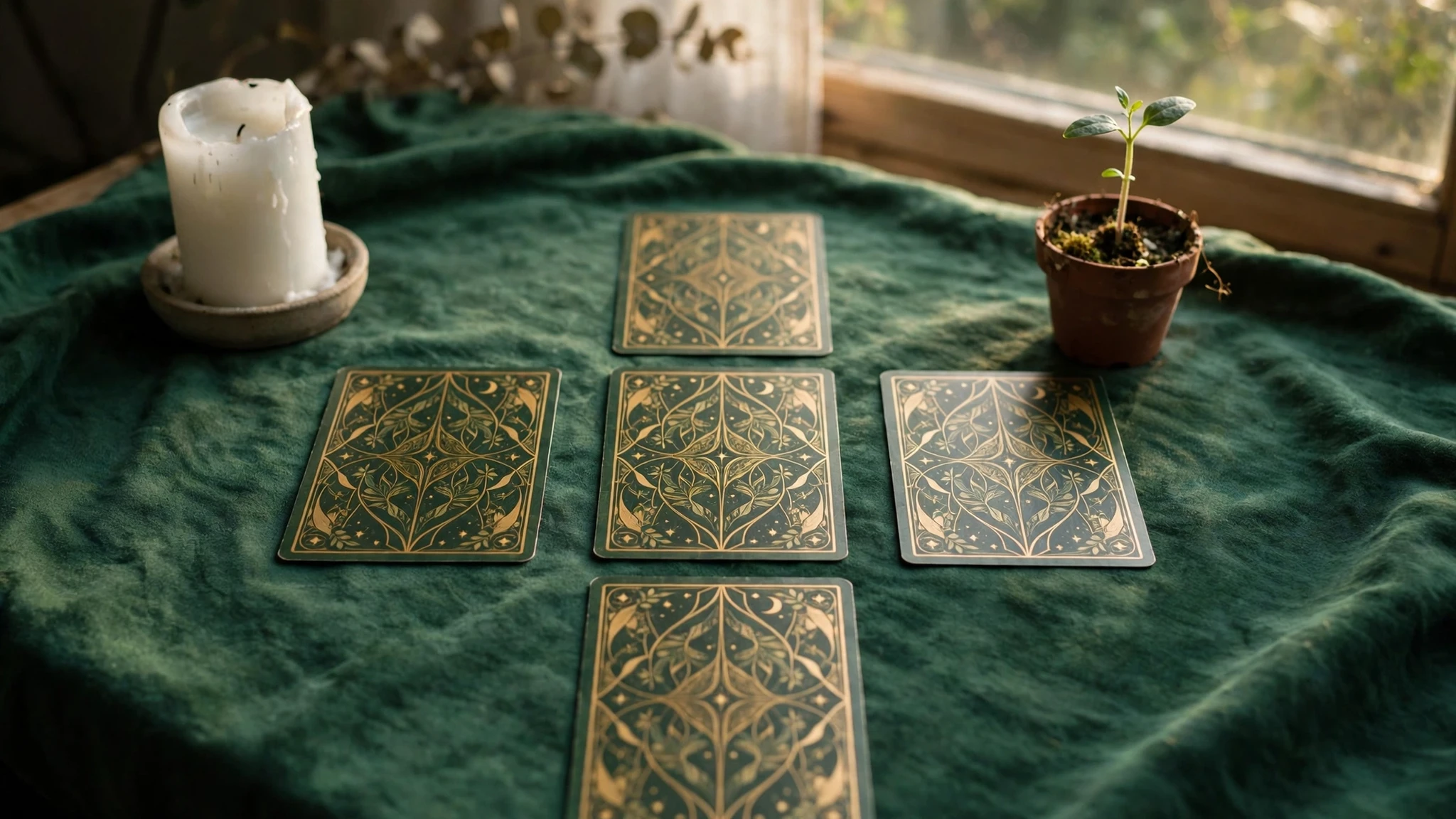
Lay the five cards in a row, left to right, or curve them into a gentle arc if that suits you better. The positions are the heart of the spread, so learn them before you shuffle. First comes Where I Am Now, an honest naming of your present inner state, without flattery. Second is What Is Calling Me, the pull you have been feeling, an interest, a practice, or a question that keeps returning. Third is What Blocks Me, the habit, fear, or old story standing between you and the calling. Fourth is What Supports Me, the strength, person, practice, or resource that can help. Fifth is My Next Step, one concrete action, small enough to do this week.
Read them in order first, then as a story. The first two positions often belong together: the present state and the direction it points toward. The third and fourth belong together too: the block and the support that answers it. The fifth is the bridge between those two pairs, the single step that carries you from where you are toward where you are called. If that step feels too large, break it down. A genuine next step fits inside one week and one afternoon. Anything bigger is a wish, not a step.
Preparing, and Choosing Your Question
A rushed reading gives a rushed answer, so give this spread twenty quiet minutes. Tidy a table, set your phone aside in another room, and shuffle slowly while you hold one question in mind. Open, honest questions suit it best: What is my inner life asking of me now? What practice would help me grow this season? What am I ready to release, and what am I ready to receive? Yes or no questions do not fit, because this layout is built for direction rather than for a verdict. For help shaping a question, see the guide on asking tarot questions well, and for the practical side of handling the deck, the guide on shuffling tarot cards.
When you feel ready, cut the deck a single time and set five cards face down in a line. Lift each one in turn from left to right, and write the card beside its place before you give it any meaning. Writing before judging keeps the reading honest, since it stops you bending a card to match what you hoped to see. If a card lands upside down, mark that too, and take it as a softer or held back form of the upright sense, rather than the reverse of it. Anyone new to tarot should read the beginners guide to tarot and the guide on reading tarot cards before trying this spread, because both explain card meanings and the roles of the positions.
A Worked Reading: Five Cards, One Quiet Story
An example teaches this layout faster than a description. The reading below belongs to no named person, and the cards were drawn to show the layout rather than to answer a real question. First, Where I Am Now, is the Four of Cups: a figure sitting under a tree, arms crossed, looking at three cups on the ground while a fourth is offered from a cloud. It describes a person who is bored or restless with what they have, and who is not noticing the new offer in front of them. Second, What Is Calling Me, is the Star: a figure pouring water under a night sky, a sign of hope, healing, and a quiet sense of direction after a hard time. The calling here is hope itself, a return to trust after a period of flatness.
Third, What Blocks Me, is the Five of Pentacles: two figures walking past a lit church window in the snow, a sign of feeling shut out, short of resources, or convinced that help is not for you. The block is the belief that you are outside the warmth, and that asking for help would be a burden. Fourth, What Supports Me, is the Queen of Cups: a calm figure holding a cup with both hands, a sign of emotional steadiness, compassion, and a friend or a practice that listens well. The support is a listening presence, either a person or a practice such as journaling or a regular walk. Fifth, My Next Step, is the Page of Wands: a young figure holding a wand and looking toward a horizon, a sign of a small brave beginning. The next step is to try one new thing, in a small way, without waiting to feel ready.
Taken together, the spread says: you are restless and missing what is offered, you are being called back to hope, the block is a belief that help is not for you, the support is a listening presence, and the next step is one small brave beginning. That is a whole reading, and it fits on one page of a notebook. More layouts like this one sit in the spreads hub, and comparing them will help you choose the right spread for the question you actually have.
How Often to Use It, and How to Keep Notes
The right pace for this spread is monthly, or when a season turns, and not daily. Inner change moves slowly, and a layout consulted too often only repeats itself, not because the cards have stalled but because the same question returns before life has shifted. A month between readings is enough for a pattern to show, and the pattern itself is where the learning sits. If you also want something daily, keep it apart and plain: a single card each morning, noted in one sentence, as shown in the daily tarot ritual guide.
Notes turn a single reading into a record you can learn from. After each reading, write the date, the question, the five cards, and one sentence for each position, then add a final line: the step you will take this week, and when you will take it. When you return to the spread a month later, read your old notes first. A card that puzzled you at the time often makes sense in hindsight, and the next step you took, however small, changed more than you expected. That hindsight is the real growth, and the notebook is what makes it visible.
Keep a separate page for the blocks. Over six months, the same block may appear in different forms, such as fear, busyness, or self doubt, and seeing the pattern across readings is more valuable than any single reading. The block is not an enemy. It is a teacher, and it returns until its lesson is learned. The spread gives you a way to meet it each month with fresh eyes.
Mistakes That Weaken This Spread
The most common error is to ask this layout to predict the future. It is not built for that. It is built for direction, and a reader who asks it for a date or a verdict will be disappointed. Ask it what is calling you, what blocks you, and what step to take, and it will answer clearly. Ask it whether a specific event will arrive on a specific day, and it will answer in riddles, because that is not its language.
A second error is to read only the cards you like and to skip the hard ones. The block card is often the most useful card in the spread, and a reader who softens it into something comfortable has wasted the reading. Sit with the block for a full minute before you write about it, and ask what it would say if it were trying to help you rather than to hurt you. A block card read with that question usually turns out to be a kindness in disguise.
A third error is to let the next step swell beyond a single afternoon. When a step calls for a month, a budget, or help from someone else, it has stopped being a step and turned into a project. Split it until one afternoon can hold it. A page of writing, a talk, a walk, a form sent. A modest step finished beats a grand step only planned, and this spread exists to yield modest steps that truly get done.
An Illustrative Example: Maya and the Monthly Spread
This example is illustrative, not a real person's story.
Maya, a 29 year old graphic designer, used this spread on the first Sunday of each month for half a year. In her first reading the calling card was the Hermit, and she took it as a nudge to spend one evening a week alone with a book instead of scrolling. In her third reading the block card was the Eight of Swords, and she recognized it as the belief that she had to answer every message at once. She started leaving her phone in another room after dinner, and within a month she felt calmer at work. By the sixth reading the next step card was the Six of Wands, and she took it as a sign to share a personal project she had been hiding. She posted it online, and the response was warmer than she had feared. None of this happened because of a single reading. It happened because she returned to the same five positions each month and let the pattern teach her, one small step at a time.
Maya later said the spread worked because it was small. Five cards, five sentences, one step. That is all the method there is.
If these five cards speak to you, try the spread once this month, write it down, and talk it through with a reader who can look at the full layout with you. First 3 minutes FREE — every time, for every reading, with all advisors.
Pull a One-Card Tarot reading and reflect on the one card that would sit in your calling position right now.
Frequently Asked Questions
What is a spiritual growth tarot spread?
It is a five card layout that maps your inner life: where you are now, what is calling you, what blocks you, what supports you, and your next step. It is built for direction and reflection rather than for predicting a specific event, and it works best once a month with one honest question.
How many cards are in the spiritual growth tarot spread?
Five cards make up this spread, arranged in a single line from first to last. Position one is Where I Am Now, position two is What Is Calling Me, position three is What Blocks Me, position four is What Supports Me, and position five is My Next Step. With only five cards the reading stays clear and the next step stays practical.
How do I use this spread as a beginner?
Find twenty quiet minutes, hold one open question in mind while you shuffle, cut the deck once, and lay out five cards face down. Lift them one by one, jot down the card and its place before you interpret anything, then follow the places in turn and afterwards join them into one story. Begin with the deck you know best.
How often should I do a spiritual growth tarot spread?
Once a month, or at the turn of a season, is enough. Spiritual growth is slow, and a spread used too often will repeat itself because nothing has had time to change. Keep a journal of each reading, and read your old notes before each new reading so you can see the pattern over time.
What makes a good question for this spread?
A good question is open and honest, such as what is my inner life asking of me now, or what practice would help me grow this season. Avoid yes or no questions, because this spread is built for direction rather than for a verdict, and avoid asking for a date or a specific event.
Last updated: November 12, 2026
