
Peridot Meaning: History, Properties, and Uses
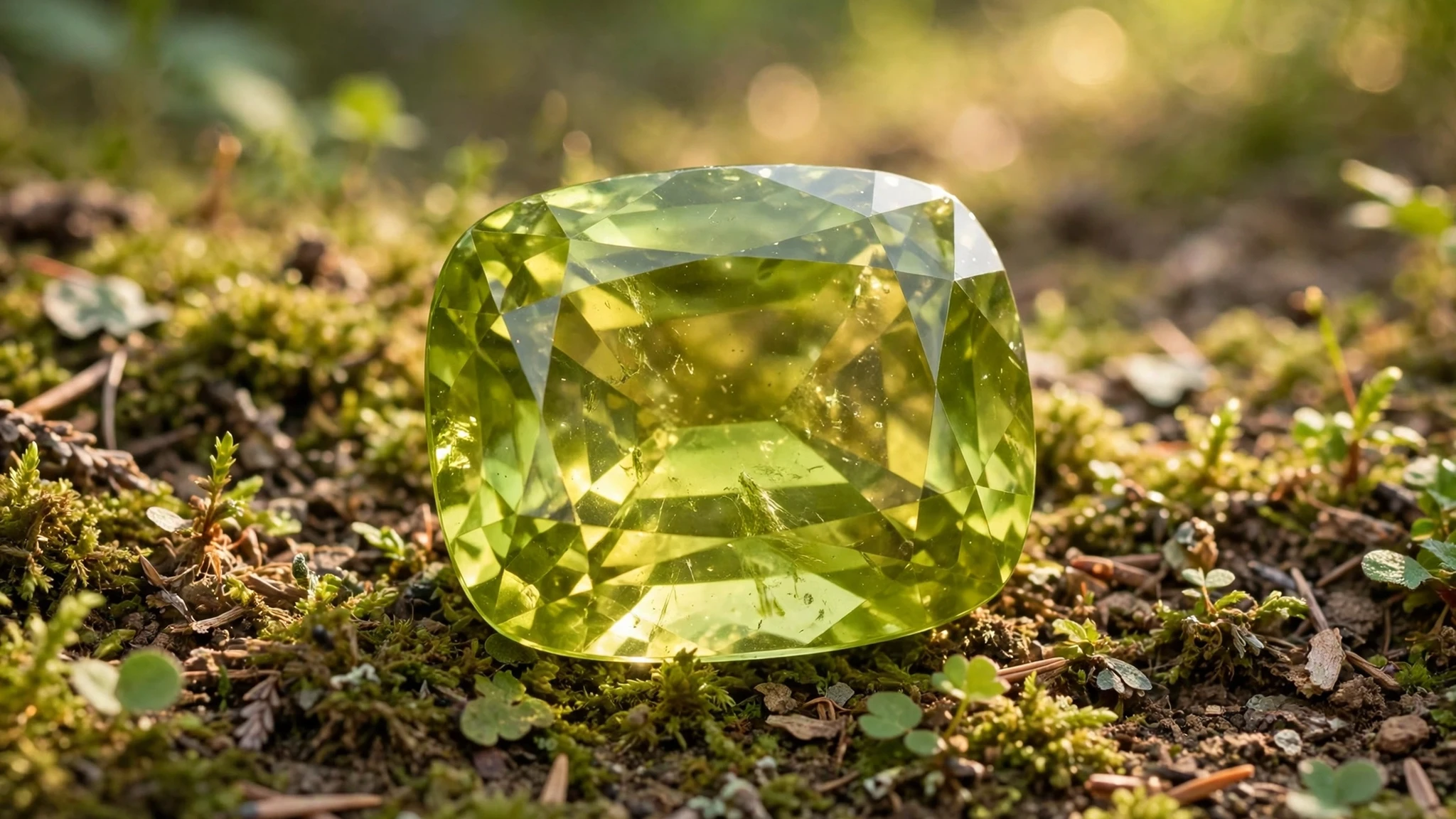
Peridot Meaning: The Green Stone of Late Summer
Peridot is the green stone of late summer, and its meaning starts with its color. It is a yellowish green to olive green gem, bright in sunlight and soft in shade, and it is the only well known gemstone that comes in just one color family: green. There is no blue peridot, no pink peridot, no colorless peridot. Every peridot is green, from pale lime to deep olive, and that single color is the heart of its identity. Peridot is the primary birthstone for August, the gem of the 16th wedding anniversary, and one of the stones covered in the spiritual awakening signs hub, and in crystal tradition it is linked with renewal, clarity, and letting go of what no longer serves you. This page covers what peridot actually is, where it comes from, how it has been used through history, and how to wear and care for it today.
Peridot is the gem variety of the mineral olivine, a magnesium iron silicate with the formula (Mg,Fe)2SiO4. Olivine is a common mineral in the Earth's crust, but gem quality peridot, transparent and clean enough to cut, is far rarer. The green comes from iron in the crystal structure: more iron means a deeper, more olive tone, while less iron means a lighter, more yellow green. Peridot rates 6.5 to 7 on the Mohs hardness scale, which puts it at or just below quartz at 7. It is hard enough for earrings and pendants worn daily, but soft enough to scratch and chip if it is knocked against a hard surface, so rings need a protective setting.
From the Earth's Mantle to Your Hand
Peridot has one of the most dramatic origins of any gemstone. Olivine is a major mineral of the Earth's upper mantle, the hot rock layer below the crust, and peridot forms deep underground under extreme heat and pressure. It reaches the surface in volcanic rock, carried up in basalt and peridotite, and it is also found in pallasite meteorites, stony iron meteorites that fell to Earth carrying olivine crystals inside a nickel iron framework. The Gemological Institute of America notes that peridot has reached Earth inside pallasite meteorites, which makes it one of the few gems with an extraterrestrial source as well as a terrestrial one. A stone that began in the mantle or in space and ended in a ring is a good reason to handle it with respect.
The oldest recorded source of peridot is the Egyptian island of Zabargad in the Red Sea, mined as early as 340 to 279 BCE according to the historical record. Zabargad was once called Topazios, and the confusion between the two stones lasted for centuries: the island's name became attached to topaz, while the stone it actually produced was peridot. Ancient Egyptians called peridot the gem of the sun, and they mined it on Zabargad for centuries, working in harsh conditions on a small, desolate island. The island was later abandoned, then revived around 1900, and it remains the classic historic source even though it is no longer commercially important.
Today's peridot comes from several places. Arizona is the main source in the United States, mined on the San Carlos Apache Reservation, where Apache families have worked the deposits for decades. Pakistan produces fine large crystals, and China, Myanmar, Vietnam, and Tanzania also produce gem material. The largest cut peridot on record, a 319 carat stone from Zabargad, is held at the Smithsonian Institution in Washington, D.C. That single stone, heavier than a small apple, shows how large peridot crystals can grow when conditions are right.
Peridot in History: Sun Stone, Royal Confusion, and Crusades
Peridot's history is a story of mistaken identity and steady admiration. In ancient Egypt, peridot was carved into beads and talismans and set into jewelry, and it was associated with the sun because of its bright, warm green. A story often repeated is that Cleopatra's famous emerald collection consisted largely of peridot from Zabargad. That story is plausible, given the confusion between the two green stones at the time, but it cannot be proven stone by stone, and honest accounts describe it as a story rather than a fact. What is certain is that Egyptians valued peridot highly, and that their mines on Zabargad supplied the ancient world for centuries.
Peridot reached Europe in larger quantities during the Crusades, when crusaders returning from the eastern Mediterranean brought back stones from the Red Sea. In medieval Europe, peridot was set into church treasures and royal jewelry, and it was believed to protect against evil spirits and night terrors. In Hawaii, peridot has a different story: small green crystals of olivine are found in the black sand beaches of the islands, and Hawaiian tradition links the stone to Pele, the goddess of volcanoes. The green grains in the sand are peridot weathered out of basalt, a reminder that the islands themselves are built from the same volcanic rock that carries the stone.
The modern birthstone list gave peridot its present role. The list was standardized in the United States in 1912, and peridot became the primary modern stone for August, joined in 2016 by spinel and by sardonyx, the original August stone. August is now one of three months with three birthstones, and peridot remains the one most people mean when they say August birthstone. It is also the gem of the 16th wedding anniversary in modern lists, a quieter role that suits a stone whose color is steady rather than showy.
What Peridot Means in Crystal Tradition
In crystal tradition, peridot is linked with renewal, release, and clear sight. Its bright green is read as the color of new growth, and its traditional uses center on letting go: letting go of old anger, old guilt, and old patterns that no longer help. Practitioners describe it as a stone for fresh starts, for the end of summer and the beginning of a new season, and for people who are ready to move forward after a difficult period. All of that comes from crystal tradition, not from science, and this page treats it as handed down lore rather than tested fact. No stone has been shown to change health or fortune, and anyone who tells you otherwise is selling something.
Peridot is also linked with the heart in traditional systems, because green is the color assigned to the heart in many crystal traditions, and with abundance, because its bright color suggests growth and harvest. It is a popular stone for gifts at turning points: a graduation, a new job, a move, a recovery. The gift works because the meaning is clear and the color is cheerful, not because the stone does anything on its own. A peridot pendant given at a fresh start says, in the language of stones, that you are wishing someone a clean beginning. That message is worth giving, and it does not need a supernatural claim to be worth giving.
If you use peridot in meditation or intention work, keep the practice simple and keep it about letting go. To keep the stone itself in good shape, see how to charge crystals for the monthly routine, and the best crystals for Scorpio season guide for stones that pair well with it in autumn work. Hold the stone, name one thing you are ready to release, and name one thing you are ready to begin. Put both on paper in your own handwriting, because a sentence you have written down is harder to dodge than a thought you only half formed. Vague intentions produce vague results, so name a release as plainly as "I am letting go of checking my old messages every night," and name a beginning as plainly as "I will walk for twenty minutes every morning." A small green stone can sit beside that paper and remind you of the pair each day. It is a reminder, not a mechanism, and the paper does the real work.
How to Choose a Good Peridot
Choosing peridot is mostly about color and clarity. The most valued color is a rich, slightly yellowish green with good saturation, neither too pale nor too dark. Very pale stones look washed out. Very dark stones look muddy. The best stones have a lively, almost glowing green that holds up in ordinary indoor light, not just in sunlight. Look at the stone in daylight and in a shop's indoor light before you buy. A stone that looks vivid in both is a good stone. A stone that only looks good under a spotlight is not.
Clarity matters because peridot is usually clean. Most peridot has few visible inclusions, and the finest stones are eye clean, with nothing visible to the naked eye. Small inclusions are normal and do not hurt the stone, but a stone with a visible dark spot or a crack should cost less, and a cracked stone should be avoided for a ring. Size also matters: peridot is one of the more affordable green gems, and larger stones are available at reasonable prices, which is why it is a good choice for a bold pendant or a pair of earrings.
Ask whether the stone has been treated. Most peridot is untreated, which is one of its selling points: the color you see is the color the Earth made. Some stones may be coated or filled, and a reputable seller will tell you. Buy from a seller who answers questions clearly and who offers a return period. A good seller will show you the stone in daylight, will tell you the source if they know it, and will not claim healing powers or a guaranteed outcome. If a seller promises that a peridot will change your luck or your health, walk away. Its green is reason enough to own it, and it needs no extra claim attached.
Wearing and Caring for Peridot
Peridot is best worn where it is protected. Earrings and pendants are ideal, because they rarely knock against hard surfaces. A ring can work, but only in a setting that guards the edges, such as a bezel that wraps the stone all the way around, and the ring should come off for gardening, cleaning, sport, and any work with your hands. Peridot at 6.5 to 7 on the Mohs scale can be scratched by harder stones, including sapphire, topaz, and diamond, so store it separately from other jewelry, in a soft pouch or a lined box, rather than loose in a drawer where it can rub against harder gems.
Wash peridot in a bowl of lukewarm water with a drop of plain soap, using a soft cloth or a soft brush, then rinse it under clean running water and pat it dry with a soft cloth. Steam cleaners and ultrasonic cleaners can damage it, so keep them away, and keep household cleaners off it too. Spray perfume and hairspray first and let them settle, then put the jewelry on, so the stone never takes a direct hit of chemicals. Sunlight does not fade peridot the way it fades some other stones, so a peridot worn outdoors is safe, but strong heat should still be avoided. If a ring needs repair, tell the jeweler the stone is peridot, so they keep a torch away from it.
Peridot pairs well with other stones in jewelry and in display. It sits beautifully beside citrine, whose golden yellow picks up the yellow in peridot's green, and beside clear quartz, whose colorlessness lets the green stand out. It also pairs well with gold, which warms the green, and with silver, which cools it. In a collection, peridot is the bright, cheerful stone, the one that catches the eye first. Keep it where you can see it. A peridot shut away in a drawer helps nobody, whatever you believe about what stones can do.
An Illustrative Example: The August Birthday Gift
This example is illustrative, not a real person's story.
A woman named Elena, a 34 year old teacher, wanted a birthday gift for her sister, who was born in August and had just finished a difficult year at work. She chose a small peridot pendant, not because she believed the stone would change her sister's luck, but because the color was bright, the price was fair, and the meaning fit: a fresh start after a hard season. She had the pendant set in a simple bezel, wrote a short note about new beginnings, and gave it at a family dinner. Her sister wore it the next day, and wore it often afterward, because it reminded her of the dinner and the note, not because of anything the stone did. What her sister kept was not a lucky charm but a note about a new beginning, and a gift that fits the moment gets worn far longer than one sold on big claims.
Peridot is a straightforward stone: one color, one mineral, one clear history, and a meaning anyone can grasp at once. It comes from deep in the Earth and from space, it was mined on a small island in the Red Sea more than two thousand years ago, and it is still mined today in Arizona and Pakistan. It is affordable, it is beautiful, and it makes no secret of what it is. That plain honesty is the heart of it.
If you would like guidance on working with peridot or choosing a stone for a fresh start, remember that you can speak with a real advisor about it. First 3 minutes FREE — every time, for every reading, with all advisors.
For a simple next step, try a One-Card Tarot reading and reflect on what the card suggests about beginning again this week.
Frequently Asked Questions
What is peridot?
Peridot is the gem variety of the mineral olivine, a magnesium iron silicate, and it is the only well known gemstone that comes in just one color family: green, from pale lime to deep olive. It rates 6.5 to 7 on the Mohs hardness scale, and it is the primary birthstone for August and the gem of the 16th wedding anniversary.
Is peridot a birthstone?
Yes. Peridot is the primary modern birthstone for August, on the list standardized in the United States in 1912. In 2016, spinel and sardonyx were added for August, so the month now has three birthstones, but peridot remains the stone most people mean by August birthstone.
Where does peridot come from?
The oldest recorded source is the Egyptian island of Zabargad in the Red Sea, mined as early as 340 to 279 BCE. Today the main sources are Arizona in the United States, Pakistan, China, Myanmar, Vietnam, and Tanzania. Peridot also arrives in pallasite meteorites, which carry olivine crystals inside a nickel iron framework.
Can peridot go in water?
Yes, for cleaning. Wash peridot in warm soapy water with a soft cloth or soft brush, rinse well, and dry it with a soft towel. Do not use steam or ultrasonic cleaners, and keep it away from strong chemicals. Store it separately from harder stones so it does not scratch.
What does peridot mean in crystal tradition?
In crystal tradition, peridot is linked with renewal, release, and clear sight, and with letting go of old anger and old patterns. These are traditional associations, not scientific claims. The stone is often given at turning points, such as a graduation or a new job, as a message of a fresh start.
Last updated: November 12, 2026
