
Horseshoe Tarot Spread: 7 Card Layout and Guide
What the Horseshoe Tarot Spread Is For
The horseshoe tarot spread is a seven card layout for a situation that has history, more than one person involved, and pressures you cannot fully control. It is laid in a shallow arc, like an open horseshoe, and read from left to right. The shape is the point. A horseshoe has two arms and a curve at the bottom, and the spread follows that shape: the past on one arm, the present near the center, and the likely direction on the other arm, with hidden forces, obstacles, outside pressure, and advice along the curve. It gives a fuller picture than a three card pull without asking for the ten positions of a Celtic Cross, and it is the right tool when a question has layers that a short spread would flatten.
Use the horseshoe when a decision has a past. A job offer that follows a difficult year at work. A relationship that has been through a rough patch and is now at a turning point. A move that involves family, money, and timing all at once. A business idea that has already been tried once and is being tried again in a new form. In each case the spread does more than answer yes or no. It shows where the situation came from, what is hidden inside it, what stands in the way, what is pressing from outside, what to do, and where it is likely to head if nothing changes. That is a lot of information, and it needs a clear question to hold it together. Write the question down in one sentence before you shuffle, and keep it in front of you while you read.
The horseshoe is an intermediate spread. A reader who is comfortable with a one card pull and a three card pull will find it a natural next step. A complete beginner can still use it, but should take it slowly, reading one position at a time and writing down each card before moving to the next. The spread rewards patience. A rushed horseshoe, read all at once, can feel like seven separate cards rather than one story.
The Seven Positions, in Order
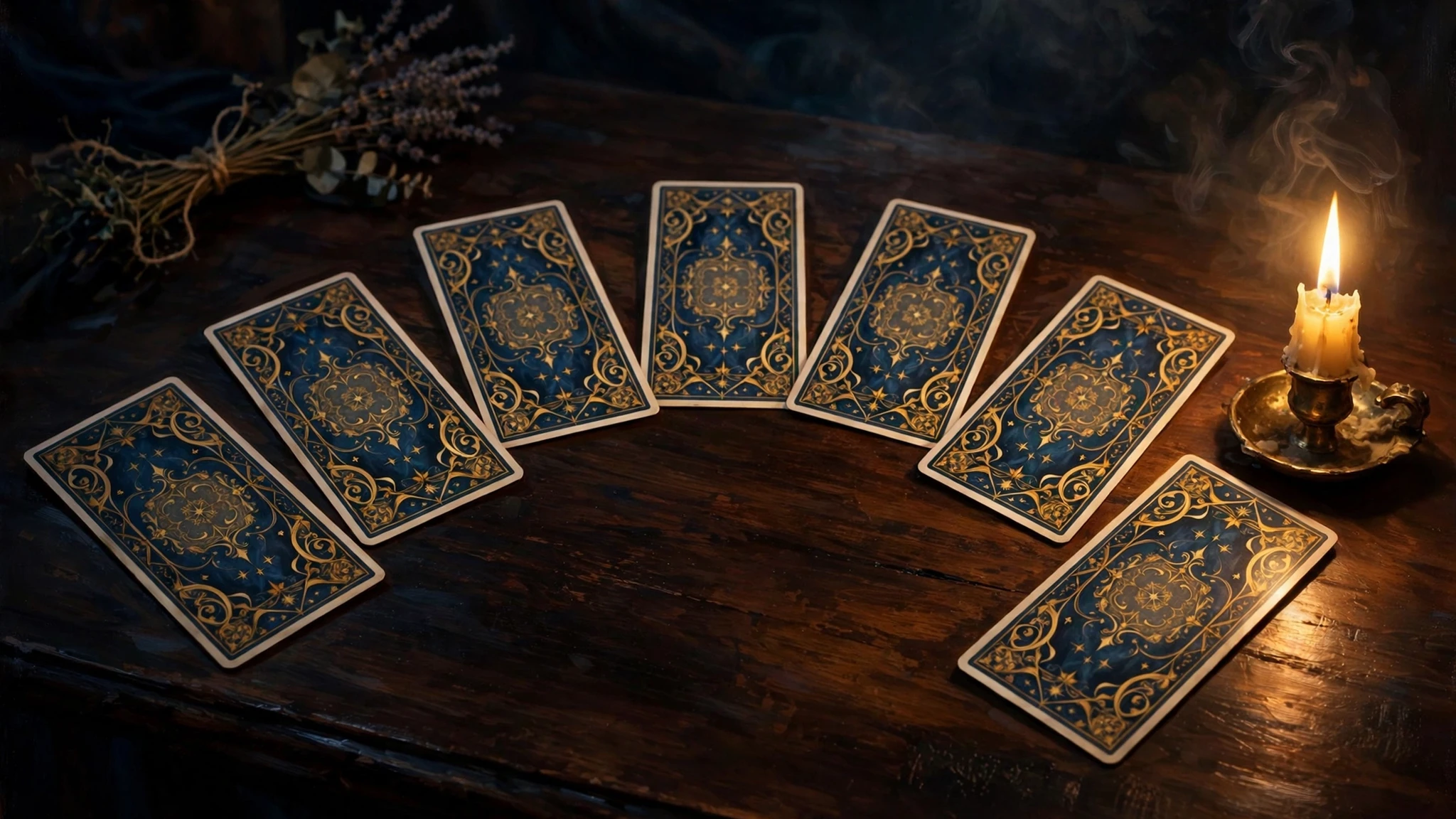
The horseshoe uses seven cards, laid in a shallow U from left to right, with the fourth card at the bottom of the curve. Each position stays put, so the same card means something different depending on where it lands. A card that means joy in the outcome position means something different in the obstacles position. Hold the arc diagram beside the cards as you work, and let an unwelcome card stay where it fell instead of moving it to a kinder spot.
Position 1 is the past. It describes the influences, events, or patterns from the recent past that shaped the current situation. This is not distant history. It is the momentum that brought you to where you stand today, such as a decision made last year, a skill built over time, or a habit that is still active. Position 2 is the present. It describes where things stand right now, the dominant energy, challenge, or opportunity in the middle of the situation. It is the center of the horseshoe and the lens through which the other cards should be read.
Position 3 is hidden influences. It describes what is operating beneath conscious awareness: an unspoken feeling, a fact not yet known, a pattern the querent has not named, or a hope or fear that is shaping decisions without being acknowledged. This is often the most revealing card in the spread. Position 4 is obstacles. It describes the primary challenge, block, or resistance on the path, whether it comes from outside, such as a deadline or a budget, or from inside, such as a fear or a habit. Position 5 is external influences. It describes the people, institutions, and circumstances surrounding the situation, the things that are not fully within the querent's control but will affect the outcome.
Position 6 is advice. It describes the most useful action, attitude, or quality to bring to the situation. It is a recommendation, not a command, and it should be read in light of the obstacles and the external influences that came before it. Position 7 is the outcome, or likely direction. It describes where things are heading if current energies continue and the advice is followed. It is a trajectory, not a fixed fate. A change in action can change the outcome, and the spread is most useful when the querent reads position 7 as a direction to work with rather than a verdict to accept.
How to Lay Out and Read the Horseshoe, Step by Step
Start with a clear question, written in one sentence. A good horseshoe question names the situation and the decision inside it: should I accept the job offer from the small studio, or what is happening in my relationship since the move? A vague question, such as what will happen to me, will give a vague reading, because the positions need a situation to describe. Shuffle the deck while holding the question in mind, cut it once, and lay seven cards face down in a shallow arc from left to right, with the fourth card at the bottom of the curve.
Reveal the cards singly, starting at position 1 and ending at position 7, jotting each card beside its position before you turn the next one. Order matters here, since the arc tells its story from past toward outcome, and a story built step by step is far easier to follow. Resist the urge to take in all seven cards in one glance. Start with the past and the present, and ask whether they match what the querent already knows. If they do, the spread is grounded in real facts. If they do not, pause and check the question. A spread that does not match the known past is often answering a different question than the one asked.
Then read the middle of the arc: hidden influences, obstacles, and external influences. These three cards describe the forces at work on the situation, and they often explain why the present feels the way it does. Look for links between them. A hidden influence that names a fear may explain an obstacle that looks like a practical block. An external influence that names a person may explain why the obstacle is hard to move. Finally, read advice and outcome together. The advice is the action. The outcome is the direction that action supports. If the advice feels hard, ask whether a smaller version of it could be taken this week. If the outcome feels unwelcome, ask what would need to change in the advice to shift it.
A Full Worked Example: The Studio Job
This example is illustrative, not a real person's story.
Here is the horseshoe at work on a real question. The question is: should I accept the job offer from the small design studio? The querent is a graphic designer named Sam, who has freelanced for three years and has been offered a junior role at a studio with lower pay than his better freelance months but steadier work and a team to learn from. The seven cards land in this order.
Position 1, the past, is the Three of Pentacles. It describes teamwork and craft: Sam built his skills by working with other people, learning from clients, and finishing real projects. The past supports the studio idea, because Sam has always learned well in collaboration. Position 2, the present, is the Two of Wands. Sam is at a planning edge, map in hand, looking at a new horizon but not yet committed. The present card matches what Sam already knows: he is ready to choose, and the choice is real.
Position 3, hidden influences, is the Seven of Cups. It describes attractive options and wishful thinking competing with the real plan. Sam has been imagining the studio as a perfect place, and also imagining a freelance future that is more glamorous than his actual freelance months were. The hidden card warns him to check the real studio against the imagined one. Position 4, obstacles, is the Five of Pentacles. It describes financial worry: the lower pay, the fear of a tight month, and the memory of a lean winter two years ago. The obstacle is real and specific, not a vague fear. Position 5, external influences, is the Emperor. It describes authority and structure: the studio has clear rules, a manager who sets the pace, and clients who expect work on time. That structure is both a support and a constraint.
Position 6, advice, is the Eight of Pentacles. It describes focused craft: specialize, do excellent work on a small scale, and build a reputation through quality rather than through speed. The advice suggests that Sam should take the role if he is willing to focus and learn, not if he expects the studio to solve his income worries on its own. Position 7, outcome, is the Ace of Pentacles. It describes a workable opening: a real opportunity, grounded in resources, if Sam follows the advice. The reading does not tell Sam to accept or to refuse. It tells him what to check: the real salary, the real hours, the real manager, and whether he is willing to focus on craft for a year. If those checks pass, the outcome supports the move.
When to Use the Horseshoe, and When to Choose a Shorter Spread
The horseshoe is the right spread when a situation has layers. A decision with a past, with other people involved, with hidden factors and outside pressure, and with a real choice to make, is a horseshoe question. A simple question, such as how will today go, or should I send this message, is better served by a one card pull or a three card pull. Using seven cards for a small question can create confusion, because the spread will invent layers that are not really there. A short question deserves a short spread.
Common Mistakes and How to Avoid Them
The most common mistake with the horseshoe is reading the outcome card as a fixed fate. Position 7 describes a likely direction if current energies continue. It does not describe a future that cannot be changed. A querent who hears a difficult outcome and gives up has misread the spread. The advice card is there precisely because the outcome can be shifted by action. Read positions 6 and 7 together, and ask what would need to change in the advice to shift the outcome.
The second mistake is ignoring the hidden influences card. Position 3 is often the card a querent wants to skip, because it names something uncomfortable. It is also often the card that explains the whole spread. A hidden fear, a hidden hope, or a hidden fact can explain an obstacle that otherwise looks mysterious. Take time with position 3, and ask the querent what it brings to mind, even if the answer is uncomfortable.
The third mistake is reading each card on its own, without letting the positions shape them. A card that means joy in the outcome position can mean a distraction in the obstacles position, or a wish in the hidden influences position. The position is half the meaning. A reader who ignores the position is reading seven single cards, not a horseshoe. Keep the layout in front of you, and let each position do its job.
The Horseshoe and Other Spreads
The horseshoe sits between the three card spread and the Celtic Cross in both size and depth. A three card spread gives a quick story in three parts. A Celtic Cross gives a full map in ten positions, including the querent's hopes, fears, and the view of others. The horseshoe gives seven positions, which is enough for a layered situation without the full weight of a ten card reading. A reader who finds the Celtic Cross too long and the three card spread too short will often settle on the horseshoe as their main spread for serious questions.
The horseshoe also pairs well with a one card pull. After a horseshoe reading, a single card drawn the next morning can serve as a daily focus, a reminder of the advice card or a small step to take that day. That combination keeps a long reading alive in daily life without repeating the full seven card layout every day. For a daily practice, the daily tarot ritual explains how to draw and record a single card each morning.
Shuffling, positions, and reversals are walked through in how to read tarot cards, while tarot for beginners introduces the deck, its suits, and the Major Arcana for someone still learning the cards. Every spread guide in the set sits under the tarot spreads hub, and the three card spread for twin flame questions offers a shorter layout built around one focused love question.
The horseshoe does not promise an easy answer. It promises a fuller picture, and a fuller picture is what a layered situation needs.
First 3 minutes FREE — every time, for every reading, with all advisors.
For a simple next step, try a One-Card Tarot reading and reflect on one layered question that deserves seven cards instead of three.
Frequently Asked Questions
What is the horseshoe tarot spread?
It is a seven card layout in a shallow arc for a layered situation. The positions are past, present, hidden influences, obstacles, external influences, advice, and outcome, read from left to right. It gives a fuller picture than a three card pull without the ten positions of a Celtic Cross.
How many cards are in a horseshoe tarot spread?
Seven cards. Lay them face down in a shallow U from left to right, with the fourth card at the bottom of the curve, then turn them over one at a time from position 1 to position 7 and write each card down before moving to the next.
When should I use a horseshoe tarot spread instead of a three card spread?
Use the horseshoe when a situation has history, more than one person involved, hidden factors, and outside pressure, such as a job offer after a hard year or a relationship at a turning point. Use a three card spread for a simple question, such as how today will go, where seven cards would create confusion.
What does the outcome card mean in a horseshoe spread?
Position 7 describes the likely direction if current energies continue and the advice is followed. It is a trajectory, not a fixed fate. Read it together with the advice card, and ask what would need to change in the advice to shift the outcome.
What is the most important position in the horseshoe spread?
Position 3, hidden influences, is often the most revealing, because it names an unspoken feeling, a fact not yet known, or a pattern the querent has not named. It can explain an obstacle that otherwise looks mysterious, so take time with it even if the answer is uncomfortable.
Last updated: November 12, 2026
