
Full Moon Tarot Spread: Six Cards for Release
The Short Answer: What a Full Moon Tarot Spread Is
A full moon tarot spread is a tarot layout used at the full moon to look back, see clearly, and let go. The full moon marks the peak of the lunar cycle, the point of most light. In tarot tradition, that light is a metaphor for illumination: what sat in shadow becomes easier to see. The spread below does two jobs at once. It names what has grown since the new moon, and it names what no longer serves you.
The new moon is the time for setting intentions in this tradition. The full moon is the time for release. This is not a spread for starting a new plan or asking for a prediction. It is a spread for taking stock and making room for what comes next. No card decides an outcome for you. There is no single ancient full moon spread. The layouts in use today are modern. The six card spread taught here comes from Biddy Tarot, the work of Brigitte Esselmont.
When to Do It: The Full Moon Window and the Next Full Moons
A full moon happens at one single instant worldwide. Your local clock and date depend on your time zone. The cycle from one new moon to the next, called the synodic month, lasts about 29.53 days. That rhythm gives 12 or 13 full moons in a calendar year. The year 2026 has 13 full moons, and 2027 has 12. Do the reading on the day of the full moon, or a day either side.
The next full moons are 24 November 2026 at 14:53 UTC, the Beaver Moon in Gemini; 24 December 2026 at 01:28 UTC, the Cold Moon in Cancer, which falls on the evening of 23 December in North America at 8:28 p.m. EST; 22 January 2027 at 12:17 UTC, the Wolf Moon in Leo; and 20 February 2027, the Snow Moon in Virgo. The February listing gives the date only, because sources differ by one minute on the exact time. These moon names are traditional, not official. For a wider view, see our moon phases explained guide, and for the meaning of the phase, see full moon meaning.
What You Need Before You Start
A standard modern tarot deck has 78 cards, 22 Major Arcana and 56 Minor Arcana. The Rider-Waite-Smith deck, first published in 1909 and illustrated by Pamela Colman Smith, is a good choice if you are new. If you are still learning the cards, keep our how to read tarot cards guide nearby, and use the tarot meanings hub to look up a card when you need it. Set aside about 30 minutes in a quiet place, with a notebook and a pen. You will also want a small slip of paper for the release ritual later. The spread below is part of the wider family of layouts on our tarot spreads hub.
The Six Card Full Moon Spread
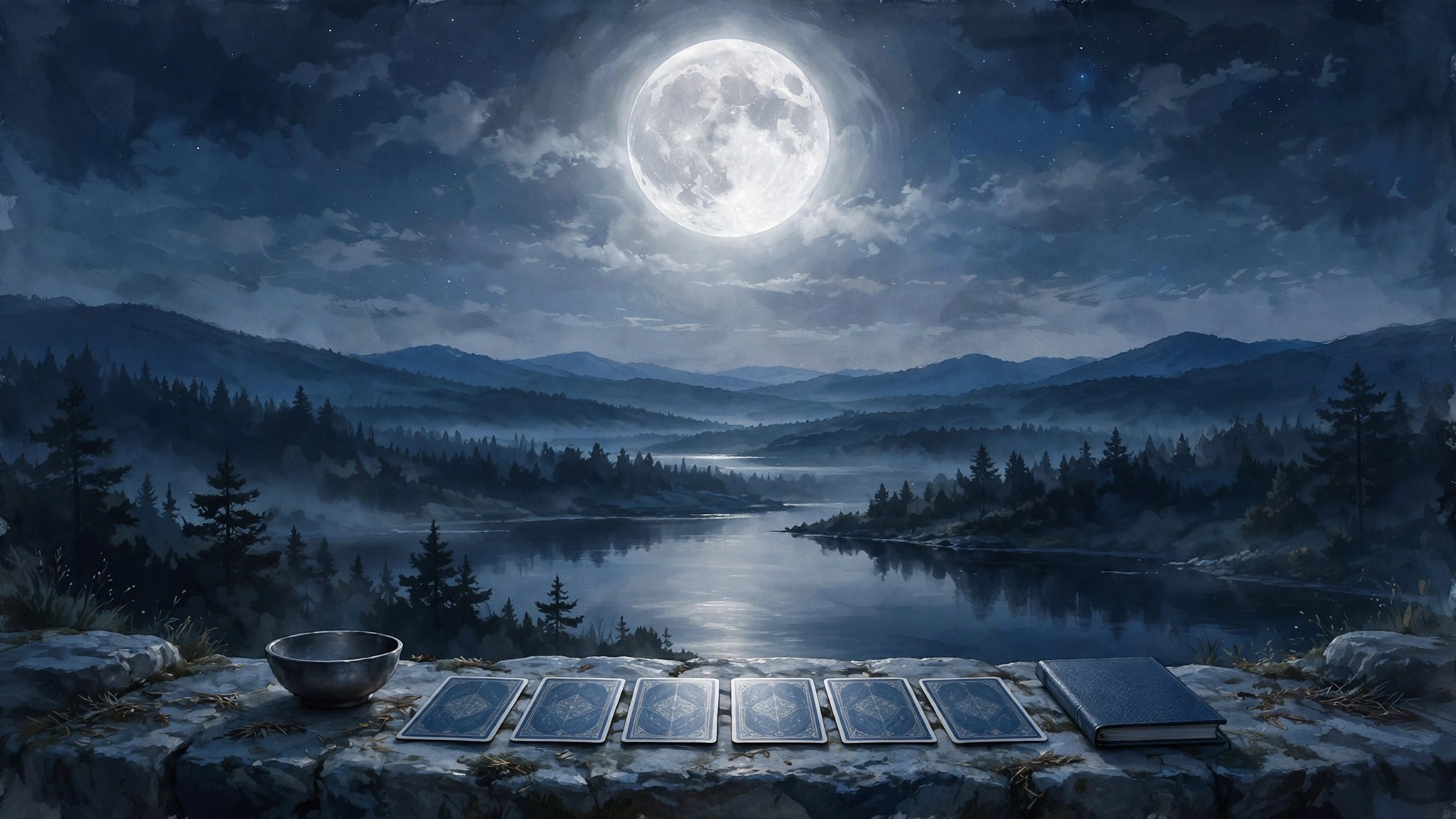
Lay six cards in a row. The order below follows the Biddy Tarot layout. Read the first three positions as the light half of the reading, and the last three as the release half.
Card 1 asks what you have created and brought into form since the new moon. It names the work, the change, or the result that grew in the past few weeks, if it is smaller than you hoped.
Card 2 asks where you stand right now. It describes your current state in plain terms: your energy, your mood, your footing.
Card 3 asks what is coming into your conscious awareness. It names a truth, a pattern, or a feeling that has been at the edge of your mind and is now clear enough to face.
Card 4 asks what is no longer serving you. This is the heart of the spread. It names the habit, belief, expectation, role, or attachment that has run its course.
Card 5 asks how you can release and let go of that energy. It suggests a practical way to loosen your grip: a conversation, a boundary, a change of routine, or a period of rest.
Card 6 asks what extra resources are open to you as you release and let go. It points to help, strength, or opportunity that is already near: a person, a skill, or a quality in yourself that you have undervalued.
How to Read the Spread Step by Step
Read the illumination cards first, then the release cards. You cannot let go of what you have not yet seen clearly. Start with cards 1 to 3 and ask what story they tell together: what grew, where you stand, and what you can now see. Then move to cards 4 to 6 and ask what needs to go, how to let it go, and what will support you after. Write down one or two lines for each card in your notebook. A card means different things in different positions, so let the position shape the meaning. A reversed card is not automatically negative. In a release position, a reversed card can show how hard it is to let go.
The Release Ritual
Take a separate slip of paper and write down what no longer serves you and what you want to release. Write it as one specific sentence. Name one thing, not five. Then burn the paper in a fireproof bowl, or tear the paper up instead. If you burn it, use a fireproof bowl, never leave burning paper unattended, and keep water nearby. Tearing the paper up is as valid, and it is the safer choice if you are indoors or unsure about fire safety.
After the ritual, record the reading in your notebook with key insights for each card. Note the release sentence, the card in each position, and the one concrete step you will take in the waning weeks. That final step is a care step, not a prediction: rest, a conversation, a boundary, or support from a professional. For a fuller ritual around the same night, see how to do a full moon ritual.
Cards That Often Show Up at the Full Moon
Some cards fit full moon work well. None of them has a fixed meaning, and none of them always means the same release. Their meaning always depends on the position and the question. On The Moon, Major Arcana XVIII, a face gazes from a circle edged with rays, placed high between two towers, while below a dog and a wolf lift their heads toward it and a crayfish rises from still water. In a full moon spread, it points to half seen things in a brighter light: a mood rather than an event, or an unease you could not explain.
The Ten of Wands pictures a burden grown to its full weight, a duty, a concern, or a task carried on behalf of another person. It does not always mean you must drop everything. Sometimes it means you need help with the load. The Eight of Cups shows walking away from an emotional investment that is no longer fulfilling. The Five of Swords points to letting go of the need to be right in a conflict. The Five of Cups points to letting go of lingering regret over past failures. In both cases, release does not always mean ending a relationship or a project. Sometimes what needs releasing is an expectation, an old role, or a rigid timeline.
Other Full Moon Spreads
Other named layouts exist, and each one is worth a single line here. AstrologyPro offers a five card full moon spread in an arc or cross pattern. Veil Soul offers a six card spread in two rows of three, with the top row for what the light shows and the bottom row for what you set down. Uranize offers a four card Full Moon Release Spread shaped like a full circle. Astrology Juno offers a five card Full Moon Release Spread built around a lesson and an affirmation. VoxFati offers a four card Full Moon Pattern read in sequence from release to a wider message. Pick one layout and learn it well. The new moon in scorpio tarot spread page shows how a different phase uses a different shape.
What to Do After the Reading
Keep the notebook note where you can find it. Look at it again a week later, when the moon is waning and the release has had time to settle. Ask whether the release sentence still feels true and whether the concrete step has helped. If the answer is no, that is useful too. It may mean the release needs a smaller first step. If you want help reading your own cards, a chat reading can look at the spread with you, one question at a time. See our tarot reading guide. First 3 minutes FREE — every time, for every reading, with all advisors.
Frequently Asked Questions
What is a full moon tarot spread?
A full moon tarot spread is a tarot layout used at the full moon to take stock, see clearly, and let go. The full moon marks the peak of the lunar cycle, so the spread looks back at what has grown since the new moon, names what is now clear, and asks what no longer serves you. The six card layout on this page covers both halves: illumination first, then release and support.
When should I do a full moon tarot spread?
Do it on the day of the full moon, or a day either side of the exact moment. A full moon happens at one single instant worldwide, and your local date depends on your time zone. The next full moons are 24 November 2026, 24 December 2026, 22 January 2027, and 20 February 2027. You do not need to time the reading to the exact minute.
How many cards are in a full moon tarot spread?
There is no single traditional count. Named layouts range from four to seven cards, and the spread taught on this page uses six cards. The six positions cover what you have created since the new moon, where you stand now, what is coming into awareness, what no longer serves you, how to release it, and what resources support you as you let go.
What does the release card mean in a full moon spread?
The release card names what has run its course, such as a habit, a belief, an expectation, a role, or an attachment. It does not automatically mean a relationship, a job, or a project must end. Sometimes the release is an expectation or a timeline, not a person or a situation. Read the card with its position, and keep the release to one specific thing.
Is it safe to burn the paper in the full moon release ritual?
Yes, if you follow basic fire safety. Burn the paper in a fireproof bowl, never leave burning paper unattended, and keep water nearby. If you are indoors, tired, or unsure about fire safety, tear the paper up instead. Tearing is just as valid as burning, and it is the safer choice in many homes.
Last updated: November 13, 2026
