New Moon in Scorpio Tarot Spread
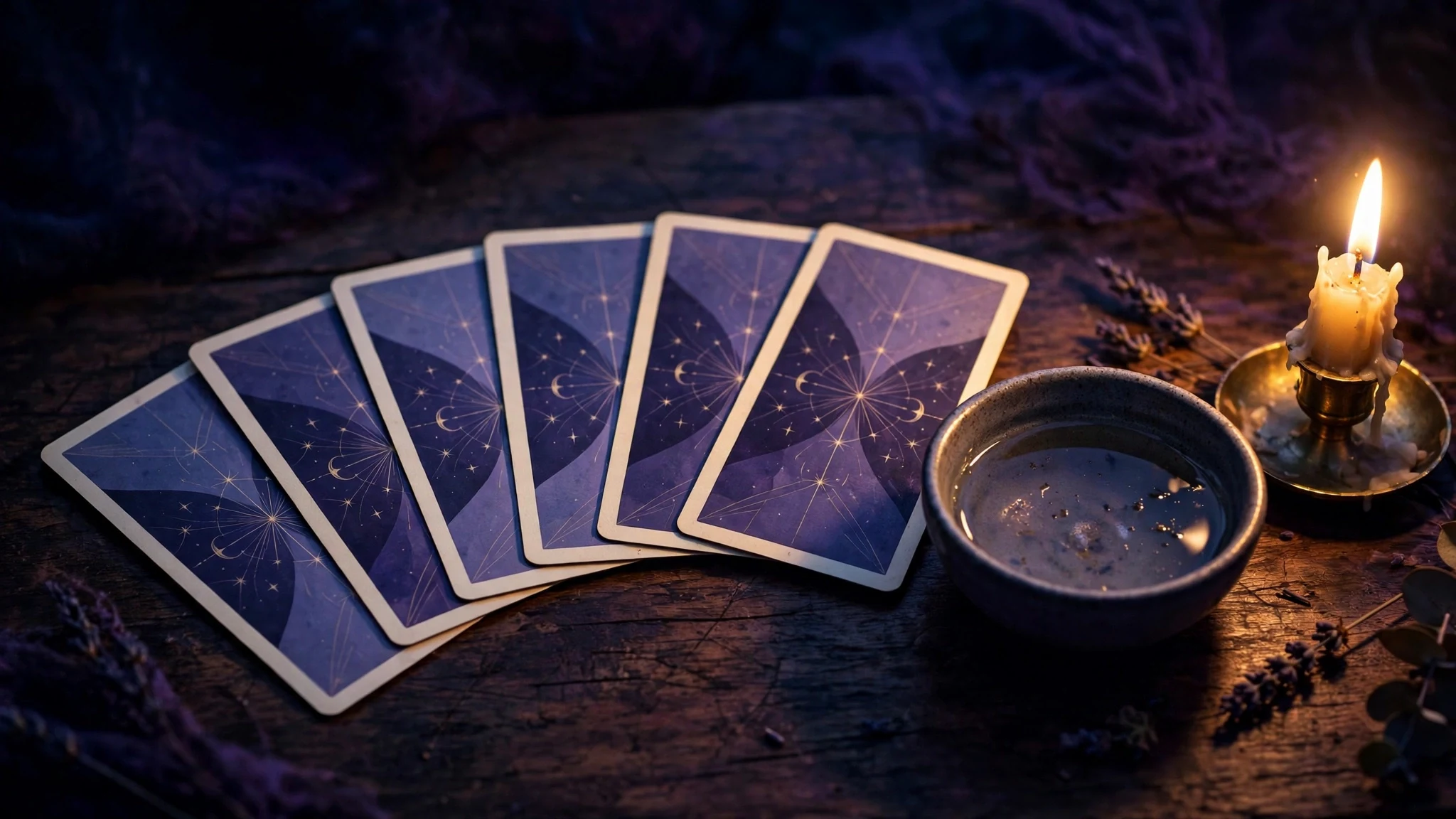
A new moon in scorpio tarot spread is a focused five card layout for the darkest, most private part of the lunar cycle, when Scorpio themes of shadow, desire, release and transformation are at their strongest. Scorpio season arrives in late autumn in the Northern Hemisphere, when nights lengthen and most people naturally turn inward. The new moon itself is the moment when the moon sits between Earth and the sun and its lit face points away from us, so the sky looks empty. In astrological tradition that emptiness is treated as a beginning rather than a blank, a pause in which intentions are set quietly before anything becomes visible.
This spread is built for that pause. It does not ask what will happen to you. It asks what you are carrying, what you are ready to set down, what you actually want underneath the safer want, and what kind of change you can tend over the coming weeks. Read it as reflective practice in the tarot tradition, not as a definite prediction about your future.
If you are newer to lunar readings, you may enjoy browsing our angel numbers hub and guide afterward, since many readers pair a moon spread with a number they keep noticing during the same week.
Why Scorpio Changes the Questions
Every new moon spread deals with beginnings, but Scorpio narrows the focus. In the astrological tradition Scorpio is a water sign associated with emotional depth, privacy, shared resources, endings that make room, and the parts of life people usually keep off the dinner table. A generic intention spread might ask what you want to grow. A Scorpio spread asks what you want once you stop editing the answer for politeness.
That honesty is the whole point of this layout. The five positions move in a deliberate order. First you name the shadow, the pattern running underneath your current situation. Then you name what is ready for release, because Scorpio beginnings almost always require an ending first. The middle card turns toward desire, the genuine one, not the presentable one. The fourth position looks at transformation, the slow alchemy between who you have been and who you are becoming. The final card offers a first step small enough to take during this moon cycle, while motivation is fresh and the sky is still dark.
Before You Shuffle: Setting Up
Choose a quiet stretch of time, ideally in the evening, and give yourself at least twenty unhurried minutes. Lay out your deck, a notebook and a pen. Some readers like a candle or a small bowl of water nearby as a nod to Scorpio as a water sign, but neither is required. What matters more is a clear question held loosely. Instead of asking the deck to decide your life, frame your focus in a sentence such as: what do I need to see clearly as this cycle begins?
Shuffle in whatever way feels natural to you. Some readers shuffle until a card jumps out for the first position. Others shuffle once, cut the deck into three piles, restack them, and deal from the top. Both approaches belong to common practice, and consistency matters more than ceremony. Use the same method each time you repeat this spread so your readings stay comparable across months.
A note on reversed cards: this spread works either way. If you read reversals, treat a reversed card as the same theme turned inward, blocked, or still ripening. If you prefer upright only, shuffle with that intention set. Decide before you deal, not after you see the cards.
The Five Positions and How to Lay Them Out
Place the cards in a shallow arc, like a crescent opening upward, dealing from left to right. Leave a little space between each card so you can see the whole shape at once. The arc matters because this spread tells a story with a curve in it: down into the shadow, across through release and desire, and up toward transformation and action.
Position 1, The Shadow Underneath. This card names the pattern, fear or old story currently running beneath your situation. It is not a villain card and it is not a judgment. It simply shows what has been steering quietly.
Position 2, Ready for Release. This card shows what has finished its usefulness: a habit, a grudge, an arrangement, a version of a story you keep retelling. Scorpio energy in this tradition is linked with letting go on purpose rather than drifting away by accident.
Position 3, The Desire Beneath the Desire. This is the heart of the spread. The card here points at what you want underneath the goal you would say out loud. If your stated goal is a new job, this card may speak about freedom, respect or rest. Read it slowly.
Position 4, The Transformation in Progress. This card describes the change already underway, often before you have language for it. It tends to show the quality being developed in you: patience, directness, self trust, the ability to receive help.
Position 5, The First Step This Cycle. This card suggests one practical move for the next two weeks, before the full moon. It should be the smallest card in emotional size even when its image looks dramatic. Translate it into an action you could schedule.
How to Read Each Position Well
Start with position 1 and resist rushing to the outcome cards. For the shadow position, ask what behavior repeats in your life even when circumstances change. Court cards here often point to a role you play, such as the fixer or the one who goes quiet. Numbered cards from the suit of Cups often point to emotional habits, while Swords tend to highlight thought loops and the stories told about them in your own head.
At position 2, look for the cost of holding on. A card that looks pleasant can still be something to release; comfort is a common reason people keep arrangements that no longer fit. Ask what would become possible with the time and attention this thing currently consumes.
Position 3 rewards honesty over interpretation skill. Notice your first reaction when you turn the card over. Relief, embarrassment and a small laugh are all information, because this position often names the want you have been negotiating down. Write the unedited version in your notebook before you refine it.
Position 4 is best read as a process, not an event. If a major arcana card lands here, the tradition usually treats the change as a larger life theme unfolding over months. If a minor arcana card lands here, the change is probably moving through daily routines, conversations and small choices, which is good news, because daily life is where you have the most say.
Position 5 should end as a sentence with a verb in it. Book, send, ask, schedule, rest, return, finish. If the card feels abstract, ask what its energy looks like at the scale of one afternoon. A spread that ends in a scheduled action has done its job.
If you want a quicker draw on ordinary days, our free three card tarot reading covers past, present and future in a few minutes, and many readers use it between moon spreads to check in on a single thread.
A Worked Example Reading
Here is an invented example so you can watch the positions work together. Imagine a reader, midway through autumn, who feels stuck in a friendship that turned into a one sided support line after a hard year. The cards dealt, in order, are the Eight of Cups, the Ten of Wands, the Ace of Cups, the Death card, and the Page of Swords.
Position 1, the shadow, holds the Eight of Cups: walking away feels like failure to this reader, so situations get endured long past the point of honesty. Position 2, release, holds the Ten of Wands: the load of being the always available listener is ready to be set down, not the friendship itself, but the unlimited access arrangement around it. Position 3, desire, holds the Ace of Cups: underneath the scheduling problem sits a simple wish for friendship that refills rather than drains, with affection flowing in both directions.
Position 4, transformation, holds Death, the card most associated with Scorpio in this tradition. Read as process, it suggests an ending of an old pattern rather than an ending of the bond: the always on call chapter closes so a different chapter can exist. Position 5, the first step, holds the Page of Swords: one honest, curious conversation, with questions asked plainly and answers actually heard. The scheduled action becomes a single coffee with a gentle, direct talk about availability and care on both sides.
Notice what the example does not do. It does not declare the friendship saved or doomed. It gives the reader a clearer view of a pattern, a release, a real desire, a change in progress and one next move. That is the correct size for a moon reading.
Journaling Prompts After the Spread
Photograph the layout before you gather the cards, then write while the images are still fresh. Good prompts for this spread include: What did the shadow card name that I already knew but had not said plainly? What is the release card costing me each week in time, sleep or attention? If the desire card told the truth, what would I stop apologizing for wanting? Where is the transformation card already visible in my recent choices? What is the smallest version of the fifth card that still counts?
Revisit the page at the full moon, roughly two weeks later, and add a few lines about what actually shifted. Readers who keep that habit across several cycles often find the notebook becomes more valuable than any single reading, because it shows desire and follow through in your own handwriting.
For single question practice between spreads, the free one card tarot draw is a gentle daily option, best used with one clear focus rather than a pile of questions at once.
One Small Question Before the Cycle Turns?
If one position in your spread raised a single yes or no question, our free Yes/No Oracle lets you test that one question in the moment, for reflection and entertainment. Treat its answer as a mirror for your own reaction, which is often where the useful information lives.
If you would like to explore your spread with a real person, our advisors at PsychicSmile are here for a live chat reading whenever it suits you. First 3 minutes FREE, every time, for every reading, with all advisors.
Frequently Asked Questions
When is the best time to use this Scorpio new moon spread?
Most readers use it on the day of the new moon in Scorpio or within the two evenings after, while the moon is still effectively dark. If you miss that window, the first few nights of the cycle still work well, since the spread is about the opening phase of a beginning rather than a single exact hour.
Do I need a special deck for a Scorpio spread?
No special deck is required. Any tarot deck you read comfortably will do, including a standard Rider Waite style deck. What matters is your familiarity with your own deck, because the shadow and desire positions depend on honest first reactions more than on rare or dramatic imagery.
What if the Death card appears in my reading?
In this tradition the Death card usually points to an ending that clears ground, such as a pattern, role or arrangement finishing, rather than a literal death. In this spread it most often appears in the release or transformation positions, where it underlines that a chapter is closing so a different one can be lived.
Can I repeat this spread if the reading feels unclear?
It is usually better to sit with one layout, journal about it, and let a few days pass before drawing again on the same question. Repeating a spread immediately tends to produce noise instead of clarity. A single clarifier card on the position that confused you is the one exception most readers allow themselves.
Is this spread suitable for beginners?
Yes, because each position has one job and the five cards tell a single story in order. Beginners often find the worked structure easier than a large Celtic cross. Read the cards one position at a time, write a sentence for each, and only then look at how the sentences connect.
Last updated: November 9, 2026