Best Crystals for Protection: Stones That Guard

The best crystals for protection are the stones people reach for when they want a boundary they can hold in the hand. This page is a list, not a ritual guide: it names the stones, explains what each one is traditionally linked with, and shows how to use and cleanse each one. Readers who want the wider picture of crystal work can start with crystal healing meaning, and readers who want the boundary and ritual side of protection should read spiritual protection, which covers that ground in full. What follows here stays on the stones themselves. Every property in this page is framed as a traditional association, not as a fact, because no stone has been proven to protect anyone, and the honest value of a protection stone lies in the practice built around it: a clear intention, a boundary that is actually held, and a small daily reminder to pause before reacting.
How Protection Stones Are Traditionally Chosen
Protection stones are usually chosen by three things: color, weight, and feel. Dark stones dominate the list, because dark colors are linked in the tradition with grounding and with absorbing heavy energy, while clear and pale stones are linked with clarity and calm. Weight matters too, because a stone that feels solid in the palm is easier to use as a reminder than a stone so light it is forgotten by noon. Feel is the most personal of the three: a stone that feels cold, smooth, or heavy in a particular hand tends to be carried more often, and a stone that is carried often is a stone that does its work as a reminder. When choosing, hold several stones in turn and notice which one the hand returns to without thinking. That quiet preference is a better guide than any ranked list, including this one.
Size and form also shape the choice. Tumbled stones fit a pocket and travel well, which makes them the most practical form for daily carry. Raw chunks suit a desk or a doorway, where their rough surface can be seen and touched through the day. Points are traditionally placed with the tip facing outward near a door, on the idea that the shape directs attention outward. Jewelry keeps the stone against the skin, which suits people who want the reminder close all day. None of these forms is stronger than the others in any proven sense. The form that works is the form that fits the life it is carried in, and a stone left in a drawer because it is too large to carry is a stone doing no work at all.
One more note before the list begins: a protection stone is a support for a boundary, never a substitute for one. If a situation needs a direct conversation, a changed routine, or distance from a harmful person, the stone cannot do that work. What the stone can do is mark the moment of decision: the hand closes around it, the intention is restated in one sentence, and the boundary is then held in waking life. Readers who keep that order clear, intention first, action second, stone as reminder, tend to get the most from the practice, and they are also the readers least likely to be disappointed by it.
Black Tourmaline: The First Name in Protection
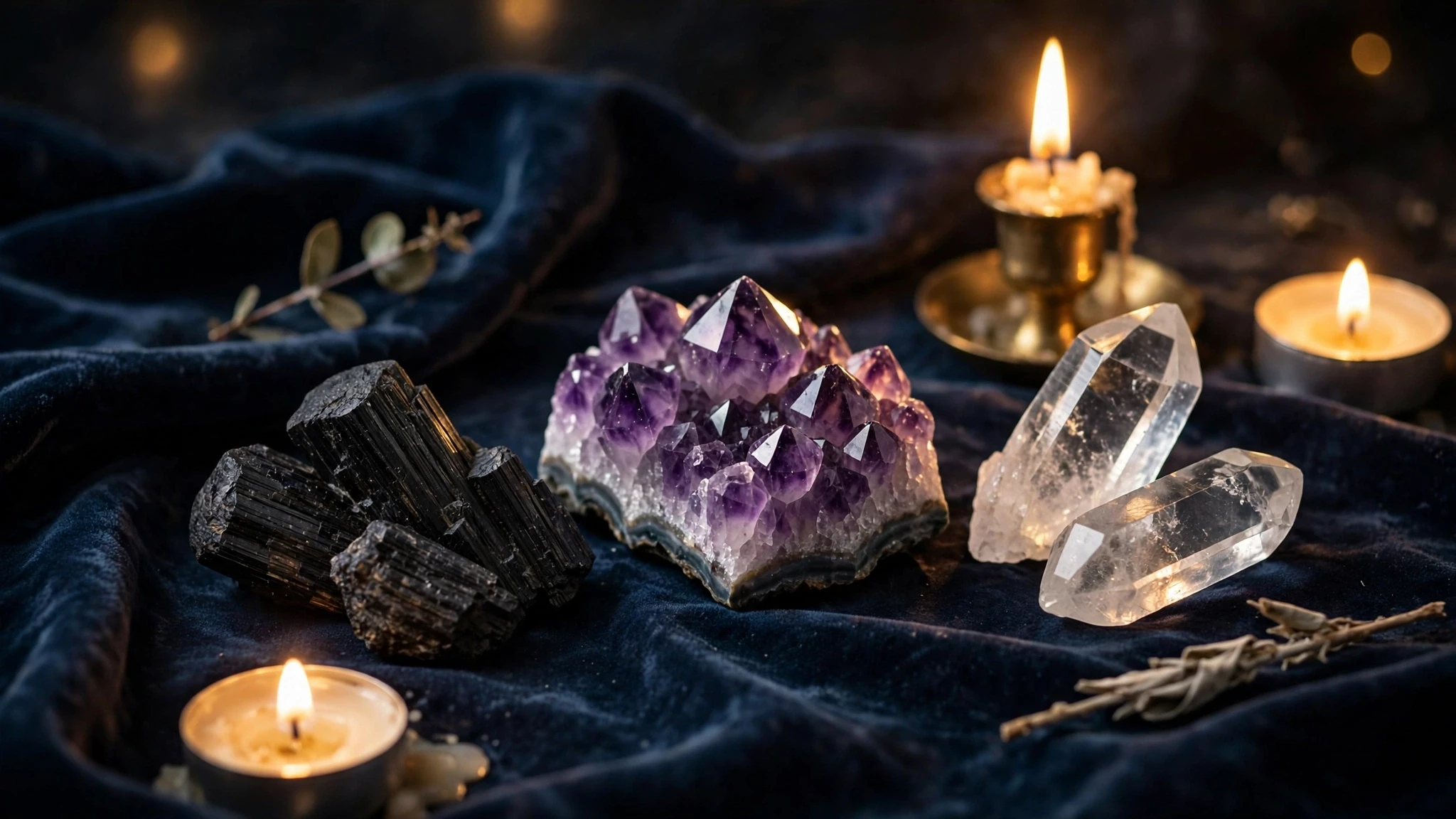
Black tourmaline is the stone named first in almost every protection list, and it earns that place through its associations rather than through any proof. Its color is deep black, its surface takes a polish well, and in the tradition it is linked with grounding and with absorbing heavy or unwanted energy. It is the stone most often recommended for a front door, a desk, or a pocket during a difficult week, because its weight and darkness make it easy to treat as an anchor. A tumbled piece the size of a coin is the common starting point, and it can be carried in a pocket, set on a desk beside a keyboard, or placed near the main entrance of a home.
To use black tourmaline, hold it for a minute each morning and state one intention in plain words, such as staying calm during a hard conversation or keeping work hours separate from rest. Then carry it through the day and notice when the hand reaches for it. Those moments of reaching are the moments the intention is being remembered, and that remembering is the practice. To cleanse it, tradition suggests smoke, moonlight, or running water, since tourmaline is water safe. Dry it well and return it to its place. If the stone chips or cracks, the tradition treats that as a sign to retire it with thanks and replace it, which is a kind reminder that no tool lasts forever and that replacement is part of the practice.
Obsidian: Sharp Boundaries in Stone Form
Obsidian is volcanic glass, black and glossy, with edges that can cut when broken, and the tradition reads that sharpness as a symbol of clear boundaries. Where black tourmaline is linked with absorbing, obsidian is linked with cutting: cutting ties that no longer serve, cutting through confusion, and cutting short a conversation that has turned harmful. It is the stone most often named for endings, for the week after a breakup, and for any situation where a clean line needs to be drawn and held. A small tumbled piece suits a pocket, while a larger polished piece suits a desk where difficult decisions are made.
Obsidian is a strong stone to live with, and the tradition advises respect for that strength. It is not usually recommended as a first stone for a reader who is already feeling raw, because its associations run toward sharpness rather than comfort. Pairing it with a calming stone, such as amethyst, is a common way to soften it, and that pairing is described below. To cleanse obsidian, smoke or moonlight is the usual method, since the stone is glass and can be scratched by rough handling. Handle it gently, keep it in a soft pouch when it travels, and treat a chip as a reason to retire the piece rather than to keep carrying a sharp edge in a pocket.
Hematite: Steady Ground Underfoot
Hematite is a heavy, metallic gray stone, and its weight is its signature. Pick up a piece of hematite and the hand knows at once that it is holding something solid, and the tradition links that solidity with grounding: staying present, staying steady, and staying in the body rather than spinning into worry. Hematite is the stone most often named for anxious days, for long commutes, for crowded rooms, and for any moment when the mind is racing ahead of the feet. It is commonly worn as a bracelet or carried as a tumbled stone, and its metallic sheen makes it one of the few protection stones that looks at home in ordinary jewelry.
To use hematite, hold it during a slow breath before a difficult moment, and let the weight of it draw attention down to the feet and the floor. That small physical anchor is the whole method, and it can be repeated as often as needed through the day. Hematite needs dry cleansing methods only, because water can rust its surface over time. Smoke, moonlight, or sound are the safe choices, and a soft cloth keeps the metallic surface bright. Readers who work with hematite often report that it is the stone they reach for first in the morning and the stone they forget they are wearing by noon, which is a good sign: a grounding tool that disappears into the day is a tool that is working.
Amethyst: Calm That Guards the Mind
Amethyst is the purple stone of the list, and its associations run toward calm, sleep, and clear thinking rather than toward walls and shields. In the tradition, amethyst is linked with protection of the mind: guarding rest, easing a racing head at night, and keeping a difficult conversation from turning into a spiral. It is the stone most often placed beside a bed, on a desk where focus is needed, or in a pocket during a week of hard decisions. Its color ranges from pale lilac to deep violet, and the deeper colors are traditionally favored for the strongest calming associations, though any shade that the reader finds pleasing will serve.
To use amethyst, place a piece where rest happens: a bedside table, a reading chair, or a windowsill that catches the evening light. Before sleep, hold it for a minute and let the day settle, naming one thing that can wait until morning. That small nightly habit is the protection practice in its simplest form, because a mind that rests well is a mind that holds boundaries better the next day. Amethyst is water safe and can be cleansed under running water, in moonlight, or in smoke, but it should be kept out of long direct sunlight, since strong sun can fade the purple over time. A faded amethyst is not broken, yet many readers prefer to keep the color rich by storing it away from a sunny sill.
Smoky Quartz: Clearing Heavy Air
Smoky quartz is a brown to gray form of quartz, and its name describes its look: clear crystal with smoke caught inside it. The tradition links it with clearing heavy air, with turning a dense mood into something lighter, and with grounding that is gentler than hematite and warmer than black tourmaline. It is the stone most often named for a home that feels heavy after an argument, for a workspace that carries tension, or for a reader who wants grounding without the sharpness of obsidian. A cluster or a large tumbled piece suits a room, while a small piece suits a pocket on a day that promises friction.
To use smoky quartz in a room, set it where people gather and let it stand as a quiet reminder to speak plainly and to leave a hard conversation before it turns unkind. To use it personally, carry it through a difficult day and hold it for a minute when the mood thickens, breathing slowly until the weight eases. Smoky quartz is water safe and can be cleansed under running water, in moonlight, or in smoke. It is a durable stone, and a piece kept on a desk for years is a common sight among readers who favor it. Its gentleness is its strength: it does not promise to block anything, and it does not need to, because its work is to keep the reader steady enough to act well.
Clear Quartz: A Lens for Intention
Clear quartz is the transparent stone of the list, and its traditional role is different from the others. Where the dark stones are linked with absorbing and grounding, clear quartz is linked with clarity and with amplifying whatever intention is set beside it. In the tradition, it is used as a lens: a reader holds a clear quartz point, states one intention in plain words, and the stone serves as a focus for that intention through the day. It is often paired with another protection stone, on the idea that the quartz sharpens the intention while the partner stone carries the grounding or boundary work. A small point or tumbled piece is the usual form, and it travels well in a pocket or a bag.
To use clear quartz, pair it deliberately rather than carrying it alone and hoping for the best. Choose the partner stone for the situation, black tourmaline for a boundary, hematite for grounding, amethyst for calm, and set the intention once, in one sentence, with both stones in hand. Then let the quartz stay in the pocket as a reminder of that sentence. Clear quartz is water safe and can be cleansed under running water, in moonlight, or in smoke, and it is hard enough to travel without a pouch, though a soft wrap keeps it free of scratches. Readers who like a simple practice often keep one clear quartz point on a desk permanently, using it as the place where each new intention is stated before the day begins.
Labradorite and Selenite: Two Quieter Guards
Labradorite is a gray stone that flashes blue, green, and gold when it catches the light, and the tradition links that flash with protection against unwanted attention and with guarding energy during change. It is the stone most often named for people who work with the public, for readers starting a new role, and for anyone who feels drained after being around many people. A polished piece worn as a pendant keeps the flash near the chest, and a tumbled piece in a pocket serves the same purpose more quietly. Labradorite is water safe for brief rinsing, and moonlight or smoke are the gentler cleansing choices.
Selenite is the pale white stone of the list, soft, fibrous, and light in the hand, and its traditional role is cleansing rather than shielding. In the tradition, selenite is used to clear other stones and to clear a room: a selenite wand passed over a desk, or a selenite tower standing in a corner, is said to refresh the space. It is the stone most often kept beside a collection, so that the other stones can rest near it between uses. Selenite must never be washed, because water dissolves its surface, so smoke, moonlight, or sound are the only safe cleansing methods. It is also soft enough to scratch, so it should be kept away from harder stones in a shared pouch. Used with that care, selenite is a quiet helper, and many readers keep a piece near their stones even when they carry a darker stone for the day itself.
Cleansing, Carrying, and Choosing One Stone
Cleansing is the routine that keeps a protection practice honest, and it is simpler than most guides make it sound. Once a month, or after a hard week, cleanse each stone by the method that suits it: smoke from incense or a bundle of herbs, a rinse under running water for water-safe stones, a night in moonlight, or a few minutes of sound from a bell or a singing bowl. Full details for each method, including which stones tolerate water, are in our crystal cleansing guide. While cleansing, restate the intention for the stone in one sentence. The restating matters more than the method, because a stone cleansed without intention is only a clean stone.
Carrying is a matter of habit, not ceremony. A pocket, a bag, a desk drawer, or a pendant chain all serve, and the best place is the one that keeps the stone within reach at the moment it is needed. A stone that lives on a shelf at home cannot remind a reader during a hard meeting across town. Start with one stone for two weeks before adding a second, and notice whether the first stone is being reached for or forgotten. A stone that is reached for often is earning its place. A stone that is forgotten for two weeks can be retired to the shelf without guilt, and a different stone can take its turn. For help choosing, see how to choose a crystal, and for the question of charging a stone under the moon, see how to charge crystals. Readers who use crystals in twin flame work may also want twin flame crystals, which covers seven stones for that specific bond.
Choosing one stone to start with is the last step, and the simplest advice is to start with black tourmaline for a boundary, hematite for grounding, or amethyst for calm, depending on which need is strongest this week. Pick a seller who labels each stone by its plain name and tells you its source when asked, and walk away from any seller who guarantees an outcome, because no seller can vouch for what no stone has been proven to do. A stone bought with honest expectations is a stone that can serve for years, and a practice built on honest expectations is a practice that lasts.
First 3 minutes FREE — every time, for every reading, with all advisors
Frequently Asked Questions
Which crystal is best for protection?
No single stone holds that title for everyone. Black tourmaline is the most widely named protection stone in the tradition, because of its dark color and grounding associations, while obsidian is named for sharp boundaries and hematite for steady grounding. The best choice is the stone whose associations match the situation and whose weight and feel suit daily carry.
How do I use a protection crystal?
Carry a small tumbled stone in a pocket or bag, wear it as a pendant or bracelet, or place a larger piece near a door, a desk, or a bedside table. Pair the stone with a clear intention stated in one sentence, and with a real boundary in waking life, because a stone alone cannot set a limit that a person will not hold.
How often should I cleanse a protection crystal?
Tradition suggests cleansing after heavy use, after a difficult week, or at least once a month. Smoke, running water where the stone is water safe, moonlight, or sound are the common methods. Check whether the stone is water safe first, since selenite and hematite need dry methods, and keep the routine simple enough to repeat.
Can I combine protection crystals together?
Yes, combining is common in the tradition. A grounding stone such as hematite pairs well with a boundary stone such as black tourmaline, and a calming stone such as amethyst pairs well with either one. Start with two stones, notice how the combination feels over a week, and add a third only if the first two are working well together.
Do protection crystals really work?
No study has shown that a crystal can protect a person, and this page makes no claim of that kind. In the crystal tradition, the stones are used as focus tools: a physical reminder to hold a boundary, to pause before reacting, and to return attention to the intention. The value lies in the practice around the stone, not in a guaranteed result.
Last updated: November 24, 2026