
What Is Palo Santo? Meaning, Use, and Care
What Is Palo Santo in Plain Language
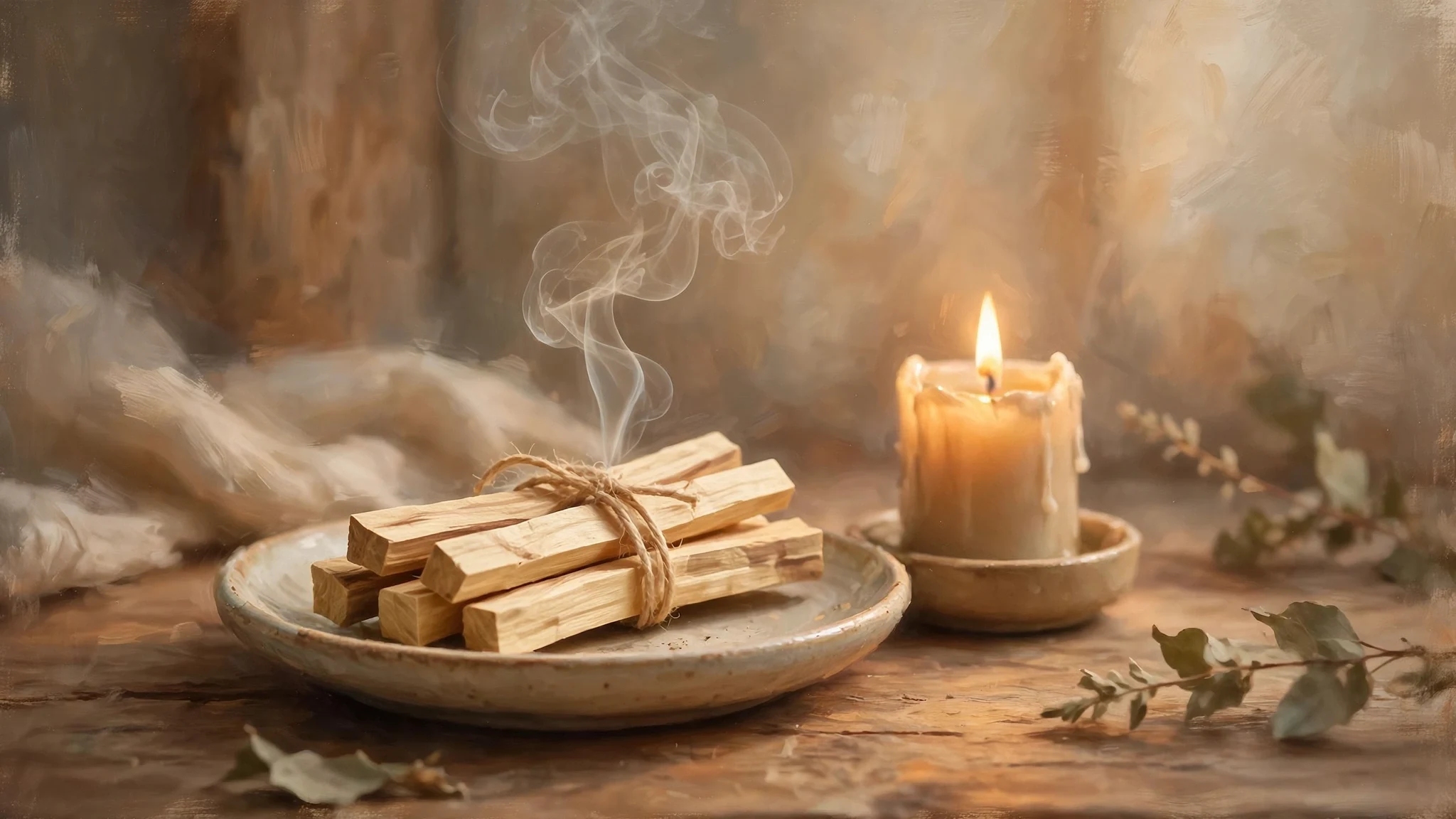
When people ask what is palo santo, they mean a fragrant wood burned as incense for its sweet, citrusy smoke. The name is Spanish and means holy wood. The wood sold in most shops comes from Bursera graveolens, a small to medium tree in the same family as frankincense and myrrh, native to the dry tropical forests of Mexico, Central America, and South America, from Mexico south to Peru, including coastal Ecuador and the Galapagos Islands. A stick of palo santo is lit at one end, allowed to catch, then blown out so it smolders and releases smoke.
Palo santo is used in ceremony, in meditation, in yoga spaces, and in homes, where the smoke is waved through a room, over a crystal, or around a person, with the intention of clearing a space and settling a mood. Indigenous and mestizo communities in Ecuador and Peru have used the wood for generations, in folk healing, in household blessings, and in the work of curanderos, the traditional healers of the region. The modern use in shops and studios is newer, and it raises questions about sourcing, respect, and safety that this page answers in plain terms.
Two Trees, One Name
The name palo santo covers two different trees, and knowing the difference matters. The first is Bursera graveolens, the common palo santo stick, a tree of the dry forests from Mexico to Peru. The International Union for Conservation of Nature, known as the IUCN, assessed Bursera graveolens in 2019 and rated it Least Concern, with a stable population, because it grows across a wide range of countries. It is not listed on any appendix of CITES, the Convention on International Trade in Endangered Species, so international trade in the wood is not subject to special regulation under that treaty.
The second tree is Bulnesia sarmientoi, also called palo santo, from the Gran Chaco region where Argentina, Bolivia, and Paraguay meet. That tree is different in every way: it has dense, heavy, olive brown heartwood, it is listed by the IUCN as Endangered, with a decreasing population, and it has been listed on CITES Appendix II since 2010, which means international trade in its logs, sawn wood, and oil requires export permits. A buyer who wants the common smudging stick should look for Bursera graveolens by name. A buyer who sees a dark, heavy wood sold as palo santo should ask which tree it comes from, because the two trees have very different conservation stories.
Palo Santo in South American Tradition
Long before palo santo sat in a gift box beside a crystal, it was part of daily life along the dry coasts and foothills of Ecuador and Peru. Indigenous and mestizo communities used the wood and its oil in folk healing, in household blessings, and in ceremony. The smoke was used to mark a space, to settle a mood, and to keep biting insects at a distance on warm evenings. The oil was rubbed into aching muscles. The wood was carved into small, everyday objects. The use was woven into a wider cosmology, not sold as a single product.
The traditional rule for harvesting is clear and strict. The living tree does not carry the aroma of commercial palo santo. The aromatic resin develops and crystallizes gradually after the natural death of the tree, over 4 to 10 years during which the dead wood remains on the forest floor. Responsible suppliers collect only naturally fallen wood that has dried for several years, which is when the aromatic oils develop. In Peru, the national list of threatened flora, in a decree from 2006, listed Bursera graveolens as critically endangered within Peru, and the forestry agency SERFOR says that management plans forbid cutting standing live trees and allow only branches, debris, and trees that died naturally. A buyer who cares about the tradition should look for that rule on the label: naturally fallen wood only, with a named source.
How Palo Santo Is Used Today
In a modern home, palo santo is usually burned as a stick. The stick is held at an angle, lit with a match or a lighter, allowed to burn for 20 to 30 seconds, then blown out. The smoldering end releases a thin stream of smoke, which is waved through a room with a hand or a feather, or held near an object such as a crystal or a tarot deck. The stick is then placed in a fireproof dish, where it goes out on its own in a few minutes, and it can be relit many times. A single stick can last for many uses if it is allowed to go out rather than left to burn away.
Other uses include palo santo oil, distilled from the wood and used in a diffuser or diluted on the skin, and palo santo chips, burned on charcoal in a fireproof burner. The scent is sweet, woody, and citrusy, with notes of pine and lemon, and it is often described as calming. The smoke is not a medicine, and it does not clean air in a medical sense. It is an incense, and its value is in the ritual: a pause, a breath, and a moment to mark a change from work to rest, from a busy room to a quiet one.
Is Palo Santo Endangered?
The honest answer is that the common palo santo tree is not globally endangered, yet its supply chain is hard to verify and its habitat is fragile. The IUCN rated Bursera graveolens as Least Concern in 2019, with a stable population, because the tree grows across many countries. The claim that only a few hundred trees are left does not hold up. The bigger concerns are local pressure and unverifiable sourcing. The dry forests where Bursera graveolens grows are among the most threatened habitats in South America, and demand for the wood adds to that pressure, alongside ranching, farming, and building.
In Peru, the species was listed as critically endangered in the national decree of 2006, and it was later removed from that national protected list in 2014, a change that shows how local rules can shift. In January 2026, SERFOR seized more than 1,300 kilograms of illegally sourced palo santo logs in the Piura region and repeated that only naturally fallen or dead material may be collected. A buyer can help by choosing a seller who names the country, the source, and the harvesting rule, by buying less often, and by considering an alternative such as cedar, rosemary, or a local incense when the source cannot be verified. Using less, and using it with respect, is the most honest response to a fragile forest.
How to Burn Palo Santo Safely
Burning palo santo is simple, yet it needs care for fire and smoke. Use a fireproof dish, such as ceramic, stone, or metal, and keep the dish on a stable surface away from curtains, paper, and children. Light the stick, blow it out after 20 to 30 seconds, and never leave a smoldering stick unattended. Open a window or a door for fresh air, because smoke in a closed room can irritate eyes, lungs, and asthma. Keep the stick away from pets, especially birds, which are sensitive to smoke, and keep it away from anyone with asthma or a breathing condition.
Do not burn palo santo near a smoke alarm that cannot be ventilated, and do not use it as a substitute for cleaning, for medical care, or for fixing a damp or moldy room. If the smoke causes coughing, a headache, or a tight chest, put the stick out, open the windows, and leave the room until the air clears. A short burn of one minute is enough for a small room. A long burn adds smoke without adding meaning, and it wastes a wood that takes years to cure. Safety and respect go together: a careful burn honors both the room and the forest the wood came from.
An Illustrative Example: Daniel and the Sunday Burn
This example is illustrative, not a real person's story.
Daniel is a 39 year old chef who burns a palo santo stick on Sunday evenings, after a long week in a kitchen. He lights the stick over the sink, lets it smolder for a minute, waves the smoke through the living room, and then puts the stick out in a ceramic dish. He bought the stick from a seller who named the source as Ecuador and the harvesting rule as naturally fallen wood only, and he keeps the label in a drawer beside the dish.
Daniel does not claim the smoke clears bad energy in a literal sense. He says the Sunday burn marks the end of the working week, gives him a reason to open the windows, and helps him sit down for a quiet hour before Monday. The example shows a grounded use: a named source, a short burn, fresh air, and a clear ritual that marks time. Daniel buys one stick every few months, not one every week, because a little wood, used with care, is enough.
Respect, Alternatives, and a Calm Choice
Palo santo has ceremonial meaning in Indigenous and mestizo traditions in Ecuador and Peru, and some people prefer not to use it casually, or prefer to learn about its roots before buying it. That respect is part of the practice, not an extra. A buyer can honor the root by learning the name Bursera graveolens, by choosing a seller who names the source, by using the wood sparingly, and by thanking the tradition in a quiet way, rather than treating the stick as a fashion item.
If the source cannot be verified, or if smoke is a problem in the home, alternatives work just as well as a ritual: a cedar stick, a rosemary sprig, a beeswax candle, or simply opening windows and tidying a room. The ritual is the pause, the breath, and the intention to mark a space as calm. The wood is one way to make that pause, not the only way. Choose the way that fits the home, the lungs in it, and the forest that the wood came from, and the choice will be a calm one.
For more context, start with the spiritual awakening signs hub, then read what is smudging for the wider practice of clearing a space with smoke. What is a talisman covers an object carried for focus, what is a grimoire holds the old books that recorded such rituals, and how to set up a spiritual altar shows where a stick can be kept with care.
First 3 minutes FREE — every time, for every reading, with all advisors.
For a simple next step, try a One-Card Tarot reading and reflect on how to bring calm into your space.
Frequently Asked Questions
What is palo santo?
Palo santo is the fragrant wood of Bursera graveolens, a tree of the dry tropical forests from Mexico to Peru, burned as incense for its sweet, citrusy smoke, with the Spanish name meaning holy wood.
Is palo santo endangered?
Bursera graveolens is rated Least Concern by the IUCN with a stable population and is not on CITES, while a different tree also called palo santo, Bulnesia sarmientoi, is Endangered and on CITES Appendix II since 2010.
How do you burn palo santo?
Light the stick, let it burn for 20 to 30 seconds, blow it out, wave the smoke through a room, and place the stick in a fireproof dish, with a window open for fresh air.
Where does palo santo come from?
Palo santo comes from Indigenous and mestizo traditions in Ecuador and Peru, where it has been used for generations in folk healing, household blessings, and ceremony.
Is palo santo safe to burn?
Palo santo is safe in a short burn with fresh air and a fireproof dish, but smoke can irritate asthma and breathing conditions, so put the stick out and ventilate the room if coughing or a tight chest appears.
Last updated: November 12, 2026
