
What Is a Spell Jar? Ingredients and Uses
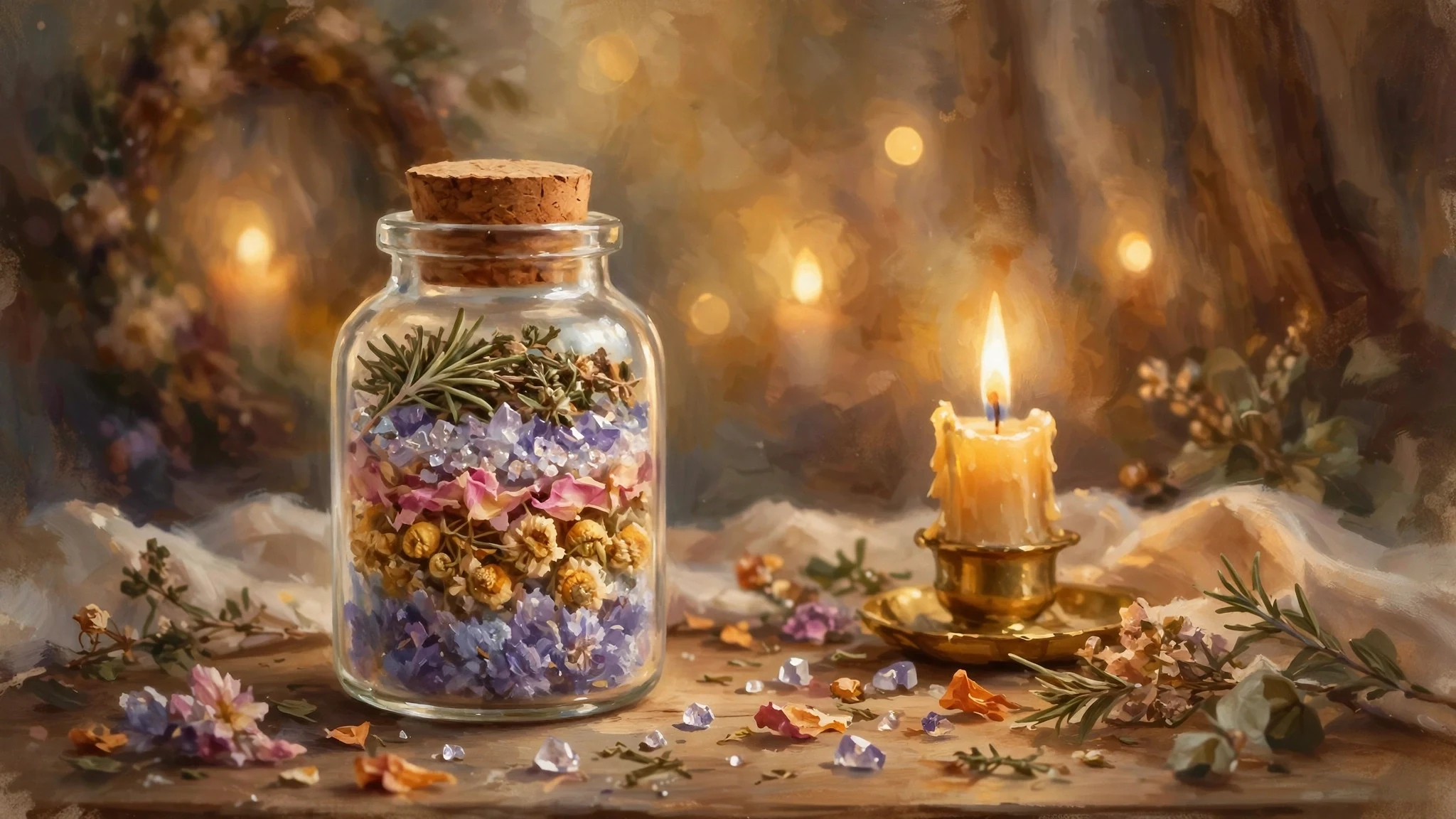
What Is a Spell Jar in Plain Language
When people ask what is a spell jar, they mean a small glass jar filled with specific ingredients, sealed with wax or a lid, and kept as a physical focus for a single intention. A spell jar is not a spell in general. A spell is a ritual, a set of words and actions meant to bring about a change. A spell jar is a specific object, a jar, that holds the ingredients of that spell in one place, so the intention can be seen, held, and kept over time. The jar is the container. The spell is the work that the jar holds.
A typical spell jar contains layers: a base of salt or rice, herbs, a stone, a written intention on a small piece of paper, and sometimes a coin, a feather, or a personal item. The jar is sealed, often with candle wax dripped over the lid, and it is placed on an altar, a shelf, or a windowsill, where it can be seen each day. The jar is not opened again. It is kept until the intention has been met, or until the maker decides to release it. This page is about the jar itself: its ingredients, its construction, its types, and its uses, not about spells in general, which are covered on a separate page on this site.
Spell Jar or Spell: How They Differ
A spell and a spell jar are easy to confuse, because a jar is often made as part of a spell. A spell is the whole ritual: the words spoken, the candle lit, the herbs chosen, the intention held, and the action taken. A spell can be spoken aloud, written on paper and burned, or performed with a candle and no jar at all. A spell jar is one form that a spell can take, a form that keeps the work in a visible, physical object that lasts for weeks or months.
The difference matters in practice. A spell that is spoken once is over in a moment. A spell jar stays on a shelf, and each time the maker sees it, the intention is remembered. A spell jar is also portable and private: it can be kept in a drawer, carried in a bag, or given as a gift, while a spoken spell leaves no object behind. A reader who wants to understand spell jars should keep the two ideas separate: the spell is the intention and the ritual, the jar is the container that holds them. A jar without a clear intention is only a jar of herbs. A spell without a jar can still be a complete spell.
A Short History of Jars in Folk Magic
Jars have been used in folk magic for centuries, in many cultures. In the American South, a witch bottle, a glass bottle filled with pins, nails, hair, and urine, was buried under a threshold or in a wall to protect a home from witchcraft. The practice appears in England and in the American colonies from the 17th century onward, and examples have been found in old houses during renovation. In other traditions, jars were used to hold a written charm, a piece of a plant, or a small object linked to a wish, and the jar was kept in a home as a focus for that wish.
The modern spell jar grew from those roots, through the New Age movement and through books and shops in the late twentieth century. The witch bottle was made for protection and was often buried and hidden. The modern spell jar is made for many aims, protection, love, money, calm, and focus, and it is often kept in plain sight, on a shelf or an altar, as a decoration and a reminder. The form has changed from a hidden bottle to a visible jar, yet the idea is the same: a sealed container, filled with chosen ingredients, kept as a physical focus for an intention.
Ingredients: What Goes in a Spell Jar
The ingredients in a spell jar are chosen to match the intention, and each ingredient is given a meaning in the tradition. Salt is the most common base, used for protection and cleansing, and it is poured in first to form a layer at the bottom. Rice is sometimes used as a base instead, for abundance and for holding the other ingredients in place. Herbs are added next: lavender for calm, rosemary for protection and memory, cinnamon for abundance and warmth, basil for money and luck, and rose petals for love. The herbs are dried, so they keep well in a sealed jar.
Stones are added for a specific aim: clear quartz for clarity, rose quartz for love, citrine for abundance, black tourmaline for protection, and amethyst for calm. A written intention, on a small piece of paper, is folded and placed in the jar, often with the name of the maker and the date. Other ingredients include a coin for money, a feather for lightness, a key for a new door, a small candle, or a personal item such as a hair or a photograph. The ingredients are layered with care, so the jar looks orderly, and the maker can see each layer through the glass. No ingredient is required. A jar with salt, a herb, a stone, and a written intention is a complete spell jar.
Types of Spell Jars
Several types of spell jars appear again and again in books and shops. A protection jar often uses salt, black tourmaline, rosemary, and a written intention for safety, sealed with black or white wax, and placed near a door or a bed. A love jar often uses rose petals, rose quartz, cinnamon, and a written intention for kindness or a new relationship, sealed with pink or red wax, and placed in a bedroom. A money jar, also called an abundance jar, often uses rice, citrine, basil, cinnamon, and a coin, sealed with green or gold wax, and placed in a workspace.
Other types include a calm jar, with lavender, amethyst, and chamomile, for sleep and rest, a focus jar, with clear quartz, fluorite, and rosemary, for study and work, and a healing jar, with rose quartz, amethyst, and a written intention for comfort, for a time of recovery. Each type uses the same structure, a jar, layers, a written intention, and a seal, and each one is judged by the same test: does the jar help the maker return to the intention each day? A jar that is forgotten on a shelf is only a decoration. A jar that is seen, held, and remembered is doing its work.
How to Build a Spell Jar Step by Step
Building a spell jar starts with a clear intention, written in a single sentence on a small piece of paper. A loose wish, such as simply feeling happier, slips away fast. A plain aim, such as sleeping soundly each night or holding focus at work, stays in view far longer. Choose a clean glass jar with a lid, small enough to hold in one hand, and clean it with warm water and a soft cloth. Dry it well, because moisture can spoil the herbs inside.
Pour a layer of salt or rice into the bottom, to form a base. Add herbs in layers, a pinch at a time, so each layer can be seen through the glass. Place the written intention in the center, folded small, and add a stone on top. Add any other ingredients, a coin, a feather, or a small object, and close the lid. Light a candle, drip wax over the lid to seal it, and let the wax cool. The sealing is the moment the jar is set, and it is often done with a short spoken intention, said aloud or in the mind. Place the jar where it will be seen each day, and note the date and the intention in a journal. Do not open the jar again. If the jar is disturbed, rebuild it calmly, because a jar is a practice, not a fragile spell.
How to Use and Release a Spell Jar
A spell jar is used by seeing it, holding it, and remembering the intention it holds. Each morning, a maker may hold the jar for a minute, read the intention in the mind, and then start the day. The jar is not shaken, not opened, and not shown to everyone who visits. It is a private object, kept on a shelf, an altar, or a desk, where it can be seen without being disturbed. If the intention is met, the maker may keep the jar as a reminder, or release it with thanks.
Releasing a jar means opening it, removing the ingredients, and disposing of them with care. Herbs and salt can be composted or thrown away, stones can be cleaned and kept, and the paper can be burned safely or torn up. The jar can be washed and used again. A jar that has not worked after a few months can also be released, without blame, because an intention may have changed, or the time may not be right. A spell jar should never be used to control another person, to harm someone, or to replace a practical step, such as a doctor visit, a job application, or an honest conversation. The jar supports an intention. It does not make a decision for the maker.
An Illustrative Example: Emma and the Calm Jar
This example is illustrative, not a real person's story.
Emma is a 29 year old care worker who built a calm jar during a hard winter, after several nights of poor sleep. She used a small glass jar, a base of salt, dried lavender, a piece of amethyst, and a written intention on a small card: sleep through the night, three times this week. She sealed the jar with white wax, placed it on her bedside table, and held it for a minute each night before turning off the light.
After two weeks, Emma found that sleep had improved, not because the jar changed the night, but because the nightly pause had become a habit that marked the end of the day. She still works long shifts, still feels tired, and still has bad nights, yet the jar has become a steady anchor on the bedside table. The example shows how a spell jar works at its best: a clear intention, a simple set of ingredients, a daily habit, and a written record. The jar did not do the work. It reminded Emma to do the work of rest, and that reminder was enough.
Safety, Cost, and a Calm Choice
A spell jar is safe when it is made with care. Use a clean glass jar, dried herbs, and a fireproof surface for sealing with wax. Keep the jar away from children and pets, because small stones and herbs can be a choking hazard, and keep it out of direct Sun, because heat can change the herbs inside. Do not put a spell jar in drinking water, do not eat the herbs from a jar, and do not use a jar as a substitute for medical care. If a jar contains a stone that is toxic, such as malachite in water, keep it dry and out of reach.
Keep the cost modest. A jar, salt, a herb, a stone, and a candle are enough for a first jar, and the total should be a few pounds, not a large sum. Do not buy a spell jar that promises a guaranteed result, a lottery win, or a medical cure, because no jar can promise those things, and a seller who makes such a promise is selling a hope, not a jar. A spell jar should make a room feel calmer and a day feel more focused. If it does, keep it. If it does not, change the intention, change the ingredients, or put the jar away without guilt.
For more context, start with the spiritual awakening signs hub, then read what is a spell to set the general practice apart from the jar. What is a talisman covers a single object carried with intention, what is a crystal grid shows a pattern built from several stones, and what is wicca explains the modern religion in which many jar makers practice.
First 3 minutes FREE — every time, for every reading, with all advisors.
For a simple next step, try a One-Card Tarot reading and reflect on what a jar may hold for you.
Frequently Asked Questions
What is a spell jar?
A spell jar is a small glass jar filled with specific ingredients such as salt, herbs, a stone, and a written intention, sealed with wax and kept as a physical focus for a single intention.
How is a spell jar different from a spell?
A spell is the whole ritual of words and actions, while a spell jar is one form a spell can take, a sealed container that holds the ingredients and the intention in a visible object over time.
What goes in a spell jar?
A spell jar usually contains a base of salt or rice, dried herbs, a stone, a written intention on paper, and sometimes a coin, a feather, or a personal item, layered in a clean glass jar.
How do you make a spell jar?
Write a clear intention, clean a small glass jar, layer salt, herbs, the written intention, and a stone, close the lid, seal it with candle wax, and place it where it will be seen daily.
What do you do with a spell jar when it has worked?
Keep the jar as a reminder or release it with thanks by opening it, composting the herbs and salt, cleaning and keeping the stones, and washing the jar for reuse.
Last updated: November 12, 2026
