
Spiral Tarot Deck Guide: Art, Cards and Use
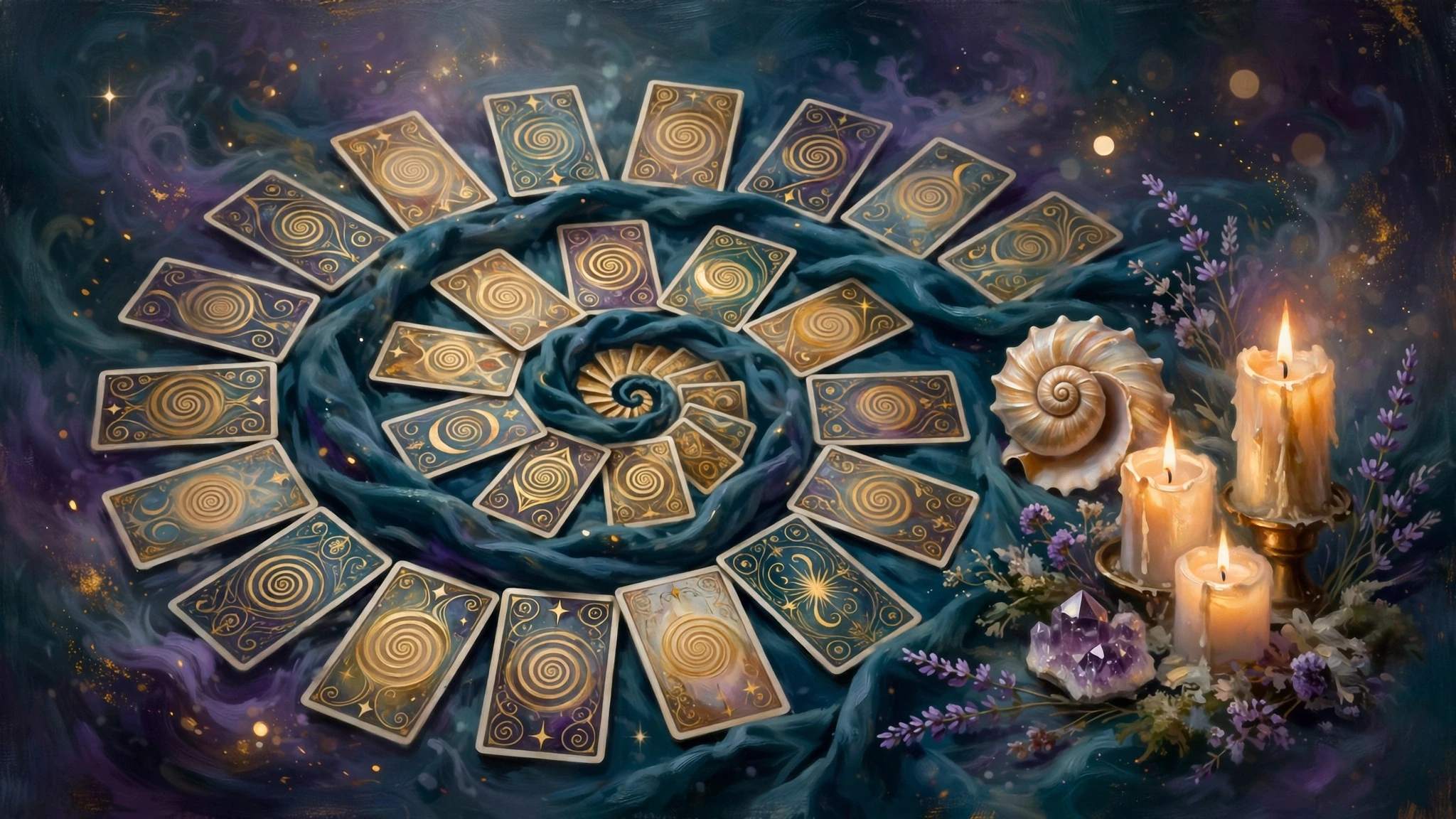
Spiral Tarot Deck Meaning and History
A portrait painter knows that a face is not a symbol. It is a person, with a history, a mood, and a story that can be read in the eyes. Kay Steventon painted portraits for a living, from a studio called Overbank End in Eltham, Victoria, in Australia, and her paintings were shown in Fiji, in America, and across Australia. When she turned to tarot, she brought that portrait eye with her, and the result was the Spiral Tarot deck, published by U.S. Games Systems in 1998. The deck is a set of seventy eight pictures that retell tarot through myth, with figures from Ancient Greek, Roman, and Celtic stories, and with Arthurian characters among them. A reader who already knows the usual tarot order will find the sequence familiar, because the deck keeps the standard order and the standard card names. What changes is the company. Instead of medieval courts and cloisters, the reader meets gods, heroes, and storytellers, painted in deep blues, warm golds, and soft skin tones, in scenes that feel like moments from a tale rather than emblems on a stage. The deck stayed in print for decades, and a larger Premier Edition followed in 2010, which is the clearest sign that readers kept asking for it.
A Portrait Painter Takes Up Myth
Steventon trained as a portrait artist, and that training shows in every card, most of all in the faces. The expressions are clear and human: a hero deciding, a goddess listening, a young figure stepping into a story they do not yet understand. A reader who spends time with a single card will often notice a second figure in the background, a small animal at the edge of the scene, or a detail that was missed on the first look, because Steventon painted the way a portraitist paints, with layers of small observation. The mythic figures are not chosen at random. Greek, Roman, and Celtic stories are stories about journeys, choices, love, loss, and return, and those are the same themes a tarot reading must handle. A card showing a Greek hero on a journey can speak to a reader facing a difficult conversation. A card showing a Celtic figure by a well can speak to a reader who needs a quiet word rather than a formal warning. The spiral in the deck name comes from the motif that runs through the art, a curling line that suggests growth, a path that returns to the same place at a deeper level, and a mind that works in circles rather than straight lines. The card backs carry a spiral design, and the borders of the standard edition are a deep blue with a gold trim.
Princesses, Not Pages: Reading the Youngest Court
The most useful difference in this deck is a small one, and a new reader should learn it early. In each suit, the youngest court card is called a Princess, not a Page, so the court in each suit runs Princess, Knight, Queen, King. A reader who is used to Pages should read the Princess in the same way: as a young person, a new idea, a message, or a beginner energy. The change matters less for the meaning than for the feeling. A Princess in this deck is a figure in a story, often standing at the start of a journey, and the picture gives the reader something to work with. That is true of the numbered cards as well. Every numbered card in the minor suits shows a scene with figures, rather than a bare pattern of suit symbols, which means a reader can work from the picture even before the meaning is memorized. A scene of two figures talking, a figure carrying a heavy load, a figure looking toward a distant hill, each of these can be read directly, and the guidebook meaning can follow. A reader who wants to go deeper can use the myth behind each card as a second layer, looking up the story of the figure shown and asking how that old story fits the present question. The deck comes with a guidebook that gives a short meaning for each card and a few layouts, written in plain language that suits a beginner.
The Two Sizes in the Hand
Tarot decks are objects as well as pictures, and size changes how a deck feels. The standard Spiral cards measure about 2.75 by 4.75 inches, a common tarot size that fits most hands and shuffles easily. The Premier Edition, released in 2010, has larger cards, and the larger size suits readers who like to see the detail clearly, because Steventon painted a great deal of detail into each scene. The two editions hold the same seventy eight cards and the same art, so the choice is about the hand, not about the content. A reader with small hands, or a reader who shuffles at a small table, may prefer the standard size. A reader who reads at a large table, or who likes to study one card at a time in good light, may prefer the larger size. The card stock is firm, and the deep colors reward careful handling, because strong light fades them over time. A reader choosing between the editions should hold both if possible, or study the pictures online, and notice which size invites a longer look. The honest reaction of the hands is a better guide than any list of measurements, because a deck that feels awkward will be used less, however beautiful its pictures are.
One Myth a Week
The Spiral deck rewards a reader who slows down and looks, and the best way to begin is one myth a week. Choose a card, find the figure shown, and read the story of that figure in a book of Greek or Celtic myth. Write the story down in three sentences of your own, then write one line about how that story fits your week. A hero who left home, a goddess who waited, a king who learned to listen, each of these stories has a shape, and the shape can be laid beside a real week to see where they match. Small layouts suit the deck best: a single card at breakfast, a three card line for a question, a five card row for a decision. The pictures carry enough detail to fill a small layout, and a large layout can feel crowded with so much imagery. Questions about making things, about dreams, about growing into a new phase of life, and about understanding a relationship all sit well with this deck, because the myths behind the figures are stories about exactly those themes. Fast readings are a poor fit, since the detail asks for a second look, and a reader who wants bare symbols will find the pictures too busy. Keep a notebook for the first month, one line per day for the card, the figure, and what happened, and the pattern that emerges over thirty days will teach more than any single draw.
An Illustrative Example: Iris and the Ink That Would Not Flow
This example is illustrative, not a real person's story.
Iris, a 36 year old calligrapher who worked from a small studio above a bookshop, bought the Spiral Tarot because she loved the painted faces and wanted a deck that felt like a storybook. She had read tarot with a standard deck for two years, and she found the Spiral art more inviting, though she was unsure whether the mythic figures would change the meanings she knew. She started a simple practice: each Sunday evening, she drew one card, looked up the figure shown, and wrote the story of that figure in three sentences in a notebook beside her inks. In the first week, she drew a card showing a Greek hero on a journey, and she spent the week thinking about a commission she had been avoiding, a wedding invitation that needed a steady hand and a brave decision about the lettering. In the second week, she drew a card showing a Celtic figure by a well, and she spent the week thinking about a student who needed a quiet word rather than a formal correction. After a month, Iris noticed that the mythic layer was helping her to see her weeks as stories, with a beginning, a challenge, and a choice, rather than as a list of jobs. She kept the Sunday draw, and she started to use the deck for a five card spread once a month, with a question about her work. The example shows the deck at its best: the art invites a slow look, the myth gives a story to work with, and the weekly practice builds a relationship that makes the readings feel personal.
A Deck for Storytellers, Not for Speed
A reader who loves stories will love this deck, and that is the simplest test. It fits a beginner who is happy to learn by looking, because every numbered card shows a scene rather than a bare pattern of symbols. It fits a collector who values a deck with a long life, since the 1998 first publication and the 2010 larger edition give it a clear history. It fits a reader who works with dreams and with making things, because the mythic figures open naturally into story based readings. It fits less well a reader who wants a plain and quiet deck, a very small deck, or a modern abstract look. It also fits less well a reader who wants to leave the familiar tarot system behind entirely, because the bones of this deck are that system, dressed in myth. When choosing, look at the pictures and notice the response: does the art make you want to pick the cards up and study them, or does it feel like too much to take in. That honest reaction is a better guide than any list of features, and it is the test Steventon herself would have understood, because a portrait either invites a longer look or it does not.
Looking After Painted Cards
Painted cards need a little care, and the habits are simple. Store the deck in its box or in a wooden box, away from a sunny windowsill, because the deep blues and golds fade in strong light. Keep the cards dry, and keep food and drink away from the reading table, because a stain on a painted face is hard to forgive. Shuffle with a gentle overhand shuffle, and avoid bending the cards sharply, since the stock creases if forced. A dry cloth now and then will lift dust without harming the finish. Read the guidebook through once, because it explains the myths behind several cards and offers a few layouts that suit the deck. To go deeper, read a book of Greek and Celtic myth beside the deck, and look up the figure on each card as it appears, asking how that old story fits the present question. To compare styles, look at the Deviant Moon tarot deck guide for a very different mood, or the the Rider Waite deck guide for the system underneath the Spiral art. Then use the deck every week for a season with a notebook, and let the habit do the teaching.
A reader who likes movement in the artwork will feel at home with the Spiral deck, and layouts that follow a path suit it best. For those layouts, the the layouts hub collects small daily draws and larger spreads in one place. The longer story behind the cards is the journey of the Fool, which walks through the major arcana from start to finish. Picking the right deck is half the work, and the the guide to choosing a tarot deck brings together the guides that compare decks side by side.
A mythic deck, read slowly, can turn a weekly draw into a small story. First 3 minutes FREE — every time, for every reading, with all advisors.
As a simple next step, try a One-Card Tarot reading and think about which myth or story from your own life feels most alive today.
Frequently Asked Questions
Who created the spiral tarot deck?
The Spiral Tarot was created by Australian artist Kay Steventon, a commissioned portrait artist who worked from a studio in Eltham, Victoria. U.S. Games Systems published it in 1998. Steventon painted the deck in a rich and detailed style, drawing on figures from Ancient Greek, Roman, and Celtic myth, and the deck has stayed in print for decades.
How many cards are in the spiral tarot deck?
The deck has 78 cards, with 22 major arcana cards and 56 minor arcana cards in four suits. Its suits are Wands, Cups, Swords, and Pentacles. The court cards in each suit are Princess, Knight, Queen, and King, with Princess used instead of Page for the youngest court card. The minor arcana scenes are fully illustrated.
Is the spiral tarot deck good for beginners?
Yes, it is a good deck for beginners who like detailed art and story based readings. The fully illustrated minor arcana makes the cards easier to read without memorizing long lists, and the guidebook gives a short meaning for each card in plain language. A beginner should spend a week looking through the cards first, and keep a daily journal for the first month.
What is the difference between the standard edition and the Premier Edition?
The Premier Edition, released in 2010, has larger cards than the standard edition, which suits readers who like to see the detail clearly. The standard edition cards measure about 2.75 by 4.75 inches. Both editions have the same 78 cards and the same art, so a reader can choose the size that feels best in the hand.
What kind of readings suit the spiral tarot deck best?
The deck works best for questions about creativity, myth, dreams, and personal growth, and for small spreads such as a one card daily draw, a three card spread, or a five card spread. The rich images give a lot of detail even in a small layout. It is less suited to very fast readings, because the detail rewards a slower look.
Last updated: November 12, 2026
