
Deviant Moon Tarot Deck Guide
The Deviant Moon Tarot Deck: A Guide to the Moonlit Deck
The deviant moon tarot deck is one of the most recognizable decks in modern tarot, and a single look at any card explains why. Every figure has a crescent moon face, long limbs, and a strange, dreamlike quality, as if the whole deck were drawn in moonlight. The deck was created by artist Patrick Valenza and first published by U.S. Games Systems in 2008, with a borderless edition following in 2014. The deck follows the Rider Waite Smith structure, with 78 cards, 22 major arcana and 56 minor arcana, so a reader who knows the classic meanings can use it without learning a new system. The Rider Waite tarot deck guide covers that classic structure in full. What changes is the feeling. The Deviant Moon is a deck for shadow work, for dreams, for the parts of life that are strange, funny, or unsettling, and for readers who want art that surprises them rather than art that soothes them. This guide covers the history of the deck, the art, the card structure, how to read with it, and who it suits best, so you can decide whether it belongs on your shelf.
History: Thirty Years in the Making
Patrick Valenza began the work behind the Deviant Moon as a teenager, drawing the first 13 major arcana cards between 1982 and 1985, when he was 15 to 18 years old, and the companion book to the deck describes the full project as at least thirty years in the making. The art grew out of childhood dreams and a fascination with old cemeteries, and Valenza built the images through a method he calls photographic manipulation, starting with a drawing, scanning it, and layering it with photographs of 18th century tombstones from a cemetery near his childhood home on Long Island. The deck was first published by U.S. Games Systems in 2008, in a bordered edition with a 48 page little white booklet, and the deck carries the ISBN 9781572816367 in that first edition. A borderless edition followed in 2014, with larger cards and no frame, so the artwork runs to the edge. The deck also has a full companion book, Deviant Moon Tarot, published by U.S. Games Systems, in which Valenza tells the stories behind the cards and the long road from teenage sketches to a published deck. The manuscript for the book took almost three years to write, a long effort on its own, though far shorter than the decades the deck itself took to shape.
The Art: Moon Faces, Long Limbs, and Dream Logic
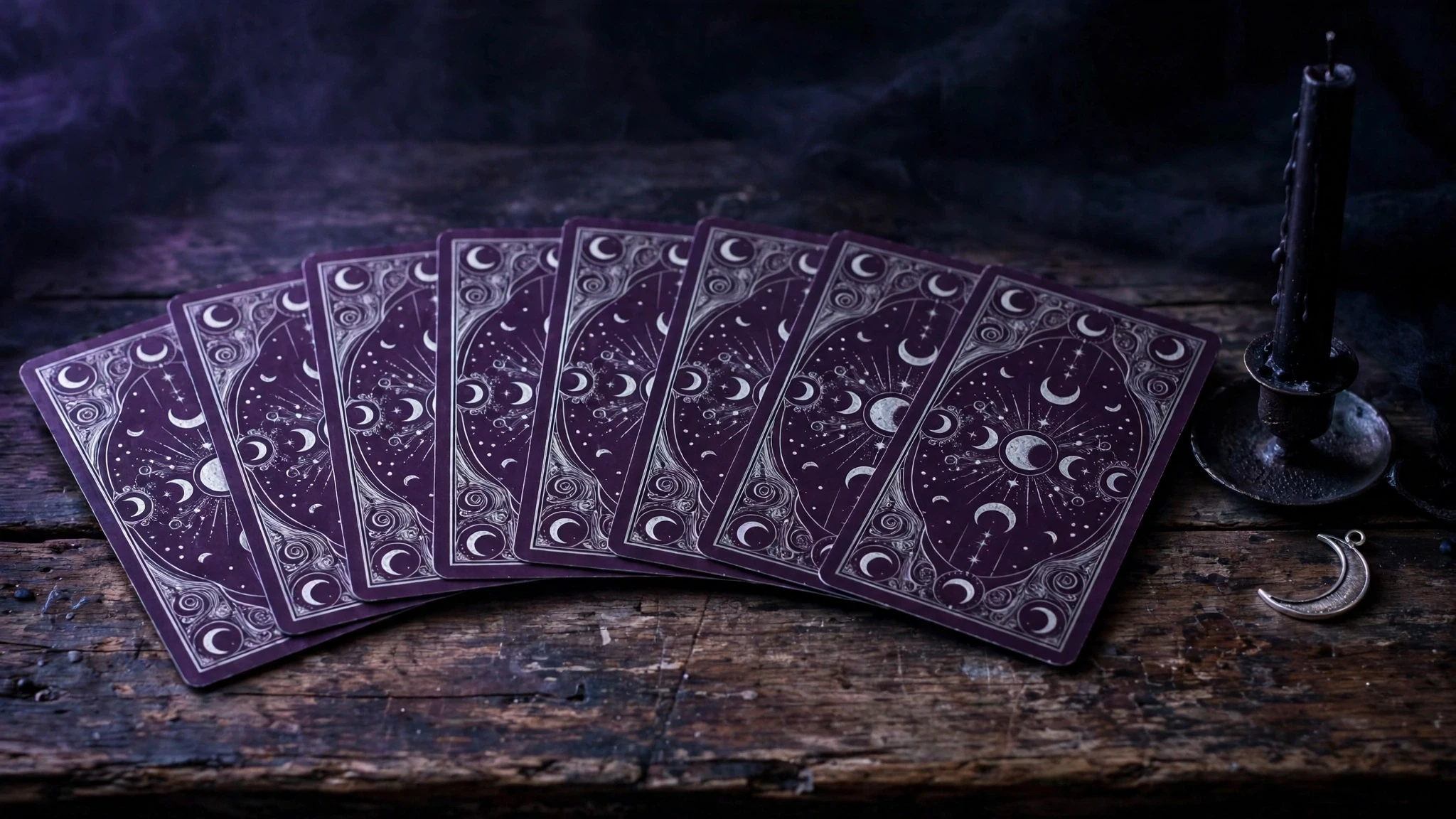
The first thing any reader notices about the Deviant Moon is the art. Every human figure has a crescent moon face, pale and curved, with hollow eyes and a small mouth, and every figure has long, thin limbs that bend in ways real bodies do not. The palette is dark and luminous at once: deep blues, purples, and blacks lit by moonlight, with flashes of red and gold. The style is surreal, closer to a dream than to a photograph, and the cards reward slow looking. The Fool shows a moon faced figure stepping toward a cliff with a small dog, the Moon shows a crayfish and two towers under a huge moon, and the Devil shows a horned figure with chained followers, all rendered in the same moonlit language. The Moon card meaning explains the classic reading of that card, which the Deviant Moon art reimagines. The art is not gentle. Some cards are funny, some are unsettling, and some are both at once, which is the point. The deck pictures the parts of life that are strange, hidden, or hard to name, and the art gives those parts a form. The cards are larger than standard tarot cards, at about 3 inches by 5.25 inches in the first edition, with a reversible back in a brown leather look with white crescents and circles. The size makes the deck harder to shuffle for small hands, and many readers use a table shuffle or a riffle on a flat surface. The borderless edition is the same size, with the frame removed, which makes the art feel even more immersive.
Card Structure: 78 Cards on a Rider Waite Frame
The Deviant Moon follows the Rider Waite Smith structure, which makes it easy to learn for anyone who knows the classic deck. The deck has 78 cards: 22 major arcana, from the Fool at 0 through the World at 21, and 56 minor arcana, in four suits of 14 cards each, with ten numbered cards and four court cards per suit. The suits are Cups, Swords, Wands, and Pentacles, and the court cards are Page, Knight, Queen, and King. The major arcana follow the standard Rider Waite order, with Strength at 8 and Justice at 11, and the minor arcana scenes follow the classic Rider Waite images closely enough that a reader can use standard meanings without relearning the deck. The differences are in tone and detail. The Moon faced figures give even the gentlest cards a dreamlike edge, and the minor arcana scenes add small surreal touches, such as elongated figures, strange animals, and moonlit landscapes, that invite a reader to look twice. The deck includes a 48 page little white booklet in English, which gives a short upright meaning for each card. For deeper study, the full companion book gives longer meanings, stories, and spreads. The deck is in English, and the card titles follow the standard Rider Waite names, so a reader can use any standard tarot book alongside it.
Reading With the Deviant Moon
The Deviant Moon reads best for questions about the inner life: dreams, fears, habits, relationships with a hidden side, and the parts of yourself that are hard to name. It is a strong deck for shadow work, the practice of looking honestly at the parts of yourself you usually avoid, because the art itself invites that kind of looking. A three card spread with this deck often goes deeper than the same spread with a gentler deck, because the images push the reader past easy answers. The deck also works well for creative questions, such as a writer blocked on a story or an artist looking for a new direction, because the surreal images spark associations that a literal deck may not. For daily draws, the deck can feel intense, and many readers use it for weekly readings or for specific questions rather than for a daily card. The deck reads reversals well, because the moonlit art already carries a sense of the hidden and the reversed, and a reversed card in this deck often points to something that needs light rather than to a simple block. New readers should start with the standard meanings and let the art add its own layer, rather than trying to read the art alone, and the tarot for beginners guide is a good companion for that first month. If you are new to reading cards, the guide on how to read tarot cards covers shuffling, layouts, and reversals. Keep a journal of readings with this deck, writing down the card, the question, and one line about what the image showed you. Over a month, that journal becomes a personal guide to the deck, and the deck becomes easier to read with confidence.
Who the Deck Suits, and Who Should Wait
The Deviant Moon suits readers who like dark, surreal, or dreamlike art, who enjoy shadow work, and who want a deck that surprises them. It suits readers who already know the Rider Waite Smith system, because the structure is familiar and the art is the new part. It suits collectors who value a deck with a long history and a strong visual identity, and it suits readers who work with dreams, the unconscious, or the stranger parts of life. The deck is less suited to readers who want a gentle first deck, because the art can feel unsettling, and some cards may distract a new reader from the meanings. It is less suited to readers with small hands, because the cards are large and the stock is slick and heavily laminated, which makes shuffling harder. It is less suited to readings for children, because some images are dark or strange, and a gentler deck serves better there. The deck is also a poor choice for a reader who wants a deck that looks traditional, because nothing about the Deviant Moon looks traditional. If you are unsure, look at ten card images online before buying, and ask whether the art draws you in or pushes you away. A deck that draws you in is a deck you will actually use, and the Deviant Moon rewards the readers who feel that pull.
An Illustrative Example: Theo and the Dream Journal
This example is illustrative, not a real person's story.
Theo, a 36 year old writer from Oregon, bought the Deviant Moon after years of reading with a standard Rider Waite deck, because he wanted a deck that matched the strange dreams he had been having. He started a simple practice: each Sunday, he drew three cards with the deck and wrote down one line for each card about what the image showed him, without looking up the meanings first. In the first week, he drew the Moon, the Nine of Swords, and the Star, and the images gave him a story about a fear that was keeping him awake and a hope that followed it. Over eight weeks, by the account in the example, the journal showed a pattern: the deck kept pointing to a novel Theo had set aside, and the images kept returning to the same theme of a door left closed. In the ninth week, Theo opened the manuscript again and wrote for an hour each morning. The example shows the deck doing what it does best. It did not give Theo a prediction. It gave him images that matched his inner life closely enough to name what he had been avoiding, and the naming was the step that mattered.
Buying, Caring For, and Storing the Deck
The Deviant Moon is widely available from bookshops, tarot shops, and online sellers, in both the bordered first edition and the borderless edition, and the deck usually sells at a standard price for a 78 card deck with a booklet. When buying, check that the box lists 78 cards and the U.S. Games Systems imprint, and buy from a seller you trust, because popular decks attract copies. The cards are slick and heavily laminated, which protects the art but makes the deck slippery when new. Shuffle on a table or a cloth until the cards loosen, and store the deck in its box or in a bag to protect the edges. The larger size means the deck needs a bigger bag or box than a standard deck, and a cloth wrap works well for travel. Clean the cards with a dry soft cloth if they pick up dust, and keep them away from water and direct sun, which can warp the stock and fade the dark palette. If you buy the companion book, read it alongside the deck, because the stories behind the cards add a layer that the little white booklet cannot. The deck is a tool that rewards care, and a well kept Deviant Moon lasts for years of readings.
More deck guides sit on the how to choose a tarot deck hub.
For a simple next step, try a One-Card Tarot reading and reflect on which deck on your shelf matches the question you are asking today. First 3 minutes FREE — every time, for every reading, with all advisors.
Frequently Asked Questions
When was the deviant moon tarot deck first published?
The deck was first published by U.S. Games Systems in 2008, in a bordered edition with a 48 page little white booklet. A borderless edition followed in 2014, with larger cards and no frame. The deck was created by artist Patrick Valenza, who began the first cards as a teenager in the early 1980s.
How many cards are in the deviant moon tarot deck?
The deck has 78 cards: 22 major arcana, from the Fool at 0 through the World at 21, and 56 minor arcana in four suits of 14 cards each. The suits are Cups, Swords, Wands, and Pentacles, and the court cards are Page, Knight, Queen, and King. The structure follows the Rider Waite Smith system.
Is the deviant moon tarot deck good for beginners?
The deck is usable for beginners because it follows the Rider Waite Smith structure, so standard meanings apply. It is not the gentlest first deck, though, because the surreal moonlit art can feel unsettling and the cards are large and slick to shuffle. A beginner who loves the art will learn it well, while a beginner who finds the art distracting should start with a gentler deck.
What is the deviant moon tarot deck best for?
The deck is best for shadow work, dreams, and questions about the inner life, because the moonlit surreal art invites honest looking at the parts of life that are strange or hidden. It also works well for creative questions. It is less suited to gentle daily draws or to readings for children, where a softer deck serves better.
What is the difference between the bordered and borderless editions?
The bordered first edition from 2008 has a thin frame around each card image, while the borderless edition from 2014 removes the frame so the artwork runs to the edge of the card. Both editions have 78 cards and the same art. The borderless edition feels more immersive, while the bordered edition is the original published form.
Last updated: November 12, 2026
