
Smoky Quartz Meaning: Grounding Stone Guide
Smoky Quartz Meaning: The Stone That Holds You Steady
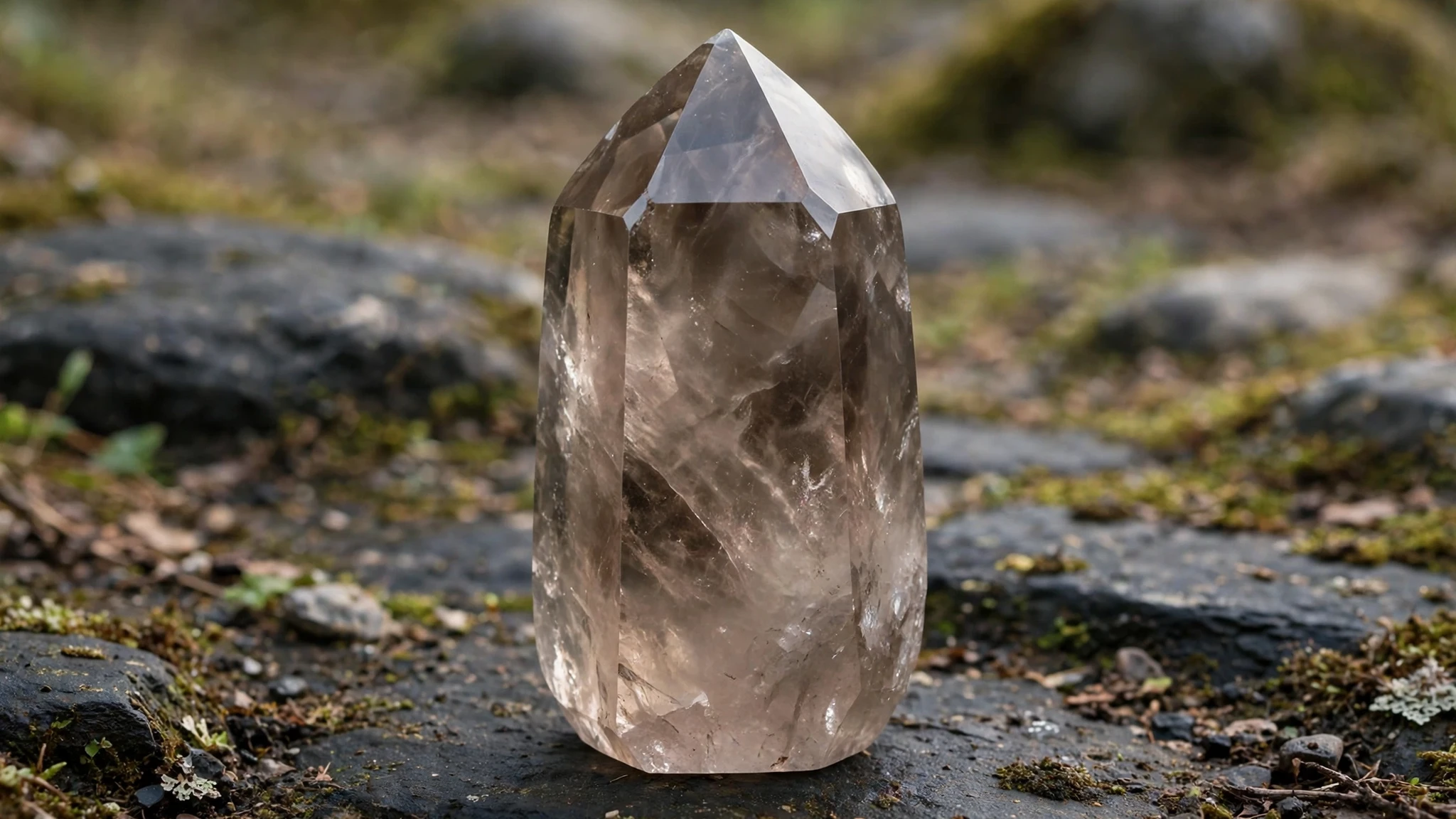
Smoky quartz is the grounding stone of the quartz family, and its meaning starts with its color. It is quartz in shades of brown and gray, from a pale champagne mist to a deep cognac brown, and at its darkest it is almost black, a variety traditionally called morion. The color looks like smoke caught inside glass, and that is almost literally what it is: a clear quartz crystal whose structure was changed, over millions of years, by natural radiation in the rock around it. This page covers how smoky quartz gets its color, where it comes from, and how it fits the wider subject gathered in the spiritual awakening signs hub, how to tell natural stone from treated stone, and how people use it for grounding, protection, and letting go.
Smoky quartz is a variety of macrocrystalline quartz, the mineral silicon dioxide, SiO2, the same mineral that gives us clear quartz, amethyst, citrine, and rose quartz. It rates 7 on the Mohs hardness scale, hard enough to scratch glass and to stand up to everyday handling, and it has no easy cleavage planes to chip, which makes it a durable stone for jewelry and for objects kept on a desk. Its specific gravity is 2.65, the same as other quartz, and its refractive index runs from 1.544 to 1.553. Those numbers matter because they are how a gemologist confirms that a stone is quartz and not glass: glass is softer, lighter, and optically different, and a simple hardness and weight check will tell them apart.
How Radiation Turns Clear Quartz Smoky
Pure quartz is colorless. Smoky quartz gets its brown to gray tint from two things working together: tiny amounts of aluminum that slip into the crystal lattice in place of silicon as the crystal grows, plus exposure to natural radiation over geological time. Trace radioactive elements in the surrounding granite or pegmatite give off low level gamma radiation, and that radiation acts on the aluminum bearing spots in the crystal to create what mineralogists call color centers, small structural changes that absorb certain wavelengths of light and leave the stone looking smoky. The longer or more intense the exposure, the darker the stone. The deepest natural stones are the ones that sat longest near mildly radioactive rock.
The stone itself is not radioactive, and it is perfectly safe to handle. The radiation changed the crystal's structure millions of years ago and is long gone. What remains is the color, and the color is stable in ordinary use, with two exceptions. Strong heat can bleach it: heating smoky quartz to around 200 to 300 degrees Celsius fills the trapped holes with electrons returning to their ground state, and the stone reverts to a colorless or pale yellow state. Strong ultraviolet light can do the same thing more slowly, which is why smoky quartz should not be left in direct sun on a windowsill for months at a time. Keep it out of prolonged sun, and the color will last.
Natural smoky quartz is rarely pitch black throughout. It usually keeps some translucency, and it often shows color zoning, where the darkness follows the growth faces of the crystal in bands or patches. That uneven color is a good sign. A stone that is perfectly even, jet black, and cheap is more likely to be colorless quartz that was exposed to gamma radiation in a laboratory. That treatment mimics the natural process, produces stable color, and is a normal, accepted practice in the gem trade, much like heat treated citrine or irradiated blue topaz. Irradiated smoky quartz is not fake quartz. It is real quartz that got its color in a lab instead of in the ground. But it is not natural, and if buying a naturally colored crystal matters to you, that distinction is worth knowing. A large share of the smoky quartz on the market, especially the deep dark material, was treated this way, and a reputable seller will tell you when asked.
Cairngorm: The Stone of the Scottish Highlands
Smoky quartz from the Cairngorm Mountains of Scotland has its own name, Cairngorm, and its own history. It is Scotland's national gemstone, and it turns up in traditional Highland dress, set into kilt pins, brooches, and the pommels of dirks. The stones were collected from the granite of the Cairngorms, where large crystals grew in pockets, and they were cut and polished in Scotland for centuries. A Cairngorm stone in a kilt pin is not just a decoration. It is a statement of place, the way a tartan is a statement of family.
The Cairngorm connection gives smoky quartz a cultural history that most quartz varieties do not have. It was worn by Scottish nobility, it appears in portraits from the eighteenth and nineteenth centuries, and it remains a symbol of the Highlands today. Collectors value documented Cairngorm material, and its provenance is established by documentation, not by gemology, because the material itself is identical to smoky quartz from any other source. A stone from the Cairngorms and a stone from Brazil are the same mineral, made the same way, and only the paperwork tells them apart.
Other important sources include the Swiss Alps, where dark smoky quartz has been collected for centuries, Brazil and Madagascar, which produce large quantities of commercial material, and the United States, where notable deposits occur in Colorado and elsewhere. The Swiss material is often deep and clean, the Brazilian material is often large and pale to medium brown, and the Scottish material is prized for its history rather than its size. When you buy a smoky quartz, ask where it came from. A seller who knows the source is a seller who cares about the stone.
What Smoky Quartz Means in Crystal Tradition
In crystal tradition, smoky quartz is the grounding stone. Its meaning centers on stability, protection, and letting go of what you no longer need to carry. Where clear quartz is described as amplifying, and amethyst is described as calming, smoky quartz is described as grounding: it brings energy down, steadies the mind, and helps a person feel present in their own body. Practitioners use it at the end of a difficult day, during stressful periods, and in rooms where they want to feel settled rather than scattered. Those links come from crystal tradition rather than from laboratory science, and this page offers them as old practice, not as proven fact.
The grounding meaning fits the stone's geology in a way that is easy to appreciate. Smoky quartz forms in granite, deep in the Earth, over millions of years, and its color comes from the rock around it. It is literally a stone of the deep Earth, and its traditional meaning follows from that origin: steadiness, endurance, and the slow work of time. People who work with it often describe it as the stone they reach for when they feel scattered, anxious, or overwhelmed, the way you might reach for a heavy blanket or a hot drink. The stone does not fix the feeling. It gives the hands something solid to hold while the feeling passes, and that is a real and useful function.
Smoky quartz is also linked with release. Its traditional use is for letting go of old habits, old worries, and old attachments, and for clearing a space, literal or mental, of what no longer belongs there. That meaning pairs naturally with its color: smoke rises and disperses, and the stone's smoky tint suggests something leaving rather than something arriving. If you use it in intention work, keep the practice simple and short. Hold the stone, name one thing you are ready to set down, and name one thing you are ready to pick up instead. Put both sentences on paper, because a written release is one you can return to and check, while a thought alone slips away by evening. A release named in plain words is a release you can actually keep.
Using Smoky Quartz at Home and at Work
The most common use of smoky quartz is as a desk stone. A tumbled piece or a small point kept on a desk, near a computer, or by a front door is the standard placement in crystal tradition, and it works well because the stone is durable, affordable, and unobtrusive. A large cluster or a carved piece can anchor a room, and a small tumbled stone can travel in a pocket or a bag. Choose the size that fits the place. A stone too large for a desk will be moved and forgotten. A stone too small to notice will be ignored. The right size is the one you actually see and touch each day.
In jewelry, smoky quartz is versatile. Its brown and gray tones work with gold and silver alike, and its hardness of 7 makes it suitable for rings, pendants, and bracelets worn daily. It is one of the few dark stones that is both affordable and durable, which makes it a good choice for a first piece of crystal jewelry. A smoky quartz ring in a simple setting is a practical everyday piece, and a pendant in a deep cognac brown is a striking one. Because the stone is common, prices are modest, and a large, clean stone costs far less than a comparable sapphire or topaz.
Smoky quartz also pairs well with other stones. Beside clear quartz, its dark tone stands out, and beside peridot its brown makes the green look brighter by contrast. and the pair is often used together in display: the clear stone for clarity, the smoky stone for grounding. Beside black tourmaline, it offers a softer, warmer kind of protection, less stark and more approachable. In a collection, smoky quartz is the steady stone, the one that makes the brighter stones look brighter by contrast. Keep it where you work or where you rest, not hidden in a drawer. A grounding stone you cannot see is a grounding stone you will not use.
Choosing, Cleaning, and Caring for Smoky Quartz
Choosing smoky quartz is mostly about color and transparency. Look for a stone with a warm brown tone rather than a cold gray one, and with enough transparency to let light pass through the edges. Hold it up to a light and look through it. Even in dark pieces, you should see light at the edges, and you may see color zoning, the bands of lighter and darker brown that mark natural growth. A stone that is opaque black throughout may be morion, the darkest natural variety, or it may be treated material. Ask the seller which it is. A reputable seller will tell you.
Check for damage. Smoky quartz has no cleavage, so it does not split easily, but it can chip if it is knocked hard against a harder surface. Look at the edges and the point of a crystal for small chips, and avoid stones with cracks that run through the middle. A small chip on a tumbled stone is normal and does not hurt its use. A crack through a faceted stone is a flaw that should lower the price. Buy from a seller who lets you examine the stone in daylight and who answers questions about treatment and source.
Cleaning is simple. Wash smoky quartz in a bowl of lukewarm soapy water, wipe it with a soft cloth or a soft brush, then rinse it under running water and pat it dry with a clean cloth. For the monthly routine, see how to charge crystals, and for a stone that traditionally cleanses others, read selenite. It is water safe and durable, so ordinary washing will not hurt it. Keep steam and ultrasonic cleaners away from set stones, and keep strong chemicals off it too. Store it away from long stretches of direct sun, because ultraviolet light can fade the color centers over time, and keep it away from heat above 200 degrees Celsius. A windowsill that takes full afternoon sun is the wrong home for a smoky quartz. A desk, a shelf, or a bedside table suits it far better.
An Illustrative Example: The Stone on the Desk
This example is illustrative, not a real person's story.
A man named Tom, a 45 year old accountant, kept a small smoky quartz point on his desk during a year when his office was going through layoffs. He did not believe the stone changed anything, and he said so plainly when friends asked. He kept it because it was heavy, cool, and brown, and because picking it up during a tense phone call gave his hands something to do while he listened. Over the year, the stone became part of his routine: he picked it up before difficult calls, set it down afterward, and wiped it clean on Fridays. When the layoffs ended and his job was safe, he kept the stone on the desk anyway, because it reminded him of a year he had gotten through. The lesson is not that the stone protected him. The lesson is that a solid, affordable object, used as part of a daily routine, can steady a person through a hard year, and that is a real use, even without a supernatural claim.
Smoky quartz is a modest stone with a deep history: millions of years in granite, centuries in Scottish Highland dress, and a present life on desks and in pockets around the world. It is durable, affordable, and plain about what it is. Its meaning is grounding, and its use is simple. Hold it, notice its weight, and let it bring your attention back to the ground under your feet. Nothing more is asked of it.
If you would like guidance on working with smoky quartz or building a grounding routine, remember that you can speak with a real advisor about it. First 3 minutes FREE — every time, for every reading, with all advisors.
For a simple next step, try a One-Card Tarot reading and reflect on what the card suggests about steadying yourself this week.
Frequently Asked Questions
What is smoky quartz?
Smoky quartz is a brown to gray variety of quartz, the mineral silicon dioxide, SiO2. It rates 7 on the Mohs hardness scale, and its color comes from aluminum in the crystal lattice plus natural gamma radiation from surrounding rock over millions of years. The darkest natural variety is traditionally called morion.
Is smoky quartz natural or treated?
Both exist. Natural smoky quartz gets its color from millions of years of natural radiation, and it often shows uneven color zoning. A large share of commercial smoky quartz, especially deep dark material, is colorless quartz that was gamma irradiated in a lab. The treatment is stable and accepted in the trade, and a reputable seller will tell you which kind a stone is.
Is smoky quartz safe to handle?
Yes. The stone is not radioactive. The radiation changed its crystal structure millions of years ago and is long gone. It is safe to wear, to hold, and to keep at home. Keep it out of prolonged direct sunlight and away from heat above 200 degrees Celsius, because both can fade the color.
What does smoky quartz mean in crystal tradition?
In crystal tradition, smoky quartz is the grounding stone, linked with stability, protection, and letting go of what you no longer need to carry. Those links come from crystal tradition, not from science. It is often kept on a desk or by a door, and used as a steady object to hold during stressful moments.
Can smoky quartz go in water?
Yes. Smoky quartz is water safe and durable at Mohs 7. Wash it in warm soapy water with a soft cloth, rinse well, and dry it with a soft towel. Avoid steam and ultrasonic cleaners on set stones, and store it away from prolonged sunlight so the color does not fade.
Last updated: November 12, 2026
