
Dumb Supper: A Samhain Dinner for Your Ancestors
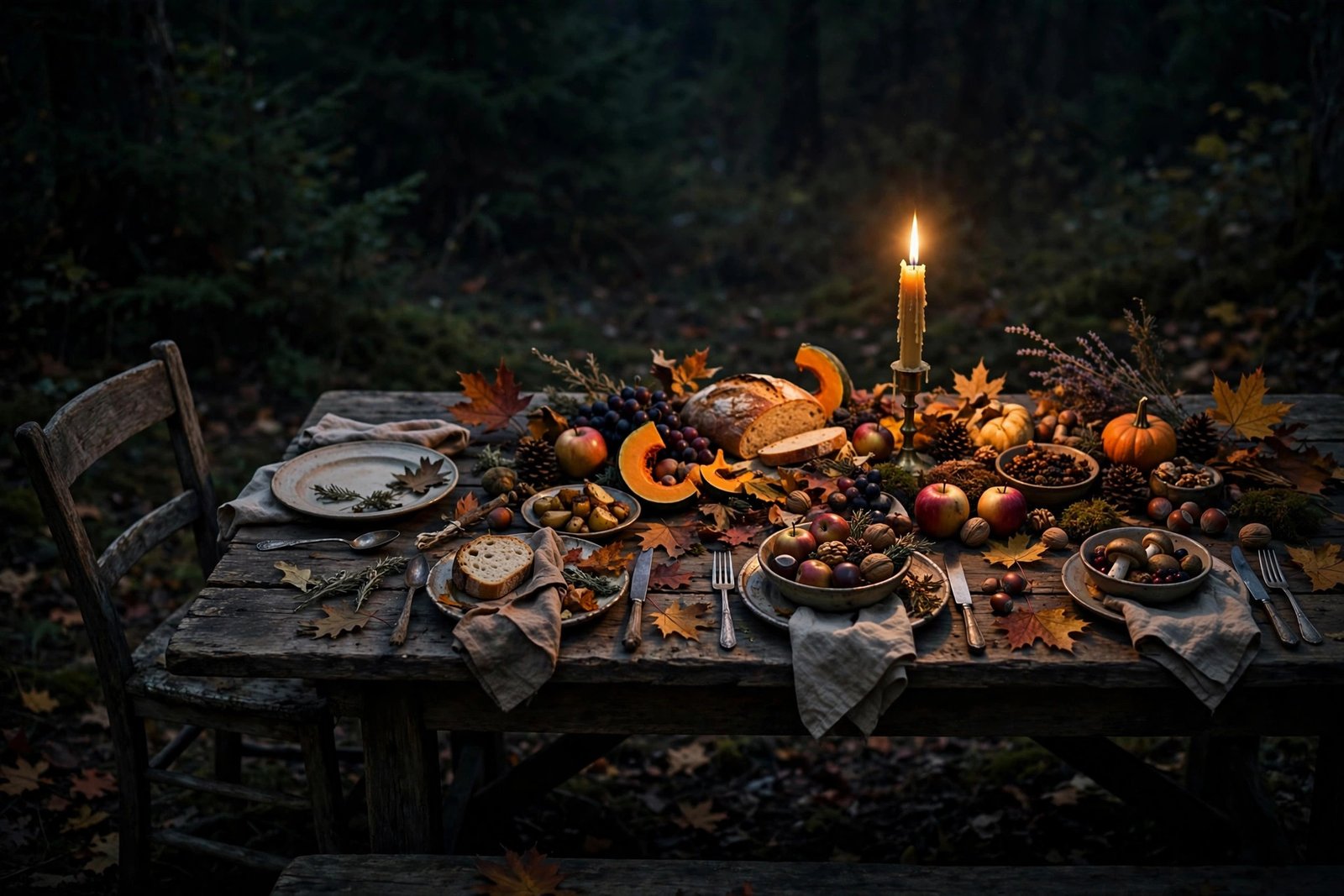
On the last night of October, some people cook a full dinner, set an extra place at the table, serve that empty seat a proper portion — and then eat the whole meal without speaking a single word. No conversation, no television, no phone face-down beside the plate. Just candlelight, warm food, and a chair that nobody treats as truly empty.
That is a dumb supper. "Dumb" here carries its older meaning: silent, without speech. The custom has folk roots in Ireland, Scotland, and rural American communities, where families held quiet meals around Samhain and Halloween — the stretch of the year when the dead were believed to wander closest to the living. Some households hoped for a sign from someone they'd lost; others simply wanted one evening when the people who came before them were fed and remembered as guests.
People still do it for the same mix of reasons: grief that hasn't finished, gratitude never expressed, or the wish to feel close to someone gone. One honest note before we begin: this is a tradition, not a promise. Nobody can guarantee you a visitation, and any version of this ritual that claims otherwise is selling something. What a dumb supper genuinely offers is an hour of undivided attention aimed at someone you miss — and many people find that more powerful than they expected.
This guide is the modern, manageable version: a small kitchen, a rented apartment, just you, and a grocery budget. You don't need to call yourself a witch or a pagan. For the background on where Samhain comes from and why October 31 carries its weight, see our guide to what Samhain means and how its traditions began. Here, we cook.
What You Need
Far less than the internet suggests:
- A table — or a tray, a desk, a coffee table, a blanket on the floor. The furniture is negotiable; the pause in your ordinary evening is not.
- Two full place settings — plate, cutlery, glass, napkin. One for you, one for them.
- A candle, or an LED candle where open flame is banned. Apartment rules outrank atmosphere every time.
- A photograph or keepsake of whoever you're honoring. A phone propped at their setting, screen lit with their picture, works fine.
- Food for one real dinner (menu below) and something to drink at their place.
- One uninterrupted hour, give or take.
On cost: with kitchen basics on hand, this comes in under fifteen dollars — soup ingredients, a decent loaf, a few apples. Spend on the meal, not on props. Your ancestors would rather be fed well than impressed by a new tablecloth.
First, Decide Who Is Coming to Dinner
Most guides skip this, and it may be the most important decision of the evening: open the seat to your ancestors as a whole, or invite one specific person.
The general invitation is gentler — a good first attempt. The specific invitation is more intimate: their photograph, their favorite dish, your thoughts aimed one direction all evening. If the grief is fresh, know that a specific seat can hit hard. That isn't a reason to avoid it; keep the tissues within reach.
One plain truth: you are allowed to be selective. Nobody is owed a chair at your table, living or dead. A relative who caused real harm doesn't earn an invitation simply by having died, and leaving them off the list is not a failure of the ritual. Feed the ones you can remember honestly. That is enough. Some hosts also set a small place for a friend who was family in every way that counted; the tradition has always bent toward the people doing the remembering.
Setting the Table
Lay their setting at the head of the table if you have one, or directly across from your seat — somewhere your eyes land naturally. Use the full arrangement: plate centered, cutlery in place, glass poured, napkin folded. A lonely saucer pushed into a corner sends a message, and it isn't welcome. Set the place as you would for a guest whose good opinion matters.
Rest their photograph or keepsake behind their plate, where a face would be. Set the candle between the two settings, close enough to light both. Dim the overheads if you can; lamplight settles the mind faster.
Then deal with modern intrusions before they deal with you. Phone in another room — not silenced on the table, but in another room, charging, forgotten. Housemates warned. The silence starts with the room itself, long before the first bite. Arrange everything before cooking finishes, so entering the meal is a step, not a scramble.
The Food: One Real Dinner, Served Twice
The menu rule is simple: one dinner, two plates, equal portions. Whatever you eat, they are served — not a symbolic spoonful, but a full serving with the same care.
A menu that works and costs little:
- A pot of soup or stew as the centerpiece — potato and leek, or root vegetables (carrot, parsnip, turnip, onion) with barley. The foods this season actually produces.
- Good bread, bought or baked, with butter.
- Something green and plain — a simple salad or steamed greens.
- Apples to finish — baked apples, an apple crumble, or sliced apples with cheese. Apples have been bound to this night for centuries, and they're at their best now.
- A drink at their setting — whatever they drank in life, if you're honoring someone specific: tea, black coffee, a glass of wine. Unsure? Water is traditional and never wrong.
Serve their plate first, while the kitchen is still an ordinary, clattery place. Carry it in, set it down gently. Then yours.
And a liberating note on favorites: if your person loved a specific dish — a particular takeout chicken, a boxed cake made exactly one way — that outranks any thematically perfect menu. Feeding someone what they actually liked is the whole point.
The Silence, Explained Honestly
The ritual runs on attention. Conversation turns a meal into a social event; silence turns it into an act of listening. That is why the supper is dumb. You're not performing reverence for an audience. You're sitting still, in the quiet, with your mind pointed at people no longer reachable any other way.
What breaks the silence? Talking. Television, podcasts, radio. Music with lyrics — and, in the modern edition, scrolling anything. What doesn't: the fridge humming, rain, your stomach announcing itself. A laugh that escapes you ruins nothing. Neither do tears. If you cry through the soup course, you haven't failed the ritual; you've arguably had it.
On music, one practical suggestion: try ten honest minutes of true quiet first. The discomfort of an empty room usually passes, and many people end up liking how loud a silent room feels. If you still want sound after that, very low instrumental music is a fair modern compromise.
Doing it alone deserves a straight answer: yes, it works alone — arguably best alone. Nobody to accidentally talk to, nobody to feel watched by. The quiet is purely yours. Plenty of people who've kept this custom for years quietly prefer the solo version.
The Meal Itself
Table set, their serving plated, phone exiled. The evening runs like this:
1. Sit down and light the candle. Treat the striking of the match as the hinge of the evening — everything before it was preparation, everything after it is the supper. The silence begins at the flame, not whenever you remember to stop talking. 2. Make a small, wordless welcome. Look at their photograph. A slow nod, a hand over your heart, a glass raised an inch in their direction. Any small, true gesture does the work; there is no script to get wrong. 3. Eat at an ordinary, unhurried pace. Don't chew reverently. Eat good food while it's hot and let your thoughts wander. Most people find memories arriving uninvited — a voice, a childhood kitchen, a joke unthought-of for a decade. That drift isn't a distraction from the ritual. It is the ritual. 4. When your plate is empty, stay seated. Pour a little more of whatever you're drinking and sit in the quiet instead of leaping up to stack dishes. Ten unhurried minutes is plenty. This lingering stretch, with nothing left to do but be present, is the part people describe most afterward.
If nothing stirs — no shiver, no presence, no cinematic moment — that is a completely normal evening too.
How to Close the Supper
End the way you began: deliberately. Don't stand up, flick on the lights, and carry plates to the sink as if the hour were a power cut. The closing is part of the custom and takes about ninety seconds.
Break the silence aloud, with thanks. Your own words are best; borrow this shape if you need one: "Thank you for everything you handed down to me. You're remembered at this table, and you're welcome here." Honoring one person, say their first name. The dead in these stories were family, not royalty — a plain "thanks for coming; I miss you" said aloud beats any formal invocation.
Once the thanks are spoken, snuff the candle — or switch off the LED — and only then bring the lights up. Your voice will sound oddly loud after an hour of quiet. Everyone notices it. It fades by the time the kettle boils.
What Happens to the Ancestors' Plate
Leave their serving where it is overnight. In the tradition, the offering stays until morning — the meal was theirs, on their schedule.
Next day, take the food outside and return it to the ground: the base of a tree, a garden bed, a compost heap. Pour their drink onto the soil. Apartment life adjusts this without breaking it — a compost caddy down to the building's bins, or food at a street tree, carries the same intention. The meaning was never in the acreage.
Don't eat their portion yourself. Partly that's the tradition — a given gift isn't taken back. Partly it's unromantic food safety: a plate at room temperature all night isn't tomorrow's lunch. Birds and soil microbiology will handle the rest, as they have always done.
The Next Few Days
Keep a notebook by the bed for the next few nights. Vivid dreams are the most common thing people report after a dumb supper — sometimes featuring the person honored, sometimes just unusually bright. Whether you read those as a visit or as your mind given an hour to work is your call; writing them down before they evaporate costs nothing.
In waking hours, watch loosely rather than hunting for proof: a song they loved surfacing somewhere unlikely, their name appearing somewhere odd, a memory arriving fully formed. If you're curious about the patterns people most often describe, our guide to the signs a deceased loved one is visiting you collects them.
And if the honest report is that nothing happened — no dreams, no signs, no shiver — consider what did. You cooked a real dinner and sat in silence for an hour with your full attention on someone who mattered. In a year running at double speed, that was never wasted.
Variations
The solo version is the one this guide describes: one setting for them, one for you, silence kept by a party of one. It needs no modification — it is the standard, not the compromise.
The household version works when everyone at the table agrees in advance. Explain the rule before the day, not at the table, because an hour of silence surprises people unprepared for it. Young children do better joining for a short stretch — the first fifteen minutes, or just the apple course — than a full silent hour. Agree on a gentle signal, like a raised hand, for anyone needing to leave quietly.
The no-cooking version skips the stove: buy the best ready meal, rotisserie chicken, or bakery dinner your budget allows, finish all unwrapping and reheating before the candle is lit, and set the same careful table. The ritual lives in the silence and the setting, not in whether you peeled the potatoes.
A Three-Card Reading to End the Night
Once the supper is closed and the candle is out, some people draw cards while the evening is still fresh — a quiet coda. Three positions work well: one card for what your ancestors most want you to hear, one for what is worth carrying forward, and one for what you may finally set down.
Draw right now with our free three-card tarot spread and sit with the cards as long as you like. For a larger layout built for this exact night, our Halloween tarot spread was designed for Samhain's questions. And when a question from the evening won't leave you alone, PsychicSmile's advisors are available by live chat — First 3 minutes FREE — every time, for every reading, with all advisors.