
Conjunction Aspect Astrology: Fusion, Orb and Meaning
What a Conjunction Aspect in Astrology Means
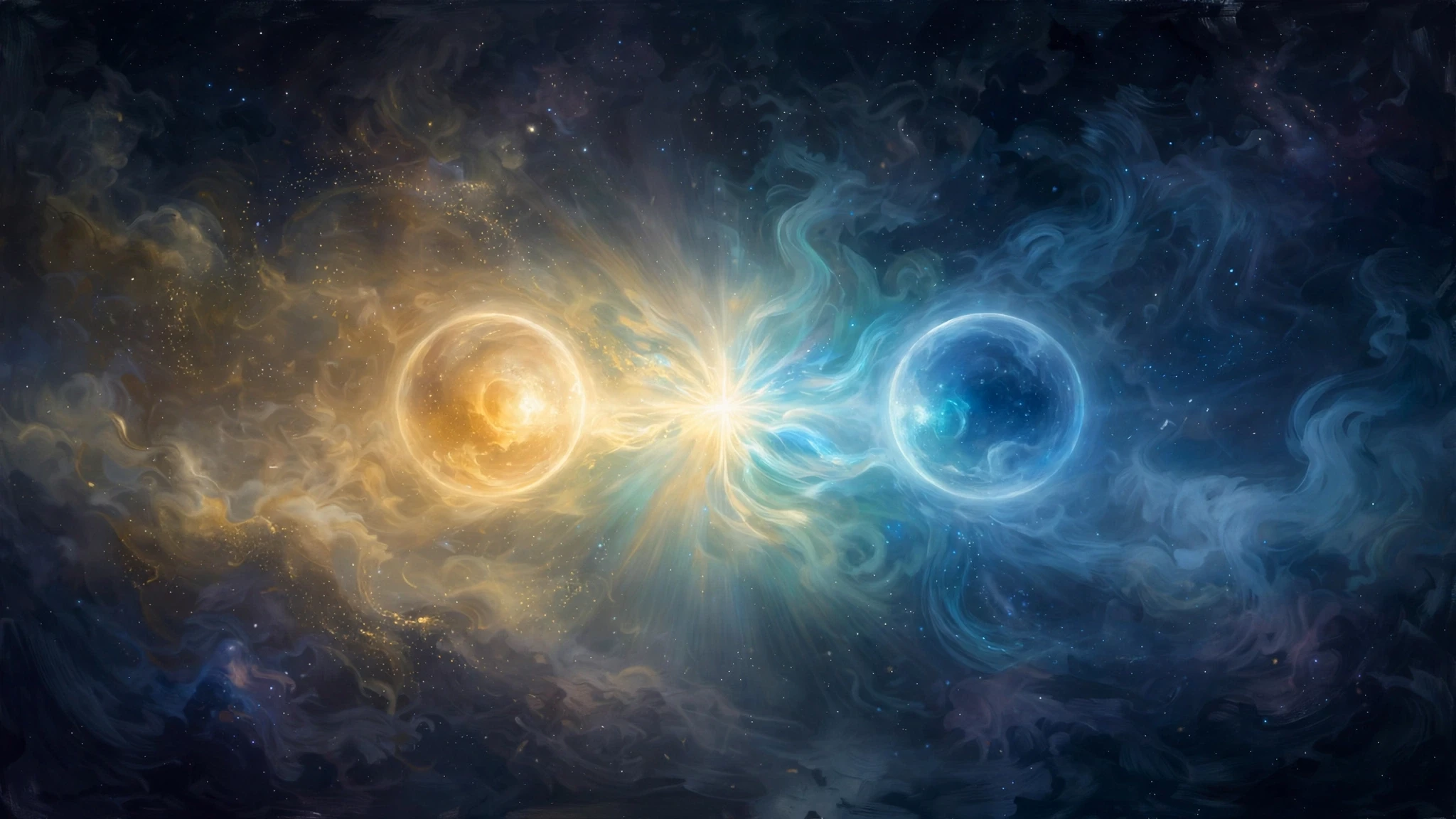
Conjunction aspect astrology describes what happens when two planets sit at the same place in the zodiac, at an angle of 0 degrees apart. The two energies fuse and act as one force, so the chart reads them together rather than separately. A Sun in astrology conjunct Mercury means identity and thinking are fused, so the person thinks out loud and speaks with confidence. A Venus conjunct Mars means love and drive are fused, so attraction and action move together. The conjunction is the strongest of the five major aspects, because there is no distance between the planets to soften the blend. It is also the most neutral in tone. A conjunction is not good or bad on its own. It is intense, and whether that intensity helps or hurts depends on the planets involved, the sign they share, and the house they sit in. A Jupiter conjunct Venus in the second house can bring ease with money and pleasure. A Saturn conjunct Mars in the twelfth house can bring a private struggle with anger and limits. The same angle, different planets, different story. The conjunction is the opposite of an opposition aspect meaning, where planets sit 180 degrees apart and pull in two directions, while a conjunction pulls them into one. Two voices become one voice, and the chart has to be read as if the two planets are speaking at the same time, in the same sign, from the same house.
The Exact Angle and Orb of a Conjunction
The exact angle of a conjunction is 0 degrees, and the orb, the allowable margin around that exact angle, is usually 8 to 10 degrees. That means two planets 7 degrees apart still count as conjunct, while two planets 11 degrees apart usually do not, unless the Sun or Moon is involved. When the Sun or Moon is one of the planets, many astrologers allow 2 extra degrees, so a Sun conjunct a planet 10 degrees away still counts. The orb is not a hard wall. It is a guide to strength. A conjunction at 0 degrees apart is exact and powerful. A conjunction at 3 degrees apart is strong. A conjunction at 8 degrees apart is noticeable but softer. A conjunction at 10 degrees apart is faint, and the planets may feel more like neighbors than a fused pair. Count longitude degrees, not sign names, when you judge how close the two planets sit. Two planets in the same sign are usually conjunct, but two planets in neighboring signs can also be conjunct if they sit close to the border. A planet at 29 degrees of Aries and a planet at 1 degree of Taurus are only 2 degrees apart, so they are conjunct even though they sit in different signs. That is called a sign border conjunction, and it is easy to miss if the reader only counts signs. The rule is simple. Measure the distance. If it is 10 degrees or less, and the Sun or Moon is involved, or 8 degrees or less for other planets, the conjunction counts.
How to Spot a Conjunction in a Birth Chart
Spotting a conjunction is the easiest part of reading aspects, because the two planets sit close together on the chart wheel. Look for two planet symbols that are grouped together in the same part of the circle, often with a line joining them in the center of the chart. Then check the degrees. A planet at 14 degrees of Leo and a planet at 17 degrees of Leo are 3 degrees apart, so they are conjunct. A planet at 14 degrees of Leo and a planet at 24 degrees of Leo are 10 degrees apart, so they are conjunct only if one of them is the Sun or Moon. A planet at 14 degrees of Leo and a planet at 28 degrees of Leo are 14 degrees apart, so they are not conjunct. The sign matters too. A conjunction in a fire sign, such as Aries, Leo, or Sagittarius, tends to be direct and visible. A conjunction in a water sign, such as Cancer, Scorpio, or Pisces, tends to be private and emotional. A conjunction in an earth sign tends to be practical and steady. A conjunction in an air sign tends to be mental and social. The house matters as well, because it shows where the fusion appears in life, and each of the 12 astrology houses gives that fusion a different address. A conjunction in the tenth house is public. A conjunction in the twelfth house is private. A conjunction in the seventh house appears through partnership. The best way to learn is to look at your own chart on a page like birth chart meaning, find the closest pair of planets, and ask what those two energies would sound like if they spoke as one voice.
Conjunctions by Planet Pair: What Fuses With What
Every planet pair fuses differently, and the list below gives the most common combinations. Sun conjunct Moon, called a new Moon birth, fuses identity and feeling, so the person often feels that their purpose and their emotions point in the same direction. Sun conjunct Mercury fuses identity and thinking, so the person is often quick to speak their mind. Sun conjunct Venus fuses identity and love, so the person often values harmony and beauty. Sun conjunct Mars fuses identity and drive, so the person is often direct and energetic. Moon conjunct Venus fuses feeling and love, so the person is often warm and affectionate. Moon conjunct Saturn fuses feeling and structure, so the person may be careful with emotion and slow to trust. Mercury conjunct Venus fuses thinking and love, so the person often speaks kindly and values good conversation. Mercury conjunct Mars fuses thinking and drive, so the person often argues well and acts fast. Venus conjunct Mars fuses love and drive, so attraction is often strong and direct. Venus conjunct Jupiter fuses love and expansion, so the person often enjoys pleasure and generosity. Mars conjunct Jupiter fuses drive and expansion, so the person often aims high and acts boldly. Mars conjunct Saturn fuses drive and limits, so the person may feel blocked and then push hard, or may learn to work steadily. Saturn conjunct Pluto fuses structure and transformation, so the person may rebuild their life slowly and thoroughly. Each pair is a blend, and the sign and house decide how the blend shows. A Venus Mars conjunction in the fifth house is romantic and playful. The same conjunction in the eighth house is intense and private.
A Real Conjunction: Saturn and Neptune in Aries in 2026
A real and checkable conjunction happened on February 20, 2026, when Saturn and Neptune met at 0 degrees of Aries. That is the first degree of the zodiac, the start of a new cycle, and the meeting of structure and dreams in the sign of identity and action. Saturn rules limits, work, and responsibility. Neptune rules dreams, imagination, and compassion. Together in Aries, they ask a practical question. What dream is worth building, and what structure will hold it? The conjunction was exact on February 20, 2026, and the two planets stayed close for weeks around that date, because both move slowly. The last time Saturn and Neptune met in Aries was in the 1700s, so this is a rare event, and astrologers noted it as a marker for a new cycle of about 36 years, the time it takes for Saturn and Neptune to meet again. The conjunction falls in the first house for a person with Aries rising, in the tenth house for a person with Cancer rising, and in the seventh house for a person with Libra rising, because the house depends on the rising sign. The example shows how a conjunction works in transit as well as in a birth chart. Two planets meet, their energies fuse, and the sign and house decide where the fusion lands. A person with a natal planet at 0 degrees of Aries, Libra, Cancer, or Capricorn would feel this conjunction most strongly, because it touches their chart by conjunction, opposition, or square.
A Worked Chart Example: Venus Conjunct Mars in Taurus
Take a person born on May 12, 1995, with Venus at 18 degrees of Taurus and Mars at 21 degrees of Taurus, both in the seventh house. The distance between them is 3 degrees, well inside the 8 degree orb, so they are conjunct. The sign is Taurus, an earth sign that values stability, pleasure, and the senses. The house is the seventh, which governs partnership. The reading starts with the fusion. Venus is love, beauty, and attraction. Mars is drive, desire, and action. Together in Taurus in the seventh house, they point to a person who loves with steady action, who shows care by doing something real, and who wants a partner who is reliable and sensual. They may be slow to start a relationship, but once they commit, they stay. The aspects refine the picture. If this conjunction forms a trine aspect meaning to Saturn in Virgo in the eleventh house, the steady love has a practical ally, and the person may build a lasting partnership through shared work. If it forms a square to Uranus in Aquarius in the fourth house, the steady love can be shaken by a sudden change at home, and the person may need to give a partner more space. The example shows the method. Measure the distance, name the two planets, take the sign, take the house, and read the fusion as one voice. A Venus Mars conjunction does not mean a person is romantic in the abstract. It means love and drive move together, in Taurus, through partnership, and that is a specific, usable reading.
How to Work With a Conjunction in Your Chart
Working with a conjunction starts with naming the fusion in plain words, such as love and drive move together, or thinking and identity move together, and then watching where that fusion appears. The conjunction is strong, so it often shows up early in life, and the person may not notice it because it feels normal to them. A person with Sun conjunct Mercury may not realize that others find their directness unusual. A person with Moon conjunct Saturn may not realize that others find their caution unusual. The work is to use the fusion on purpose rather than letting it run on autopilot. A Venus Mars conjunction can be used for creative work, for sport, or for a relationship that needs both love and action. A Mercury Mars conjunction can be used for writing, for debate, or for a job that needs quick decisions. The conjunction also needs an outlet, because fused energy that has nowhere to go can turn inward and become frustration. A regular practice, such as a creative project, a physical activity, or a honest conversation, gives the fusion a place to go. You can find your own conjunctions by looking at your birth chart and finding the closest pair of planets, then reading them together rather than separately. If you want help reading your own conjunctions, a live reader can walk through your chart and show which planets are fused and what that fusion asks of you. First 3 minutes FREE — every time, for every reading, with all advisors.
For a simple next step, try a One-Card Tarot reading and reflect on two parts of yourself that always seem to move together.
Frequently Asked Questions
What is a conjunction in astrology?
A conjunction is an aspect where two planets sit at the same place in the zodiac, 0 degrees apart. Their energies fuse and act as one force, so the chart reads them together rather than separately.
What is the orb for a conjunction?
The orb for a conjunction is usually 8 to 10 degrees. Two planets 7 degrees apart count as conjunct, while two planets 11 degrees apart usually do not, unless the Sun or Moon is involved, which allows 2 extra degrees.
Is a conjunction good or bad?
A conjunction is neither good nor bad on its own. It is intense, and whether it helps or hurts depends on the planets involved, the sign they share, and the house they sit in.
What was the Saturn Neptune conjunction in 2026?
Saturn and Neptune met at 0 degrees of Aries on February 20, 2026, the first degree of the zodiac. It is a rare meeting of structure and dreams in the sign of identity, and it marks the start of a new cycle of about 36 years.
How do I find a conjunction in my chart?
Look for two planet symbols grouped together on the chart wheel, then check the degrees. If they are 8 degrees apart or less, or 10 degrees apart or less when the Sun or Moon is involved, they are conjunct.
Last updated: November 11, 2026
