
Aventurine Meaning: The Stone of Opportunity
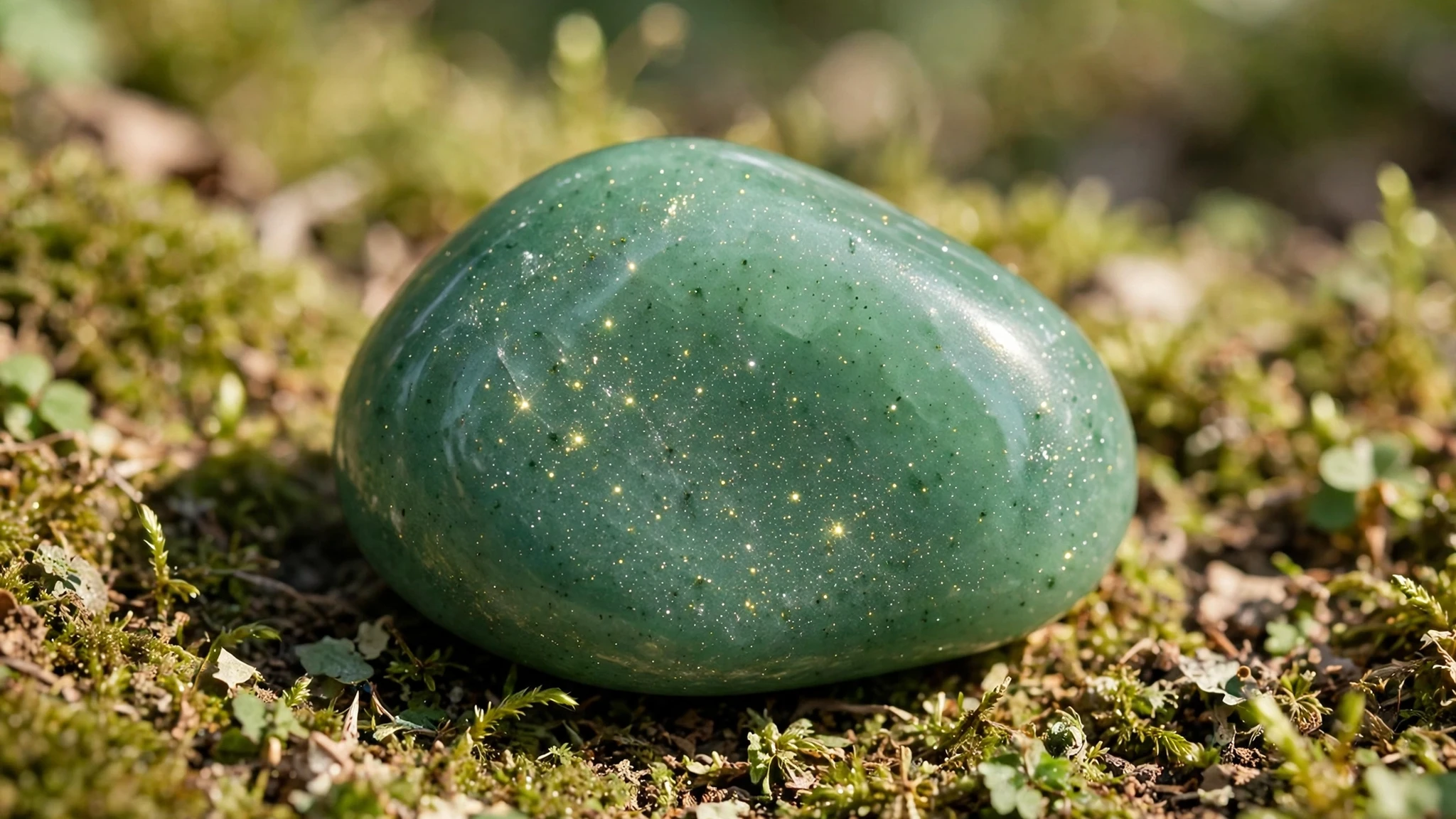
Aventurine Meaning: The Green Stone That Glitters
Aventurine is the green stone that glitters, and its meaning starts with that sparkle. Hold a piece of green aventurine in sunlight and turn it slowly, and tiny flashes of light move across the surface, like mica dust caught in glass. That effect has a name, aventurescence, and it is the stone's signature. Aventurine is a variety of quartz, colored green by flakes of fuchsite mica, and its traditional meaning is luck, opportunity, and fresh growth. The spiritual awakening signs hub gathers it among the stones it covers. This page covers what aventurine actually is, how its sparkle works, how it differs from jade and from goldstone, and how people use it for new beginnings, for work, and for gifts.
Aventurine is not a mineral in its own right. It is a variety of quartz, silicon dioxide, SiO2, and most material is technically quartzite, a rock made of compacted quartz grains, carrying tiny plate like mineral inclusions. It rates 6.5 to 7 on the Mohs hardness scale, hard enough for everyday jewelry, beads, and carvings, and its specific gravity runs around 2.64 to 2.69, the same as ordinary quartz. Its luster is waxy to vitreous after polishing, and it is translucent to opaque. The stone is durable, affordable, and widely available, which is why it is one of the most sold green stones in the world.
The Sparkle: Aventurescence and Fuchsite
The green color of aventurine comes from fuchsite, a chromium bearing variety of muscovite mica. Chromium gives the green tone, and the flat mica plates give the glitter. When light hits the tiny flakes, they reflect together, producing a granular, flashing effect that gemologists call aventurescence. The word comes from the Italian a ventura, meaning by chance, because the effect was first noticed by chance in glassmaking. The stone was named for the accident, and the accident became its identity.
Green is by far the most common color, ranging from pale mint to deep forest green, but aventurine also occurs in other colors, each with its own coloring inclusion. Orange, brown, and reddish aventurine owe their color and sparkle to flakes of hematite or goethite, both iron oxides. Blue aventurine is colored by other inclusions and is much rarer. Yellow, peach, purple, and white material also occurs. The color tells you which inclusion is inside, and the inclusion tells you the stone's story. A green stone is a fuchsite stone. A red brown stone is a hematite stone. Both are aventurine, because aventurine is defined by its appearance and its inclusions, not by a single color.
The amount of fuchsite matters. More fuchsite means stronger color and more sparkle, but it can also reduce translucency and create softer zones, because mica is much softer than quartz and splits into sheets. A stone with heavy fuchsite may look rich and dark, but it may also be more fragile along the mica rich areas. A stone with light fuchsite may look pale but will be harder and more even. The best pieces balance the two: enough mica for a clear green and a visible sparkle, not so much that the stone turns opaque or soft. Hold a piece up to the light and turn it. The sparkle should move. If it does not move, the stone may be dyed or may not be aventurine at all.
Aventurine Is Not Jade, and It Is Not Goldstone
Two confusions follow aventurine everywhere, and clearing them up is part of understanding the stone. The first is jade. Green aventurine and jade look similar at a glance, and both are sold as green stones for luck and for carving, but they are different materials. Jade, whether nephrite or jadeite, is a different mineral family, denser and tougher than aventurine, with a specific gravity around 3.3 compared with aventurine's 2.64 to 2.69. Aventurine is lighter, shows a visible glitter from flat inclusions when turned in the light, and has a slightly greasy to glassy luster. Jade shows no such glitter. If you hold two similar green stones and one glitters when you turn it, that one is aventurine.
The second confusion is goldstone, a man made glass with copper sparkles that is sometimes sold as a natural stone. Goldstone is glass, made in a furnace, and its sparkle comes from copper crystals suspended in the glass. Aventurine is natural quartz with mica flakes. The difference is easy to feel: goldstone is usually a deep reddish brown or dark blue, with a uniform glitter that looks the same from every angle, while aventurine's sparkle is uneven, granular, and tied to the stone's green or brown color. A seller who calls goldstone a natural crystal is either mistaken or dishonest. Ask, and buy from someone who answers clearly.
Aventurine is also sometimes confused with green quartz, and the distinction is worth knowing. Green quartz is quartz colored green by other means, usually by trace elements in the crystal itself, and it forms as single crystals. Aventurine is a massive aggregate, a rock of quartz grains with mica flakes, and you never see individual crystals in a piece. That granular build is why aventurine is carved and tumbled rather than faceted, and why it takes a soft, waxy polish rather than a sharp, glassy one. The stone's character is in its aggregate nature: many small parts, working together, making a green that glitters.
Where Aventurine Comes From
India has historically been the main source of green aventurine, particularly Rajasthan and the south of the country, where fuchsite bearing quartzite has been quarried for centuries. Brazil is another major source, producing large quantities of green and red material, and Russia, China, and Tanzania also produce aventurine. Chinese material, sometimes called Dongling stone, has been carved in China for generations. The stone's wide availability is one reason for its low price: aventurine is abundant, easy to cut, and easy to polish, so a good piece costs far less than a comparable piece of jade or emerald.
Aventurine has been used since antiquity. It was carved into beads, seals, and small figures in ancient cultures, and it was used for tools as well as ornaments, because its hardness of 6.5 to 7 makes it tough enough to hold an edge. In Tibet, aventurine was used for sacred objects and for eyeglasses, a use that took advantage of its translucency and its toughness. In modern times, it is used for beads, cabochons, carvings, tumbled stones, and small sculptures, and it is one of the most common stones in crystal shops, where its green color and low price make it an easy first purchase.
The stone's history is quieter than that of emerald or sapphire. It was not a royal stone. It was a working stone, a carving stone, a bead stone, and its meaning grew from that everyday use rather than from courts and crowns. That history suits its present role. Aventurine is the stone of ordinary luck: a new job, a first home, a small business, a garden. It is not the stone of empires. It is the stone of people starting something.
What Aventurine Means in Crystal Tradition
In crystal tradition, aventurine is the stone of opportunity. Its meaning centers on luck, prosperity, growth, and fresh starts, and it is often called the stone of opportunity because its traditional uses cluster around new ventures: a job interview, a business launch, a move, a new relationship. Practitioners describe it as a stone that encourages a person to take a chance, to notice an opening, and to act on it. Those are the associations of crystal tradition, not findings of science, and this page sets them out as tradition, not as fact. No stone has been shown to change luck or fortune, and anyone who tells you otherwise is selling something.
Aventurine is also linked with the heart in traditional systems, because green is the color assigned to the heart in many crystal traditions, and with calm, because its soft green is read as soothing. It is described as a stone for emotional balance, for patience, and for a generous attitude toward other people. That combination, luck plus calm, is unusual, and it is why aventurine is often given as a gift at stressful turning points: it says, in the language of stones, take the chance and stay steady while you take it.
If you use aventurine in intention work, tie the practice to action, not to wishing. Hold the stone, name one opening you want to pursue, and name one concrete move you will make toward it this week. Write the opening and the move on paper, because a plan you have written down in plain words is a plan you can check yourself against, while a plan kept only in your head is easy to forget. A green stone sitting beside that written plan can jog your memory each morning. It cannot take the step for you, and it should never be asked to.
Wearing, Gifting, and Caring for Aventurine
Aventurine is one of the easiest stones to wear. Its hardness of 6.5 to 7 makes it suitable for rings, pendants, bracelets, and beads worn daily, and its toughness is good because it has no cleavage. It is water safe, so a wash in lukewarm soapy water with a soft cloth suits it, followed by a rinse under clean water and a pat dry with a clean cloth. Keep harsh chemicals away from it, and do not drop it on a hard floor, because a hard knock can chip the edge of a carved piece. Store it apart from harder stones such as sapphire and topaz, which can scratch it.
Aventurine is a popular gift stone, and it suits gifts well because its meaning is clear and its price is modest. A small tumbled stone in a gift bag, a beaded bracelet, or a carved heart are common choices. It is given for new jobs, for exams, for house moves, and for birthdays, and it is often given to people who are starting a business, because its luck meaning fits the occasion. A gift of aventurine works best when it comes with a short note naming the opportunity it marks. The note is the real gift. The stone is the reminder.
In a collection, aventurine is the cheerful green stone, the one that brightens a shelf. To keep it in good shape, see how to charge crystals, and for seasonal pairings, the best crystals for Scorpio season guide. It pairs well with clear quartz, whose colorlessness lets the green stand out, and with smoky quartz, whose dark brown makes the green look brighter by contrast. It also pairs well with wood and with gold, both of which warm its green. Keep it where you can see it: on a desk, by a door, or on a windowsill that does not take full sun for hours. A green stone shut away in a drawer serves no purpose, whatever you believe about what stones can do.
An Illustrative Example: The First Market Stall
This example is illustrative, not a real person's story.
A woman named Maya, a 29 year old baker, was setting up her first market stall and felt nervous about whether anyone would buy her bread. A friend gave her a small green aventurine tumbled stone and a note that said, in plain words, "For the first stall." Maya put the stone in her apron pocket on market days, and she kept it there for a year, through good Saturdays and slow ones. She did not believe the stone brought customers. She believed it reminded her, each time she felt the smooth stone in her pocket, that she had chosen to take a chance, and that the choice was hers. When the stall grew into a small shop, she put the stone on the counter by the till, where customers could see it. The lesson is simple: a stone's meaning works best as a reminder of a decision you already made, and a decision you can touch is a decision you will keep.
Aventurine is a working stone with a glittering surface: quartz and mica, green and sparkle, luck and calm. It is affordable, durable, and easy to find, and its meaning is one anyone can grasp. It offers no fortune. It offers a nudge to notice an opening and to act on it, and that modest nudge is worth keeping.
If you would like guidance on working with aventurine or choosing a stone for a new beginning, remember that you can speak with a real advisor about it. First 3 minutes FREE — every time, for every reading, with all advisors.
For a simple next step, try a One-Card Tarot reading and reflect on what the card suggests about an opportunity in front of you this week.
Frequently Asked Questions
What is aventurine?
Aventurine is a variety of quartz, silicon dioxide, SiO2, usually quartzite, carrying tiny plate like mineral inclusions. Green aventurine is colored by fuchsite, a chromium bearing mica, and its glittering effect is called aventurescence. It rates 6.5 to 7 on the Mohs hardness scale.
Is aventurine the same as jade?
No. Jade is a different mineral family, denser and tougher, with a specific gravity around 3.3 compared with aventurine's 2.64 to 2.69. Aventurine is lighter and shows a visible glitter from flat mica inclusions when turned in the light. Jade shows no such glitter. Goldstone, another lookalike, is man made glass, not a natural stone.
What does aventurine mean in crystal tradition?
In crystal tradition, aventurine is the stone of opportunity, linked with luck, prosperity, growth, and fresh starts. It is often given for new jobs, business launches, and moves. These meanings belong to crystal tradition and carry no scientific proof. The stone works best as a reminder of a step you have already decided to take.
Can aventurine go in water?
Yes. Aventurine is water safe at Mohs 6.5 to 7. Rinse it in lukewarm water with a mild soap, wipe it with a soft cloth, and let it dry fully before you store it. Avoid harsh chemicals, and store it separately from harder stones such as sapphire and topaz, which can scratch it.
Where does aventurine come from?
India has historically been the main source of green aventurine, particularly Rajasthan and the south of the country. Brazil, Russia, China, and Tanzania also produce it. Chinese material is sometimes called Dongling stone. Aventurine is abundant and affordable, which is why it is one of the most sold green stones in the world.
Last updated: November 12, 2026
