Wheel of Fortune Tarot Card Meaning
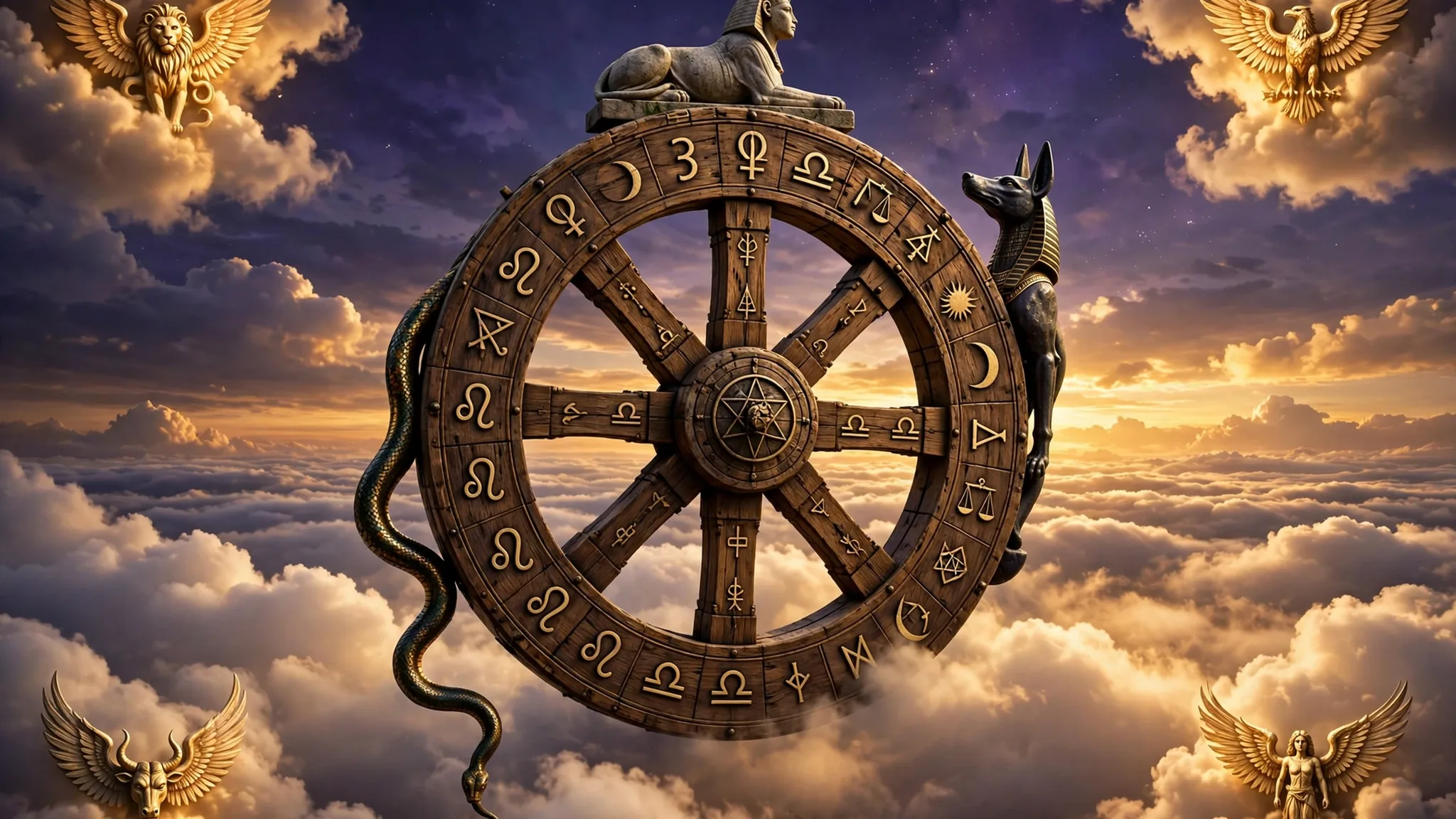
The Wheel of Fortune tarot card meaning is the moment the Major Arcana stops being a story about what a person does and becomes a story about what happens to them. Card ten shows a great wheel turning in the sky, letters and symbols worked into its rim, a sphinx resting at the top, strange figures riding its sides up and down, and in the four corners of the card, winged creatures reading books, unmoved by the turning. Every card before this one had a protagonist. This one has a mechanism, and the mechanism does not take instructions.
A compact portrait of the Wheel in both orientations appears on Wheel of Fortune card page. This page remains with the upright turning, because the card's real teaching is subtler than luck: it is about how a wise person behaves inside a life that rotates.
The Short Answer
Upright, the Wheel of Fortune points to a turning point: a cycle shifting, a season changing hands, circumstances moving in ways that effort did not schedule and cannot prevent. Readers generally treat an upright Wheel as movement in your favor or at least toward renewal, with a condition attached. The card does not promise the top of the wheel. It says the wheel is turning, and it counsels you to move with the rotation: take the opening while it is open, release what the downward side is carrying away, and keep your balance near the center, where the spinning is slowest.
| At a glance | What the upright Wheel suggests |
|---|---|
| Core theme | Cycles, turning points and change larger than the plan |
| In love | A fated-feeling meeting, or a relationship entering its next season |
| At work | Market turns, lucky breaks and timing that rewards readiness |
| As advice | Move with the turn; prepare so chance has something to land on |
| A warning? | Only against clutching at a season that is already rotating away |
Every card guide in the series, upright and reversed, is gathered on our tarot card meanings hub.
Reading the Picture on the Card
The wheel itself carries three rings of meaning. Its rim is lettered T-A-R-O between its spokes, which readers delight in rearranging into rota, the Latin for wheel, and tarot itself, a small built-in sermon that the deck and the wheel are the same machine. Between the letters sit Hebrew characters naming the divine, marking the turning as sacred rather than random. On the wheel's left a snake descends, the old tempter riding the downward arc, while on the right a red jackal-headed figure rises, a guardian of the dead climbing toward the top. Above them all sits the sphinx, sword in paw, calm as a judge. She does not ride the wheel. She presides over it, and readers read her as the part of the self, or of fate, that watches change without being spun by it.
The corners complete the philosophy. An angel, an eagle, a lion and a bull, all winged, all reading books, hold the corners of the card steady while the center rotates. They correspond to the four fixed signs and the four evangelists, and their message is posture: learn while it turns. They are not gripping the wheel to stop it or push it. They are studying. In a card about fortune, the wisest figures are the ones with books, and that detail has quietly instructed readers for a century. What you can control is not the rotation. It is whether you meet it educated.
One more proportion matters. The human-scale figures on the wheel are small, and the wheel is large. The picture is honest about scale in a way the earlier cards, with their heroes and thrones, were not. Much of a life is weather. The Wheel is the first card to say so outright, and to suggest that maturity consists less in commanding the weather than in building a house, a center, that the turning cannot tip.
What the Wheel Means in a Reading
When the Wheel appears upright, readers first locate the querent on it. Rising side, top, falling side: the card describes seasons more than events, and the counsel changes with the position. For someone rising, it advises generosity and memory: bank goodwill, write down what worked, and avoid mistaking a favorable rotation for personal invincibility, because the sphinx has seen the top before and is not impressed. For someone at the top, it counsels completion: sign the thing, harvest the crop, marry the person, while the window stands open, because windows are the wheel's native architecture. For someone descending, its message is the one the whole tradition exists to deliver: the downward arc is a phase of a circle, not the end of a line. What is being carried away is usually what the next season cannot use.
The card also governs encounters that feel arranged: the meeting in the wrong airport, the book that falls open at the relevant page, the old friend calling in the exact week. The Wheel does not ask you to worship these. It asks you to respect timing as a real ingredient in outcomes, alongside effort and character. When the Wheel turns up beside a stubborn situation, readers often give its plainest counsel: stop pushing the spoke that is moving away from you and look for the one rising. Every rotation lifts something. The skill is in noticing what, early. Where the turning feels cursed or jammed, Wheel of Fortune reversed covers the rough rotation.
The Wheel in Love and Relationships
In love, the Wheel is the card of fate-flavored meetings and of seasons turning inside established bonds. For singles, it describes the encounter that has an arranged quality to it, the person met through a delay, a detour, a plan that failed correctly. Readers do not promise that such meetings are destined in any provable sense. They observe that the querent will often experience the meeting as significant, and counsel the posture the corner figures model: curious, unhurried, learning. A wheel meeting does not need to be chased. Its nature is arrival.
Inside a relationship, the Wheel marks the turning of a shared season: the end of the long-distance chapter, the arrival of the child, the career change that rotates the household's whole map, the gray stretch that turns, almost without announcement, into a second spring. Its counsel to couples is balance near the hub. Partners who build a shared center, rituals, honesty, a few non-negotiables held in common, find the wheel's rotations survivable and sometimes exhilarating. Partners who live out at the rim, where every external change flings them, experience the same rotations as chaos. The card cannot slow the wheel for anyone. It can, and regularly does, relocate a couple toward the middle of it.
The Wheel at Work and With Money
At work, the Wheel rules the factors no strategy controls: market turns, industry weather, the reorganization decided three floors above your life. Upright, it suggests the weather is shifting, usually in ways a prepared person can use. Its counsel is readiness as a discipline: the updated portfolio, the savings buffer, the skills kept current, so that when rotation lifts your sector you are standing where the rising spoke passes. It also favors timing moves: launches into a turning market, applications sent in the week the door opens, the phone call made while the reorganization is still fluid and roles are being invented rather than filled from a list.
With money, the Wheel is the tradition's standing lecture on cycles. It favors the investor and the earner who expect rotation: reserves for the downward arc, no lifestyle built to require the top of the wheel as a permanent address, windfalls treated as weather to be banked rather than climate to be trusted. It is pointedly unimpressed by strategies that only work while things rise. Readers pass on its homeliest test: if your financial plan cannot describe what it does in a bad year, you do not have a plan, you have a photograph of a good year. Build the bad-year page while the wheel is kind, and the card's blessing, the long view, becomes yours.
A Quick Question Before You Decide Anything
If a turning point has your timing in question, our free Yes/No Oracle tool can help you act while the window is open rather than after it closes. Under the Wheel, a fast honest answer beats a perfect late one, because the spoke does not wait.
Talk It Through With a Reader
Turning points are easier to ride with a witness who can see the whole wheel. If your season is changing, a career rotating, a bond entering its next chapter, a run of luck asking what it is for, a live reading at PsychicSmile lets you locate yourself on the wheel with a real reader and prepare for the arc that follows. First 3 minutes FREE, every time, for every reading, with all advisors.
Last updated: November 9, 2026
Frequently Asked Questions
Is the Wheel of Fortune a lucky card?
It is the deck's card of fortune in the old sense: fortune as turning circumstance, not as guaranteed luck. Upright, readers lean favorable, because the rotation is moving and openings are appearing. The luck it describes rewards people who are prepared to move when the spoke rises past them.
What does the sphinx on top of the wheel represent?
The sphinx presides rather than rides, and readers take her as the observing part of the self, or of fate, that watches change without being spun by it. Her calm is the card's ideal posture: engaged with the turning, centered above it, sword laid across her paws rather than raised.
I am going through a bad stretch and pulled the Wheel upright. Is that a contradiction?
Not in this card's logic. The Wheel describes motion, and for someone on the downward arc, an upright Wheel often reads as the assurance that the arc is part of a circle. The counsel is to release what the turn is carrying away and to watch for the rising spoke, which the rotation brings round in its turn as part of the same machine.
How is the Wheel different from the Tower, which also brings sudden change?
The Wheel is change as cycle: expected in kind if not in timing, survivable, often beneficial, and part of a pattern that also lifts. The Tower is change as rupture: a structure collapsing because it was false. The Wheel turns seasons. The Tower ends arrangements.
What are the four creatures in the corners doing?
An angel, an eagle, a lion and a bull sit winged in the corners, each reading a book, steady while the center spins. Tradition links them to the fixed signs and the four evangelists. Their teaching is the card's posture: keep learning through the turning instead of trying to stop it or being thrown by it.