The Tower Tarot Card Meaning
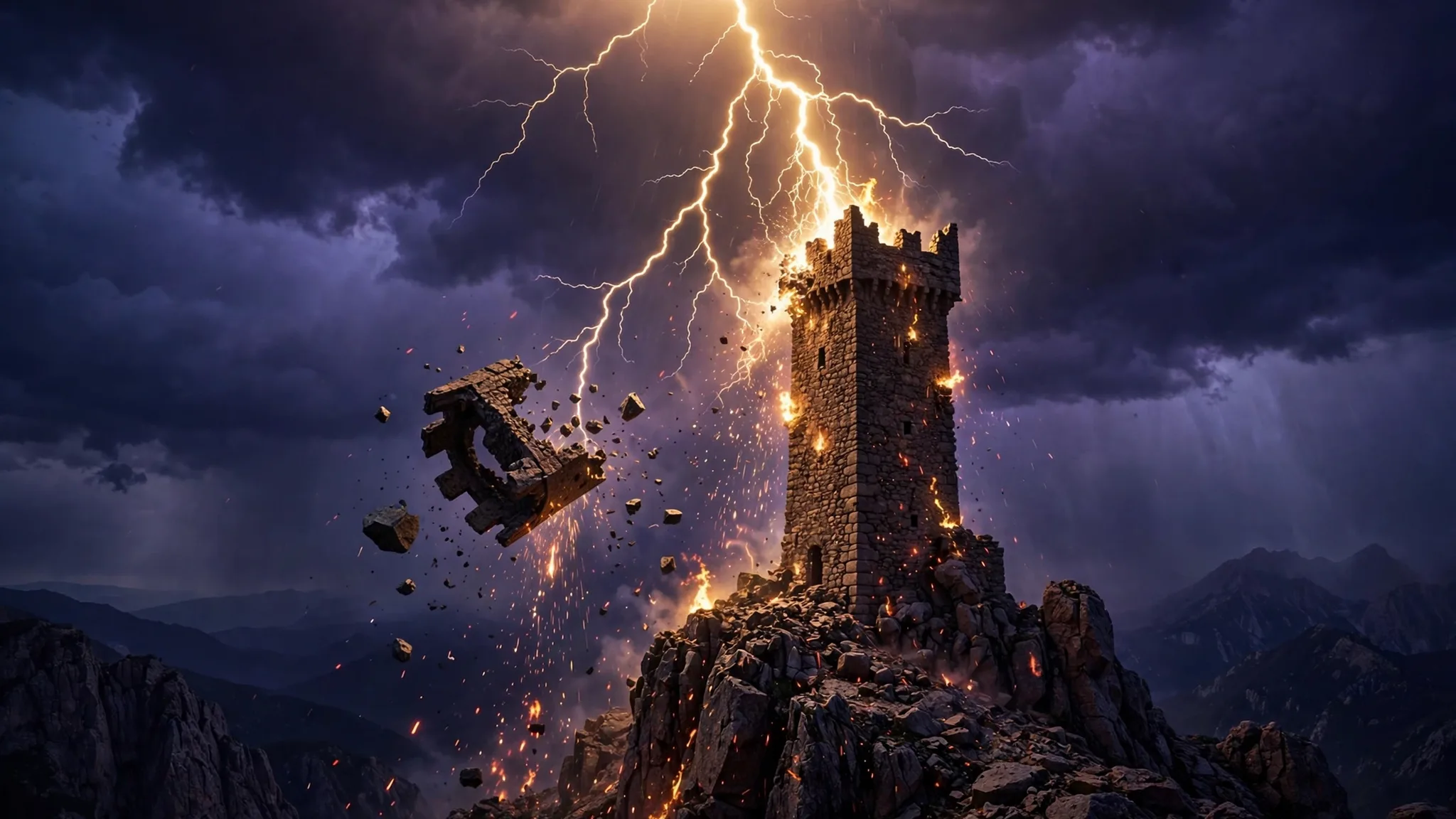
The Tower tarot card meaning is the deck's lightning strike: sudden, loud and impossible to schedule. Card sixteen shows a tall tower on a rocky peak, its crown-shaped roof blown clean off by a bolt from a black sky, flames licking from the windows, two figures falling headfirst toward the rocks with their arms flung wide, and twenty-two drops of fire scattered around them like sparks or strange fruit. It is the card querents fear most, more than Death, more than the Devil, and the tradition's explanation for the fear is itself part of the meaning: the Tower is the one event in the deck nobody gets to negotiate with.
A compact portrait of the strike in both orientations appears on The Tower card page. This page remains with the upright collapse, because its central idea, that what falls in this card was built on a falsehood and could not have stood much longer, is the only version of the story that helps anyone standing in the rubble.
The Short Answer
Upright, the Tower points to a sudden disruption that exposes a false foundation: a revelation, a collapse, a piece of news that changes the architecture of a situation in a day. Sometimes the card describes an event. Sometimes it describes the moment a long-private knowledge becomes unavoidable, the results opened, the message seen, the figures finally read. Readers treat it as neither punishment nor random malice. In the tradition's consistent telling, the lightning is the truth arriving faster than the renovations could, and the tower that falls was already condemned by the lie in its footing.
| At a glance | What upright Tower suggests |
|---|---|
| Core theme | Sudden collapse of a structure built on a falsehood |
| In love | A revelation or rupture that ends the arrangement as it was |
| At work | A venture, role or reputation failing fast and publicly |
| As advice | Do not prop the ruin; salvage the true things from it |
| A warning? | Yes: the foundation was the problem, not the weather |
The whole sequence, upright and reversed, is gathered on our tarot card meanings hub.
Reading the Picture on the Card
Start at the top, where the picture starts. The thing struck off the tower is shaped like a crown. Readers take this as the card's thesis statement: what the lightning removes first is the false crown, the pride at the structure's peak, the story its builders told about its height. The tower itself stands on a crag too narrow for it, the architectural version of a life arranged beyond its foundation's width, and its windows burn from the inside, which matters. The fire is not only the sky's. The structure was combustible on its own floors.
The two figures fall headfirst, one in the dress of wealth and one in the clothes of poverty, repeating the deck's old democracy: the strike does not check the guest list. Their arms are flung wide and neither is holding anything, the picture's small mercy and its whole lesson in one gesture. Nothing could be carried out. What was in the tower was the tower. Around them fall the twenty-two fire drops, a number readers have connected for generations with the twenty-two major arcana themselves, as if the whole curriculum of the deck were raining out of the one moment: every lesson, delivered at once, in sparks.
The sequence around the card completes the teaching. The Devil's cellar came just before, and readers draw the line openly: a bondage maintained long enough builds itself a tower, the life arranged around the loop grows floors, and what consent renews daily in private, lightning eventually audits in public. And directly after the Tower comes the Star, the deck's quietest image of hope, which the tradition places there on purpose, as if to say the very next thing after the collapse, chronologically in the great story, is a woman pouring water under a clear sky.
What the Tower Means in a Reading
When the Tower appears upright in a reading about ordinary life, its first referent is usually not an event but an unsustainability. Readers ask which structure in the situation is being maintained past its foundation: the business whose real figures describe a closing, the marriage organized around a fact neither party will pronounce, the public self that requires a private one to be starved. The card's gift, and it is real, is compression: it takes the slow, deniable erosion that would have consumed years and delivers it as a season. People consistently report, looking back, that the collapse quarter was not the worst quarter. The worst was the preceding period of propping, which had no end date. The Tower has an end date built in. The rubble, unlike the rot, can be cleared.
Its second teaching concerns the clearing. The card counsels speed in one specific thing: salvage the true from the wreck before rebuilding anything. The skills are true. The friendships tested by the fall are true. The figures, now finally readable, are true. What must not be salvaged is the false footing itself, and the commonest post-Tower error is rebuilding the same tower on the same crag with better paint, the same arrangement with a new cast. The lightning, in the tradition's dry formulation, charges for repeat visits.
A calibration matters here, and careful readers always offer it. The Tower in a spread is a lens on a situation's structure, not a timetable of disaster, and most of its appearances in daily practice describe the internal version: the day a story about yourself stops working, the conversation after which a plan cannot be un-known. The drama is real. It is very often quiet. For the version of this card where the collapse is sensed, dreaded and indefinitely postponed, The Tower reversed takes up the waiting.
The Tower in Love and Relationships
In love, the Tower is the revelation card: the discovery that changes what the relationship is built on, the double life surfaced, the debt disclosed, the message read, the feeling confessed at the wrong altitude. Upright, its consistent counsel to the person inside the strike is unglamorous and vital: do not make permanent architecture out of the first week's information, in either direction. The fall reveals the foundation, which is priceless data, but it does not reveal what, if anything, can be built on the cleared ground, and that second question belongs to the calmer cards that follow in the sequence and the slower months that follow in a life.
It also describes, and readers meet this often, the collapse of a couple's shared fiction rather than of the couple: the arrangement both partners privately knew was over, ended by one sentence said at last; the roles, rescuer and rescued, earner and kept, that a crisis makes suddenly unplayable. Some bonds end on this ground and some, remarkably, begin honestly there for the first time. The card does not decide between those futures. It certifies only the thing that fell, which is the version of the relationship that required a falsehood to stand. What the two people build on a true footing, or whether they build it together, is a question the Star, two cards later, was designed to answer, and The Star tarot card meaning covers that rebuilding in full.
The Tower at Work and With Money
At work, the Tower is the fast failure: the venture whose market vanishes, the merger announced and reversed, the reputation event that takes a career's architecture in a week. Its professional counsel surprises people, because it is almost cheerful about salvage. Reputations, it observes, are rebuilt from the rubble of exactly one thing, the person's conduct during the fall, and the figures who emerge well from public collapses are consistently those who read the true figures aloud first, carried people out before assets, and declined to blame the weather. The tower fell. The lightning is not the story people retell. The story they retell is what you did in the smoke.
With money, the card is the correction that reveals the footing: the portfolio whose growth was one asset's mania, the household budget balanced on overtime that was never guaranteed, the business whose profit was a single client's patience. Its advice to anyone not currently mid-strike is architectural rather than fearful. Narrow towers on narrow crags are a choice, made in calm weather, by leaving the foundation's width unaudited. Diversify the footing. Keep the crown removable. And hold the reserve that lets a strike be a season rather than a biography.
A Quick Question Before You Decide Anything
If a decision feels like it is standing on a narrow crag, our free Yes/No Oracle tool can help you hear the answer in one quiet signal. Under the Tower, follow it with the foundation question: what in this structure is true, and what is paint?
Talk It Through With a Reader
Strikes are lonely weather, and propping is lonelier. If some structure in your life, a bond, a business, a version of events, feels like it is standing on less than it admits, a live reading at PsychicSmile lets you audit the footing with a real reader while the choices are still yours to make. First 3 minutes FREE, every time, for every reading, with all advisors.
Last updated: November 9, 2026
Frequently Asked Questions
Does the Tower mean a disaster is coming?
It points to sudden disruption and revelation in a structure built on something false, which reads as disaster mainly when it is resisted or when it arrives in event form. In practice, most Tower moments are the collapse of an arrangement that was already unsustainable, and many people later describe the quarter it happened as the end of a worse, slower one.
I pulled the Tower about my job. Am I about to be fired?
The card does not work as a personnel forecast. It flags fragility: something in the situation stands on a narrow footing, a single client, a single skill, a single manager's goodwill. Its counsel is to audit the footing now, while the weather is yours to choose, and to build width where you can.
Why is the Tower sometimes described as a good card?
Because what falls in it could not have stood, and its fall ends the expensive period of propping. The deck places the Star, its image of calm renewal, immediately after the Tower, which readers take as the sequence's built-in consolation: cleared ground, however unwelcome, is ground that can be built on honestly.
What usually falls, in real readings?
A sustaining fiction: the figures are fine, the affair is over, the plan is funded, the symptom is nothing. The card describes the moment the fiction becomes unmaintainable, by discovery, by collapse, or by one person finally declining to hold it up. The truth in the event is usually old. Only its unavoidability is new.
Can the Tower be about a positive change, like a breakthrough?
Yes, in its sudden-revelation register. A breakthrough is a lightning strike aimed at a false ceiling: the realization that restructures a problem in an afternoon. The card's events are abrupt and often unwelcome in form, but their content is consistently the truth arriving early, which some situations experience as rescue.