The Devil Tarot Card Meaning
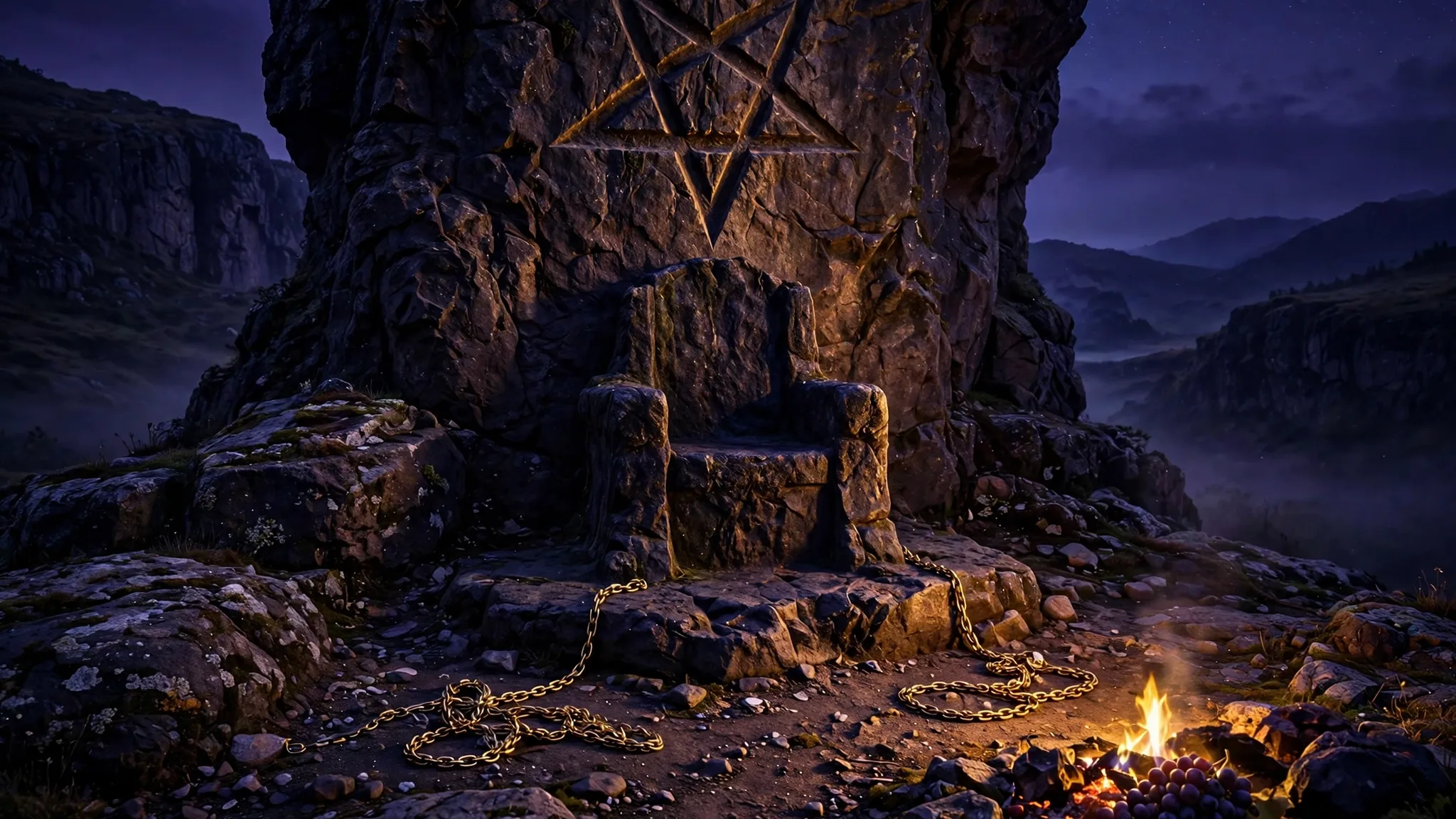
The Devil tarot card meaning lives in one small, famous detail: the chains are loose. Card fifteen shows a horned, bat-winged figure squatting on a black block, one hand raised and one holding a torch pointed down, while below him a naked man and woman stand chained to the block by collars that hang wide enough, as readers have pointed out for generations, to be lifted off over their heads. The picture is a parody of the Lovers, who stood in a garden under an angel. This couple stands in a cellar under a jailer, and the card's lifelong subject is how they got there, and why they stay.
A compact portrait of the figure in both orientations appears on The Devil card page. This page remains with the upright card, because its central claim, that the chains of appetite and attachment are mostly maintained by the person wearing them, is one of the most useful and most refused ideas in the whole deck.
The Short Answer
Upright, the Devil points to bondage by appetite: a habit, substance, person, pattern or pleasure that has moved from the category of choice into the category of management, something you now organize your life around feeding or concealing. He also covers materialism in its honest sense, the point where money and status stop being tools and become the scoreboard of the self. His tone is diagnostic rather than damning. In the tradition's reading, he is less a supernatural enemy than an X-ray of a loop: cue, craving, compliance, and the small payment of shame that keeps the loop funded.
| At a glance | What upright Devil suggests |
|---|---|
| Core theme | Attachment, appetite and the loops that run a life quietly |
| In love | Desire, obsession, or a bond held by need rather than by choice |
| At work | Golden handcuffs, workaholism, or money as the only measure |
| As advice | Name the loop precisely; check how loose the chain really is |
| A warning? | Yes: whatever must be hidden is already in charge |
The full upright and reversed sequence is gathered together on our tarot card meanings hub.
Reading the Picture on the Card
Every element of the picture is the Lovers inverted, and readers teach the two cards as a pair for that reason. The angel's blessing hand becomes the Devil's raised palm, marked as if for a twisted benediction. The fruit trees of the garden become a single bunch of grapes and a tail ending in flame, pleasures reduced to their consumable and combustible parts. The couple are growing small horns and tails of their own, the picture's way of saying that long residence in the cellar changes the residents. And above the whole scene hangs the figure himself, part man, part bat, part goat, squatting rather than enthroned, because appetite in this card is not majestic. It is cramped, airless and a little ridiculous once seen in daylight, and being seen in daylight is precisely what it cannot survive.
Then the chains. They are the most discussed detail in the card because they refuse the story the wearers would tell. The collars are wide. The block they are anchored to is half the Devil's height, not a mountain. Nothing in the picture shows a locked gate, a guard, a wall that could not be walked around. The torch points down into the dark, as if to say the light available here only illuminates the floor of the cellar. Readers take the whole composition as the tradition's verdict: this bondage is real, its costs are real, and its mechanism is consent renewed daily, which is also why it can be ended by a person rather than only by a rescue.
The card before him explains his timing. Temperance tarot card meaning was about proportion, and the Devil is what a flooded ingredient becomes when it stops being an imbalance and starts being a government. The spill that is never mopped becomes the address you live at.
What the Devil Means in a Reading
When the Devil appears upright, readers ask one question in several forms: what is running this? The loop he describes is always specific. A substance whose use requires lying by calendar. A relationship maintained by the terror of its ending rather than by anything it contains. A phone checked like a slot machine. A grievance curated daily, because outrage is the day's most reliable hit. The card does not deal in generic vice. It deals in the particular arrangement by which a particular person has traded jurisdiction over some province of their life, and its first mercy is precision: unnamed, the loop is an atmosphere; named, it is a mechanism, and mechanisms have parts that can be reached.
Its second teaching is about shame, which it treats as the loop's fuel rather than its cure. The arrangement survives by being concealed, from others and in a negotiated way from the self, and shame is the rent paid on the concealment. This is why the tradition pairs the Devil with honesty as his specific solvent: the telling of the exact truth to one other person, a sponsor, a therapist, a friend, a reader, is not a preliminary to breaking such a loop. In the card's teaching, it is the break itself, the moment the torch gets turned around. Where the picture instead shows the refusal to look, the loop denied or romanticized as fate, The Devil reversed covers the shadow side.
A word of calibration belongs here. Not everything intense is the Devil. Strong desire, serious ambition, a love with real heat in it are the garden's own goods, and the card does not police pleasure. Its line is jurisdiction. Pleasure you can take or leave is pleasure. Pleasure you organize around, lie for, and pay for in self-respect has changed departments, and that change, not the pleasure itself, is what the horns mean.
The Devil in Love and Relationships
In love, the Devil is the deck's specialist in attachment that has lost its freedom. At one pole he describes obsession: the bond as surveillance and withdrawal symptoms, the phone checked through the night, the relationship that feels most intense precisely when it is most harmful, because intensity is being mistaken for depth. At the other pole he describes the bond held by logistics and fear: the shared lease, the shared debt, the horror of explaining a departure, two people chained to the same block by paperwork and calling the arrangement loyalty. Both poles share his signature: the question "do I choose this person today, freely?" has become unaskable, because the honest answer is managed rather than heard.
He also appears, more cheerfully, for desire itself in new or renewed bonds, where his counsel is calibration rather than alarm: enjoy the heat, and keep the accounts honest. Is the rest of life still funded? Are the friends still seen, the work still done, the self still recognizable in the mirror? Heat that coexists with a whole life is the garden. Heat that requires the life to shrink around it is the cellar with better lighting. For someone attached to an ex in the form this card knows best, checking, rehearsing, keeping a key to the old house in the form of a thread never quite deleted, his advice is the picture's own: lift the collar, which in practice means the boring machinery of freedom, blocked numbers, returned objects, a witness told, a season of no contact honored like a fence while the craving re-learns its size.
The Devil at Work and With Money
At work, the Devil wears the famous golden handcuffs: compensation structured so that leaving a corrosive job costs more than staying in it, paid in installments against your own departure. He also governs workaholism in its loop form, where the job is not loved but needed, the inbox checked at hours when no inbox could repay the checking, because stillness produces a craving the work then medicates. And he covers the subtler professional chains: the reputation that must be fed daily, the side business that became a second landlord, the metric that started as information and ended as identity.
With money he is the scoreboard problem: wealth as self-worth, spending as medication, debt as the chain whose collar is genuinely tight, since interest is the one jailer in this picture who does compound. His financial counsel is unfashionable in its plainness. Shrink the secrecy first: the full figures on one page, seen by one other set of eyes. Then treat the loop as a loop, cue by cue, rather than as a verdict on your worth. The card has watched money for a long time, and its consistent report is that people escape financial cellars by mechanisms, not by self-disgust, which is only the rent in another currency.
A Quick Question Before You Decide Anything
If you are weighing a choice where appetite has a vote, our free Yes/No Oracle tool can cut one clean signal. Under the Devil, add his own audit question afterward: who benefits from my answer, the self I am building or the loop I am feeding?
Talk It Through With a Reader
Loops are hardest to see from inside the loop, which is most of what makes them loops. If some habit, bond or money pattern is drawing this card's picture in your life, a live reading at PsychicSmile lets you lay the mechanism out with a real reader and find the part of it that can actually be reached. First 3 minutes FREE, every time, for every reading, with all advisors.
Last updated: November 9, 2026
Frequently Asked Questions
Is the Devil a bad card to pull?
He is an uncomfortable card and often a useful one. He points to a loop of appetite or attachment that is quietly running some province of your life. Nothing in him is a verdict on your character, and his most famous detail, the loose chains, is the tradition's built-in reminder that the arrangement runs on renewed consent.
I pulled the Devil about someone I am dating. Should I run?
Not automatically. Check jurisdiction. Desire that coexists with your whole life, friends, work, rest, self-respect, is the garden the card parodies rather than the cellar it depicts. The warning signs are shrinkage and secrecy: a life narrowing around the bond, and facts about it you have started managing rather than sharing.
What does the Devil mean as a daily card?
Usually a small loop asking to be noticed: the third hour of scrolling, the purchase made to change a mood, the message sent for the hit of its reply. Daily-sized devils respond well to daily-sized honesty. Name it, delay it by an hour, and tell the truth about it to someone.
How do I actually break a pattern this card describes?
The tradition's method is mechanical, not motivational: name the loop precisely, end the secrecy by telling one person the exact truth, and change one part of the mechanism, the cue, the access, the hour, the place. Professional and peer support exist for the loops with teeth, and using them is the card's counsel, not a departure from it.
How is the Devil different from the Tower, the next card?
The Devil is a cellar you maintain. The Tower is a structure that collapses. One is bondage by consent renewed daily, slow and deniable; the other is the sudden end of a false arrangement, whether or not anyone consents. Readers often note that a Devil refused long enough eventually schedules a Tower.