Four of Swords Tarot Card Meaning
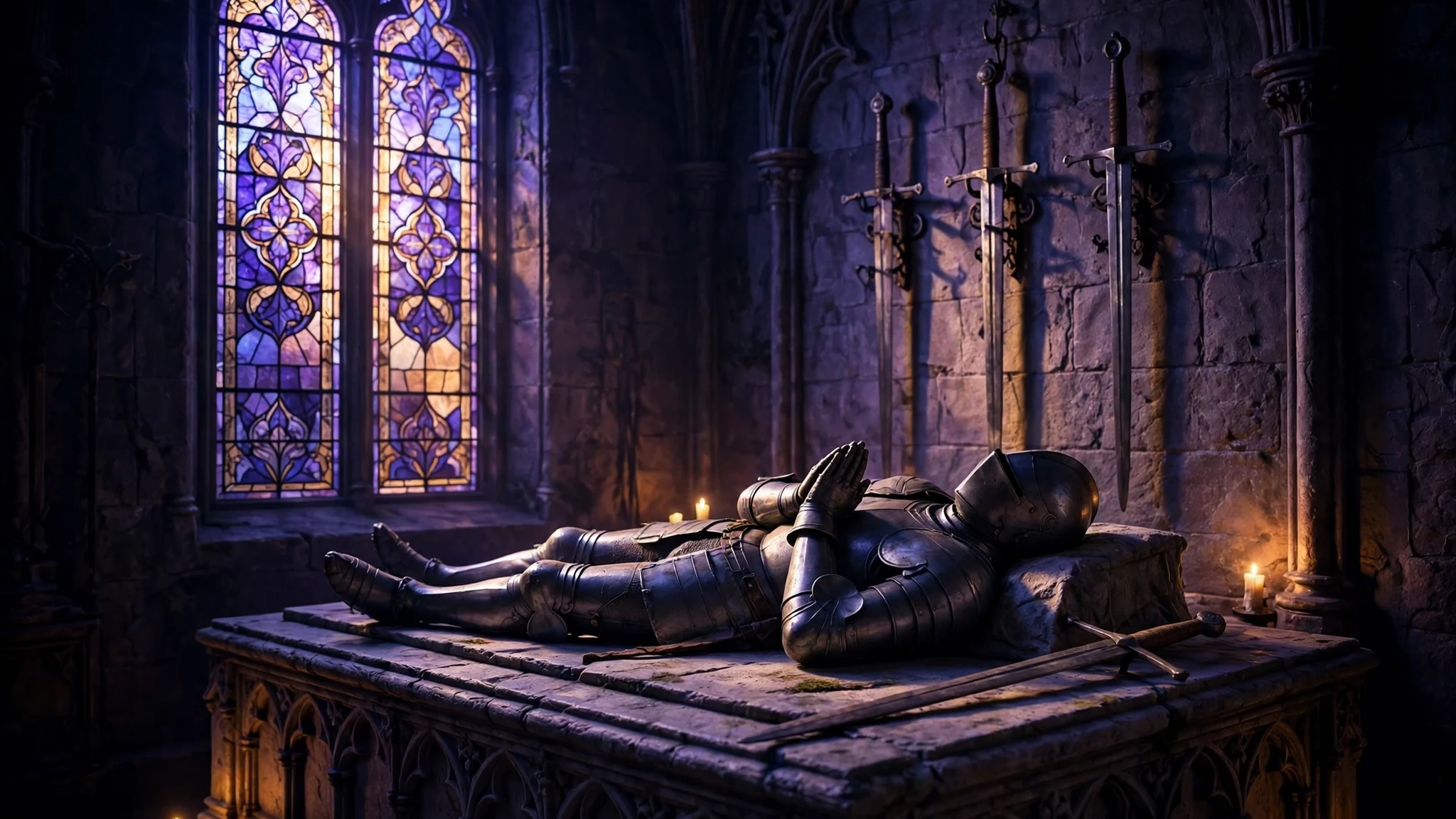
The Four of Swords tarot card meaning is the deck's formal permission to stop. Inside a chapel like space, a knight in full armor lies in repose on a stone tomb, his hands joined as in prayer, while three swords hang point down on the wall beside him and a fourth sword lies along the side of the tomb below them. Nothing in the picture is broken or threatened. The battle is not lost. It is paused by design, and the figure at the center has laid his weapon down in the correct order, within reach and out of his hands.
A short combined study of this resting knight in both orientations appears on the Four of Swords card page. This page remains with the upright card, the truce itself, while the harder question of a rest refused or ended too soon is taken up at Four of Swords reversed.
The Short Answer
Upright, the Four of Swords points to rest, recovery and a deliberate retreat from conflict while strength returns. It can describe convalescence after illness or strain, a pause in an argument before words do damage, or a quiet period of thinking in which a plan is rebuilt away from noise. The card does not counsel quitting. It counsels timing, and it treats genuine rest as part of the campaign rather than as an escape from it, since a fighter who never sheathes the sword eventually drops it at the wrong moment.
| At a glance | What the upright Four of Swords suggests |
|---|---|
| Core theme | Rest and recovery inside a chosen truce |
| In love | A pause that protects the bond, space taken with care |
| At work | Recovery time, strategic quiet, thinking before the next move |
| As advice | Withdraw on purpose, rest fully, and let the plan rebuild itself |
| A warning? | Only against treating rest as surrender or skipping it entirely |
The whole upright and reversed series is collected on our tarot card meanings hub.
Reading the Picture on the Card
Look first at where the rest is happening. This is not a battlefield nap or a collapse in a ditch. The knight lies on a stone tomb inside a chapel like interior, a place built for silence, ritual and the long view. Readers stress the setting because it changes the meaning of the pause. He has not been carried off the field. He has withdrawn to consecrated ground, where nobody is allowed to demand anything of him, and the architecture itself enforces the truce.
His body tells the second part of the story. He wears full armor even in repose, which readers interpret in two compatible ways: the fight that tired him was real, and the man resting is still a knight, with his identity intact underneath the stillness. His hands are joined as in prayer, palms together, fingers pointing up. The gesture is not sleep exactly. It is the posture of someone using quiet deliberately, letting the mind do the slow work that noise prevents, the sorting of what the battle was actually about.
The swords are arranged with almost bureaucratic care. Three hang point down on the wall beside him, points aimed at the floor, hung up in a row like tools returned to their hooks. They have not been surrendered to an enemy or thrown away in disgust. They have been stored. A fourth sword lies along the side of the tomb, horizontal beneath the hanging three, closest to his hand. Readers often read that fourth blade as the one issue that stays near even during rest, the live concern that cannot be fully shelved, kept visible and within reach but, crucially, not gripped.
In the stained glass window, two figures appear, one kneeling before the other in what looks like a plea or a blessing. The detail is easy to miss and readers prize it, because it shows that the world of people, petitions and needs continues beyond the glass, colored and distant. The knight is not dead to that world. He is behind glass from it for a season. Compare the stillness here with its uneasy cousin in the Two of Swords tarot card meaning, where a blindfolded figure holds two blades crossed and calls the tension peace. The Four has set the swords down. That difference is the difference between a truce and a standoff.
What the Four of Swords Means in a Reading
When this card appears upright, its first instruction is diagnostic. What exactly is tired? Readings with this card often uncover that the exhaustion is specific rather than total: not the whole job but the conflict inside it, not the whole relationship but one unsolved argument circling it, not the whole body but a season of broken sleep and carried worry. The card favors a retreat sized to the actual wound. A weekend of true quiet may repair what a dramatic resignation would only scatter, and the knight's example suggests that proportion is part of wisdom.
Its second teaching concerns the quality of the pause. Rest in this picture is structured. The swords are hung in order, the place is chosen, the hands are folded rather than fidgeting with a phone at the edge of the tomb. Readers translate that structure into modern terms without mercy: a rest that keeps one eye on the conflict, refreshing the news of the battle hourly, is not the rest this card prescribes. The truce has terms. Contact paused, inputs lowered, sleep defended, the problem formally tabled until a named day. Within those terms the mind does surprising work, and solutions that refused to appear under pressure often present themselves on the third quiet morning, dressed as obvious.
The card also defends retreat against the charge of cowardice, which makes it a frequent sight in the readings of conscientious people. Some querents can only rest if a card gives them written permission, and this card exists in the deck partly to issue it. A strategic withdrawal that preserves the fighter serves the fight better than a collapse at the front, and everybody in the chapel picture understands this except, sometimes, the knight himself in the days before he finally lies down.
Four of Swords in Love and Relationships
In love, the upright Four of Swords most often describes a protective pause. A couple may need a truce inside an argument that has started to repeat itself at higher volume, a night or a week in which the contested subject is formally shelved so both people can sleep, eat and remember that they are allies. The card distinguishes that kind of pause from stonewalling by its intent and its term: a truce has a return date and a shared purpose, while a freeze has neither. Readers counsel naming both out loud, so the quiet reads as care rather than as abandonment.
It can also describe recovery after a hard passage in a bond, the season following an illness, a loss, a betrayal being repaired, or a birth, in which the relationship itself needs convalescence more than it needs analysis. During such a season the card favors gentleness over progress reports. Not every quiet week is a symptom. Some are the tomb in the good sense, the stone room where strength quietly returns to a bond that spent it all surviving something.
For someone single, this card often validates a deliberate season out of the field. After a bruising relationship or a long stretch of dating that felt like shift work, a chosen pause can restore the ability to want anything at all. The card's condition is that the retreat stay a retreat, restorative and time aware, rather than hardening into a fortress story about how the field itself is hopeless. The knight expects to rise. The picture's whole calm depends on that expectation.
Four of Swords at Work and With Money
At work, the Four of Swords is the card of the strategic pause: the project deliberately tabled while information gathers, the negotiation cooled before positions harden, the professional who takes the owed leave before the body schedules it without permission. It favors thinking work done away from the meeting room, where a plan can be rebuilt in quiet and brought back stronger. Managers who draw it are often being advised to protect a team's recovery after a brutal quarter, because output borrowed against exhaustion arrives later as errors, resignations and sick days, with interest.
It also speaks directly to the worker who has been carrying a conflict at a job into every evening. The fourth sword along the tomb is theirs: the one live issue that cannot be shelved completely, lying visible beside the rest. The card's advice is to let it lie there, horizontal and ungripped, during off hours, and to pick it up only in its scheduled time. A problem kept in the hand all night is not being solved. It is being fed.
With money, the upright Four tends to counsel a cooling period. After a shock, a loss or a season of frantic financial firefighting, it favors pausing new commitments, letting accounts settle, and reviewing the whole field from the chapel quiet before signing anything. It is rarely a card of bold moves. Its financial wisdom is the wisdom of the hung swords: capital, like a knight, works better after rest, and decisions made from inside the truce tend to be the ones that still look sound a year later.
A Quick Question Before You Decide Anything
If you are mid conflict and tempted to answer from inside the noise, our free Yes/No Oracle tool can hold one question still for a moment. Under this card, let the truce come first anyway: table the matter, rest, and ask again when the quiet has had a night to work.
Talk It Through With a Reader
It can be surprisingly hard to tell, from inside a tired season, whether you need rest, a truce or a genuine change of field. If a conflict or a workload has followed you onto the tomb, a live reading at PsychicSmile lets you lay the swords out in order with a real reader and decide what the pause should protect. First 3 minutes FREE, every time, for every reading, with all advisors.
Frequently Asked Questions
Does the Four of Swords mean I should quit?
Usually not. It points to a pause, a truce or a recovery period inside an ongoing campaign, not to abandonment of the field. If quitting is genuinely the question, the card suggests resting first and deciding from restored strength, because exhausted people often quit things that rest would have made workable.
I drew the Four of Swords about a fight with my partner. What does it advise?
A structured truce. Name the contested subject, shelve it for an agreed short period, sleep properly, and return to it on the named day in calmer voices. The card favors a pause with a return date over both endless rounds of argument and a silence with no plan to resume.
Is the knight in the picture dead?
Readers do not read him as dead. He lies on a tomb in the posture of prayer, in a tradition of chapel effigies that represent rest and vigil rather than a corpse. His swords are stored, not buried with him, and the card's meaning in practice is recovery, which requires a living knight.
How long should the rest this card suggests last?
Long enough to change the state you decide in, which the card leaves deliberately practical. A night of real sleep before answering, a weekend fully off, a leave actually taken. If you return to the question and the noise in your head has dropped, the truce has done its work.
What is the difference between this card and the Hermit?
The Hermit withdraws to search for insight and carries a lantern into the dark on purpose. The Four of Swords withdraws to recover strength, and its figure lies down rather than wandering. One retreat is a quest for answers. The other is a repair shop for the person who will use them.
Last updated: November 9, 2026