
Eight of Pentacles Tarot Card Meaning
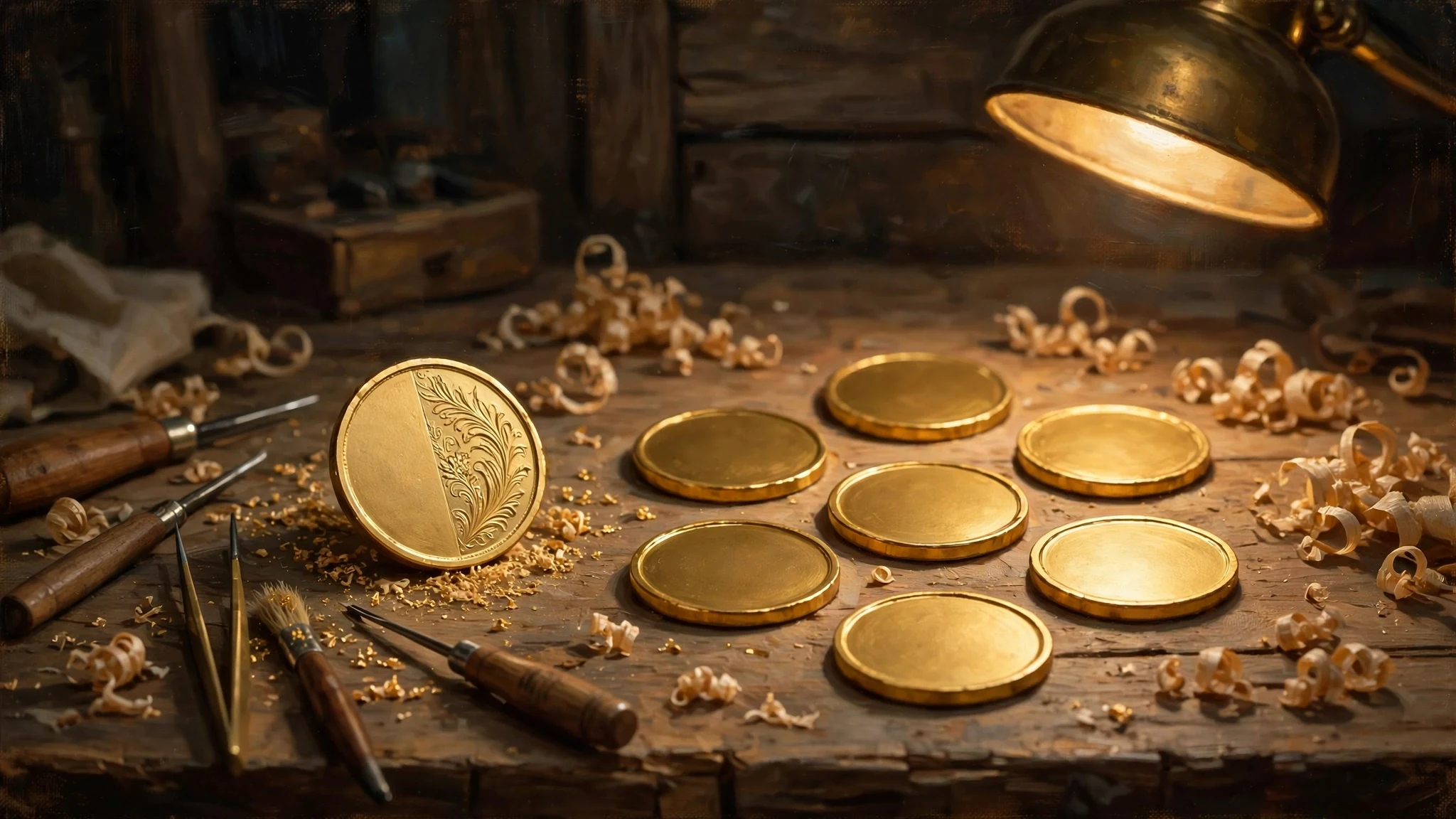
Eight of Pentacles Tarot Card Meaning: Practice, and the Craft That Grows
The eight of pentacles tarot card meaning starts at a workbench. A craftsman sits alone, hammering a pentacle into shape, with seven finished pentacles hung on a post beside him and one more under his hammer. He is not looking at the viewer. He is looking at the work. When this card appears, the reading is about practice: a skill being learned a little at a time, the hours that no one sees, and the mastery that grows from repetition. The question is not whether the work is glamorous. The question is whether the querent is willing to do it again, and again, until it is good.
That repetition is what makes the Eight of Pentacles different. The Three of Pentacles is the craft shown to others, and the Ten of Pentacles is the wealth at the end. The Eight is the lonely middle, the hours at the bench when no one is watching and no one is paying. Practice can be dull, and mastery can be slow, and the card asks: what are you practicing, and how many hours have you actually put in?
This is a Pentacles card, and Pentacles is the earth suit, the suit of money, work, the body and everything solid. The suit counts what can be held, kept and spent, and this card counts what is made. There are 14 Pentacles cards in a 78 card deck, and the Eight sits just past the middle of the numbered run, right after the patience of the Seven. The Seven waits for the harvest, and the Eight goes back to the bench.
The Eight of Pentacles Picture: A Craftsman at the Bench
Seven finished pentacles hang on the wall, and the eighth is still being made. A craftsman sits at a bench in a quiet town, hammering an eighth pentacle into shape. Seven finished pentacles hang on a post beside him, each one clean and complete, and the eighth is under his hammer. The town is behind him, quiet and distant, and there is no one else in the picture, which says this work is done alone. The craftsman's apron is plain, his tools are simple, and his attention is on the piece in front of him.
All 78 Rider-Waite-Smith images came from the hand of Pamela Colman Smith, and William Rider and Son of London published them in December 1909, and she made this craftsman ordinary. The hammer matters. It is the tool of a person who works with their hands, and the card borrows it to say that skill is earned, not given. The seven finished pentacles matter most. They are proof of the hours already spent, and they tell the reader that the eighth will be better than the first, because the craftsman has learned from the seven before it. The empty town matters too. It says the work happens before the audience arrives, and the audience only ever sees the finished piece, never the hours. The card asks: if you are the craftsman, how many pentacles have you finished, and is the next one better than the last?
Sun in Virgo and the Lord of Prudence
Every numbered Minor Arcana card has a planet and a sign in the Golden Dawn system, whose teaching document Book T comes from the order founded in London in 1888. The Eight of Pentacles is the Sun in Virgo, the first decan of Virgo, covering roughly August 23 to September 1. The Sun speaks of identity, vitality and what shines, while Virgo, mutable earth, covers craft, detail and careful work. Together they describe an identity built on skill: a person who knows who they are because they know what they can make.
Book T calls this card the Lord of Prudence. The prudence is in the doing: careful work, steady hands, and attention to the small things. On the Tree of Life the number eight sits at Hod, the sphere of intellect, learning and the mind. Hod is the place where skill is studied and refined, which is the card's quiet point: the Eight is the apprentice who has become a student of the craft itself. The card sits beside its Virgo siblings, the Nine and Ten of Pentacles. The Eight is the practice, the Nine is the independence it earns, and the Ten is the legacy it leaves.
Forty Five Minutes a Day for Six Months: A Worked Money Example
Count the practice hours, because the card is about the hours themselves. Take a querent who is learning woodwork. The querent practices dovetail joints for 45 minutes a day, every day, for 180 days. That is 8,100 minutes, or 135 hours of practice. At the start, the querent takes an hour to cut one joint, and the joint is rough. After 135 hours, the querent takes 20 minutes, and the joint is clean. A cabinet with 12 joints took 12 hours of joint work at the start, and it takes 4 hours now, which is 8 hours saved on every cabinet.
The money follows the skill. The querent charges 45 dollars an hour for woodwork. A cabinet that took 12 hours of joint work cost 540 dollars in labor, and the same cabinet now takes 4 hours, which is 180 dollars. The querent can now make three cabinets in the time it once took to make one, or charge the same price and keep the difference. That is the arithmetic of the Eight of Pentacles: 135 hours of practice, 8 hours saved on every cabinet, and a skill that pays for itself. The card also asks whether the querent will keep practicing after the skill is good enough. The honest answer is that good enough is not mastery, and the eighth pentacle is better than the first because the craftsman kept going.
Eight of Pentacles Upright: Love, Career, Money and Health
In love, the Eight of Pentacles upright often describes a relationship that is built a little at a time. Two people who work at the relationship, who practice listening, who get better at being together. The card can also mark a person who is focused on work and has little time for love, which is honest: the focus is real, and it is not the whole story. For single querents it can mean a time of working on the self, learning a skill or building a life, before a partner arrives.
In career, this card is the strongest sign for learning and mastery. It favors the apprentice, the student, the person putting in the hours, and the manager who invests in training. It also appears for people working toward a qualification or a certification, now asking whether the effort is paying off. The practical advice is to count the hours. A person who has practiced 135 hours is a different thing from a person who has practiced 10, and the card asks the querent to tell the difference.
In money, the Eight of Pentacles upright describes income earned through skill. Money comes in because the work is good, and the work is good because the hours were put in. The card favors a fixed daily practice, a named skill, and a clear measure of progress. It also warns against the most common mistake in learning: practicing the same error for 135 hours. A person who practices badly gets better at being bad, and the card asks them to get a teacher, a book, or a second pair of eyes.
In health, the Eight of Pentacles points to a routine followed with care. A person who exercises a little every day, who eats well most of the time, or who follows a treatment plan step by step. Rest and warmth count too, and so does the help around you: a clinic, a community nurse, a friend who will listen. Nothing in this reading replaces medical advice. Health, like skill, is built a little at a time, and 45 minutes a day for six months is worth more than a single heroic effort.
Eight of Pentacles Reversed: Perfectionism, and the Drudgery
Reversed, the Eight of Pentacles shows the practice going wrong. The most common reversed reading is perfectionism: a person who will not finish anything because it is never good enough, who polishes the first pentacle forever and never starts the second. This is the card of the work that never ships, and it is often a warning. The querent has the skill, and the work is ready, and the reversal asks them to let it go.
A second reversed reading is the opposite: drudgery, when the work has become boring and the querent has stopped learning. A third reversed reading is sloppy work, when the hours are put in without care and the skill does not grow. In love reversed, the card can mark a relationship where one partner does all the work, or a querent who is so focused on work that the relationship is starving. In career reversed, it can mark a job that has become a grind, or a person who is practicing without a teacher and getting worse. The remedy is the same in every case: change the practice, get a second pair of eyes, and finish something, even if it is not perfect.
Eight of Pentacles Combinations With Three Named Cards
The Eight of Pentacles beside the Three of Pentacles meaning describes practice that becomes public. The Three is the craft shown to others, the first paid commission, and the Eight is the hours that made it possible. Together the pair points to a person whose practice has paid off: a portfolio that wins the commission, a skill that earns its first fee. The advice is to show the work, because the Three is the reason the Eight matters.
The Eight of Pentacles with The Magician meaning describes skill put to use. The Magician is will, focus and the power to make things happen, and the Eight supplies the craft. Together the pair points to a person who has learned a skill and is now using it: a carpenter who builds, a coder who ships, a healer who helps. In a career reading this pair often means a new role that uses the skill, and in a money reading a rate rise earned by real ability. The advice is to use the skill, because a pentacle left on the bench earns nothing.
The Eight of Pentacles with the Page of Pentacles meaning describes a student at the start. The Page is the learner, the first coin held up to the light, and the Eight is the practice that follows. Together the pair points to a person who has just begun: a first course, a first job, a first skill. The advice is to start, because the Page is the reason the Eight exists.
A Worked Three Card Reading With the Eight of Pentacles
A reader asks: "Should I take a certification course to learn a trade?" The layout runs past to present to future. Past is the Page of Pentacles meaning, present is the Eight of Pentacles, future is The Magician meaning. The Page of Pentacles in the past shows a student at the start, holding a coin up to the light and wondering what it is worth. The Eight of Pentacles in the present is the practice itself: 45 minutes a day, every day, for six months, until the skill is real.
The course costs 1,200 dollars, and it takes six months of practice at 45 minutes a day, which is 135 hours. After the course, the querent's rate rises from 30 dollars an hour to 45 dollars an hour, which is 15 dollars more per hour. At 10 hours of work a week, that is 150 dollars a week of extra income, or 600 dollars a month. The 1,200 dollar course pays for itself in two months, and after that the extra 600 dollars a month is gain. The Magician ahead means the skill gets used: the new ability becomes real work. The reading is honest: take the course, because the practice is real and the numbers work, but only if the querent will actually do the 45 minutes a day.
The Bench, Every Day
Pulled as a daily card, it asks you to practice. Pick one skill, set a timer for 45 minutes, and do the work. Do not check the phone, do not wait for inspiration, and do not stop early. Upside down as a daily card, the day asks for the opposite: finish something. Pick one piece of work that is almost done, and finish it, even if it is not perfect, because a finished pentacle is worth more than a perfect one that never leaves the bench.
See it in the company of its Pentacles siblings. The Three of Pentacles meaning shows what the practice is for, and the Seven of Pentacles meaning shows the pause that comes after the work. All fourteen cards of the suit appear together in the Pentacles suit guide. Every deep meaning page is collected in the Tarot Meanings hub, and the Eight of Pentacles legacy page gives the short version when you are short on time.
If a reading left you with a question about learning a skill, a live reader can help you plan the practice. First 3 minutes FREE — every time, for every reading, with all advisors.
Draw a card in a One-Card Tarot reading and listen to what it says about the skill you are building right now.
Frequently Asked Questions
What does the Eight of Pentacles mean in a love reading?
In love, the Eight of Pentacles often describes a relationship that is built a little at a time. Two people who work at the relationship, who practice listening, who get better at being together. The card can also mark a person who is focused on work and has little time for love, which is honest, and which the card treats with respect. For single querents it can mean a time of working on the self, learning a skill or building a life, before a partner arrives.
Is the Eight of Pentacles a good card for work?
Yes, it is one of the best cards for work. The Eight of Pentacles favors the apprentice, the student, the person who is putting in the hours, and the manager who invests in training. It appears for people working toward a qualification or a certification, and it asks the querent to count the hours. A person who has practiced 135 hours is a different thing from a person who has practiced 10, and the card asks the querent to tell the difference.
What does the Eight of Pentacles reversed mean?
Reversed, the Eight of Pentacles most often shows perfectionism: a person who will not finish anything because it is never good enough, who polishes the first pentacle forever and never starts the second. It can also mark drudgery, when the work has become boring and the querent has stopped learning, or sloppy work, when the hours are put in without care and the skill does not grow. In love reversed, it can mark a relationship where one partner does all the work.
How long does the Eight of Pentacles say to practice?
The card does not give a fixed time. It favors a fixed daily practice, a named skill, and a clear measure of progress. The worked example uses 45 minutes a day for 180 days, which is 135 hours, and the point is the habit, not the number. A person who practices 45 minutes a day for six months is a different thing from a person who practices once a week, and the card asks the querent to choose the habit that fits their life.
What does the Eight of Pentacles mean with the Three of Pentacles?
Together the two cards describe practice that becomes public. The Three of Pentacles is the craft shown to others, the first paid commission, and the Eight is the hours that made it possible. The pair points to a person whose practice has paid off: a portfolio that wins the commission, a skill that earns its first fee. The advice is to show the work, because the Three is the reason the Eight matters, and the eighth pentacle is ready to be seen.
Last updated: November 11, 2026
