Death Tarot Card Meaning
The Death tarot card meaning is not what the name threatens, and readers have been saying so, in some frustration, for a century. Card thirteen shows a skeleton in black armor riding a white horse across a field where a king lies fallen, while a bishop pleads, a woman turns away, a child offers flowers, and between two towers in the distance the sun is rising. The picture's subject is an ending. Its mood, when you actually look at it, is closer to a procession than a catastrophe, and that mismatch between reputation and image is the first thing this page will repair.
A short combined portrait of the rider in both orientations appears on Death card page. This page remains with the upright card, because the honest version of its meaning, the ending that makes room, is the one frightened querents most need and least often receive.
The Short Answer
Upright, Death points to a genuine ending that clears ground: a chapter closing completely rather than fading, a role, habit, bond or version of life finishing so that its successor can start. Readers do not treat the card as a prediction of physical death, which belongs to medicine and fate rather than to tarot. They treat it as the deck's most reliable marker that something is over in the structural sense, and that resisting the paperwork only prolongs the rent on a building already condemned.
| At a glance | What upright Death suggests |
|---|---|
| Core theme | An ending that completes, clearing ground for what follows |
| In love | A bond or a phase within one finishing, honestly and finally |
| At work | A role, business or method ending so a better fit can begin |
| As advice | Close the chapter properly; do not rent rooms in a closed house |
| A warning? | Only against bargaining with an ending that has already happened |
The entire upright and reversed series is gathered together on our tarot card meanings hub.
Reading the Picture on the Card
Read the field from the ground up. The fallen figure wears a crown: a king, the highest worldly rank, lies in the mud with his crown off, because the card's jurisdiction is total. Endings do not check status. Beside the horse stand three responses to that fact, and readers use them as a taxonomy of how people meet closure. The bishop pleads and bargains, hands raised, as if the procession could be negotiated with. The woman turns her face away, the refusal to look. The child, holding flowers, simply gazes, the only figure meeting the rider without a strategy, and tradition suggests the child has understood the card best.
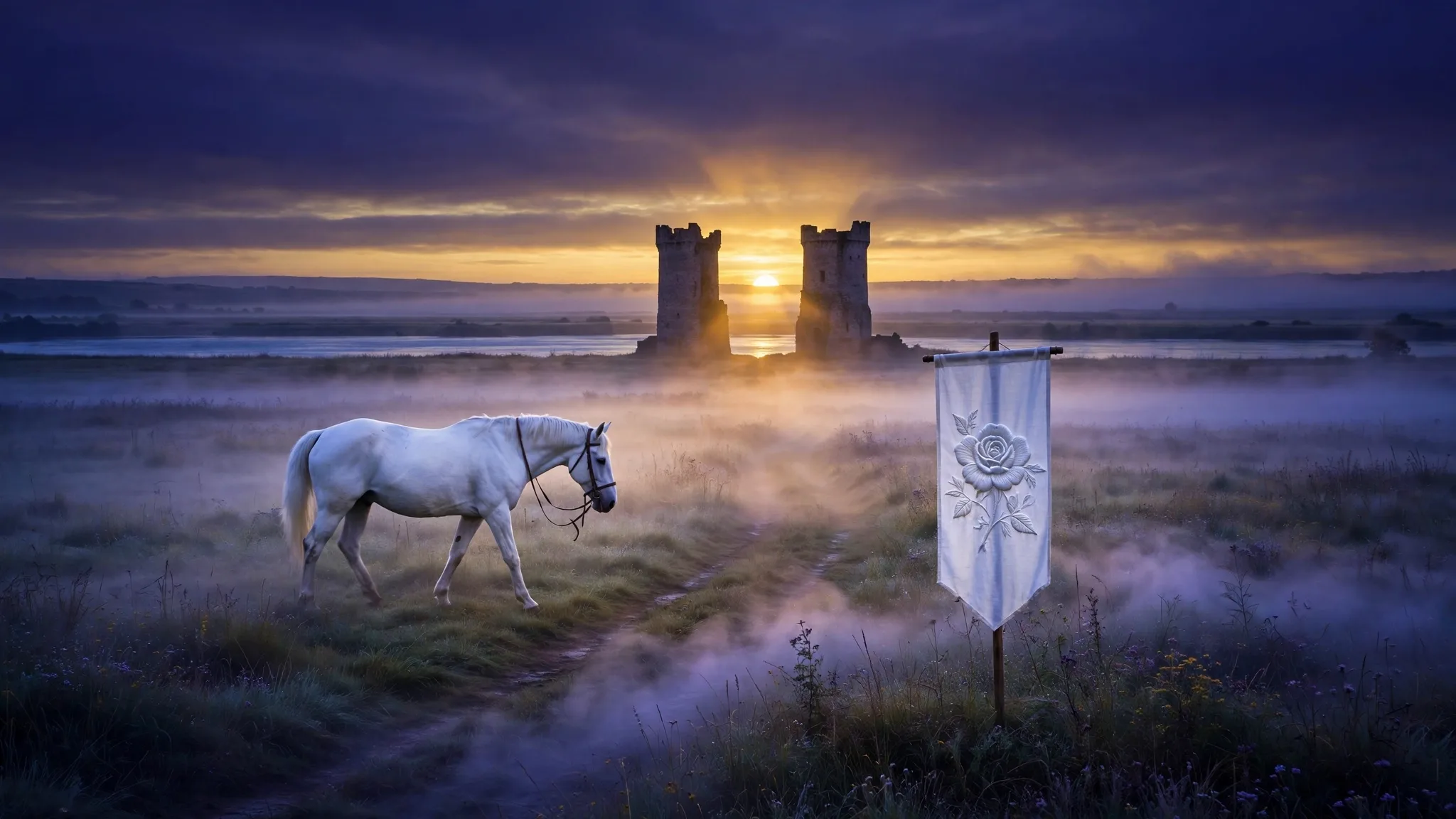
The rider himself repays a slow look. He carries no weapon. His banner is white and bears a mystic rose of five petals, a symbol of life and dawn carried into the field by the supposed enemy of both. His horse is white, unhurried, almost gentle in its stride, and beyond the river behind him the land continues into a farther shore. Between the two towers on the horizon, the same towers that appear on the Moon later in the sequence, the sun is unmistakably rising rather than setting. The picture's entire lighting votes for morning. Readers who know the card well often begin their explanation here, with the sun, because a querent who has seen it cannot unsee what the card actually depicts: not a termination in darkness, but a procession at dawn, moving in one direction, toward the towers, with the whole field lit by what is coming rather than by what is going.
Compare him, finally, with the card before him. The Hanged Man tarot card meaning taught suspension, the fertile pause. Death is what the pause was gestating in the cases where the angle, once changed, reveals that the old arrangement cannot be resumed. The Hanged Man comes down from his tree. This card tells him what he will find on the ground: a field to cross, and a sun already up.
What Death Means in a Reading
When Death appears upright, the first task is identification: what, precisely, is over? The card is rarely vague for long. Querents usually know, once the question is asked in its exact form, whether the ending belongs to a role that has been performed out of habit for two years, a business model that stopped working three winters ago, an identity maintained for an audience that has itself dispersed. Readers note how often the ending has already occurred in fact and is only awaiting its paperwork, the resignation, the conversation, the lease allowed to lapse, the name changed back. The card's arrival tends to feel less like news than like a signature being requested on a document already read.
Its second teaching concerns the quality of the closing. Endings done properly, with the goodbyes said, the accounts settled, the lessons written down while they are still warm, release an amount of energy that astonishes people. Endings done by drift, by ghosting, by keeping a key to the closed house just in case, leak that energy for years. The tradition's counsel is ceremonial in the practical sense: mark it. Return the things. Write the unsent letter and burn or send it deliberately. Tell one witness the chapter is closed, with its dates. The card does not promise that what follows will be better by Friday. It observes, from long professional experience of endings, that nothing follows at all until the closing is complete, because successors cannot move into occupied rooms.
There is a grief protocol embedded in the card that careful readers never skip. An ending can be right and still be mourned at full volume, and the card does not ask anyone to skip the mourning in the name of growth. The child with the flowers is in the picture for a reason. Tributes are part of the procession. Where an ending is being resisted past all reason, Death reversed covers the holding pattern.
Death in Love and Relationships
In love, Death is the card readers handle with the most precision, because its appearance in a relationship spread is not automatically a breakup announcement. It marks the end of a phase with the same reliability as the end of a bond, and the surrounding conversation decides which. Many strong relationships contain a Death card season: the end of the version where one partner was the other's project, the end of the long-distance arrangement, the end of the couple that existed before the child, the illness, the migration. The bond continues across the border. Its earlier form does not, and couples who can say that sentence out loud to each other tend to cross in good order.
When the card does describe a bond itself ending, its counsel is the counsel of the whole page: completeness. The honest conversation rather than the slow freeze. The belongings returned without ceremony-as-weapon. The story told, to friends and to oneself, in its true proportions, neither gilded nor prosecuted, because a past relationship misremembered on purpose tends to bill the next one. For someone single and drawing Death about the future, the card frequently points backward before it points forward: an old chapter whose paperwork is unfinished, an ex whose tenancy in the imagination continues rent-free, an identity as someone's former partner that has outlasted its lease. Close that, the card says, in whatever practical form it takes, and notice how much of the field turns out to be empty, lit and available.
Death at Work and With Money
At work, Death is the card of the true ending: the role abolished rather than lost, the product line that has had its decade, the business whose honest accounts describe a finished thing. Upright, he is surprisingly kind to professionals, because he distinguishes between failure and completion. A venture can end because it was completed, its market served, its lessons banked, its season honored, and the person who can close one that way carries no smell of failure into the next room. He favors the negotiated exit, the handover done properly, the reputation for finishing things completely, which turns out to be a rarer and more hireable quality than brilliance.
He also governs the identity endings inside a career: the manager who must let the expert die, the founder who must let the scrambler die, the expert whose method the field has retired. Those are the deaths professionals resist longest and benefit from most. With money, the card advises the complete close: the account consolidated, the dead subscription canceled rather than ignored, the failing investment sold at its honest price instead of held as a monument to the price once paid. His financial principle is that capital, like attention, can only be spent once, and money parked in a finished story is money being spent on rent for a closed house. Release it, mourn the lesson if there is one, and let the field be a field again.
A Quick Question Before You Decide Anything
If you are standing at the edge of an ending and need one clean signal, our free Yes/No Oracle tool can hold the question still. Under Death, the more valuable act is usually paperwork: name the chapter, give it its dates, and let the naming start the closing.
Talk It Through With a Reader
Endings are easier to complete with a witness who is not inside them. If a chapter of your life is asking to be closed properly, a love, a role, a version of yourself, a live reading at PsychicSmile lets you walk the field with a real reader and decide what the procession needs to carry with it. First 3 minutes FREE, every time, for every reading, with all advisors.
Last updated: November 9, 2026
Frequently Asked Questions
Does the Death card mean someone will die?
No. In tarot practice the card signifies endings and transitions in the structural sense: chapters, roles, habits, phases and arrangements finishing. Readers do not use it to predict physical death, and any reading that frightened you with that claim departed from the tradition this page describes.
I pulled Death about my relationship. Is it over?
The card does point to an ending, firmly, but the ending may be a phase rather than the bond: the end of long distance, of an old pattern, of the version of the relationship that existed before a major change. Ask what in the bond has already finished in fact. If the bond itself is the honest answer, the card counsels a complete and kind closing.
Why is the sun rising in a card called Death?
Because the picture's subject is transition rather than termination. The sun rises between the two towers on the horizon, the white banner carries a rose of life, and the horse walks toward a farther shore. The imagery insists that the ending is a procession at dawn, lit by what follows it.
What ending might Death be pointing at in my life?
The one that has already happened in fact and awaits only its paperwork: the role performed from habit, the arrangement kept from guilt, the identity maintained for a departed audience. A useful test is to ask what you would stop doing this month if stopping carried no judgment from anyone, including you.
How is Death different from the Tower?
Death is an ending that completes a natural or necessary cycle, usually recognized in advance at some level, and it proceeds like a procession. The Tower is a rupture: a structure collapsing suddenly because it was built on a falsehood. Death is a season turning. The Tower is a floor giving way.