
Dreaming About a Monkey: Meaning and Signs
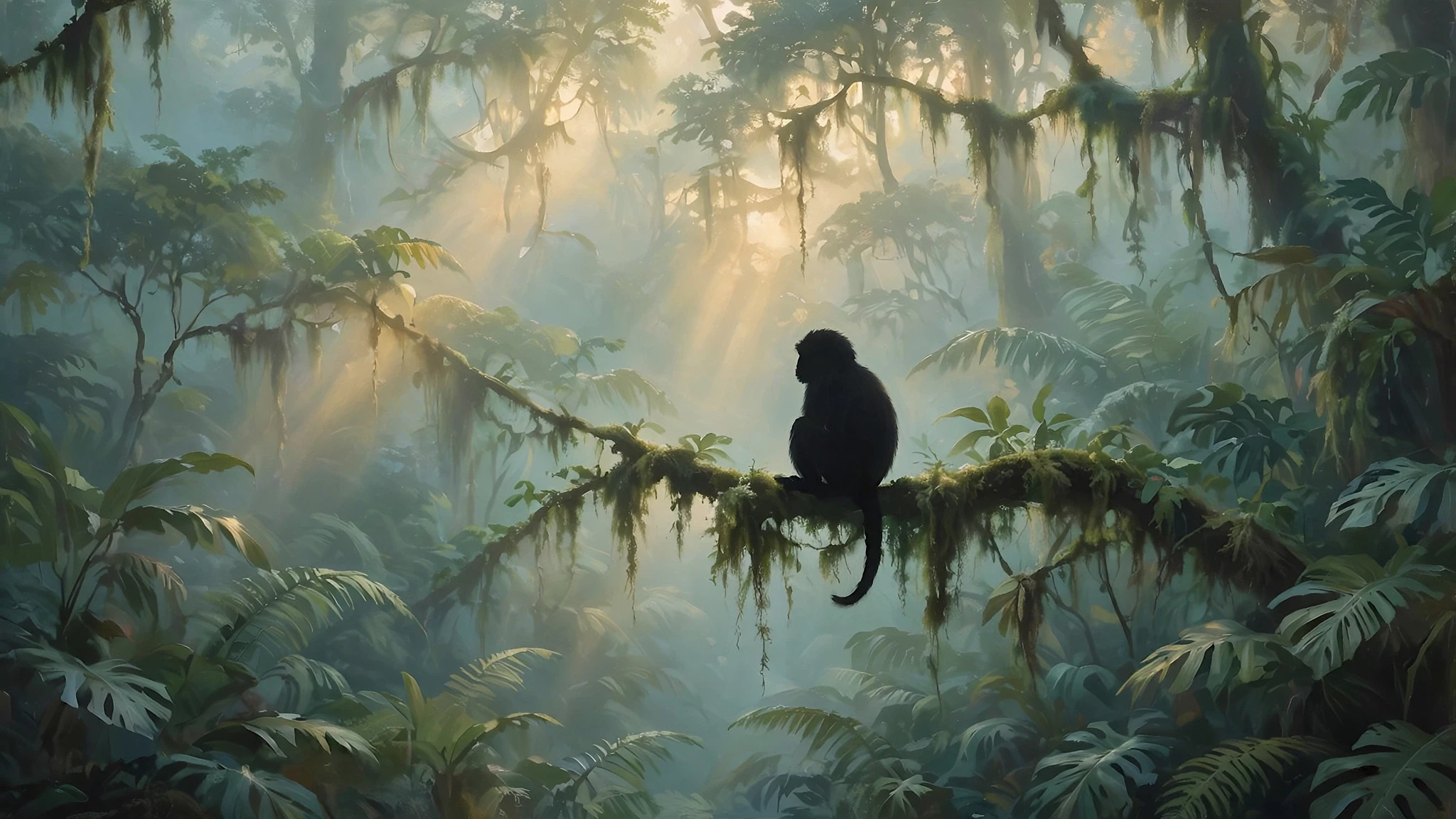
Dreaming About a Monkey: What It Often Means
Dreaming about a monkey usually points to play, cleverness, and imitation. A monkey in a dream can stand for a playful part of yourself that wants more room, a clever person in your life, or a situation where someone is copying you, mocking you, or testing your patience. Monkeys are social, quick, and hard to pin down, and a dream monkey often carries exactly those qualities. If your waking life has felt too serious, too repetitive, or too full of people who act without thinking, a monkey is a natural image for that feeling.
The monkey's behavior is the key to the dream. A monkey swinging through trees reads very differently from a monkey stealing food from your hand, and both read differently from a monkey sitting quietly and watching you. Start with what the monkey did, then ask how you felt while it did it. A dream that made you laugh means something different from a dream that made you angry, even when the monkey looks the same.
The Real Monkey Behind the Symbol
There are more than 260 recognized species of monkeys in the world, split into two broad groups. Old World monkeys live in Africa and Asia, and include baboons, macaques, langurs, and guenons. New World monkeys live in Central and South America, and include capuchins, howler monkeys, spider monkeys, and marmosets. The two groups evolved separately, and they differ in clear ways: many New World monkeys have prehensile tails that can grip branches, while Old World monkeys cannot hang by their tails, and their nostrils face in different directions.
Monkeys are among the most social animals on earth. Most species live in troops with clear hierarchies, grooming rituals, and long lasting bonds between mothers and young. Capuchin monkeys are known tool users: wild capuchins in Brazil crack open palm nuts with large hammerstones and anvils, a skill that takes years to learn and is passed from one generation to the next. Japanese macaques, often called snow monkeys, live farther north than any other nonhuman primate and warm themselves in natural hot springs during winter. Rhesus macaques were among the earliest animals sent into space by the United States, with a rhesus macaque named Albert II flying in 1949.
That intelligence and social life is why the monkey works so well as a dream symbol. A monkey is not a wild beast and not a pet. It is a clever social creature that watches, copies, and tests boundaries, much like the people around us and much like the playful, restless part of ourselves.
The Most Common Monkey Dream Variations
A playful monkey swinging through trees is the lightest version of this dream. It often points to a need for fun, movement, or freedom in your life. It can also point to a part of yourself that is bored with routine and wants to climb out of it. If you watched the monkey with delight, the dream may be a simple message: you need more play. If you watched it with envy, the dream may be about freedom you want but have not claimed.
A monkey copying you is a variation people search for often, and it usually points to imitation in waking life. Someone may be copying your ideas at work, your style, or your way of speaking. It can also point to a child or a younger person learning by watching you, which is a different kind of copying, one that carries responsibility rather than annoyance. A monkey that copies your gestures exactly can also point to your own habit of copying others, doing what the group does instead of deciding for yourself.
A monkey stealing from you points to a small loss or a boundary being crossed. In the dream the theft is usually food, money, or something you were holding. In waking life it often maps to a person who takes your time, your ideas, or your credit without asking. The monkey's speed matters here: it takes and runs, which is how small boundary crossings often feel. They happen fast, and by the time you react, the moment has passed.
A monkey attacking or biting you is a sharper variation. It usually points to a conflict with someone who acts impulsively, or to your own impulsive side causing trouble. A bite on the hand can signal friction at work. A bite that draws blood can point to a conflict that left a real mark. If the monkey attacked without warning, the dream may be about a person whose behavior you find unpredictable. If you provoked the monkey first, the dream may be asking you to look at your own role in the conflict.
A baby monkey in a dream points to innocence, vulnerability, or a new responsibility. It can stand for a child, a new project that needs care, or a playful part of yourself that is still young and unformed. A baby monkey clinging to you suggests something or someone depends on you right now. A baby monkey alone in a tree suggests a young part of yourself that feels exposed or unprotected.
A monkey in your house points to mischief or chaos inside your private life. It can be a child making a mess, a family member who stirs things up, or your own restless energy disrupting a calm routine. A monkey in a cage points to playfulness or cleverness that has been locked away, either by you or by circumstances. A monkey escaping from a cage points to that energy breaking free, for better or worse.
The Psychological Reading
In psychological terms, a monkey dream often reflects the tension between the serious adult self and the playful inner child. Dream researchers often say an image can give words to a feeling we have not named, and the monkey gives words to restlessness, curiosity, and the urge to break rules. If your life has been all duty and no play, a monkey dream can be your mind asking for balance. If your life has been chaotic, a monkey dream can be your mind showing you the chaos in a form you can look at.
There is also a social layer. Monkeys live in troops with hierarchies, and they groom each other, compete for status, and form alliances. A monkey dream can reflect your feelings about your own social group: who is at the top, who is being groomed for favor, who is being teased, and where you stand in the order. Dreaming of a monkey that is higher in a tree than you can point to feeling looked down on. Dreaming of a monkey that grooms you can point to a relationship that feels caring and close. Dreaming of a troop of monkeys chattering can point to gossip or to a group whose talk never stops.
A third layer is imitation. Human beings learn by copying, and so do monkeys. A monkey dream can surface the question of who you are copying and who is copying you. Are you living your own life, or are you repeating someone else's script? Are you annoyed because someone copied you, or because they copied you badly? Those are questions worth asking, and the monkey is a good prompt for them because it copies without understanding, which is exactly how thoughtless imitation feels.
The Spiritual Reading
In spiritual terms, the monkey is read in different ways in different traditions. In Hindu tradition, the monkey god Hanuman stands for devotion, strength, and selfless service, and a monkey dream can be read as a call to serve something larger than yourself with a loyal heart. In Chinese tradition, the monkey is one of the twelve animals of the zodiac, linked to cleverness, curiosity, and quick thinking. A monkey dream in that reading can point to a clever solution arriving, or to a need for flexibility when a straight path is blocked.
In some spiritual readings the monkey stands for the restless mind itself, the part of us that jumps from branch to branch and never settles. In this reading, a monkey dream is a picture of a mind that needs stillness. The monkey is not an enemy. It is a part of you that needs training, not punishment. A calm monkey in the dream can mean the mind is settling. A wild monkey can mean it is still jumping.
Treat these spiritual readings as questions to carry into your day, not as verdicts, and notice which one keeps coming back to you. If the Hanuman reading of loyal service fits your life, ask where your loyalty is being tested. If the restless mind reading fits, ask what would help your mind settle for even a few minutes a day. If neither one fits, the play and imitation reading is still worth a second look. A dream can hold more than one true meaning.
What Changes the Meaning
The monkey's species or size is a first modifier. A small monkey, such as a marmoset or a capuchin, points to something small and quick: a minor annoyance, a small clever trick, or a lighthearted moment. A large monkey, such as a baboon or a mandrill, points to something bigger: a powerful person, a serious conflict, or a social hierarchy that feels heavy. A monkey with a long tail points to agility and escape, while a monkey without a tail points to something more grounded.
The monkey's action is a second modifier. A monkey that plays points to joy and freedom. A monkey that steals points to boundaries and loss. A monkey that grooms you points to care and closeness. A monkey that throws things points to anger or frustration, either yours or someone else's. A monkey that watches you silently points to being observed, judged, or studied by someone in your life. Before you pick a meaning, sum up the monkey's action in one sentence, because that action is the heart of the dream.
Your own reaction is a third modifier. Laughter in the dream usually means the monkey stands for something you enjoy or something you need more of. Anger usually means it stands for someone who is testing your patience. Fear usually means it stands for unpredictability, a person or situation you cannot control. Affection, especially toward a baby monkey, usually means it stands for something you want to protect or nurture.
The setting is a fourth modifier. A monkey in a jungle or forest points to your natural instincts and to a situation that feels wild or unmanaged. A monkey in a city points to social life, work, or public behavior. A monkey in your house points to private life and family. A monkey in a zoo or a cage points to something contained, a wild part of yourself or someone else that has been fenced in.
A Worked Example: Reading Your Own Monkey Dream
Take a dream people often tell: you are walking through a market, and a small monkey jumps down from a stall, snatches an apple from your bag, and runs up onto a roof to eat it while looking down at you. You feel annoyed but also a little amused. Here is one way to work through it.
First, note the facts. One small monkey, outdoors, in a market, theft of food, the monkey escapes upward, and your feeling was mixed annoyance and amusement. Second, match the setting to your life. A market is a place of exchange, buying and selling, so the dream is probably about an exchange in your waking life, perhaps at work or in a friendship. Third, read the theft. An apple is food, a basic need, and it was taken quickly and openly, which suggests a small loss that happened in plain sight. Fourth, read the monkey's position. It sits above you on the roof, which suggests the person or situation feels out of reach, and you cannot easily get back what was taken. Fifth, check your feeling. Amusement mixed with annoyance suggests the loss was small and the person involved may be someone you actually like. A fair reading would be: someone took a small thing from you, perhaps credit, time, or attention, in a way that was cheeky rather than cruel, and you are deciding whether to laugh it off or to set a boundary.
Alter one small detail and watch the meaning swing. If the monkey had bitten you instead of stealing, the reading would shift toward conflict and hurt. If the monkey had been large and aggressive, the reading would shift toward a serious power struggle. If you had felt only anger, the reading would shift toward a boundary that needs to be set firmly. The modifiers are what make the dream yours rather than generic.
What to Do After a Monkey Dream
Jot the dream down the morning you have it, with the monkey's size, action, and location, and your feeling during the dream. Then ask yourself three plain questions. Where do I need more play in my life, and what keeps me from taking it? Who is copying me, or who am I copying, and is that copying harmless or harmful? Is there a small boundary crossing I have been laughing off that actually needs a clear word?
If play was the point, schedule it rather than waiting for it. Even a short walk, a game, or an hour with no obligations can answer a playful monkey dream. If imitation was the point, name it calmly, to yourself or to the person involved, and decide what is yours to protect. If the dream pointed to a restless mind, the practical step is a small daily stillness: a few minutes of quiet, a short walk without a phone, or a single task done slowly and fully.
If monkey dreams keep repeating, look at your social life and your schedule rather than the symbol. When monkey dreams keep repeating, they often arrive when a person is either overworked and starved of play, or surrounded by social noise and in need of quiet. Looked at that way, the dream reads less like a forecast and more like a status report: your inner monkey is either caged or running wild, and the balance needs attention. That is an everyday problem with an everyday fix, so let the dream point you toward the fix.
If a different dream is tugging at you now, these three are worth a look: dreaming about a frog, dreaming about a bear, and dreaming about a child, or swing through the full dream meanings hub for the one that matches.
If you want to talk this dream over with someone, remember: First 3 minutes FREE — every time, for every reading, with all advisors.
If you want a playful next step, try a One-Card Tarot reading and ask where your life needs more play or a clearer boundary.
Frequently Asked Questions
What does it mean to dream about a monkey chasing you?
A monkey chasing you usually points to a playful problem that will not leave you alone, or to someone in your life who keeps testing your patience. If you were laughing while running, the dream may be about fun you are avoiding. If you were afraid, it more likely points to unpredictability or a conflict you need to face rather than outrun.
What does it mean to dream about a monkey biting you?
A monkey bite usually points to a sharp conflict with someone impulsive, or to your own impulsive words or actions causing harm. A bite on the hand can point to work friction, while a bite that draws blood can point to a conflict that left a real mark. Ask who acted without thinking, you or someone else, and what needs to be repaired.
Is dreaming about a monkey a good sign?
A playful monkey is generally read as a positive sign of cleverness, humor, and a need for fun that deserves attention. An aggressive monkey, a thief, or a monkey that frightens you points instead to boundary problems, imitation, or social tension. The monkey's behavior and your feeling decide whether the sign feels good or warning.
What does a baby monkey mean in a dream?
A baby monkey usually points to innocence, vulnerability, or a new responsibility that needs care. It can stand for a child, a new project, or a playful part of yourself that is still young. A baby monkey clinging to you suggests something depends on you right now, while one alone suggests a young part of yourself feels exposed.
What does it mean if a monkey copies you in a dream?
A monkey copying you usually points to imitation in waking life, someone copying your ideas, style, or way of speaking. It can also point to a child learning by watching you, or to your own habit of copying others instead of deciding for yourself. Ask who is doing the copying and whether it is harmless, flattering, or crossing a line.
Last updated: November 11, 2026
