
Dreaming About a Bat: Meaning and Signs
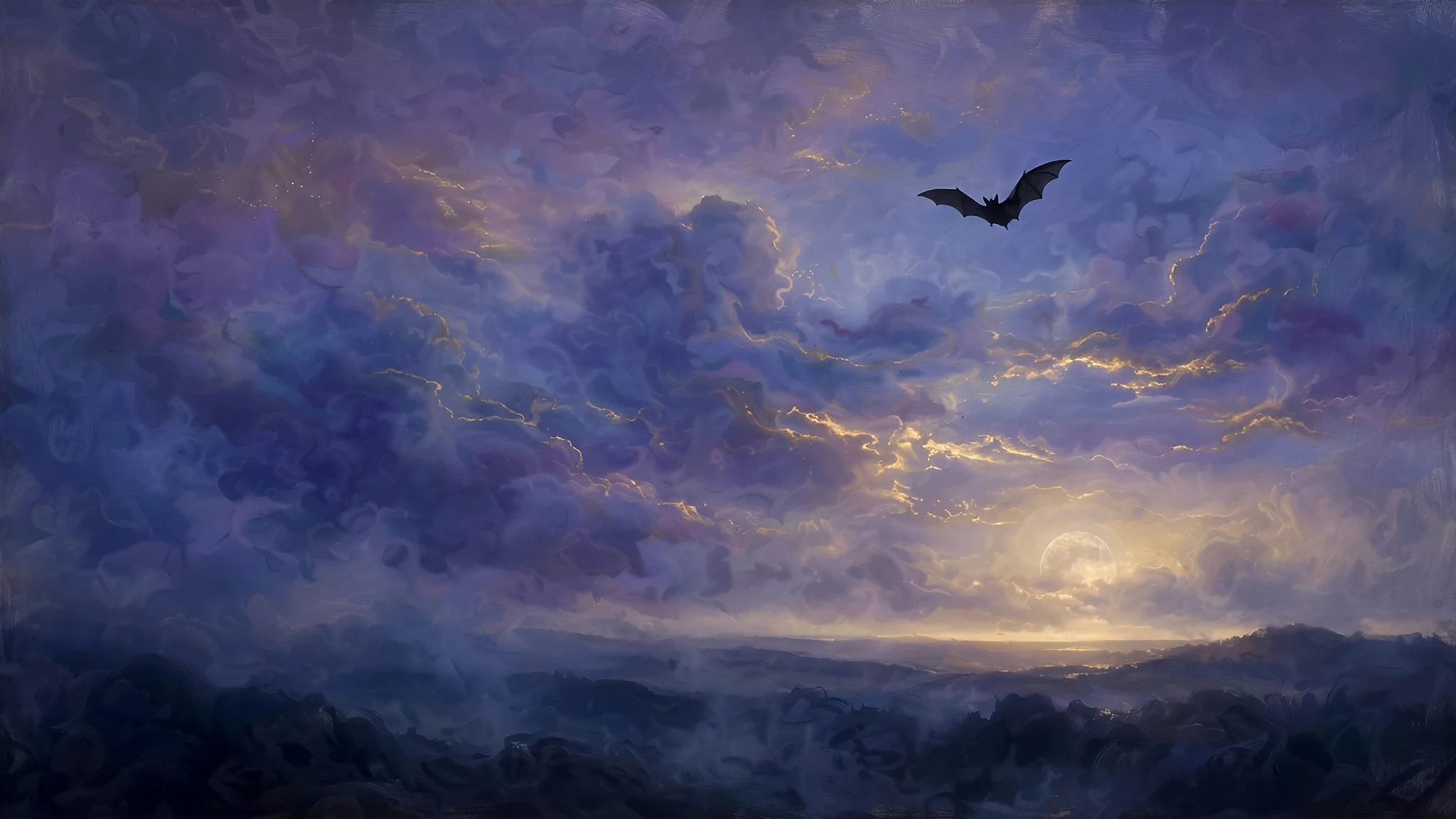
Dreaming About a Bat: What Makes This Dream Different
Dreaming about a bat is a night dream in almost every sense. The animal flies in darkness, it navigates by sound rather than sight, and it hangs upside down to rest, which makes it look like the world turned over. People who dream about bats usually remember one of three things: a single bat crossing a dark room, a cloud of bats pouring out of a cave or a roof, or a bat that gets tangled in their hair. Each of those pictures carries a different weight, and this page separates them before it offers any meaning.
The bat is one of the most misunderstood animals in the world, and the dream inherits that confusion. In some cultures the bat is a sign of bad luck and death. In Chinese tradition, the bat is a symbol of good fortune, and five bats together stand for five blessings. In the stories of the Maya, bats were connected to the underworld and to rebirth. A single dream image cannot carry all of those traditions at once, so the honest way to read a bat dream is to start with your own feeling in the dream and your own associations, then check them against the facts of the animal.
You will find the facts first in this page: what bats really do, how they navigate in darkness, and how many species there are. An illustrative example follows, a bat loose in a bedroom at night, and then the two readings side by side, the psychological one about sensing what you cannot see and the symbolic one about the bat as a messenger between night and day. The variations close the page, a bat in the house, a bite, a swarm, a bat that changes shape, plus questions to carry into your week.
An Illustrative Example: The Bat in the Bedroom
This example is illustrative, not a real person's story.
A man named Daniel, 41, dreamed that a bat was flying in circles around his bedroom at night. The windows were shut. He could not find how it had come in. He tried to catch it with a towel, and every time he got close, the bat slipped past his hands in the dark. He was not bitten. He was not hurt. He was exhausted by the effort, and he woke up before he caught it.
The details do the work here. The bedroom is the most private room in a house, so a bat inside it suggests something private has been disturbed. The closed windows matter, because they rule out an open door; whatever is flying around in the dream came in through a gap Daniel had not noticed. The towel matters too, because it is a clumsy tool for a fast animal, which suggests Daniel was trying to solve the problem with the wrong approach. And the fact that the bat never bit him matters most of all, because the fear in the dream was larger than any actual harm.
In Daniel's waking life that week, he had been trying to fix a problem with his sleep. He had bought a new mattress, changed his bedtime, and cut out coffee, but he was still waking at 3 in the morning with his mind racing about money. He was treating the symptom, the waking, while the cause, the money worry, flew around untouched. The bat was the worry itself, quick, hard to catch, and active in the dark hours. The dream did not tell him his finances were doomed. It showed him that his tools did not match his problem, and that the worry would keep circling until he dealt with it directly, in daylight, with numbers on paper.
The Real Bat: The Only Mammal That Truly Flies
Bats are the only mammals capable of true, sustained flight. Flying squirrels and similar animals only glide, while bats power their flight with wings formed from elongated hand bones stretched with skin, which is why their scientific order is called Chiroptera, from Greek words meaning hand wing. Britannica records more than 1,200 recognized species, and more recent counts put the number above 1,400, making bats the second largest order of mammals after rodents. They live on every continent except Antarctica, and they fill roles from pollinating plants to eating insects.
Most small bats navigate by echolocation. They send out high frequency calls and listen for the echoes, building a sound picture of the space around them that is precise enough to catch a flying insect in total darkness. Fruit bats, the large flying foxes of the Old World tropics, mostly rely on eyesight and smell instead. The common phrase blind as a bat is wrong: bats can see, and many see well, but their hearing does the finer work in the dark. A single little brown bat can eat hundreds of insects in an hour, which is why farmers value them, and some bats live more than 20 years in the wild, which is long for an animal of their size.
Bats also rest in a way no other mammal does, hanging upside down by their feet. Their tendons lock automatically, so hanging costs them no effort, and they can drop straight into flight from that position. That upside down rest is part of why the bat feels uncanny in dreams. It is an animal that does everything the other way around: active at night, guided by sound, resting upside down. When your dreaming mind needs an image for something that works by different rules from your daytime logic, the bat is waiting.
The Psychological Reading: Sensing What You Cannot See
The strongest psychological reading of a bat dream starts with echolocation. Your waking mind gathers information mostly through sight, but in a dream the bat moves by listening. That makes it a natural image for intuition, the kind of knowing that arrives without a clear picture. If you have been sensing that something is wrong in a relationship or at work without being able to point to a single fact, the bat can stand for that sensing itself. The dream may be telling you that your ears are working even when your eyes cannot see the problem yet.
Sleep researchers have a name for the way dreams borrow from waking life: the continuity hypothesis, which holds that dreaming carries the concerns of the day into sleep in a different form. A bat dream fits it neatly, since the animal stands for information gathered without sight, the tone of a conversation, a pause, a pattern noticed but not named. Freud's 1900 book treated such images as disguised wishes, and Jung read them as messages from a deeper layer of the mind, but you do not need either theory to use the dream. The practical point is that your ears were working while your eyes were closed, and the bat is the shape your mind gave to what they heard.
Freud, in The Interpretation of Dreams of 1900, would have looked for a repressed wish behind the bat, something hidden in the dark of the mind. Jung would have treated the bat as an archetype of the night side of the self, the parts of you that only come out when the daytime rules relax. Both point in the same practical direction: ask what you know that you have not said out loud yet. Write down the thing you sensed but could not prove. Often the sentence, once written, turns out to be something you already had good reason to believe.
The Symbolic Reading: Night, Change and Second Sight
In symbolic traditions, the bat belongs to the threshold between day and night, and thresholds are where change happens. The bat leaves its roost at dusk, the hour when the day ends and the night begins, and it returns at dawn. A dream bat can therefore stand for a transition you are in the middle of: a job ending, a relationship changing shape, a belief you are outgrowing. The bat does not belong fully to either side, and neither do you, while the change is unfinished.
The bat also carries the symbolism of rebirth in several traditions. It disappears into caves and dark places and comes out again, which reads as a small death and return. In a dream, that can point to a part of your life that went quiet and is now coming back, such as a friendship, a skill, or an interest you set aside. It can also point to a part of yourself that you thought was finished, a version of you that the dream suggests is still alive in the dark, waiting for the right hour to fly again.
The darker symbolic layer is fear of the unseen, and it deserves an honest mention. Bats have been linked in folklore to vampires, disease, and bad omens, and those associations are old and strong. If your bat dream felt frightening, that fear is real and worth naming, but it is not evidence about your future. The fear usually belongs to the situation the bat stands for, not to the bat itself. A bat in a dream is a symbol you can think with, not a verdict you must obey.
Variations That Change the Meaning
A single bat flying calmly across a room is usually the gentlest version of this dream. It often matches a small worry or a quiet intuition, something you have noticed and can afford to watch for a while. A swarm of bats is different. A cloud of them pouring from a roof or a cave usually matches overwhelm: too many small worries arriving at once, or a situation where the noise has become louder than any single fact. The reading shifts from what is the worry to how many of them are there, and whether you need help sorting them.
A bat that gets tangled in your hair is a common and specific variation. Hair in dreams often stands for thoughts, so a bat caught in it suggests a thought that has become tangled with a fear, where you can no longer tell which is which. The practical step is to separate them on paper: write the fact, then write the fear, and see how much of the tangle is fact and how much is feeling. A bat bite is rarer and sharper. In waking life, bat bites are uncommon, but they are taken seriously because bats can carry rabies, so a bite dream often points to a small thing you fear could have larger consequences, a remark at work, a missed payment, a test result you are waiting for.
A bat that turns into something else, a bird, a person, a shadow, points to a situation whose shape keeps changing. The meaning is in the change itself: you are dealing with something that refuses to stay still long enough to be named. A dead bat usually marks the end of a fear or the end of a phase of worry. A white bat, which is rare in nature, tends to stand out as a dream image of something unusual or pure, and dreamers often remember it as beautiful rather than frightening, which suggests the night side of the dream carries something hopeful rather than threatening.
What to Do After a Bat Dream
Begin by writing down where the bat was and what it did, because the setting carries most of the meaning. A bat outdoors at dusk is a different dream from a bat trapped in a bedroom, and a calm bat is a different dream from a swarm. Then ask yourself the echolocation question: what have I been sensing lately that I cannot yet see clearly? Give it one sentence, even if the sentence feels uncertain. Uncertainty is the point. The dream is about sensing, not proving.
If the dream felt frightening, take one practical step in daylight. Check the thing you are worried about, call the person, look at the account, ask the question you have been avoiding. Bats navigate by sound, and so can you: listen to what people actually say, rather than to the echo of your worry. If bat dreams repeat for weeks, or if they come with real fear of the dark or trouble sleeping, it is worth talking with a counselor or a sleep professional, since recurring night dreams sometimes point to stress that needs a waking solution rather than a symbolic one.
If a bat crossed your dream last night, treat it as a question about what you have been hearing in the dark, and give that question one honest sentence in daylight. First 3 minutes FREE — every time, for every reading, with all advisors.
When the room feels dark, open a One-Card Tarot reading and listen for the quiet signal your daytime eyes missed. Listen for what you have been sensing in the dark.
A bat belongs with other night creatures, so the Dream dictionary places it near dreaming about an owl and dreaming about a bird, two very different kinds of flight. For the fear underneath, dreaming about being chased and dreaming about a ghost cover pursuit and haunting, while dreaming about flying looks at the freedom on the other side of the dark.
Frequently Asked Questions
What does dreaming about a bat mean?
Dreaming about a bat usually points to something you sense but cannot see clearly, such as an unspoken tension, a quiet intuition, or a change that is still taking shape. The bat navigates by sound in the dark, so the dream often stands for knowing that arrives through feeling rather than through facts you can point to.
Is dreaming about a bat a bad omen?
Not necessarily, and in some traditions it is the opposite. In Chinese tradition the bat is a symbol of good fortune, while in some Western folklore it is linked to fear and bad omens. The feeling of your own dream matters more than any single tradition: a calm bat and a frightening swarm are different dreams, and the meaning follows the feeling and the setting.
What does it mean to dream about a bat in your house?
A bat in your house usually points to something private that has been disturbed, such as a worry you carry at home, a secret, or a problem that followed you into your personal life. The house in dreams often stands for the self, so a bat inside it suggests the issue is close to home rather than distant or abstract.
What does a bat bite mean in a dream?
A bat bite in a dream often points to a small thing you fear could grow larger, such as a remark at work, a missed payment, or a result you are waiting for. Real bat bites are uncommon but are taken seriously, and the dream borrows that weight. The bite usually marks anxiety about consequences, not a prediction that harm will happen.
Why do I keep dreaming about bats?
Recurring bat dreams usually mean there is something you sense but have not yet named or dealt with, and the dream keeps returning while the situation stays unresolved. When you put the sensed thing into words, even as a guess, and take one small step toward it, the dreams often change or fade.
Last updated: November 11, 2026
