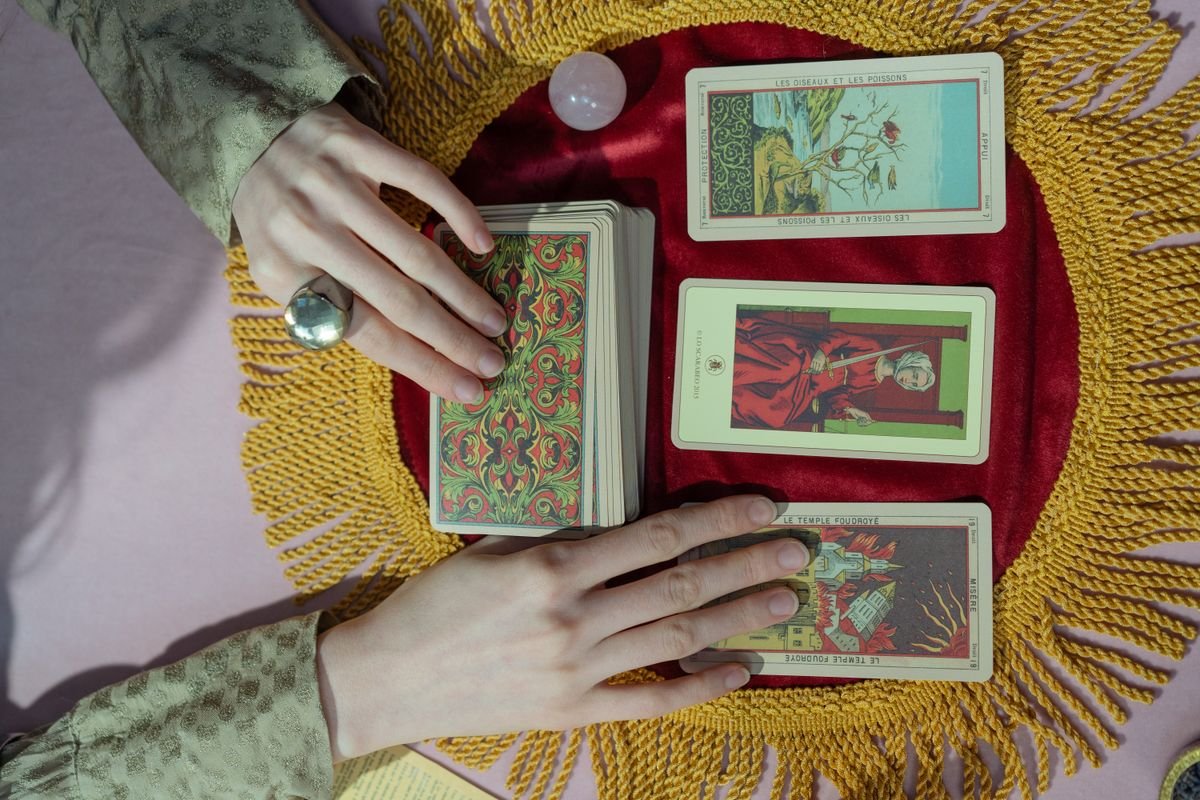
Year-Ahead Reading: How to Get One That Is Actually Useful


December and January bring a spike in year-ahead readings, and most of them go to waste. Not because the readers are bad, but because "tell me about my year" is too vague to produce anything actionable. Here is how to get one worth paying for.
Go in with themes, not a blank slate. Pick three areas that matter: love, work, and one personal thing (health, family, a move). Ask about each one specifically. "What should I focus on career-wise in the first half of the year?" will always beat "what does my year look like?" the first gives the reader a channel to tune into; the second is static.
Ask for seasons, not dates. Good readers sense rhythms a slow winter, an opening in spring, a decision point around autumn. Pinning it to months is fine as a rough map, but treat it as weather forecasting: useful for planning, foolish for scheduling your life around.
Write it down. Seriously. The transcript from your chat is saved automatically, so revisit it quarterly. A year-ahead reading isn't a one-night event. It is a map you check against the terrain as you travel.
This guide is the full playbook: why most year-ahead readings fail, how to prepare, the exact questions to ask for every life area, how to handle a hard forecast, and how to make the reading keep paying you back all year long.
Why Most Year-Ahead Readings Are Wasted
The number one killer of a year-ahead reading is vagueness. "Tell me about my year" is the spiritual equivalent of walking into a restaurant and saying "bring me food." You'll get something but it'll not be what you actually wanted, and you'll walk out unsure whether it was worth it. The reader isn't failing you. They're working with no signal, and even the best reader can't tune into static.
The second killer is the entertainment trap. Plenty of people get a year-ahead reading the way they read a horoscope column for a pleasant shiver of possibility, nodded at and forgotten by February. There's nothing wrong with enjoying it, but if you paid for guidance and treated it as entertainment, you paid for a map and used it as wallpaper.
The third is the fortune-telling fantasy: the hope of receiving a neat list of predictions to check off through the year. March: promotion. June: new love. October: windfall. That's not how this works, and any reader who hands you that list is either guessing or selling. Real year-ahead insight comes as themes, rhythms, and decision points orientation, not a schedule.
Here is the reframe that changes everything: a year-ahead reading is a compass, not a calendar. It'll not tell you what will happen on the 14th of May. It'll tell you which direction the year leans, where the headwinds are, and when the windows open. Used that way, it's one of the most practical things a reading can do.
Prepare With Three Themes, Not a Blank Slate
Three is the magic number for a year-ahead reading. One topic leaves most of your life unexamined. Five topics turns the session into a speed-run where everything gets thirty seconds and nothing gets depth. Three areas give you breadth with room to actually go somewhere in each one.
Pick the three before you book the reading not during it. Write them down in order of importance. The reading will follow your energy, and scattered energy gets scattered answers.
If you have never had a reading before, start with a first psychic reading focused on a single theme, so the session stays useful instead of scattered.
Theme one: love and relationships
This is the area most people lead with, and for good reason the heart drives more life decisions than anything else. Before the reading, get honest with yourself about where you actually stand. Are you partnered and wondering about depth or direction? Single and wondering about openness or timing? Healing from something and wondering about readiness? The reader can only meet you where you're, so know where that is. "What does my love life need from me this year?" is a stronger starting question than "will I meet someone?" the first invites guidance, the second invites a yes-or-no that helps nobody.
Theme two: work and career
Career questions benefit enormously from specificity because professional life runs on decisions with deadlines. Think about what is actually on your plate: a possible move, a skill to build, a business to start, a role that's draining you, a promotion you want. Bring the real situation, not the abstract one. "What should I focus on career-wise in the first half of the year?" gives the reader something concrete to read around. "What does my career look like?" gives them fog.
Theme three: one personal thing
This is the wildcard, the thing that keeps you up at night that's neither romance nor résumé. Health, family, a move, a creative project, a spiritual question, a relationship with a parent or child, money patterns. Whatever it's, name it before the reading. Most people discover that this third theme is where the reading hits hardest, because it's the area they think about constantly but never quite say out loud. Giving the reader permission to go there's half the work.
The Best Questions to Ask (With Examples)
How you ask shapes what you receive. Questions built around guidance outperform questions built around guarantees every single time. "What should I focus on" beats "will this happen." "What do I need to understand about" beats "tell me about." Here are concrete questions for each life area steal them freely.
Love
"What pattern in my relationships needs my attention this year?" This is the highest-value love question there is. It skips past the who and the when and goes straight to the work that would change everything. "Is this a year for deepening something or for opening to someone new?" Direction beats detail knowing whether the year's energy favors depth or discovery shapes a hundred small choices. "What am I not seeing about my current situation?" Blind-spot questions are where readers earn their fee.
Career
"Is this a building year or a leap year for me professionally?" This single distinction clarifies everything building years reward patience and foundations; leap years reward bold moves. "What strength of mine is underused right now?" Readers often spot the asset you have stopped noticing. "What should I be cautious about in the second half of the year?" Caution questions are practical, not fearful they are how you avoid the avoidable.
Health and family
"Where should I put my energy for my wellbeing this year?" Note this asks about energy and attention, not diagnosis no reader should be diagnosing you, and you should not ask them to. "Is there anything I should pay attention to in my family this year?" Family rhythms an aging parent, a sibling's quiet struggle, a shift in dynamics often show up in year-ahead readings before they become obvious. "What would restore me most right now?" Simple, underrated, often the most useful question of the session.
Personal growth
"What is the theme of this year for me?" Every year has one a word or phrase the whole twelve months keeps circling. Readers are good at naming it. "What habit or mindset would change the most if I worked on it?" Leverage questions find the one domino that knocks down the others. "What am I ready for that I don't believe I'm ready for?" Ask this one last, when the reader is fully tuned in. The answer is frequently the moment of the whole reading.
Ask for Seasons, Not Dates
Good readers sense rhythms the way sailors sense weather not as calendar appointments but as approaching conditions. A slow winter. An opening in spring. A decision point around autumn. A burst of momentum late in the year. This is the natural language of year-ahead insight, and you should ask for it in these terms.
Pinning everything to exact months is fine as a rough map "does that opening feel like spring or summer?" is a fair clarifying question. But treat the months like a weather forecast: genuinely useful for planning, foolish for scheduling your life around. Forecasts update. Conditions shift. Your choices change the terrain.
There's a real danger in exact dates that goes beyond inaccuracy. When a reader says "March," March becomes a countdown. You stop living February and start waiting for March. Every decision gets distorted by the approaching date. And if March passes quietly, the disappointment poisons the rest of the reading retroactively even the parts that were accurate. Seasons don't do this to you. "Spring" lets you stay present while staying oriented.
How to phrase it: "What does the first half of the year feel like compared to the second?" "When in the year does the energy shift?" "Is there a season I should protect keep clear for rest or for a big push?" These questions get you the rhythm without the countdown. For more on why exact dates disappoint, see our guide on why timing questions are the hardest ones in a reading.
What a Good Reader Will Actually Tell You And What They Can't
Set your expectations honestly and the reading will exceed them. Set them magically and nothing can meet them.
A good reader will tell you: the year's themes and emotional weather. Your strengths to lean on and your blind spots to watch. The rhythms when to push, when to rest, when to decide. The patterns in your relationships and work that are ready to shift. The decision points likely to arrive, and what each choice costs. The inner work the year is asking of you.
A good reader can't tell you: exact dates of specific events. What another person will choose free will is real and it belongs to everyone, not just you. Lottery numbers, stock picks, or gambling outcomes. Medical diagnoses or legal verdicts. Anything with the certainty of a contract. The future is not a fixed script being read to you; it is a set of trajectories being sensed, and your choices remain the largest variable.
Watch for red flags the way you would in any professional service. Guaranteed outcomes "you will meet your husband in June" are a lie dressed as confidence. Fear-based upsells "I see darkness around you in March, but I can remove it for an extra fee" are a scam, full stop. Claims to override someone else's free will "I can make him come back" are both unethical and untrue. Our curse scam breakdown shows exactly how the fear-based upsell works. A genuine reading leaves you calmer and clearer than you arrived. If you leave more afraid and more dependent, the reader failed you, not the other way around.
The January Rush: Book Early
Every December and January, demand for year-ahead readings spikes and the best readers' calendars fill first. If you want a specific reader, book in November or December for a January slot. Waiting until the second week of January to book the reader everyone wants is like trying to get a dinner reservation on Valentine's Day.
Don't, however, panic-book on New Year's Eve. The reading doesn't expire at midnight on December 31st. A year-ahead reading done in mid-January or even February works exactly as well. In fact, the timing of the reading barely matters at all: a "year ahead" read in March simply covers March through February. The twelve months start whenever you start.
One more practical note: the reader you get in the January rush is often reading their eighth year-ahead of the day. If you can, book a morning slot or an off-peak week. A fresh reader gives a fresher reading. This isn't mystical advice. It is the same reason you don't schedule important meetings at 4:55 on a Friday.
When the Reading Shows a Hard Year
Sometimes the reading doesn't show sunshine. The reader senses struggle a slow season, a loss, a hard decision, a relationship tested, a plan that won't survive contact with reality. Here is the honest truth about that: some years are difficult, and knowing it in advance is a gift, not a curse.
Not every year is a harvest year. Some are planting years slow, unglamorous, everything happening underground. Some are shedding years, where what leaves was already too heavy to carry. Some are quiet years, where the work is internal and invisible. A reader who tells you "this looks like a hard year" isn't punishing you. They're handing you a coat before the cold arrives.
When the forecast is difficult, change your questions. "What is this season for?" reframes suffering as curriculum. "What will it build in me?" looks past the pain to the person on the other side. "How do I move through it well?" is the most practical question there is it asks for the strategy, not just the forecast. And "what should I protect during this time?" your health, your savings, one key relationship turns a vague dread into a concrete plan.
Learn to distinguish genuine difficulty from manufactured fear. A real reader names the hard thing plainly, without drama, and without selling you a fix. "I sense the spring will test that relationship the work is honest conversation, and it's worth doing" is guidance. "I see darkness over your love life that only a special cleansing can remove" is a sales pitch wearing a costume. The first leaves you steadier. The second leaves you reaching for your wallet. Trust the difference in your body.
The Quarterly Review Method
Here is where most people leave 80% of the reading's value on the table: they never look at it again. A year-ahead reading isn't a one-night event. It's a map and maps are for checking against the terrain as you travel.
Set four dates: early April, early July, early October, early January. Fifteen minutes each. Open the transcript, read it fresh, and ask three questions. First: what themes have actually emerged? You will be startled how often the reading named the year's shape before you could see it. Second: what rhythms matched did the slow season arrive when sensed, did the opening come roughly when indicated? Third, and most valuable: what advice did I ignore, and what happened? The ignored advice is where the real tuition gets paid.
Keep it simple: one page per quarter. What the reading said. What actually happened. What you would ask now. By October you will have something remarkable a documented conversation between the year's forecast and the year's reality, in your own words. Patterns will emerge that no single reading could have given you: how you personally receive guidance, which kinds of insight prove accurate for you, where your own blind spots consistently live.
This is how a reading compounds. The value was never in the hour. It was in the year of reference that follows if you do the fifteen minutes, four times.
Year-Ahead Readings vs New Year's Resolutions
These two are not competitors. They are complements and they answer different questions. Resolutions are what you want from the year. The reading is what the year seems to want from you. The magic is in holding both.
Let the reading sharpen your resolutions. "Get fit" is a wish; "the reading showed spring as my opening season" turns it into a plan build the foundation in winter, push hard in spring. "Change careers" is a hope; "the reading showed the first half as a building season and the second as a leap season" tells you when to prepare and when to jump. The reading does not replace your goals. It gives them timing and texture.
But do not outsource your resolutions to the reading either. If the reader senses a quiet year and you want an ambitious one, you are allowed to want the ambitious one. The reading informs your choices; it does not make them. A forecast of headwinds is a reason to trim the sails, not to stay in port unless staying in port is genuinely what you need.
The best use of both together looks like this: set your resolutions first, from your own honest desires. Then get the reading. Then adjust not the destination, but the route and the timing. Desire sets the direction. The reading reads the weather. You still have to sail the ship.
Keeping Realistic Expectations (Plus Year Cards and Personal Years)
A quick word on two tools readers sometimes weave into year-ahead sessions, because knowing what they are keeps you from being mystified or misled.
The numerology personal year number is calculated from your birth month, birth day, and the calendar year: add all the digits and reduce to a single digit. Born March 14th, looking at 2026? Add 3 + 1 + 4 + 2 + 0 + 2 + 6 = 18, then 1 + 8 = 9. A Personal Year 9 classically a year of completion, release, and wrapping up old chapters. Each number 1 through 9 describes a phase of a nine-year cycle, and readers use it as background texture for the year's theme. Our life path number guide covers the deeper numerology behind this.
The tarot year card uses the same sum but maps it to the Major Arcana instead of reducing past 22. That same 18 becomes The Moon a year of intuition, things surfacing from the depths, and learning to navigate by inner light rather than clear sight. It is a lens, not a verdict: a way of naming the year's flavor, not a prediction of its events.
Neither of these replaces the reading, and neither should be treated as authoritative on its own. They are seasoning, not the meal. If a reader leans entirely on your year card and calls it a year-ahead reading, you paid for a calculator.
So here are your realistic expectations, all in one place. A year-ahead reading gives you orientation, not prediction. Themes, not events. Rhythms, not dates. It shows you the weather and the terrain; you still walk the road. It is most powerful when you prepare with three themes, ask guidance-shaped questions, listen for seasons, write it down, and revisit it quarterly. Do that, and the December reading will still be paying you back the following November which is rather the whole point.
The year ahead is unwritten, and that is not a problem to solve. It is the entire adventure. A good reading does not take the adventure away from you. It just makes sure you pack for the weather and that you notice, when you look back in December, how far the map carried you.
Looking far ahead can bring the year into focus, and dreaming about a telescope explores distance, direction, and the wide view that helps you plan the road ahead. First 3 minutes FREE — every time, for every reading, with all advisors.
Frequently Asked Questions
Why do so many year-ahead readings feel vague?
A reading without a focus gives the reader very little to work with. "Tell me about my year" covers love, work, family, health, and everything else at once, so answers naturally stay broad. Narrowing to three themes you care about most for many people, love, work, and one personal matter lets the reader go deeper in each area. Prepare those themes before the session, in order of importance, and the whole reading becomes sharper and more practical.
What questions work best?
Guidance-shaped questions beat yes-or-no questions almost every time. Try "what pattern in my relationships needs attention this year," "is this a building year or a leap year at work," or "what strength of mine is going unused?" These invite themes, blind spots, and practical next steps instead of a single prediction you must wait to verify. End with an open question such as "what am I ready for that I do not yet believe?" it often brings the most surprising insight.
Should I ask for dates or seasons?
Ask for seasons, rhythms, and decision points rather than exact dates. A slow winter, an opening in spring, or a choice point in autumn gives you direction without turning a month into a countdown. Exact dates can distort everything around them: you may pause your life waiting for March, then feel the whole reading failed if March passes quietly. Seasons keep you present and oriented at once, and they leave room for your choices to shift the pace.
When should I get a year-ahead reading, and how do I revisit it?
You do not need to rush for a January slot. A year-ahead reading works whenever you have it: a March reading simply covers the twelve months from March onward, so book when you feel ready and when a reader you trust has space. Save the transcript and revisit it briefly each quarter early April, July, October, and January work well. Note which themes appeared, which advice you followed or ignored, and what you would ask next. That short review turns one session into guidance that keeps paying off.
What if the reading points to a hard year?
A difficult forecast is not a sentence; think of it as a coat handed to you before cold weather. Ask what the season is for, what it might build in you, and what you should protect your energy, your savings, or one key relationship. That turns vague worry into steps you can actually take. Be wary of any reader who pairs a hard forecast with a paid fix or fear-based upsell. For a calm second perspective, start with an introductory reading:
Last updated: November 12, 2026