
What Is Synastry: How Two Charts Are Compared
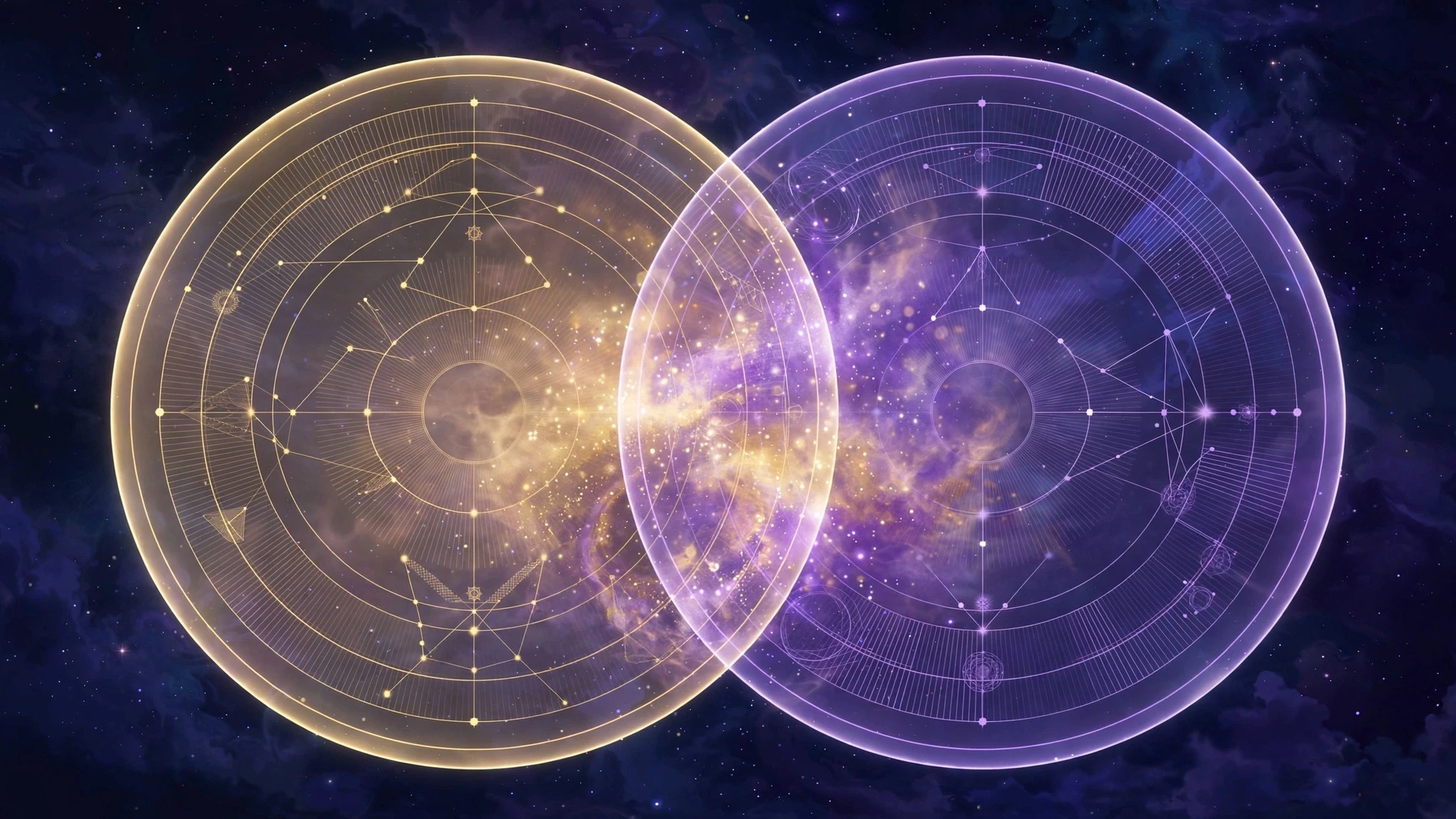
What Is Synastry
What is synastry, in plain words, is the comparison of two birth charts. Synastry is the branch of astrology that takes the chart of one person and the chart of another person and lays them side by side, planet by planet, to see how the two people affect each other. The word comes from the Greek syn, meaning together, and astron, meaning star. The method keeps both charts separate. Nothing is merged, nothing is averaged, and neither chart disappears into the other. The reading describes a meeting: what one person brings, what the other person brings, and what happens when the two sets of planets touch each other through aspects.
The technique has two parts, and both matter. The first part is the interaspects: the angles between the planets of one chart and the planets of the other chart. When the Sun of one person forms a conjunction with the Moon of the other, the two charts are linked at the level of core identity and emotional need, and astrologers read that link as one of the strongest signs of a natural bond. When the Venus of one person forms a square to the Mars of the other, the two charts are linked at the level of desire and assertion, and astrologers read that link as attraction mixed with friction. The second part is the house overlay: the houses of one chart into which the planets of the other chart fall. When the planets of one person fall into the seventh house of the other, the bond is read as focused on partnership itself. When they fall into the tenth house, the bond is read as focused on career and public life.
Synastry is used for every kind of one to one bond, not only for romance. Two business partners, two friends, a parent and a child, a teacher and a student: any pair of people with birth data can be compared, and the reading will describe the chemistry between them in the same way. The technique stays put whatever the bond is called. What shifts is the interpretation, since one interaspect reads differently in a marriage than in a business partnership, while the work of laying two separate charts side by side never varies. That steadiness is the strength of synastry. It maps the meeting, and a meeting is the same kind of event under any name.
It helps to say plainly what synastry is not. It is not a score, and it is not a verdict. There is no single number that says two people are compatible or incompatible, and any reading that gives one is selling certainty that astrology does not offer. Synastry describes the shape of the meeting: where it flows, where it grates, and where it asks for work. A pair with many smooth interaspects may feel easy and still fail, if the ease becomes boredom. A pair with many hard interaspects may feel difficult and still last, if the difficulty is met with honesty and effort. The chart shows the terrain. The two people walk it, and the walking is what decides the outcome.
How Synastry Works: Interaspects and House Overlays
The interaspects are the heart of synastry, and they work the same way as the aspects inside a single chart. An aspect is an angle between two planets, and the five major aspects are the conjunction at 0 degrees, the sextile at 60 degrees, the square at 90 degrees, the trine at 120 degrees, and the opposition at 180 degrees. In synastry, the angle is measured between a planet in one chart and a planet in the other chart. The closer the angle is to exact, the stronger the reading. An interaspect within one or two degrees is read as strong. An interaspect within five degrees is read as moderate. An interaspect wider than eight degrees is usually read as too weak to matter, though some astrologers allow wider orbs for the Sun and the Moon.
The most watched interaspects are the ones that link the personal planets: the Sun, the Moon, Venus, and Mars. The Sun of one person to the Moon of the other is the classic synastry link, read as a natural fit between the core identity of one and the emotional need of the other. The Venus of one person to the Mars of the other is the classic attraction link, read as desire and chemistry, with the Venus person bringing the charm and the Mars person bringing the pursuit. The Moon of one person to the Moon of the other is the classic comfort link, read as an easy emotional understanding, with both people feeling at home in the same mood. The Sun of one person to the Sun of the other is the classic identity link, read as a shared sense of purpose when the signs are harmonious, and as a clash of wills when the signs are square or opposed.
The outer planets add a slower layer. Saturn in synastry is the planet of commitment and of limits, and a Saturn interaspect is read as a bond that lasts because it is built on duty, on shared responsibility, or on a test that was passed together. A Saturn link can feel heavy, and it can also feel secure, and the difference depends on whether the two people accept the weight or resent it. Uranus in synastry is the planet of freedom and surprise, and a Uranus interaspect is read as a bond that stays alive through change, with excitement that can turn into instability if the freedom is not negotiated. Neptune in synastry is the planet of dreams and illusion, and a Neptune interaspect is read as a bond colored by idealization, with the risk of disappointment when the fog lifts. Pluto in synastry is the planet of power and transformation, and a Pluto interaspect is read as a bond of unusual intensity, with the power between the two people as the central theme.
The house overlays are the second part of the method, and they describe where the meeting happens in life. The overlay is found by placing the planets of one person into the houses of the other person, using the house cusps of the second chart. When the Sun of one person falls into the seventh house of the other, the bond is read as focused on partnership, with the Sun person bringing identity and direction into the house of the other. When the Moon of one person falls into the fourth house of the other, the bond is read as focused on home and family, with the Moon person bringing emotional safety into the house of roots. When the planets of one person cluster in the tenth house of the other, the bond is read as focused on career and public life, with the relationship visible to the world and judged by its results. The overlay does not change the interaspects. It shows the stage on which the interaspects play out.
The Key Interaspects in Synastry
A few interaspects deserve a closer look, because they appear in almost every synastry reading and because they are the ones most often misunderstood. The first is Sun to Moon. When the Sun of one person stands in the same sign as the Moon of the other, or in a sign that forms a trine or a sextile to it, astrologers read the link as a natural harmony between purpose and feeling. The Sun person understands the Moon person without effort, and the Moon person feels safe with the Sun person without explanation. The link is often described as the most reliable sign of a lasting bond, not because it removes all difficulty but because it gives the two people a shared ground to return to when difficulty arrives.
The second is Venus to Mars. When the Venus of one person forms a conjunction, a trine, or a sextile to the Mars of the other, astrologers read the link as mutual attraction, with the Venus person drawn to the energy of the Mars person and the Mars person drawn to the charm of the Venus person. The link is often described as chemistry, and the description is fair, because the attraction is felt in the body as well as in the mind. A square or an opposition between Venus and Mars is read as the same attraction with friction added: the desire is strong, and the clash is strong too, and the bond can swing between passion and argument until the two people learn to handle both.
The third is Moon to Moon. When the Moons of two people stand in the same sign or in signs that form a trine, astrologers read the link as emotional ease, with both people needing the same kind of comfort and the same kind of space. When the Moons stand in signs that form a square, the link is read as emotional friction, with one person needing closeness when the other needs distance, and the difference becoming a regular source of misunderstanding. The Moon to Moon link is quieter than the Sun to Moon link, but it matters more than it looks, because the Moon governs the daily mood, and the daily mood is where a relationship actually lives.
The fourth is Saturn to a personal planet. When the Saturn of one person forms a conjunction or a square to the Sun, the Moon, or the Venus of the other, astrologers read the link as a test of commitment. The Saturn person may feel like a teacher, a critic, or a weight to the other, and the other may feel judged, limited, or held back. The same link, handled well, is read as the foundation of a lasting bond, because Saturn brings the structure that keeps a relationship standing through hard seasons. The difference between the heavy version and the steady version is usually a matter of respect: whether the Saturn person uses the authority with care, and whether the other person accepts the structure without resentment.
The fifth is the Ascendant to Descendant link. When the rising sign of one person matches the Descendant of the other, or when the planets of one person fall close to the Ascendant or Descendant of the other, astrologers read the link as a strong sense of recognition. The meeting can feel familiar from the start, as if the two people have known each other before. The feeling is genuine, and it carries real information, yet it settles nothing on its own. A strong Ascendant to Descendant link can still fail when the two people lack shared values, shared timing, or the willingness to put in the work a relationship needs. The axis signals attraction. What the bond becomes rests on the two people living inside it.
An Illustrative Example: Ana and Ben
This example is illustrative, not a real person's story.
Two real charts make the method concrete. Take Ana, born with the Sun in Leo, the Moon in Cancer, and Venus in Virgo, and Ben, born with the Sun in Aquarius, the Moon in Leo, and Venus in Aries. The first thing a synastry reading notices is the Sun to Moon link: the Sun of Ana in Leo stands in the same sign as the Moon of Ben in Leo, a conjunction across the two charts. Astrologers read that link as a strong natural fit, with the core identity of Ana matching the emotional need of Ben, so that Ben feels seen by Ana without having to explain himself, and Ana feels valued by Ben without having to perform.
The second thing the reading notices is the Venus to Mars link, though the Mars placements are not listed here and the reader would need the full charts to check it. The Venus of Ana in Virgo and the Venus of Ben in Aries stand in signs that form a square to each other, and astrologers read a Venus to Venus square as a difference in taste: Ana shows love through practical help and attention to detail, while Ben shows love through bold gestures and direct action. The difference is not a flaw. It is a translation problem, and the remedy is for each person to learn the love language of the other, rather than to assume their own language is the only one.
The third thing the reading notices is the house overlay. The Sun of Ana in Leo falls into the seventh house of Ben, if the rising sign of Ben places Leo on the Descendant, and the overlay is read as a bond focused on partnership itself, with Ana bringing identity and direction into the house where Ben meets the other. The Moon of Ben in Leo falls into the fifth house of Ana, if the rising sign of Ana places Leo there, and the overlay is read as a bond that brings play, creativity, and warmth into the house of pleasure. The two overlays together describe a relationship that is both serious and joyful, with the partnership at the center and the play around the edges.
The reading does not end with the links. It ends with the work. The Sun to Moon conjunction gives the pair a shared ground. The Venus square gives them a translation task. The overlays give them a stage. The two people must still do the daily work of the relationship: the conversations, the compromises, the apologies, and the shared plans. The synastry describes the terrain, and the terrain is favorable, but the walking is still theirs. A pair with a favorable synastry can still fail, if the walking stops, and a pair with a difficult synastry can still last, if the walking continues with honesty and care.
What Synastry Cannot Tell You
The limits of synastry matter as much as the method, so they need a plain airing. Whether two people stay together is not something synastry can settle, since staying together is a choice renewed daily, not a fact written in a chart. Nor can synastry judge a person good or bad, since the chart maps patterns rather than character, and a hard interaspect can sit in the chart of a kind person as readily as in that of an unkind one. Nor can synastry name the day a relationship will begin or end, since timing in astrology speaks in themes rather than dates, and a theme can be met in many ways.
Synastry also cannot replace the evidence of the relationship itself. When the synastry looks kind and the relationship feels wrong, trust the feeling, since the chart is only a map while the relationship is the ground itself, and the ground is always the surer guide. When the synastry looks hard and the relationship feels right, trust the feeling once more, since the two people have found a way across ground the chart alone could not foresee. Use the chart as a mirror for reflection, not as a stand-in for paying attention to the person in front of you.
There are also practical limits. Synastry needs accurate birth times for both people, because the house overlays and the Ascendant to Descendant links depend on the rising sign, and the rising sign changes about every two hours. With dates alone and no times, the planet to planet interaspects can still be read, since the planets move slowly enough that the hour of birth rarely changes their signs, but the overlays cannot be trusted, and the reading loses half its worth. A synastry read from dates alone, without times, is a partial reading, and an honest astrologer will say so before beginning.
One last limit touches the composite chart, the other main way of reading a relationship, and the one most often mixed up with synastry. Synastry lays two separate charts side by side. The composite folds the two charts into one, by averaging each pair of planets at its midpoint, and reads that one chart as the chart of the bond itself. Each method answers its own question. Synastry asks how two people shape each other. The composite asks what the bond grows into as a thing in itself. Each has its use, and they work best as a pair, synastry first and the composite after, so the meeting is grasped before the merged picture is read.
To read further, the compatibility page sketches how the signs meet in general. The sun sign vs moon sign vs rising sign page sets out the three points that count most in any synastry comparison, and the composite chart page covers the merged method that pairs with synastry. The guide to reading your birth chart lays out how to find the planets and houses a synastry reading uses. A brief session can open up what a synastry comparison means for your own relationships. First 3 minutes FREE — every time, for every reading, with all advisors.
Close with a One-Card Tarot reading, and carry the question of which quality you most value in the people closest to you.
Frequently Asked Questions
What is synastry in simple words?
Synastry is the comparison of two birth charts, planet by planet, to see how two people affect each other. The method keeps both charts separate and reads the angles between the planets of one chart and the planets of the other, plus the houses into which each chart falls.
What is the difference between synastry and a composite chart?
Synastry compares two separate charts and describes how two people affect each other. A composite chart merges the two charts into a single chart, by taking the midpoint of each pair of planets, and reads that single chart as the chart of the relationship itself.
Which synastry aspect matters most?
The Sun of one person to the Moon of the other is usually read as the strongest link, because it joins core identity with emotional need. Venus to Mars is the classic attraction link, Moon to Moon is the classic comfort link, and Saturn links describe the commitment and the test of the bond.
Can synastry tell me if two people are compatible?
Synastry describes the shape of the meeting, where it flows and where it grates, but it cannot give a verdict on whether two people will stay together. Staying together is a decision made daily, and a favorable synastry can still fail while a difficult one can still last.
Do I need birth times for a synastry reading?
Accurate birth times are needed for the house overlays and the Ascendant to Descendant links, because the rising sign changes about every two hours. Without times, the planet to planet interaspects can still be read, but the overlays cannot be trusted, and the reading is only partial.
Last updated: November 12, 2026
