
What is Sacred Geometry | PsychicSmile
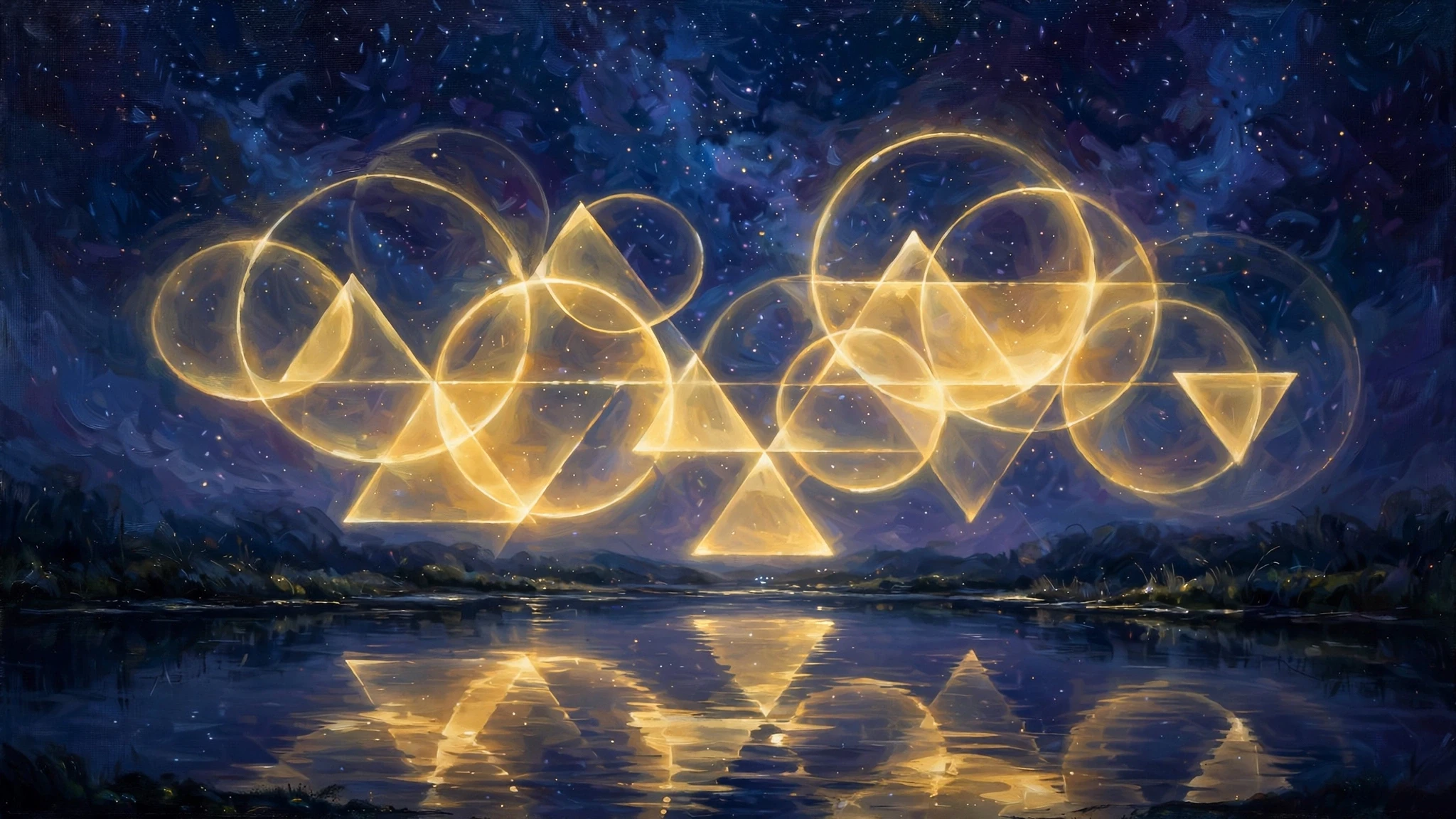
What is Sacred Geometry: The Patterns Beneath the World
What is sacred geometry? It is the belief that certain shapes, proportions and patterns carry spiritual meaning, and that the same forms repeat through nature, art, architecture and the human body, revealing an order that connects them all. A circle, a triangle, a spiral, a flower made of overlapping circles: in sacred geometry, these are not only drawings. They are read as the building blocks of creation, a visual language in which the universe describes itself. The mathematics is real and measurable. The spiritual reading of that mathematics is a matter of belief, and this page keeps the two apart, showing you what can be measured, what has been claimed, and where the line between them runs.
The idea is ancient, and it is also very much alive. You will find sacred geometry in the floor plan of a Gothic cathedral, in the tile work of a mosque, in the layout of a Hindu temple, in the spiral of a sunflower, and in the jewelry, tattoos and meditation cards of a modern spiritual shop. It is one of those subjects that sits exactly on the border between science and spirituality, and that is why it fascinates people. The patterns are undeniably there. The question is what they mean.
The Golden Ratio and the Fibonacci Spiral
No tour of sacred geometry can begin anywhere but the golden ratio. The golden ratio is a proportion, written with the Greek letter phi, equal to about 1.618. Two quantities are in the golden ratio when the larger relates to the smaller in the same way that the whole relates to the larger. It is a real mathematical constant, and it has been studied by mathematicians for centuries. It is closely tied to the Fibonacci sequence, the series of numbers in which each number is the sum of the two before it: 0, 1, 1, 2, 3, 5, 8, 13, 21, 34, and on. Divide any Fibonacci number by the one before it and the result gets closer and closer to 1.618 as the numbers grow. Lay those numbers out as squares and you can draw a curve called the golden spiral.
The Fibonacci sequence appears in nature with a frequency that is genuinely striking. The seeds of a sunflower are arranged in spirals whose counts are Fibonacci numbers. The scales of a pinecone follow the same pattern. The arrangement of leaves around a stem, the branching of trees, and the chambers of some shells all show related proportions. These are measurable facts, and they are the reason the golden ratio feels like more than a mathematical curiosity. When a pattern shows up in a sunflower and in a cathedral and in the proportions of the human body, it is natural to wonder whether something deeper is going on.
That wonder has also produced exaggeration, and honesty requires saying so. The nautilus shell is often called a perfect golden spiral, but it is actually a logarithmic spiral that does not match phi exactly. Claims that the golden ratio governs the Parthenon or the pyramids are often overstated, resting on selective measurements rather than on the original design. The pattern in nature is real. The claim that every beautiful thing follows the golden ratio is not. A careful reader of sacred geometry keeps that distinction in mind: the mathematics is solid, the mystical superstructure built on it is a matter of interpretation.
The Flower of Life, the Seed of Life and Metatron's Cube
The most famous image in sacred geometry is the Flower of Life, a pattern of overlapping circles arranged in a hexagonal lattice, most often shown with 19 circles inside a larger enclosing circle. The pattern begins with a single circle. Add six circles around it, each centered on the edge of the first, and you have the Seed of Life, seven circles that form a flower shape. Extend the pattern outward and you reach the Flower of Life, a lattice of petals that seems to contain every other shape within it. People who work with the symbol say it contains the patterns of creation itself, and that meditating on it can bring a sense of unity and connection.
From the Flower of Life comes another figure: Metatron's Cube. Take the Fruit of Life, a set of 13 circles drawn from the Flower of Life, connect the centers of those circles with straight lines, and a complex three dimensional figure appears, named for the angel Metatron in some mystical traditions. Hidden inside Metatron's Cube are the five Platonic solids, the only five three dimensional shapes whose faces are all identical regular polygons. That discovery, that a two dimensional flower can contain five perfect solids, is one of the moments that convinces people sacred geometry is more than decoration. Whether it is a message from the universe or a property of geometry itself is the question the tradition asks you to sit with.
The history of the Flower of Life is less certain than its geometry. Overlapping circle patterns appear in many places, including the Temple of Osiris at Abydos in Egypt, and some popular books claim the carvings there are thousands of years old. The age and method of specific carvings are debated by archaeologists, and the grander claims about their antiquity are not established. What is established is that the pattern has been drawn for a long time, in many cultures, and that it continues to be drawn today. That continuity is itself meaningful, even without an ancient origin story.
The Five Platonic Solids
The five Platonic solids are the heart of sacred geometry, and they are also solid mathematics. A Platonic solid is a three dimensional shape made of identical faces, with the same number of faces meeting at every corner. There are exactly five, and there can be no more: the tetrahedron, with four triangular faces; the cube, with six square faces; the octahedron, with eight triangular faces; the dodecahedron, with twelve pentagonal faces; and the icosahedron, with twenty triangular faces. The Greek philosopher Plato, who lived from about 428 to 347 BC, described these solids in his dialogue Timaeus, and linked four of them to the classical elements: the tetrahedron to fire, the cube to earth, the octahedron to air, and the icosahedron to water. The fifth, the dodecahedron, he linked to the heavens, or to the cosmos itself.
In sacred geometry, each solid carries a feeling and a meaning. The tetrahedron, sharp and pointed, is read as fire, energy, focus and transformation. The cube, stable and grounded, is read as earth, structure and material life. The octahedron, balanced between points, is read as air, communication and clarity. The icosahedron, with its many faces, is read as water, flow, emotion and receptivity. The dodecahedron, the most complex of the five, is read as spirit, the container of all the others, and the shape of the universe itself. These associations are traditional, not scientific, and they work as a language for reflection. A person drawn to the tetrahedron may be in a season of change. A person drawn to the cube may be seeking stability. The solids give those feelings a shape to hold.
The solids also appear in nature and in the built world. Crystals form in shapes related to the Platonic solids. Viruses and other microscopic structures show icosahedral symmetry. The dice used in games are often Platonic solids. Architects have used them as design elements for centuries. The mathematics is exact, and the spiritual reading grows out of that exactness: if only five perfect solids exist, and they appear everywhere from crystals to cathedrals, then perhaps they are the alphabet in which the world is written.
Sacred Geometry in Temples, Art and the Body
The patterns of sacred geometry are built into some of the most beautiful structures in the world. Gothic cathedrals use the circle, the vesica piscis, the almond shape formed by two overlapping circles, and precise proportions in their floor plans and windows. Islamic art, which avoids figurative images, builds its beauty from geometric patterns of stars, polygons and interlacing lines, many of them derived from the same shapes. Hindu temples are laid out on geometric grids, with the central shrine placed at the intersection of lines that map the cosmos. The Vitruvian Man, Leonardo da Vinci's famous drawing of a man inscribed in a circle and a square, is a study of human proportion through geometry, and it has become an emblem of the whole tradition.
The human body itself is part of the story. The proportions of the hand, the face and the body have been studied through the golden ratio for centuries, and the results are mixed: some proportions approximate phi, others do not, and the claims are often stronger than the measurements. The honest version of the story is that the body shows geometric order, in the symmetry of the face, the spiral of the ear, the branching of the lungs, without being a perfect diagram of any single ratio. That is enough. The body does not need to be a golden rectangle to be a wonder of pattern.
Sacred geometry also connects with other systems. The Tree of Life in the Kabbalah, a diagram of ten spheres connected by paths, is read by some as a geometric map of creation, and it can be overlaid on the Flower of Life in ways that practitioners find meaningful. What is numerology explores the parallel tradition of finding meaning in numbers, and the two systems share a belief: that the world is ordered, and that the order can be read. The what are chakras page describes the energy centers that some sacred geometry practitioners associate with the Platonic solids, pairing each solid with a chakra in meditation.
An Illustrative Example: Wren and the Sunflower
This example is illustrative, not a real person's story.
Wren, a 33 year old art teacher, first encountered sacred geometry in a photograph of a sunflower head, where the seeds spiraled outward in two sets of curves. She counted the spirals, as a book had suggested, and found 34 in one direction and 55 in the other, both Fibonacci numbers. The discovery changed how she looked at her garden. She began drawing the Seed of Life with a compass, seven circles on a sheet of paper, and she found the slow, precise work calming in a way that scrolling through her phone never was. She now starts each art class with five minutes of geometric drawing, and she tells her students that the exercise is not about belief. It is about attention. A sunflower, a compass and a quiet five minutes can teach a person to see pattern where they used to see noise, and that shift in attention is the real gift of sacred geometry, whether or not the patterns carry a deeper message.
How to Work With Sacred Geometry
If you want to explore sacred geometry, start with drawing. A compass, a ruler and a sheet of paper are all you need. Draw a circle. Draw six circles around it. Watch the Seed of Life appear. Extend the pattern and watch the Flower of Life grow. The slow, exact work of drawing is itself a meditation, and it teaches the patterns in a way that reading about them cannot. Meditation for beginners covers the attention skills that make this kind of practice rewarding, and grounding techniques offer a way to settle yourself before you begin.
You can also work with the symbols as objects of reflection. Choose a solid that draws you, hold a model of it or a picture of it, and notice what comes to mind. Use the Flower of Life as a focus for a few minutes of quiet. Or simply look for the patterns in the world around you: the spiral of a pinecone, the hexagon of a honeycomb, the geometry of a window. The practice is attention, and attention is available to everyone. Be cautious of expensive courses that promise to unlock the secrets of the universe through geometry. The patterns are public, the tools are cheap, and the experience is yours to have without a price tag.
The spiritual awakening signs page gathers more on the wider experiences people report when they begin practices like this one. Sacred geometry rewards a particular kind of looking: slow, exact and open to wonder. Whether you read the patterns as the handwriting of the divine or as the beautiful behavior of mathematics, the looking itself changes what you see.
If you would like a quiet space to reflect on the patterns in your own life, a reading can be a gentle next step. First 3 minutes FREE — every time, for every reading, with all advisors.
For a simple next step, try a One-Card Tarot reading and reflect on what pattern you notice repeating in your life right now.
Frequently Asked Questions
What is sacred geometry in simple terms?
Sacred geometry is the belief that certain shapes, proportions and patterns carry spiritual meaning, and that the same forms repeat through nature, art, architecture and the human body. The mathematics behind the patterns is real and measurable, while the spiritual reading of them is a matter of belief.
What is the Flower of Life?
The Flower of Life is a pattern of overlapping circles arranged in a hexagonal lattice, most often shown with 19 circles inside a larger enclosing circle. It begins with a single circle, grows through the seven circle Seed of Life, and is said by practitioners to contain the patterns of creation. Overlapping circle patterns appear in many cultures, including at the Temple of Osiris in Egypt.
What are the five Platonic solids?
The five Platonic solids are the only three dimensional shapes whose faces are all identical regular polygons: the tetrahedron with four triangular faces, the cube with six square faces, the octahedron with eight triangular faces, the dodecahedron with twelve pentagonal faces, and the icosahedron with twenty triangular faces. Plato linked them to fire, earth, air, water and the heavens.
What is the golden ratio?
The golden ratio is a proportion, written with the Greek letter phi, equal to about 1.618. Two quantities are in the golden ratio when the larger relates to the smaller the same way the whole relates to the larger. It is closely tied to the Fibonacci sequence, in which each number is the sum of the two before it, and it appears in the arrangement of sunflower seeds and pinecone scales.
Is sacred geometry a science or a belief?
Both parts are present. The geometry itself, the five solids, the golden ratio, the Fibonacci sequence, is mathematics, and it is real and measurable. The claim that these patterns carry spiritual meaning or reveal a divine order is a belief, and it should be understood as one. The patterns are undeniable; their meaning is a matter of interpretation.
Last updated: November 12, 2026
