
What is Ectoplasm | PsychicSmile
What is Ectoplasm and Where the Idea Came From
What is ectoplasm? In Spiritualist belief it is a pale, misty or clothlike substance said to stream from the body of a physical medium during a seance, sometimes taking the shape of a face, a hand or a whole figure. The word itself comes from Greek roots meaning outside and something formed, and it was borrowed from biology, where ectoplasm already named the outer layer of a cell. Spiritualists used it to describe something they believed was real and physical, a kind of living material that a medium could exteriorize while in trance so that spirits could use it to show themselves. Science has never confirmed that such a substance exists, and many famous samples turned out to be ordinary cloth, paper or egg white. Yet the idea shaped a whole era of mediumship, and its story runs through the most dramatic decades of the Spiritualist movement.
The word entered the Spiritualist vocabulary in 1894, when the French physiologist Charles Richet began using it for what he believed he had seen at seances with the Italian medium Eusapia Palladino. Richet was no outsider to science. He worked at the College de France, and his research on anaphylaxis later won him the Nobel Prize in Physiology or Medicine in 1913. That background is exactly why his interest mattered so much to Spiritualists. Here was a respected scientist who said he had watched something leave a medium's body. Richet himself did not think the substance came from spirits. He believed it might be a physical projection from the medium's own body, a third kind of matter that science had not yet classified. He rejected the spirit explanation as unscientific and favored what he called the sixth sense hypothesis. The distinction is worth holding on to, because Richet's ectoplasm and the Spiritualist version of ectoplasm were never quite the same thing.
Ectoplasm in the Seance Room
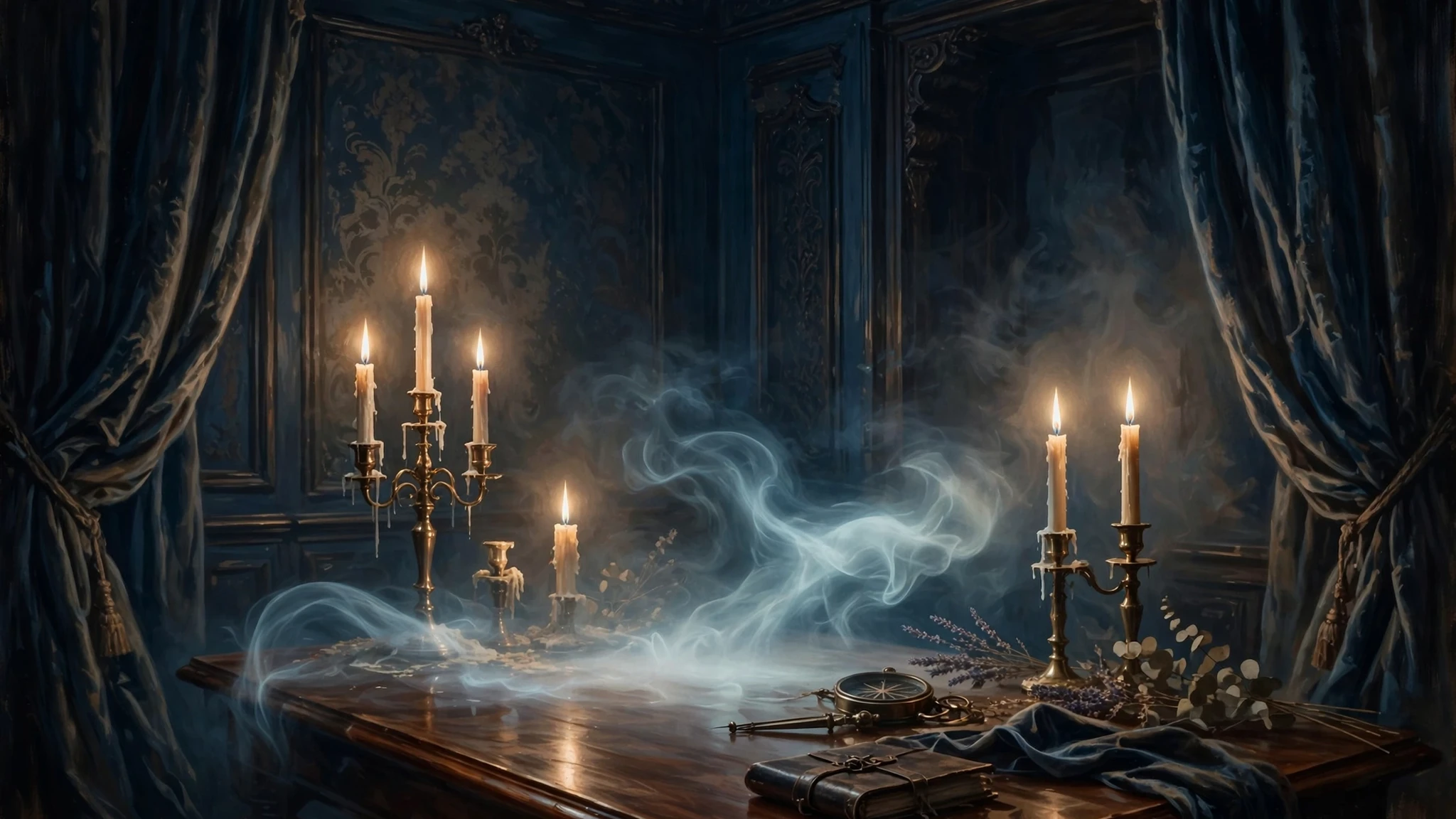
Picture a Victorian seance room in the 1890s or 1900s. The curtains are drawn, the lamps are turned low or covered with red cloth, and a dozen sitters hold hands around a table. The medium sits in a cabinet, a small curtained enclosure, and slips into trance. Then, according to reports from believers, something begins to emerge. Witnesses described it in strikingly similar terms across many accounts: a white vapor, a cloudy mass, a ribbon of gauze that seemed to grow from the medium's mouth, nose or hands. Sometimes it hung in the air like smoke. Sometimes it thickened into a shape. Sitters reported seeing faces form in it, or a hand reach out and touch someone, or a full figure step forward and speak in the voice of a dead relative.
Photographs from the period show mediums with long streamers of white material pouring from their faces or draped across their shoulders. Those photographs are the images most people still associate with ectoplasm today, and they were reproduced in newspapers, books and lecture slides for decades. The sitters who described these scenes were often sincere and often grieving. Many had lost children, spouses or parents, and the seance room offered them something no church or doctor could: a face to look at and a hand to hold. That emotional weight is part of the story. It explains why people defended what they saw so fiercely, and why investigators who called it fraud were sometimes treated as enemies rather than as honest inquirers.
Physical mediumship, the kind that produced ectoplasm, differed from mental mediumship, where a medium simply spoke messages or described impressions. Physical mediumship promised evidence you could touch and photograph. That promise made it the most popular and the most contested form of mediumship in the movement. If you want the wider background, the history of mediumship page traces how these practices grew from the Fox sisters' raps in 1848 into a worldwide movement.
The Investigators Who Took It Seriously
Ectoplasm did not go unexamined. Some of the sharpest minds of the age sat in seance rooms and tried to test it, and their work is still the best guide to what was actually happening.
William Crookes, a respected British chemist and physicist, investigated mediums in the early 1870s, years before Richet coined the word. Crookes studied the young medium Florence Cook, whose sittings featured a spirit figure called Katie King who appeared in the room alongside the entranced medium. Crookes reported that he had seen the figure, touched it and photographed it, and he defended Cook in print. His support gave physical mediumship enormous credibility, because Crookes was known for real scientific work, including his discovery of the element thallium. Critics answered that his controls were weak, that the cabinet made trickery easy, and that affection or admiration may have clouded his judgment. The argument has never been settled to everyone's satisfaction, and that is itself instructive. Even careful people can disagree about what they saw in a dark room.
The Society for Psychical Research, founded in London in February 1882 with the Cambridge philosopher Henry Sidgwick as its first president, took a different approach. Its members investigated mediums systematically, kept records, and published their findings whether the results favored belief or not. The Society's investigators exposed many fraudulent mediums over the years, and their reports helped turn opinion against physical mediumship. They also documented cases they could not explain, which is why the Society's archive remains a serious resource rather than a simple debunking file.
The Exposures That Broke Its Reputation
For every investigator who left a seance convinced, another left holding a piece of cheesecloth. The history of ectoplasm is, in large part, a history of exposures, and the exposures were often dramatic.
Eusapia Palladino, the medium Richet worked with, was caught using trickery more than once. At sittings in Cambridge in 1895, investigators from the Society for Psychical Research observed her freeing a hand or foot to produce effects while sitters believed she was fully controlled. She was also tested many times under stricter conditions, and some investigators continued to defend her. Her career shows the pattern that repeated across the movement: a medium could be caught cheating on one night and still draw believers the next, because supporters argued that a genuine medium might cheat when the real power failed, or that hostile investigators created conditions where no real phenomenon could occur.
The most famous exposure involved Mina Crandon, known as Margery, a Boston medium who claimed to channel her dead brother Walter. In 1924, Scientific American offered a prize of 2,500 dollars to any medium who could produce physical manifestations under strict test conditions, and Crandon became the leading candidate. The magician Harry Houdini joined the investigating committee, examined the seance room in daylight, and said Crandon was ringing a bell with her foot while her hands were supposedly held. He designed a wooden cabinet that held her legs in place, and when she sat inside it, the phenomena stopped. Crandon never won the prize. Houdini then spent the last years of his life campaigning against fraudulent mediums, and his pamphlets and stage demonstrations did more than any scientific paper to turn the public against physical mediumship. If you are curious about how a sitting was actually run, our guide on what is a seance explains the format that mediums like Crandon used.
Samples said to be ectoplasm were also tested in laboratories, and the results were consistently ordinary. Investigators identified cheesecloth soaked in potato starch, gauze, paper, egg white and similar materials. These are substances that could be hidden on the body and produced at the right moment in dim light, and several mediums were caught with such materials in their possession. No sample has ever withstood controlled scientific testing. That is the position of mainstream science today, and it is stated plainly on this page because it is part of the honest record.
Why the Idea Has Not Disappeared
If ectoplasm was so thoroughly discredited, why do people still talk about it? Part of the answer is popular culture. The word moved from the seance room into films, comics and games, where glowing green slime became the standard visual shorthand for ghosts. A generation met ectoplasm first as a cartoon effect and only later learned it had once been a serious claim. The pop culture version is harmless fun, but it keeps the word alive and keeps people curious about where it came from.
Another part of the answer is that physical mediumship itself never fully died. Small circles still practice it, and some modern physical mediums still report ectoplasm, usually in private sittings with strict rules about light and photography. Believers argue that the old exposures say nothing about today's practitioners, and that harsh controls destroy the conditions the phenomena need. Skeptics answer that the rules that protect the phenomena are exactly the rules that make trickery possible. The debate is the same one Crookes and Houdini were having a century ago, and neither side has conceded.
There is also a quieter reason. Ectoplasm spoke to a deep human wish: to have something to touch when someone you love is gone. A message spoken by a medium can be doubted, but a hand you can hold feels like proof. That longing did not end when the photographs were exposed. It moved into other forms of mediumship, especially the mental and evidential styles that dominate today, where a medium offers specific details about a loved one rather than producing a visible substance. The mediumship hub gathers those modern approaches, and how a medium reading works explains what a present day sitting usually looks like.
An Illustrative Example: Dana and the Photograph
This example is illustrative, not a real person's story.
Dana, a 41 year old librarian, found a photograph of a seance in a secondhand book and could not stop thinking about it. The image showed a medium with a long white streamer flowing from her mouth, and the caption claimed it was ectoplasm photographed in 1912. Dana spent a weekend reading about the medium, and what she found changed how she saw the picture. The same medium had been caught with a length of cheesecloth hidden in her clothing at a sitting two years later, and the investigator who caught her had written a detailed report. Dana also learned that the photograph had been taken in near darkness with a flash, which made it hard to tell fabric from vapor. She did not come away thinking everyone in the room had been lying. She came away thinking the picture proved something simpler: that people in grief will look hard at a blurry image and see the person they miss. That is the honest way to approach ectoplasm. Look at the photograph, read the exposure report next to it, and let both pieces of evidence sit side by side.
How to Think About Ectoplasm Today
A fair way to hold the subject is to keep three facts together. First, ectoplasm was a real historical claim made by sincere people and investigated by serious scientists, not a joke invented for films. Second, every sample that was tested turned out to be an ordinary material, and several leading mediums were caught producing it by trickery. Third, the absence of proof is not the same as proof that every sitter was deceived about what they felt. Many people left seances comforted, and that comfort was real even if the substance was not.
If you visit a modern physical seance, the sensible approach is the one the Society for Psychical Research modeled: go with an open mind, note the conditions, and ask what controls are in place. Bright light, a searched room, and a medium who welcomes examination are signs of confidence. A dark room, a cabinet, and a ban on inspection are the conditions under which the old exposures happened. You do not need to decide the whole question in one evening. You can appreciate the history, respect the people who believed, and still ask for evidence before you accept a claim.
Ectoplasm also offers a useful lesson about belief itself. A claim that is dramatic, visual and emotional will travel further than a quiet one, and it will survive longer than the evidence for it. The word began in a biology textbook, passed through the hands of a Nobel laureate, filled the photograph albums of a grieving generation, and ended up as green slime in a cartoon. That journey tells you as much about people as it does about spirits, and it is why the subject is still worth reading about more than a century after Richet gave it a name. For a grounded view of the people who practice this work now, read what is a medium before you decide what you think.
If you would like a quiet space to reflect on what you have read, a reading can be a gentle next step. First 3 minutes FREE — every time, for every reading, with all advisors.
For a simple next step, try a One-Card Tarot reading and reflect on what the card brings up about belief, evidence and the people you miss.
Frequently Asked Questions
What is ectoplasm in simple terms?
In Spiritualist belief, ectoplasm is a pale, misty or clothlike substance said to come from a physical medium's body during a seance, sometimes forming a face, a hand or a figure. Science has never confirmed that it exists, and tested samples turned out to be ordinary materials such as cheesecloth, gauze or egg white.
Who coined the word ectoplasm?
The French physiologist Charles Richet coined the paranormal use of the word in 1894, during his investigations of the medium Eusapia Palladino. Richet borrowed the term from biology, where it already named the outer layer of a cell. He later won the Nobel Prize in Physiology or Medicine in 1913 for his work on anaphylaxis.
Was ectoplasm ever proven to be real?
No. No sample of supposed ectoplasm has ever withstood controlled scientific testing. Investigators identified materials including cheesecloth soaked in potato starch, paper, gauze and egg white, and several well known mediums were caught producing effects by trickery.
What is the difference between ectoplasm and a ghost?
A ghost is generally described as a spirit itself, seen or sensed in a place. Ectoplasm was described as a physical substance produced by a living medium that spirits could supposedly use to become visible or to touch sitters. In the belief system, ectoplasm was the material, not the spirit.
Do mediums still report ectoplasm today?
A small number of physical mediums still report it, usually in private sittings with strict rules about light and photography. Most modern mediumship is mental or evidential instead, where the medium shares spoken messages and specific details rather than producing a visible substance.
Last updated: November 12, 2026
