
What Is a Mantra? Meaning and Examples
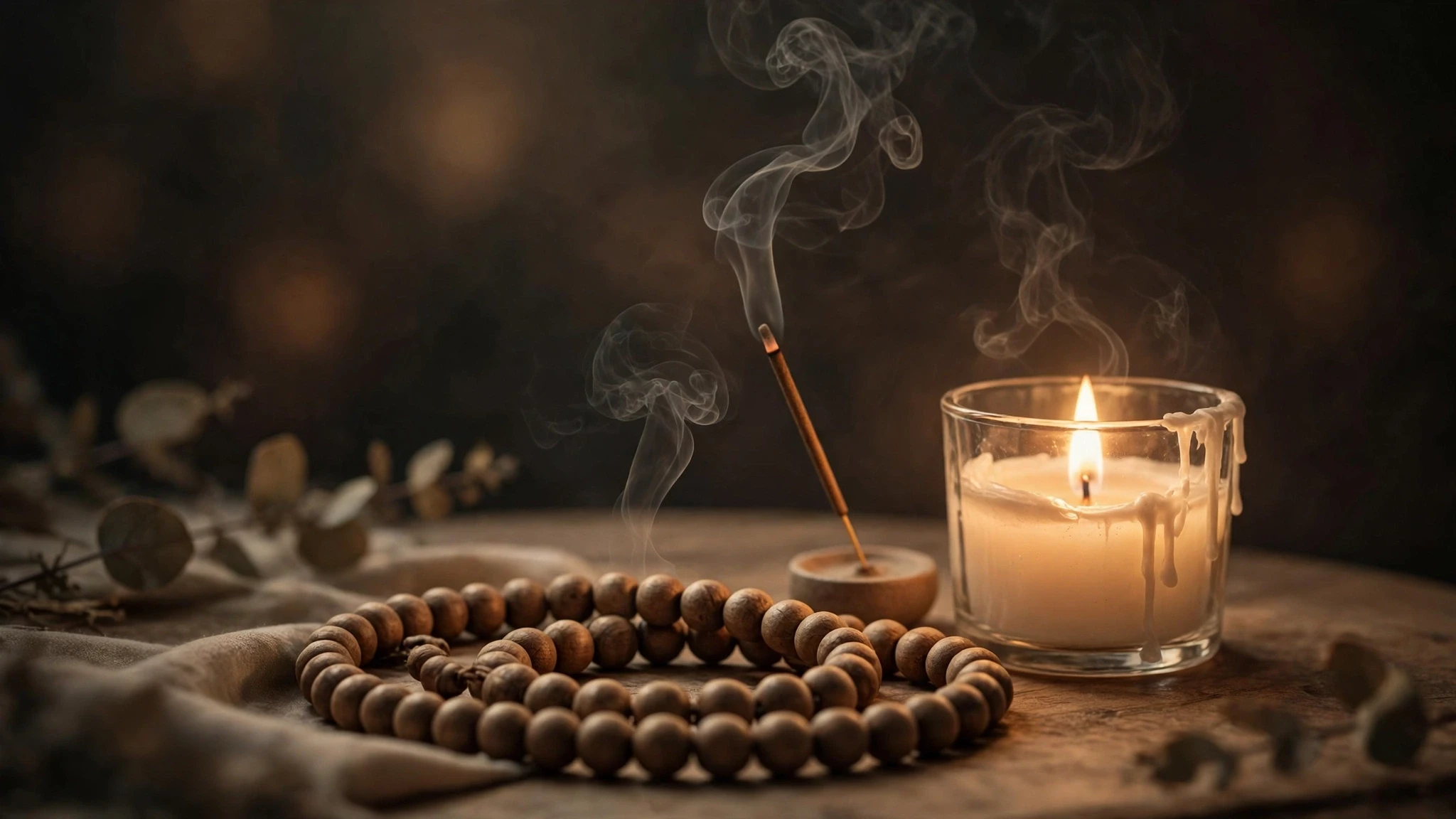
What Is a Mantra, in Plain Terms
What is a mantra? A mantra is a sacred sound, syllable, word or group of words, most often in Sanskrit, that practitioners repeat with focused attention as a tool for the mind. The word comes from Sanskrit, from manas, meaning mind, and tra, meaning instrument or tool. A mantra is literally an instrument of the mind. Some mantras have a clear literal meaning, such as a name of a deity or a prayer for clarity. Others have no literal meaning at all, and their value lies in the sound itself and in the attention that repeating it requires. Practitioners believe mantras have religious or spiritual power, and they use them in Hinduism, Buddhism, Jainism and Sikhism, and in some forms of yoga and meditation. A mantra is not a magic spell, and it is not a wish. It is a practice, a short sound or phrase repeated until the mind settles, and this page explains what it is, where it comes from, named examples, and how it is used.
The Word and Its Roots
The Sanskrit word mantra is built from two roots. Man means mind, in the sense of thinking and attention. Tra is the suffix that turns a root into an instrument, and in the compound it gives the sense of a tool. Put together, a mantra is an instrument that protects the mind from distraction and carries attention across to a steadier state. The Pali form of the word is manta, and the word appears in the earliest Vedic texts, composed between about 1500 and 1200 BCE. In the Rig Veda, mantras were hymns and formulas used in ritual, spoken by priests to invoke a deity or to mark a moment in a sacrifice. Over time, the use widened. Mantras moved from public ritual into personal practice, from priests into the hands of ordinary devotees, and from Sanskrit into other languages, including Tibetan, Chinese and Japanese, where they were translated, transliterated or kept in Sanskrit. The root meaning stayed the same through all those changes. A mantra is a tool for the mind, and its work is attention.
Om: The Seed Sound
The best known mantra is also the shortest. Om, also written Aum, is a single syllable, and in Hindu teaching it is believed to be the first sound, the sonic essence of the absolute divine reality. Om is an example of a seed syllable mantra, called a bija mantra, a short sound that carries a whole teaching in compressed form. Nearly every Sanskrit mantra opens with Om, not as a beginning in the ordinary sense, but as an acknowledgment of what everything is built from. In practice, Om is chanted aloud, in a long exhale, three times at the start of a session, or it is repeated silently as a focus for meditation. The sound has three parts in traditional teaching, A, U and M, which are linked with waking, dreaming and deep sleep, and with the gods Brahma, Vishnu and Shiva, and the silence after the sound is linked with a fourth state beyond the three. That teaching is presented as belief, not as a fact of acoustics. What can be said plainly is that a long, slow chant of Om asks for a long, slow breath, and a long, slow breath calms the body. The calm is real, and it does not need a metaphysical explanation to be useful.
The Gayatri Mantra: A Prayer for Clarity
The Gayatri Mantra is one of the most widely used mantras in Hinduism, and it is also one of the oldest. It comes from the Rig Veda, book 3, hymn 62, verse 10, and it is addressed to Savitar, the sun, as a source of light and wisdom. In transliteration, it reads Om bhur bhuvah svah, tat savitur varenyam, bhargo devasya dhimahi, dhiyo yo nah prachodayat. In plain English, it means, let us meditate on the excellent glory of the divine light. May that light stimulate our understanding. The three opening words, bhur, bhuvah and svah, name the physical world, the astral world and the celestial world. The mantra is called the mother of all Vedic meters, because the Gayatri meter, a verse of 24 syllables, is one of the oldest meters in the Veda. In traditional practice, the Gayatri is chanted at dawn, at noon and at dusk, often 108 times, and it is traditionally taught by a teacher to a student at initiation. In modern practice, many people chant it in the morning as a way to set intention for the day. The mantra asks for clarity of intellect, not for wealth or success, and that focus is part of why it has lasted for more than 3,000 years.
Om Namah Shivaya: Five Syllables
Om Namah Shivaya is one of the most widely chanted mantras in Shiva worship, and it is known as the Panchakshara, the five syllable mantra. The five syllables are Na, Ma, Shi, Va and Ya, and with Om before them it becomes a six syllable form. The literal meaning is Om, salutation to Shiva, or I bow to Shiva, the auspicious one. In traditional teaching, the five syllables correspond to the five elements, earth, water, fire, air and space, and chanting the mantra is believed to balance those elements in the body and in the mind. The mantra appears in the Shri Rudram, a hymn in the Krishna Yajurveda, and it is explained at length in the Shiva Purana, where Shiva himself is said to teach it to Brahma and Vishnu. In practice, Om Namah Shivaya is chanted aloud, whispered or repeated silently, often with a mala, a string of beads used for counting. A full round of a mala is 108 repetitions, and a practitioner may do one round in the morning and one in the evening. The mantra is simple enough for a beginner to learn in a minute, and deep enough for a lifetime of practice, and that combination is rare.
Other Named Mantras
Four more mantras are worth naming, because they show the range of the form. The Hare Krishna mantra, also called the Maha Mantra, is Hare Krishna, Hare Krishna, Krishna Krishna, Hare Hare, Hare Rama, Hare Rama, Rama Rama, Hare Hare. It is a call to Krishna and Rama, and it is chanted in the Gaudiya Vaishnava tradition and in the International Society for Krishna Consciousness, founded in 1966. Om Mani Padme Hum is the mantra of Avalokiteshvara, the bodhisattva of compassion in Tibetan Buddhism. In plain English, it is often rendered as praise to the jewel in the lotus, and it is carved on stones, printed on prayer flags and repeated by millions of people across Tibet, Nepal and Mongolia. So Hum is a two syllable mantra that means I am that, and it is used in yoga and meditation as a breath mantra, So on the inhale and Hum on the exhale. The Maha Mrityunjaya Mantra, the great death conquering mantra, is a longer prayer to Shiva for protection and for release from fear, and it is chanted in times of illness or danger. The Mul Mantar, the root mantra of Sikhism, opens the Guru Granth Sahib and begins Ik Onkar, there is one God. Each mantra belongs to a specific tradition, and each one is best learned inside that tradition, with its own pronunciation and its own setting.
How a Mantra Is Used
A mantra is used in a few clear ways, and the ways are similar across traditions. First, it is repeated aloud, in a steady rhythm, often with a mala. A mala usually has 108 beads, a number that is sacred in Hindu and Buddhist teaching, and one full round is 108 repetitions. A practitioner holds one bead per repetition and moves to the next bead, which keeps the hands busy and the mind focused. Second, it is whispered, so quietly that only the practitioner can hear it, which is used when other people are near or when the mind needs a softer focus. Third, it is repeated silently, in the mind only, which is the most inward form and the hardest to sustain, because the mind wanders more easily without sound. Fourth, it is written, in a practice called likhita japa, where the mantra is written out by hand again and again, often in a notebook kept for that purpose. Fifth, it is listened to, in a recording or in a group chant, where the sound itself carries the attention. A session can be as short as five minutes or as long as an hour. A common pattern is one round of a mala in the morning, about 10 to 15 minutes, and one round in the evening. The guide to meditation for beginners explains posture, breath and attention in more detail, and it is a good companion for a person starting a mantra practice, because a mantra is one form of meditation, not a separate thing.
Mantra, Affirmation and Prayer: Three Different Tools
A mantra is often confused with two other tools, and the confusion is worth clearing up. An affirmation is a positive statement in the first person, in the present tense, such as I am calm and capable. Affirmations are a modern psychological tool, and they work by shaping self talk. A mantra is older, and it is not a statement about the self. It is a sound, a name or a prayer, and its work is attention, not self persuasion. A prayer is a communication with a deity, often a request, a thanksgiving or a confession, and it is usually spoken once, in the words of the practitioner. A mantra is repeated, often hundreds of times, and the repetition is the point. The three tools can be used together. A person can pray, then chant a mantra, then speak an affirmation, and each one does a different job. A person who treats a mantra as an affirmation will be disappointed, because the mantra does not argue with a negative thought. It gives the mind something else to hold, and the negative thought fades because attention has moved, not because it has been answered.
Choosing a Mantra
Choosing a mantra is simpler than many books suggest. A beginner can start with Om, because it is short, it needs no translation, and it is used in almost every tradition that uses mantras. A person drawn to Shiva can start with Om Namah Shivaya. A person drawn to the sun and to clarity can start with the Gayatri Mantra, although traditional teaching says it should be learned from a teacher. A person drawn to compassion can start with Om Mani Padme Hum. A person drawn to breath can start with So Hum. Three rules help. First, choose one mantra and stay with it for at least 30 days, because switching every week prevents the practice from settling. Second, learn the pronunciation as well as you can, from a recording by a native speaker or from a teacher, and do not worry about perfection. Third, use the mantra at the same time each day, so it becomes a habit rather than a decision. A mantra that is used every day for a month will teach you more about itself than a book about mantras will, and that is the point of the practice. If a mantra brings up strong emotion, pause and talk with a teacher or a trusted person. If it brings up curiosity, read more of the tradition it comes from.
Mantra and the Chakras, Karma and Past Lives
Mantra practice connects with other ideas on this site, and the connections are worth naming. Each chakra, in the system described in the guide to what the chakras are, is linked with a seed syllable, such as Lam for the root chakra and Om for the crown chakra, and practitioners sometimes chant those syllables while focusing on the corresponding part of the body. Mantra practice also connects with karma, because the traditions teach that repetition with clear intention creates wholesome karma, and the guide to what karma means explains that teaching in full. Mantra practice connects with the idea of a past life, because some practitioners believe that a mantra learned in an earlier life returns easily in this one, a belief explained in the guide to what a past life means. Mantra practice also connects with awakening, because many people report that a daily mantra practice changes how they notice their own thoughts, and the guide to what a spiritual awakening is describes that change. None of those connections makes a mantra work faster. They show that a mantra is not an isolated trick. It is one thread in a larger fabric of practice, and it is best understood inside that fabric.
If this explanation gave you a mantra you want to try, consider speaking with a reader who can help you think about which practice fits your life right now. First 3 minutes FREE — every time, for every reading, with all advisors.
For a simple next step, try a One-Card Tarot reading and reflect on one word or sound you want to carry with you through the week.
Frequently Asked Questions
What is a mantra in simple terms?
A mantra is a sacred sound, syllable, word or group of words, most often in Sanskrit, that practitioners repeat with focused attention as a tool for the mind. The word comes from manas, meaning mind, and tra, meaning instrument. Some mantras have a literal meaning, and others work through sound and attention alone.
What is the most common mantra?
Om is the most common mantra, a single syllable that many Sanskrit mantras open with. In Hindu teaching, Om is believed to be the first sound and the sonic essence of the divine reality. It is chanted aloud or repeated silently, and it is also a seed syllable mantra in its own right.
How many times should I repeat a mantra?
A common pattern is one round of a mala, which is 108 repetitions, in the morning and one round in the evening, taking about 10 to 15 minutes each. A beginner can start with a shorter count, such as 27 repetitions, and build up. The number matters less than daily repetition at the same time.
Is a mantra the same as an affirmation?
No. An affirmation is a positive statement in the first person, such as I am calm and capable, and it works by shaping self talk. A mantra is a sound, a name or a prayer, repeated often, and its work is attention, not self persuasion. The two tools can be used together, and each one does a different job.
Do I need a teacher to learn a mantra?
No, for a simple mantra such as Om or Om Namah Shivaya, which can be learned from a recording by a native speaker. Traditional teaching says the Gayatri Mantra should be learned from a teacher, and a teacher can help with pronunciation and with any strong emotion that practice brings up. A teacher is helpful, not required, for most mantras.
Last updated: November 12, 2026
