
Tarot Spread for Shadow Work: A 5-Card Guide
The Short Answer: What a Tarot Spread for Shadow Work Is
A tarot spread for shadow work is a layout of card positions built for one purpose: to turn your attention toward the parts of yourself you keep out of sight. Shadow work means meeting the traits, wishes, and feelings you deny, hide, or judge, with the aim of understanding them instead of being driven by them. The shadow is the unconscious material that shapes your choices, your relationships, and your reactions, often without your knowledge.
A spread does not diagnose you, and it does not fix you overnight. It gives you a structure for honest self-inquiry: one question, five cards, and time to sit with what comes up. The cards act as mirrors. The work happens in the reflection that follows, in the journaling, and in the small choices you make after the reading ends. Used this way, tarot becomes a tool for looking inward, not a way to predict the future.
Where the Idea Comes From
The idea of the shadow comes from Carl Gustav Jung, a Swiss psychiatrist and psychoanalyst who founded analytical psychology. Jung lived from 1875 to 1961. In Aion, published in 1951, he developed the shadow as part of his system of archetypes, alongside the self, the persona, and the anima and animus. He called the shadow the most accessible of the archetypes, and the easiest to experience.
Jung described the shadow as "the thing a person has no wish to be": the parts of the personality that are rejected and hidden. Those parts are not always dark. In Aion, paragraph 423, Jung wrote that the shadow also holds good qualities, such as sound instincts, realistic insight, and creative impulses, that are pushed aside because of convention, education, and social expectation. The light side of the shadow has its own name, the golden shadow: the talents, strengths, and hopes you deny in yourself or project onto other people.
One honest correction matters here. Jung never used the term "shadow work." In his own writing he spoke of shadow assimilation and shadow integration. The phrase "shadow work" first appeared in the 1910s and became widely used in the 2010s and 2020s, as the practice spread through books and social media. The practice is modern in form, with Jungian roots. It is not ancient, and it is not a ritual handed down from an old tradition.
Tarot met this idea through writers who treated the cards as a tool for self-exploration. Rachel Pollack, in Seventy-Eight Degrees of Wisdom, published in 1980, helped establish tarot as a psychological tool that draws on Jungian archetypes. Later writers, including Mary K. Greer and Robert Place, developed that psychological approach further. To learn the wider concept first, read our guide to what is shadow work.
What Shadow Work Is Not
Shadow work is not a one-off ritual, and it is not a personality test. It is not a way to fix yourself overnight, and it is not an excuse to stay stuck. Naming a pattern is only the start. The change comes from what you do with the pattern afterward.
It is also not therapy, and it is not a replacement for professional help. There is little research on shadow work as a practice, and no trial of shadow-work prompts has been found, so no one can claim it is scientifically proven. If a reading stirs something heavy, or touches on trauma, a professional is the right call. A reader can help you look at the cards. A therapist can help you work through what the cards bring up.
The Five-Card Shadow Spread
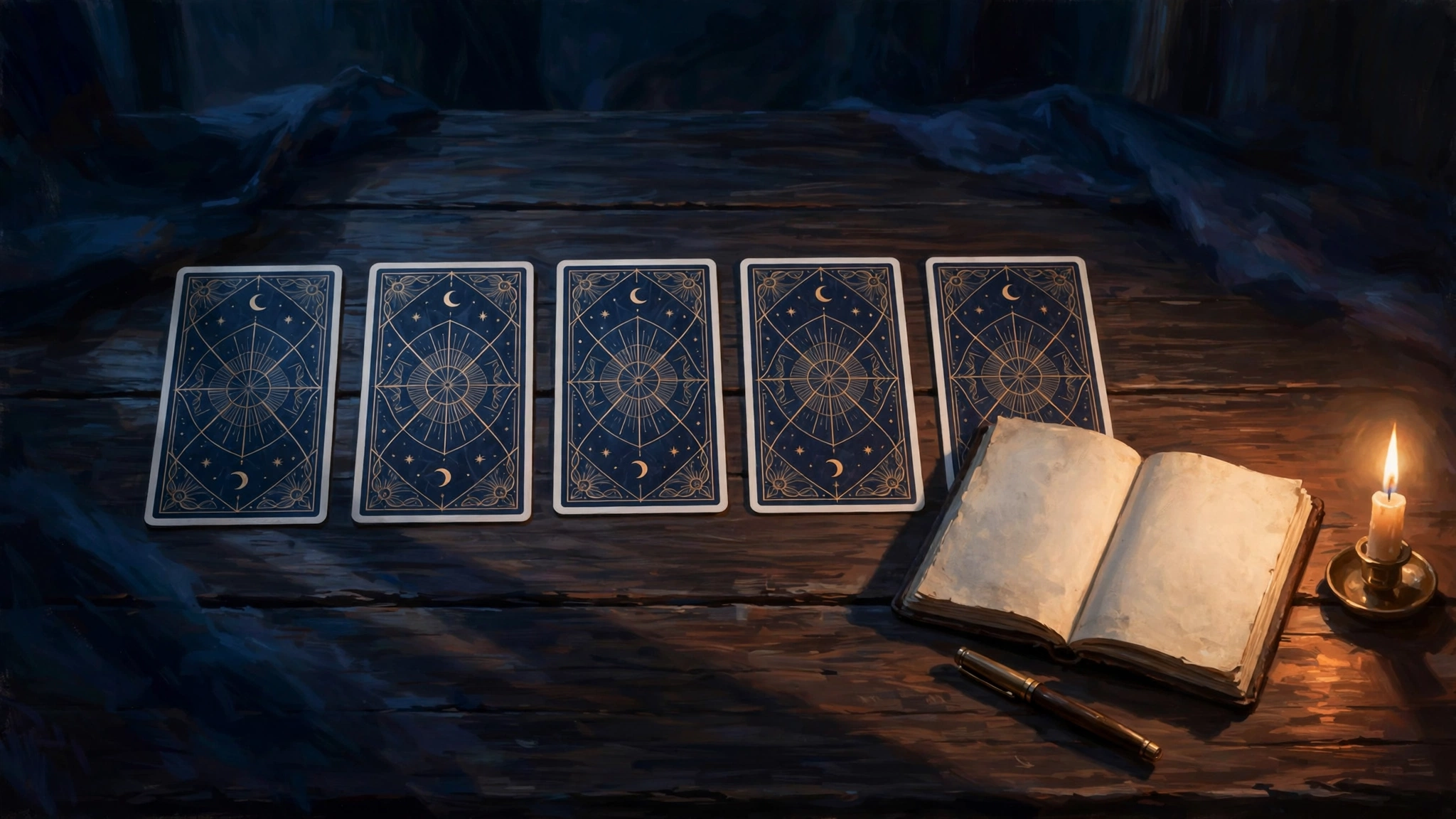
There is no single canonical shadow spread. Many layouts exist, and the five-card beginner spread is the best documented. Two teachers, Juniper Divination and Nox Tarot, teach the same layout, which makes it a solid place to start. The five positions are:
- What I am hiding from myself. This card names the trait, wish, or feeling you have pushed out of view. It may be anger, ambition, need, or joy. Whatever it is, you decided, often long ago, that it does not belong.
- Why I hide it. This card points to what you fear would happen if the hidden part were seen. Rejection, judgment, conflict, or loss of love are common fears. Naming the fear takes away some of its power.
- How it shows up in my life. This card shows where the hidden part leaks out: in relationships, at work, or in reactions that feel out of proportion. The pattern often repeats until it is seen.
- What it needs from me. This card points to the strength or wisdom inside the shadow, sometimes called the golden shadow. The need is acceptance, not defeat. The aim is to hold the part without surrendering to the impulse behind it.
- One gentle step toward integration. This card suggests one small action that turns insight into a choice. Integration is a process, not an event, so the step should be small enough to take this week.
Use the spread this way. Start with a few slow breaths and a clear question, written in your journal first. Good starter questions include "What am I not seeing about myself?" and "What pattern keeps repeating in my relationships?" Shuffle with that one question in mind. Lay five cards face down, then turn them over one at a time. Sit with each card before you interpret it, and notice your first reaction: relief, defensiveness, or recognition. That reaction is your first piece of data. Then write. Try this prompt in your journal: "What part of me could this card be pointing at, the part I usually look away from?" Then return to the pictures again over the next few days and let them stay with you. This kind of material usually needs more than a single reading to settle.
Cards That Often Show Up
The cards that appear in shadow readings are often the ones readers find hardest to face. Five turn up again and again.
The Devil points to attachments and patterns: the habits, cravings, and loops that hold you in place. The Moon points to what is hidden or unclear: the part of the picture you cannot yet see. The Ten of Swords points to an ending that has already happened, even if you have not yet accepted it. The Emperor points to control or rigid authority, in yourself or in someone close to you. The Five of Pentacles points to feeling left out or unsupported, and to fear of scarcity or exclusion.
Two cautions belong here. First, reversed cards are not automatically negative. A reversed card can soften a meaning, delay it, or turn it inward. Second, any card can serve as shadow material. The most useful card is often the one you resist most. If you dislike pulling a particular card again and again, ask what quality in that card you have denied in yourself.
Shorter and Longer Versions
If five cards feel like a lot, a three-card version works for a quick check, and a seven-card Deep Shadow Spread suits a longer session when you want to look at history and integration in more depth. A six-card Raka variant adds a deeper middle, asking what the hiding protects and what it costs. For the full set of layouts, see our tarot spreads hub.
How to Read the Spread Without Forcing Answers
Let the cards speak before you decide what they mean. Sit with the images, and let the reaction come first. Then ask what the card would mean if it were describing something true about you that you would prefer not to see. That question opens the reading more than any list of keywords can.
Keep the aim in view. The goal is integration, not excavation. Owning anger rather than repressing it, accepting a need for rest rather than shaming yourself, or admitting a capability you have judged harshly in others: these are the moves that matter. The same quality may need revisiting at different stages of life, and that is normal. A spread that leaves you with one honest insight and one small step has done its job.
What to Do Next
Try the spread with one question and a journal beside you. Give yourself time, and let the cards sit with you for a few days before you draw a conclusion. If something heavy comes up, talk to a professional as well as to a reader. If you want a lighter start, pull a single card with our One-Card Tarot tool and sit with the image for a few minutes. A chat reading can also walk through the five positions with you, one card at a time. First 3 minutes FREE — every time, for every reading, with all advisors.
Frequently Asked Questions
What is a tarot spread for shadow work?
A tarot spread for shadow work is a layout of card positions that turns a reading toward the parts of yourself you keep out of sight. The five-card beginner spread asks what you are hiding from yourself, why you hide it, how it shows up in your life, what it needs from you, and what one gentle step toward integration looks like. The cards act as mirrors, and the work happens in the reflection and journaling that follow.
What are the five positions in the shadow work tarot spread?
The five positions are: 1. What I am hiding from myself. 2. Why I hide it, and what I fear would happen if it were seen. 3. How it shows up in my life, in relationships, at work, and in reactions. 4. What it needs from me, which is acceptance, not defeat. 5. One gentle step toward integration. Lay the cards face down, turn them one at a time, and journal after the reading.
Which tarot cards show up most in shadow work?
The Devil, The Moon, the Ten of Swords, The Emperor, and the Five of Pentacles appear most often. The Devil points to attachments and patterns, The Moon to what is hidden or unclear, the Ten of Swords to an ending that has already happened, The Emperor to control or rigid authority, and the Five of Pentacles to feeling left out or unsupported. Any card can hold shadow material, and the card you resist most is often the most useful one.
Is shadow work the same as therapy?
No. Shadow work with tarot is a self-inquiry practice, not a form of therapy and not a replacement for professional help. There is little research on the practice, and no trial of shadow-work prompts has been found. If a reading stirs something heavy or touches on trauma, a professional is the right call.
Can a beginner do a shadow work tarot spread?
Yes. The five-card spread is designed for beginners, and you need no special skill beyond honesty and time. Start with one clear question, shuffle, lay five cards face down, turn them one at a time, and write down what comes up. Work with the images over days if you need to, and keep the steps small.
Last updated: November 13, 2026
