
Tarot for Anxiety: A Calm Reflective Practice
The Short Answer: Tarot for Anxiety as Reflection
Tarot for anxiety works best as a calm reflective practice, not as a way to predict what will happen next. A short reading gives worry a shape on the table. You name a feeling, look at one image, and write one clear sentence about what you will do next. The cards do not answer the future.
In this article, the word anxiety means the everyday sense of worried, restless feelings. It does not mean a diagnosis. Tarot is not therapy, not a treatment, and not a diagnostic tool. Tarot does not treat anxiety. It is not a substitute for professional mental health care. If worry is persistent, disabling, or hard to manage on your own, reach out to a qualified therapist, counselor, or crisis line.
What Tarot Can Do Here, and What It Cannot
A standard tarot deck has 78 cards: 22 Major Arcana and 56 Minor Arcana. The Rider-Waite-Smith deck dates to 1909, illustrated by Pamela Colman Smith. If you are new to reading, start with our guide on how to read tarot for yourself.
Anxiety often pulls attention into the future, toward worry about what might happen, or into the past, toward regret. A tarot practice works in the opposite direction. It anchors attention in the present. Shuffling, handling the cards, looking at one image, and writing one sentence all ask you to stay with this moment.
Tarot has no clinical evidence base as a treatment for anxiety. No clinical trial or peer reviewed study in the research for this article showed that tarot reduces anxiety. The sources behind this practice are practitioner guides, not clinical sources. This article therefore makes no claim that tarot cures, reduces, or manages anxiety as a medical matter.
What tarot can do is narrower. It can help you notice a thought, name a feeling, and externalize worry. A short spread can turn a vague dread into a small plan.
Ask a Question That Can Be Answered
The question matters more than the cards drawn. A prediction question has no answer and keeps the worry loop running. "Will the thing I dread happen?" invites the mind to rehearse disaster, then to demand certainty that no reading can give.
Answerable reflective questions work differently. They ask about the present, not the future. Try questions that stay present: name the feeling here now, ask what need the worry guards, or picture a kinder next hour. Write your question down before you shuffle.
A Single Card Check In
A single card check in takes under two minutes, and it is the best place to start. First, name the feeling out loud or on paper. Second, breathe while you shuffle, with each exhale longer than the inhale. Third, pull one card and ask a reflective question, not a prediction question. Fourth, sit for a minute with the image. Fifth, write one sentence about what the card seems to be offering, then close the book.
Before you begin, say out loud: "Whatever I pull, I will not make any major decisions today." Then use a 24 hour rule before acting on a reading. For the journal part, see our guide on how to journal your daily tarot card. Keep the reading small on purpose. Three to five cards, about ten minutes, and one page of notes is enough.
The Quiet Ground Spread: Five Cards
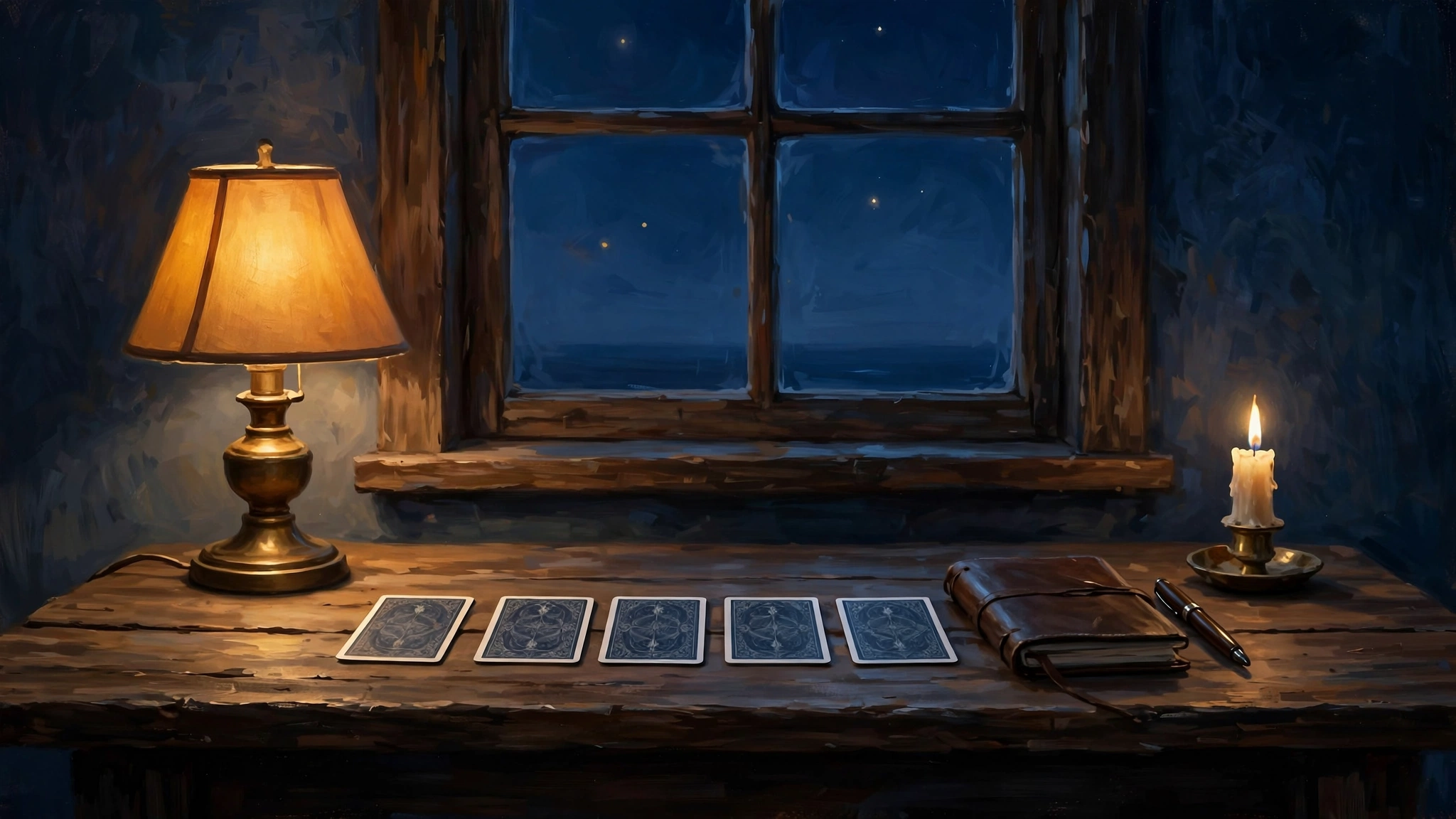
The Quiet Ground spread is a five card spread for a worried evening, from Veil Soul. It is the only full spread taught in this article. Before you begin, sit with both feet flat on the floor, breathe out slowly three times, put a hand where the anxiety is felt most, and say what it is.
Position 1 is What I am feeling. It labels the feeling as it is, without debating whether it makes sense. Position 2 is What sits underneath it. It looks for the deeper need or fear underneath the worry, like needing rest, money, safety, or permission to refuse. Position 3 is What I can set down tonight. It names one specific thing that can wait until morning. Position 4 is What steadies me. It points to help already close by: someone trusted, a calm place, a steady habit, or a verifiable fact. Position 5 is The smallest next step. It names one action small enough to finish today. When the card points to a big task, cut it down to ten minutes or less.
After laying the cards, read the five as a single sentence. When the sentence reads as a plan, you can stop there. When it sounds like a forecast, go back and ask a narrower question. When a position gives you nothing, write "nothing yet" beside it and carry on.
The Grounding Spread, the Worry Inventory Spread, and the Self-Compassion Spread are named in the sources only, with positions not fully verified. See the tarot spreads hub.
Cards That Often Show Up
Cards are anchors for reflection in this practice, never prescriptions. A card does not diagnose a feeling or order a course of action. It offers an image to think with.
The Star stands for hope returning slowly through ordinary feelings, and rest as part of getting better. Temperance stands for one measured step at a time: this hour, this one task. The Empress stands for basic care, food, sleep, and warmth. Strength stands for staying with fear without forcing it away. The Hermit stands for turning outside noise down. Four of Swords stands for rest as recovery, not avoidance.
Nine of Swords names the worry instead of soothing it. It is the three in the morning card, one thought on repeat. It is not a prediction of disaster. It shows worry outgrowing what is actually known, so go back and check what is true. The Moon also names the worry: uncertainty, with imagination filling gaps.
Death, The Tower, and Three of Swords can spike anxiety if read predictively. If one appears, read it as an image to reflect on, not as a forecast. Stop the reading if it starts to frighten you.
An Illustrative Example: The Night Before a Difficult Conversation
This example is illustrative, not a real person's story.
The question asked is: what should I notice before the talk with my manager tomorrow about the project that ran late? Nine of Swords lands in the feeling position, naming the late night loop: one thought on repeat, fear grown larger than the facts. The Empress reversed lands underneath, pointing at basic care left undone: little sleep and a skipped meal. The Moon lands in the set down tonight position, naming the uncertainty to leave till morning. Strength lands in the steadies me position, offering patience rather than force. Temperance lands in the smallest next step position, shrinking the plan to one move: write down three plain sentences for the talk, then stop.
Read as one sentence, the spread becomes a plan: name the loop, eat and sleep, set the unknown aside till morning, stay steady, and prepare three sentences.
Guardrails That Keep the Practice Calm
Guardrails matter more than any single card. Without them, a calming practice can turn into a compulsive one. Ask one question a day, and write it down before shuffling. Do not redraw for a better card. Set a ten minute timer. When the timer ends, the deck goes away. Write one line of notes: what was drawn, what was decided, and the date.
If a reading frightens you, close it physically. Stand up and leave the room. A brief walk outside can ease things, as can cool water splashed on the wrists or a warm shower. Slow breathing helps too: in for a count of four, out for six to eight, for roughly a minute. Another plain technique counts down through the senses: look for five sights around the room, feel four textures within reach, listen for three sounds nearby, catch two scents, and notice one taste. Do not use cards to decide medical, legal, financial, or major relational commitments. Do not make a major decision on the day of a reading. Wait 24 hours first. If worry keeps returning, if it disrupts sleep or daily life, or if a reading leaves you more afraid than before, stop the practice and talk to a qualified professional.
What to Do Now
Start small tonight. Pick one reflective question, pull one card, sit with the image for a minute, and write one sentence. If that feels steady, try the Quiet Ground spread on another evening, with the timer set and the notebook open. If it feels shaky, stop and talk to someone you trust instead.
A chat reading can sit with you and look at your own situation one question at a time. First 3 minutes FREE — every time, for every reading, with all advisors.
Frequently Asked Questions
What is tarot for anxiety?
Tarot for anxiety is a reflective practice that uses a short card reading to notice thoughts, name feelings, and externalize worry. It is not therapy, not a treatment, and not a diagnostic tool. A typical practice is one question, one to five cards, about ten minutes, and one line of notes. The aim is a small clear plan, not a prediction about the future.
Can tarot treat anxiety?
No. Tarot does not treat anxiety, and no clinical trial or peer reviewed study in the research for this article showed that tarot reduces anxiety. Tarot is a reflective practice only. If worry is persistent, disabling, or hard to manage on your own, tarot is not a substitute for professional mental health care, and you should reach out to a qualified therapist, counselor, or crisis line.
How do I do a tarot reading for anxiety?
Start with a single card check in. Name the feeling out loud or on paper, breathe while you shuffle with each exhale longer than the inhale, pull one card, sit for a minute with the image, and write one sentence about what the card seems to be offering. For a longer reading, use the Quiet Ground spread: what you are feeling, what sits underneath it, what you can set down tonight, what steadies you, and the smallest next step. Read the five cards as one sentence. When the sentence reads as a plan, you can stop there.
What cards are good for anxiety readings?
The Star, Temperance, The Empress, Strength, The Hermit, and Four of Swords are steadying anchors in this practice, for hope, measured steps, basic care, patience, quiet, and rest. Nine of Swords and The Moon are worry naming cards: one names a thought on repeat at three in the morning, the other names uncertainty with imagination filling in the gaps. Cards are anchors for reflection, never prescriptions, and no card diagnoses a feeling.
What should I do if tarot makes my anxiety worse?
Stop the reading. Do not redraw for a better card, and do not sit with a frightening image trying to argue it into a kinder shape. Stand up, leave the room, and let the timer rule end the session. A short walk, a longer exhale, or one sentence to one person can help in the moment. If worry keeps returning or disrupts sleep or daily life, talk to a qualified therapist, counselor, or crisis line. Professional support is the right next step when reflection alone is not enough.
Last updated: November 13, 2026
