
Rider Waite vs Thoth Tarot: Which Deck to Learn On
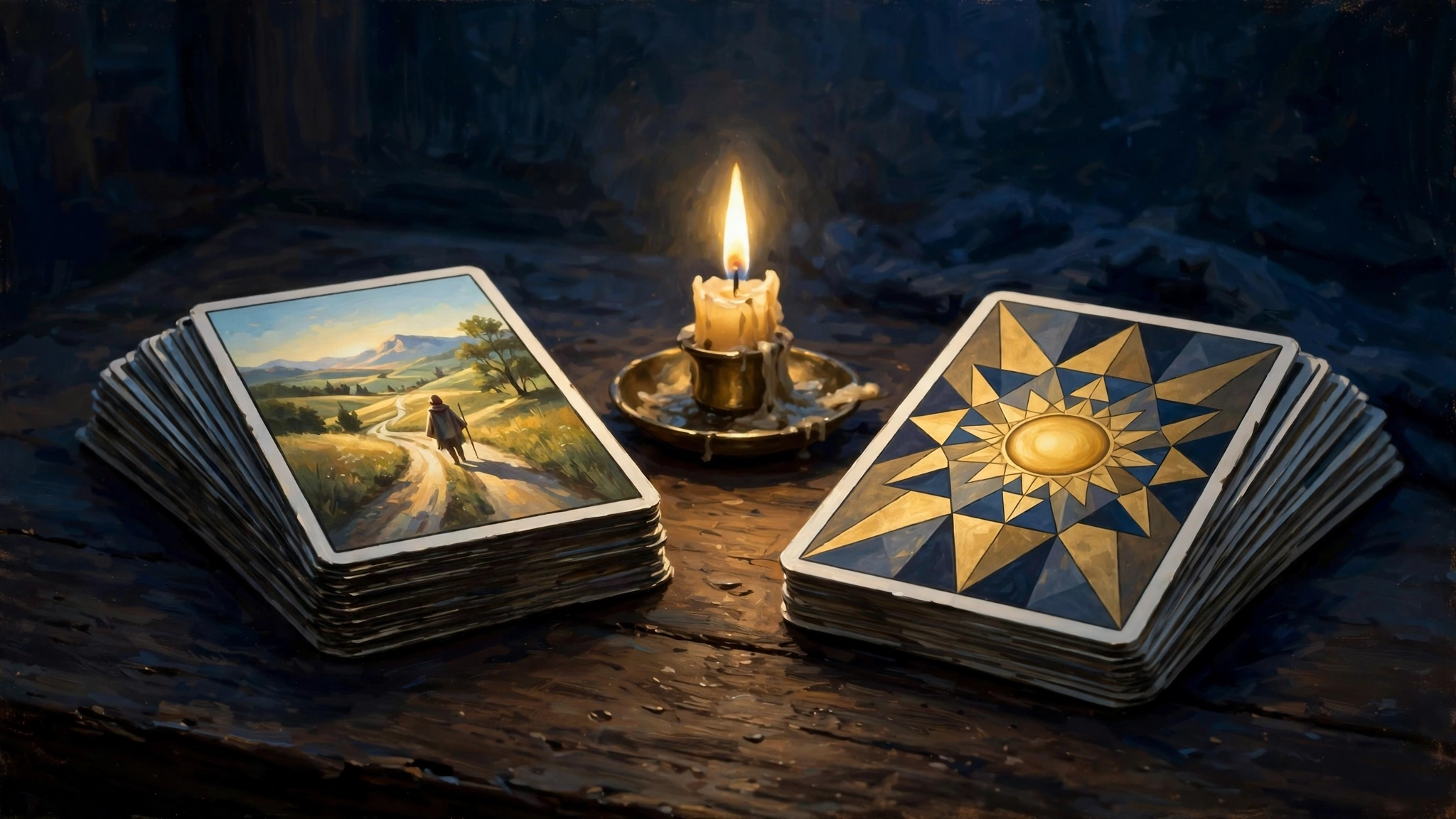
The Short Answer: Two Decks, One Structure
Rider Waite vs Thoth Tarot is the comparison every new reader meets sooner or later, because these two decks shaped almost all modern tarot. Both hold 78 cards, 22 Major Arcana and 56 Minor Arcana, and both grew out of the same Golden Dawn system. A spread learned on one works on the other. What changes is the art, the names, and the amount of study each deck asks of the reader.
The Rider-Waite deck, also called Rider-Waite-Smith, came first. It appeared in December 1909, and its great gift to readers was a full scene on every Minor Arcana card, so a beginner could read from the picture. The Thoth deck came from a later generation. Aleister Crowley designed it and Frieda Harris painted it, working from 1938 into the early 1940s, and it packs astrology, Kabbalah, and alchemy into dense, abstract art.
In short, start with Rider-Waite if you are new, and move to Thoth later if deep study calls to you. The rest of this guide shows why, card by card.
The Rider-Waite Deck: Pictures That Teach
Arthur Edward Waite conceived the deck and Pamela Colman Smith illustrated it. Both were members of the Hermetic Order of the Golden Dawn, the London occult society founded in 1888, and the deck carries the stamp of that system. William Rider and Son of London published it in December 1909, with a larger printing in March 1910.
Smith made the choice that defines the deck. Before her work, numbered Minor Arcana cards in most decks showed only the suit symbols, with no scene to read. Smith gave every pip card a full picture, with people, landscape, and action, so the Ten of Swords or the Three of Cups could be read from the image alone. That single change is why the deck became the standard first deck, and why most modern decks still copy its images.
Waite wrote a short guide to go with the deck in 1909, and the expanded Pictorial Key to the Tarot followed in 1910 and 1911. Today the deck is the most widely used tarot deck in the English-speaking world, and most books and courses teach from it. The card meanings on this site follow the Rider-Waite images, so a reader who learns on this deck can use every card meanings page without translation. For the full story of the deck, see our Rider-Waite deck guide.
The Thoth Deck: A System Built for Study
Aleister Crowley designed the Thoth deck and Frieda Harris painted it. Crowley lived from 1875 to 1947 and founded the spiritual system called Thelema. Harris lived from 1877 to 1962 and brought her own ideas to the work, including the use of projective geometry in the art. The two began work in 1938, and sources give 1942 or 1943 as the finish, so the safe way to date the work is 1938 into the early 1940s.
Crowley wanted a deck that carried far more occult teaching than the decks of his day. Where Rider-Waite speaks through pictures, Thoth speaks through systems: Kabbalah, astrology, alchemy, and numerology are woven into the images, and many Minor Arcana cards carry a printed keyword. The art is abstract and geometric, with an Art Deco feel, and the pip cards show arrangements of suit symbols with astrological and geometric patterns rather than narrative scenes. The deck takes its name from Thoth, the Egyptian god of wisdom and magic.
The dates around Thoth cause the most confusion, so they are worth setting out plainly. The Book of Thoth, the full commentary by Crowley, appeared in 1944 in a limited edition of 200 numbered and signed copies, with eight color plates of the Harris cards pasted in. That 1944 date belongs to the book, not to the card pack. The first full color pack appeared in 1969, though sources differ on whether Llewellyn or Samuel Weiser issued it, and one library record dates it to about 1971. Crowley died in 1947 and Harris died in 1962, so neither lived to see the pack in print. For a closer look, see our Thoth deck guide.
Side by Side: The Comparison
The table below puts the two decks next to each other, point by point.
| Aspect | Rider-Waite-Smith | Thoth |
|---|---|---|
| Creator and artist | Arthur Edward Waite and Pamela Colman Smith | Aleister Crowley and Frieda Harris |
| First published | December 1909 | Book 1944, first full color pack 1969 |
| Minor Arcana art | Full scene on every pip card | Abstract patterns of suit symbols, not scenes |
| Suits | Wands, Cups, Swords, Pentacles | Wands, Cups, Swords, Disks |
| Court cards | Page, Knight, Queen, King | Princess, Prince, Queen, Knight |
| Key renames | Standard names | Magus, Priestess, Adjustment, Lust, Fortune, Art, Aeon, Universe |
| Strength and Justice | Strength VIII, Justice XI | Adjustment VIII, Lust XI |
| Symbolism | Picture-led, Golden Dawn imagery | Kabbalah, astrology, alchemy, Thelema |
| Best for | Beginners and first-time readers | Advanced study after Rider-Waite |
Court Cards: The Translation That Trips Readers Up
Court cards cause the most confusion when readers switch decks, because Thoth keeps four court ranks but gives three of them different names and different places in the order. The mapping runs like this. Thoth Knight stands where the Rider-Waite King stands. Thoth Prince stands where the Rider-Waite Knight stands. Thoth Princess stands where the Rider-Waite Page stands. Thoth Queen matches the Rider-Waite Queen, the one rank that stays put.
Behind the names sits the Golden Dawn order of the elements. Knight stands for Fire, Queen for Water, Prince for Air, and Princess for Earth. A reader who moves from Rider-Waite to Thoth and reads a Thoth Knight as a Knight will misread the card, since the Thoth Knight carries the weight of a King. Learn the four-way mapping before your first Thoth reading, and the rest of the deck opens up far more smoothly.
Strength and Justice: The Number Swap
The second number change to learn is the Strength and Justice swap, and it is the point where many online comparisons go wrong. In Rider-Waite, Strength is VIII and Justice is XI. Waite made that swap from the older Marseille order, following Golden Dawn correspondences. In Thoth, the Marseille order returns under new names: Adjustment, the Justice card, is VIII, and Lust, the Strength card, is XI.
A few online comparisons print this the wrong way round, giving Rider-Waite Justice VIII and Strength XI and saying Crowley reversed them. That is backwards. Rider-Waite holds Strength VIII and Justice XI. Thoth holds Adjustment VIII and Lust XI. Keep the two pairs side by side until the numbers feel natural, because a swapped pair will throw off any reading that leans on the Major Arcana order.
Which Deck Should You Learn On First
Learn on Rider-Waite first. The illustrated pip cards let a beginner read from the picture instead of memorizing lists of correspondences, and most books, courses, and card meaning pages teach from this deck. Every spread in our tarot spreads guide works with it, and the how to choose a tarot deck guide walks through the same choice in more detail.
Move to Thoth when the Rider-Waite deck feels familiar and the deeper systems start to interest you. Thoth rewards a reader who enjoys astrology, Kabbalah, and ceremonial magic, and it repays slow study with layers that a picture-led deck cannot carry. The standard starting book for that study is the 2003 guide by Lon Milo DuQuette, and the Book of Thoth by Crowley remains the source text for the system behind the cards.
Neither deck reads better than the other, and no evidence supports a claim that one is more accurate. The difference is fit: Rider-Waite fits a reader who wants clear pictures and the widest shelf of teaching material, while Thoth fits a reader who wants a dense symbolic system to study for years. Many readers keep both, using Rider-Waite for everyday readings and Thoth for deep study.
What to Do Next
If you are choosing your first deck, pick up Rider-Waite and learn its pictures well before you add a second deck. If you already read Rider-Waite with ease, spend time with the Thoth guide and the court card mapping above, then try a simple spread with the Thoth images and see how the abstract art speaks to you. A chat reading can help you talk through which deck fits the way you like to read, one question at a time.
First 3 minutes FREE — every time, for every reading, with all advisors.
Frequently Asked Questions
What is the main difference between Rider-Waite and Thoth tarot?
The main difference is the art and the depth of study each deck asks for, not the structure. Both decks hold 78 cards, 22 Major Arcana and 56 Minor Arcana, and a spread learned on one works on the other. Rider-Waite gives every Minor Arcana card a full scene that a reader can read from the picture. Thoth uses abstract, geometric art packed with astrology, Kabbalah, and alchemy, and it renames several Major Arcana cards and three of the four court ranks.
Which deck should a beginner learn on, Rider-Waite or Thoth?
A beginner should learn on Rider-Waite first. The illustrated pip cards let a new reader work from the picture instead of memorizing correspondences, and most books, courses, and card meaning pages teach from this deck. Thoth is best saved for later, once the Rider-Waite deck feels familiar and the deeper systems behind the cards start to interest you.
Why do Thoth court cards have different names?
Thoth follows the Golden Dawn order of the elements, so its court ranks carry different names and different places in the order. Thoth Knight stands where the Rider-Waite King stands, Thoth Prince stands where the Rider-Waite Knight stands, and Thoth Princess stands where the Rider-Waite Page stands. Only the Queen matches in both decks. A reader who moves between the decks should learn this four-way mapping first, or the court cards will be misread.
Is Strength 8 or 11 in the Thoth deck?
In Thoth, Adjustment, the Justice card, is VIII, and Lust, the Strength card, is XI. In Rider-Waite, Strength is VIII and Justice is XI. Waite made that swap from the older Marseille order, following Golden Dawn correspondences, and Thoth restores the Marseille order under new names. A few online comparisons print this the wrong way round, so check the pair against the deck in your hands.
When was the Thoth deck published?
The Book of Thoth, the commentary by Crowley, appeared in 1944 in a limited edition of 200 numbered and signed copies, but that date belongs to the book, not to the card pack. The first full color pack appeared in 1969, though sources differ on whether Llewellyn or Samuel Weiser issued it, and one library record dates it to about 1971. Crowley died in 1947 and Harris died in 1962, so neither lived to see the pack in print.
Last updated: November 13, 2026
