
Marseille Tarot Deck: History and How to Read It
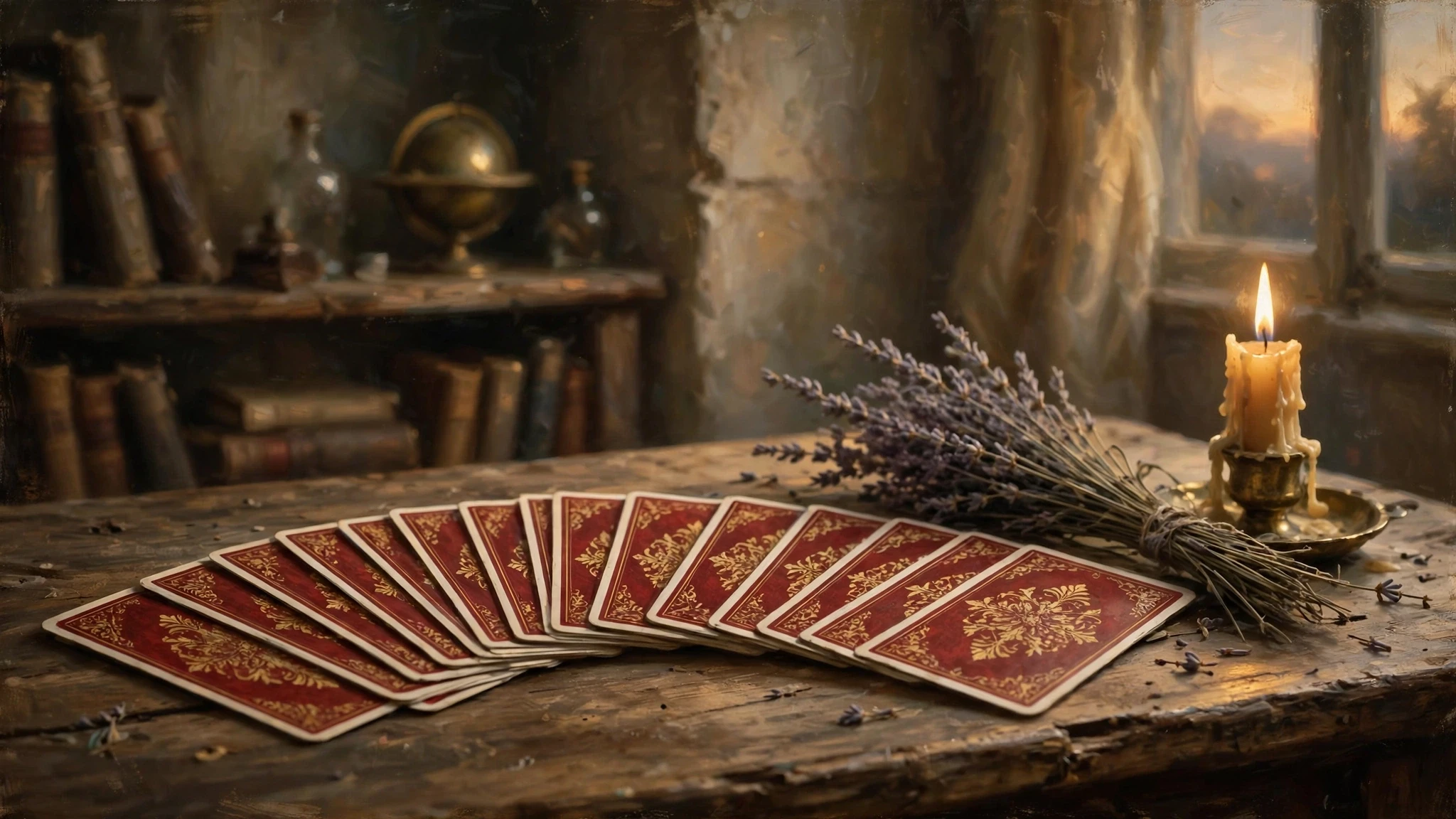
The Marseille Tarot Deck: The Old Pattern That Started It All
Walk into a card maker's workshop in Marseille in the 1700s and you would smell wood shavings, ink, and hot glue. A craftsman cuts a woodblock, inks it, presses it onto paper, and hands the sheet to a colorist who fills in the reds, blues, and yellows by hand. The cards that come off that press are the ancestors of nearly every tarot deck printed since. The marseille tarot deck is not one single deck. It is a pattern, a family of closely related designs made in France in the 17th and 18th centuries, and it is the standard from which most later decks are derived. If you have ever held a modern tarot deck, you have held a descendant of Marseille, whether you knew it or not.
The deck has 78 cards, like every standard tarot: 22 Major Arcana and 56 Minor Arcana, in four suits of fourteen cards each. What makes it different is not the count. It is the look and the feel. The Major Arcana are bold woodcut figures with French titles. The Minor Arcana pips are not illustrated scenes. They are arrangements of swords, cups, wands, and coins, counted out like playing cards. The colors are flat and few: red, blue, green, yellow, and flesh tones. The style is simple on purpose. It was made to be printed fast, sold cheaply, and played hard, and that working history is exactly what gives the deck its power for readers today.
A Short History: From Milan to Marseille
Tarot itself was invented in northern Italy in the early 15th century, and it spread into southern France when French soldiers conquered Milan in 1499 and carried the game home with them. The designs that became the Marseille pattern grew out of those Milanese cards over the next two centuries, and the earliest surviving examples of the pattern are older than the city that gave it its name. The Jean Noblet deck, made in Paris around 1650, was long called the oldest complete Marseille deck known, until a complete Philippe Vachier deck dated 1639 resurfaced at auction in 2023 and took that place. The Jean Dodal deck followed in Lyon around 1701. The deck that became the template for most modern reproductions is the Nicolas Conver deck, printed in Marseille in 1760, which standardized the imagery: the Magician's table, the Pope's triple crown, the World dancer's pose.
The name Tarot de Marseille is younger than the cards. The French card historian Romain Merlin coined the name in 1856, and the cartomancer Paul Marteau popularized it in the 1930s, giving a collective name to a variety of closely related designs made in Marseille. The chief use of the deck originally was to play the game of tarot, a trick taking game still played in France today. The use of cards in divination is first attested in the 18th century, in the journals of Casanova, who described a cartomancy game with a 25 card square around 1765 rather than a tarot reading. The earliest evidence for tarot divination itself is a Bolognese manuscript from around 1750, and it was the Conver deck, or one very like it, that came to the attention of Antoine Court de Gebelin in the late 18th century. Court de Gebelin's writings, which speculated about an Egyptian origin for the cards, helped turn a game into an occult tool, and the Marseille pattern has been read that way ever since.
What Makes the Marseille Deck Different
The first difference a reader notices is the pips. In the Rider Waite deck, first published in 1909, every Minor Arcana card is a little painting: the Three of Swords shows a heart pierced by three blades, and the Ten of Cups shows a family beneath a rainbow. In the Marseille deck, the Three of Swords is three swords, arranged in a pattern, and the Ten of Cups is ten cups, arranged in a pattern. The pips do not tell you the meaning. They ask you to find it. Readers of the Marseille deck learn to read number, suit, and arrangement: three is a beginning of growth, swords are thought and conflict, and the way the three blades cross tells the reader whether the thought is ordered or tangled. It is a harder way to read, and a freer one, because the reader is not following a picture. They are building the meaning from the pieces. A reader who wants the opposite approach, dense occult symbolism packed onto every card, will find it in the Thoth tarot deck guide, a deck that loads each image with correspondences the Marseille pattern leaves out.
The second difference is the numbering. In the Marseille deck, Justice is card 8 and Strength is card 11, the reverse of the Rider Waite order, where Strength is 8 and Justice is 11. The swap matters because it changes the story of the Major Arcana. In the Marseille order, Justice comes early, right after the Chariot, and Strength comes late, after the Wheel of Fortune. Readers who switch between decks should know which order their deck uses, because the number is part of the card's meaning. The third difference is the Death card, numbered 13, which is generally left unnamed in the Marseille deck, though the Noblet deck of around 1650 names it LAMORT. The fourth is the Fool, called Le Mat, who carries no number at all, a wanderer outside the sequence.
Reading the Pips: Number, Suit, and Arrangement
The pips are the part of the Marseille deck that frightens new readers, and they are also the part that rewards study most. Each suit has its own character. Swords are thought, conflict, and truth. Cups are feeling, relationship, and the inner life. Wands, called Batons in the French deck, are action, energy, and growth. Coins, called Deniers, are money, work, and the material world. Each number has its own character too. Aces are beginnings and pure potential. Twos are balance and choice. Threes are growth and the first result. Fours are stability and rest. Fives are conflict and loss. Sixes are harmony and exchange. Sevens are challenge and assessment. Eights are movement and power. Nines are near completion and solitude. Tens are completion and the turn into a new cycle.
A reader puts the three pieces together: suit, number, and arrangement. The Five of Cups is feeling, conflict, and loss: a sorrow in the heart. The Eight of Wands is action, movement, and power: swift news traveling. The Ten of Coins is money, completion, and the turn: a family wealth, or a cycle of earning that has reached its end. The court cards add the people: the Valet is the page, the Chevalier is the knight, and the Reine and Roi are the queen and king. A reader who learns these pieces can read any pip card without memorizing 56 separate pictures, and that is the Marseille deck's gift. It teaches the system, not the scene, and the system travels with the reader to every deck they ever pick up.
The Major Arcana in Marseille: Bold, Simple, Direct
The Major Arcana in the Marseille deck are woodcut figures with French titles, and their simplicity is their strength. The Fool, Le Mat, is a wanderer with a bundle on a stick, chased by a dog or a cat. The Magician, Le Bateleur, stands behind a table covered with cups, coins, and dice, a juggler rather than a priest. The High Priestess, La Papesse, sits with a book. The Empress, L'Imperatrice, sits with a shield bearing an eagle. The Emperor, L'Empereur, sits with the world in his hand. The images are direct, and they leave room for the reader. There is no elaborate scenery to interpret. There is a figure, a posture, and a title, and the reader brings the meaning.
Two cards deserve special attention. The Tower, called La Maison Dieu, the House of God, shows a tower struck by lightning with figures falling from it, much like the Rider Waite Tower, and it is one of the few Marseille images that is dramatic rather than calm. The World, Le Monde, shows a dancing figure inside a wreath, much like the Rider Waite World, and it is the deck's final card, the completion of the journey that began with the Fool. A reader who learns the Marseille Major Arcana learns the skeleton of tarot itself, and every later deck they meet will be a variation on this skeleton, dressed in different clothes.
Who the Marseille Deck Suits, and How to Start
The Marseille deck suits readers who like systems, history, and freedom. It suits a reader who wants to understand why the cards mean what they mean, rather than memorizing a picture. It suits a reader who is willing to be confused for a while, because the pips do not give up their meanings at first sight. It does not suit a reader who wants every card to be a painting, or who wants the deck to do the interpreting for them. A reader who buys a Marseille deck should expect a learning curve, and should treat that curve as the point. The deck is a teacher, and its lessons are about number, suit, and the reader's own intuition.
A good way to start is to read with the Major Arcana only for the first month. Shuffle the 22 trumps, draw one card each morning, and write down what it says about the day. When the Major Arcana feel familiar, add the court cards, and then the pips, one suit at a time. A second habit helps: keep a notebook for the pips, and for each pip card, write the suit, the number, and one sentence about what the arrangement shows. The Three of Swords is three blades crossing. The Eight of Cups is eight cups in two rows, with a gap. The notebook becomes a personal Marseille dictionary, and it is worth more than any book, because it is written in the reader's own words. You can compare the Marseille approach with the illustrated approach in our Rider Waite tarot deck guide, and learn the wider history in our history of tarot.
A Worked Example: Three Cards From the Old Deck
A reader lays three cards from a Marseille deck for a querent who has asked about a career change. The past position shows the Eight of Deniers: money, movement, and power, eight coins arranged in a steady pattern, suggesting years of earning through craft. The present position shows Le Bateleur, the Magician: a juggler with his tools on the table, suggesting skill that is ready and a new beginning that is already in the querent's hands. The future position shows La Roue de Fortune, the Wheel of Fortune: a turning wheel, suggesting a change of season that the querent does not control.
The reading is simple, because the deck is simple. The past is steady earning. The present is skill that is ready. The future is a turn. The advice is to let the skill meet the turn: prepare the portfolio, tell the network, and be ready when the wheel moves. The pips did not paint a picture of the career. They gave the reader number, suit, and arrangement, and the reader built the meaning from those pieces. That is the Marseille way, and it is a way that grows stronger the longer a reader practices it. For the single card meanings, see what is the major arcana, and the wider family of decks is gathered on the how to choose a tarot deck hub, in one place. To learn the basic skills the Marseille deck rewards, start with our guide to how to read tarot cards.
The oldest pattern is still the clearest teacher. Learn its numbers, learn its suits, and let the woodcuts speak. First 3 minutes FREE — every time, for every reading, with all advisors.
For a simple next step, try a One-Card Tarot reading and reflect on which suit most shapes your life right now.
Frequently Asked Questions
What is the Marseille tarot deck?
It is a historic pattern of tarot cards made in France in the 17th and 18th centuries, not one single deck. The best known example is the Nicolas Conver deck of 1760, and the pattern has 78 cards with bold woodcut art and unillustrated pips.
How old is the Marseille tarot deck?
The earliest surviving complete Marseille pattern deck is the Philippe Vachier deck of 1639, which resurfaced at auction in 2023. The Jean Noblet deck followed around 1650, and the Nicolas Conver deck of 1760 became the template for most modern reproductions.
How is the Marseille deck different from Rider Waite?
Its Minor Arcana pips are arrangements of suit symbols rather than illustrated scenes, so the reader builds meaning from number, suit, and arrangement. It also places Justice at 8 and Strength at 11, the reverse of the Rider Waite order.
Is the Marseille tarot deck hard to read with?
It has a learning curve, because the pips do not paint the meaning for you. Readers who learn the system of number and suit find it freer than illustrated decks, and a good start is to read with the 22 Major Arcana only for the first month.
Was the Marseille deck made for fortune telling?
No, it was originally made for the game of tarot, a trick taking game. Divination use is first attested in the 18th century, and the deck became an occult tool through the writings of Antoine Court de Gebelin and later readers.
Last updated: November 12, 2026
