
How to Hold a Seance | PsychicSmile
How to Hold a Seance: The Short Answer First
How to hold a seance comes down to a small group of willing people, a quiet room, a clear purpose, and a set of ground rules everyone agrees to before you begin. You sit in a circle, usually around a table, in low light. One person leads, the group focuses together, and you invite contact, often through raps, table movement, or messages spoken by a medium. Then you close the sitting properly, bring the lights up, and talk about what happened. That is the whole shape of it. Everything else on this page is about doing that shape well: choosing the right people, setting the room, keeping everyone safe and comfortable, and knowing what to do when the room stays quiet, which is the most common outcome of all.
A seance is not a party game and not a test you can pass or fail. In the Spiritualist tradition it is a sitting, a deliberate act of attention shared by a group. The people who have done it for generations will tell you the same thing: the quality of the circle matters more than any prop you buy. A calm, respectful group that agrees on its purpose will have a better evening than a large, restless group with expensive equipment and no plan. Read the definition first if you are new to the idea, on our what is a seance page, then come back here for the practical steps.
Before You Invite Anyone: Purpose, Consent and Boundaries
Start with purpose, because purpose decides everything else. Are you gathering to remember someone who died, to explore mediumship as a practice, or simply to learn what a seance feels like? A sitting held to remember a grandmother needs a different tone from a sitting held out of curiosity, and the people you invite should know which one it is. Write the purpose down in one sentence and share it when you invite people. If someone's reason for coming clashes with that sentence, it is kinder to find out before the night than halfway through it.
Consent is not optional. Every sitter must be there because they chose to be, and every sitter must be free to leave at any time without argument or embarrassment. That includes the right to sit out a round, to keep their eyes open, or to say they are uncomfortable and step away. Nobody should be pressured into attending, and nobody should be teased for declining. Be especially careful with people who are recently bereaved. Grief can make a person say yes to things they are not ready for, and a seance that raises hope of contact and then delivers silence can leave a grieving person worse than before. If someone lost a loved one in the last few weeks, consider waiting, and suggest a gentler option such as a one to one reading, explained on how a medium reading works.
Set boundaries in advance, out loud, before you sit down. Agree that no one will be touched without permission, that no one will be restrained or held in place, and that anyone can call a pause. Agree that the sitting will not be used to make medical, legal or financial decisions, and that no message received in the circle should be treated as an instruction for real life. Agree on a time limit, usually 60 to 90 minutes, and a clear ending. These rules protect everyone, including the person leading, because they remove ambiguity at the exact moments when ambiguity causes trouble.
Choosing Your Circle
Keep the group small. Four to eight sitters is the range most experienced circles recommend, and six is a good number for a first sitting. Fewer than four can feel thin and self conscious. More than eight becomes hard to manage, because side conversations start, attention drifts, and it becomes impossible to tell who moved the table or knocked on the wood. Small groups also make consent easier, since everyone can see everyone else and speak up without raising their voice.
Choose people who are steady, respectful and able to sit quietly for an hour. Leave out anyone who is intoxicated, anyone who treats the evening as a joke to be disrupted, and anyone who is determined to prove a point, whether that point is belief or disbelief. A skeptic who is polite and open minded can be a fine sitter. A person who plans to grab at the medium or shout accusations is not. Children should not attend. A seance room in low light with talk of the dead is frightening for a child, and a child cannot give the same informed consent an adult can.
One person should lead. The leader does not need to be a medium. The leader needs to be organized, calm and trusted by the group. The leader opens the sitting, sets the pace, speaks the invitations, watches the clock, and closes the sitting. If a medium is present, the medium and the leader should agree in advance on who speaks when, so the group is never confused about who is in charge. If you are looking for a professional rather than leading yourself, read how to choose a medium before you book anyone.
Setting the Room
Choose a room you can make quiet and private. A living room or dining room works well. Close the curtains, silence phones, and put a note on the door so nobody walks in halfway through. A sudden interruption in a dark room startles people and breaks the focus the group has built, so prevention is better than apology.
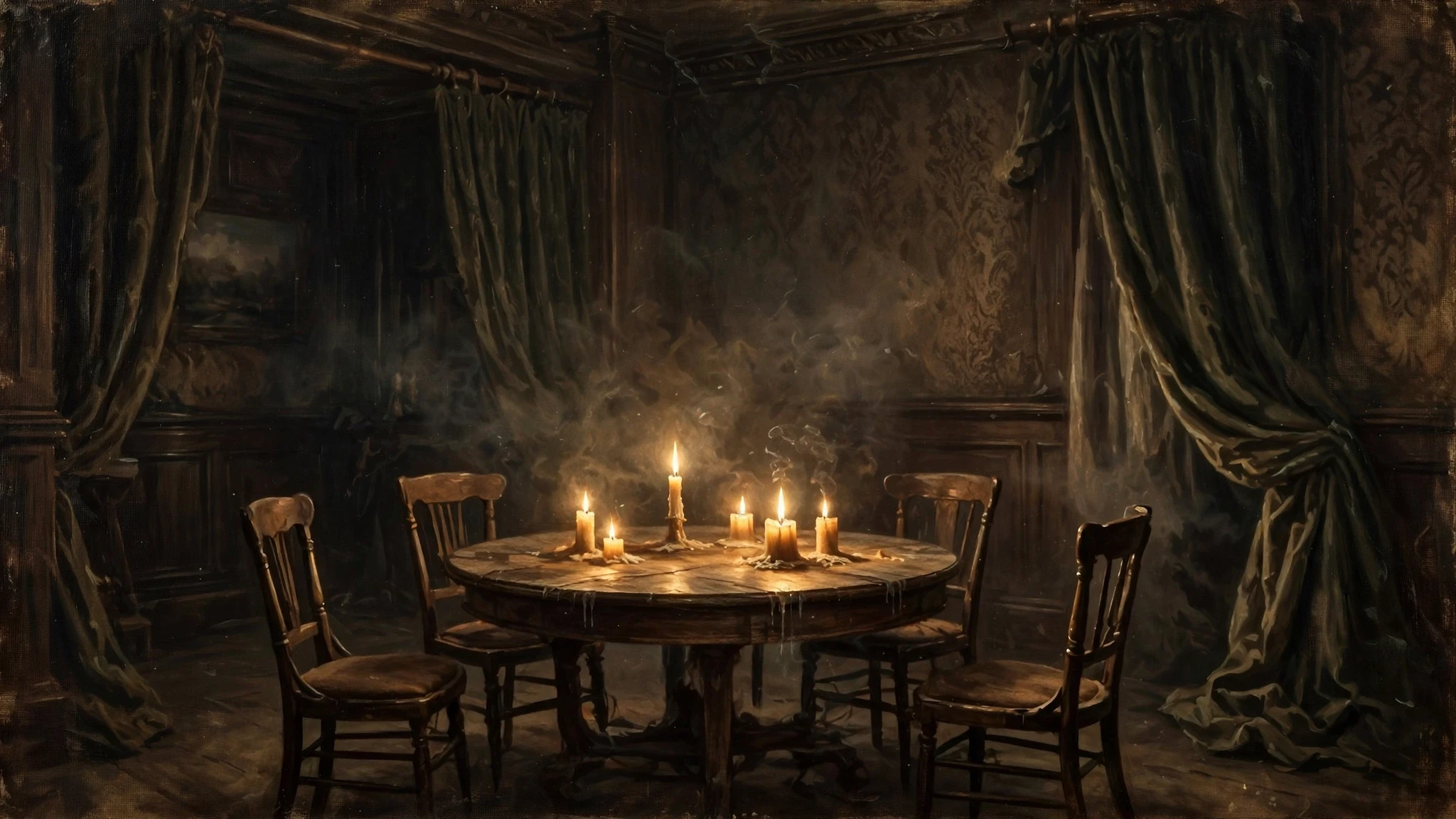
Use a plain wooden table with enough space for everyone to rest their hands lightly on the surface. Chairs should be comfortable and stable. Some circles use a single candle in the center of the table, and some use a lamp turned low or covered with a red cloth. The old reason for dim light was that spirits were said to be disturbed by bright light. The practical reason is simpler: low light helps people relax and focus, and it reduces visual distraction. But do not sit in total darkness, especially the first time. Total darkness makes it impossible to see what is happening, which is exactly the condition under which trickery has historically flourished. Keep enough light to see each other's hands.
Place a few simple items on the table if you wish: a glass of water, a notebook and pen for recording, and perhaps a photograph or object connected to the person you hope to remember. Keep the table clear of anything breakable, and keep candles in a stable holder away from sleeves and hair. Check the room for hazards before you begin, and know where the light switch is. Practical safety sounds unromantic, and it is the part people skip, which is why it belongs here in plain language.
The Sitting Itself, Step by Step
Begin by settling. The leader asks everyone to sit, place their hands lightly on the table with fingertips touching the hands of the people beside them, and breathe quietly for a few minutes. Some circles open with a short spoken statement of purpose, such as naming the person they hope to remember, or a simple request that any presence be kind and respectful. Others open with a minute of silence. Either way, the opening should be short and sincere, not theatrical.
Next comes the invitation. The leader speaks aloud, calmly, inviting contact. A plain form works best: an invitation to anyone present in spirit to make themselves known by a rap, a movement of the table, or a message through the medium. Then the group waits. Waiting is most of a seance. Minutes pass. Someone's stomach rumbles. A floorboard creaks. The leader's job in this stretch is to keep the group patient and to resist the urge to fill silence with chatter. If nothing happens for 15 or 20 minutes, the leader can repeat the invitation once, in different words, and then let the group sit a little longer.
If something does happen, the leader's job is to keep it orderly. If raps are heard, the leader can ask for one rap for yes and two for no, and then ask simple questions with yes or no answers. If the table moves, the leader should note who is touching it and whether the movement could have an ordinary cause. If a medium begins to speak messages, the leader should write down what is said, word for word where possible, so the group can review it later in full light. Do not let the group interrogate the medium or argue about a message while the sitting is running. Save discussion for the closing.
Watch the clock. A sitting that runs too long turns tired people into suggestible people. Ninety minutes is a sensible maximum for a first seance, and an hour is often enough. When the time is up, the leader closes the sitting whether or not anything happened. Closing matters more than opening. The leader thanks any presence, states clearly that the sitting is over, and asks everyone to lift their hands from the table. Then the lights come up, the candles are put out safely, and the group talks. That conversation is part of the practice, not an afterthought, because it is where you compare notes and decide together what you actually experienced.
When Nothing Happens, and Why That Is Normal
Most seances produce nothing dramatic, and that is the honest truth that experienced sitters will give you. A quiet evening is not a failed evening. It may mean the group was not settled, or the time was not right, or that contact simply does not happen on demand. Spiritualist teaching itself says that communication cannot be forced and that spirits are not performers who appear when summoned. If your group treats a quiet night as a failure, the next sitting will be tense, and tension makes a quiet night even more likely.
Do not manufacture phenomena to fill the silence. Do not nudge the table, tap the floor with a foot, or whisper answers and pretend they came from elsewhere. A trick played on friends who trusted you is a breach of that trust, and it is also the reason the wider world stopped taking physical seances seriously. The exposures of the 1920s, when investigators caught mediums ringing bells with their feet and producing cheesecloth as ectoplasm, began with small deceptions in dark rooms. Keep your sitting honest, even when honesty means saying that nothing happened.
After a quiet sitting, talk about what the evening was still worth. People often find that sitting quietly together, remembering someone they loved, and speaking about them aloud has value of its own. That is a real outcome, and it does not depend on a rap or a moving table. If the group wants to try again, schedule the next sitting for another night rather than pushing on the same one. Fresh attention beats tired persistence every time.
An Illustrative Example: Marcus and the First Circle
This example is illustrative, not a real person's story.
Marcus, a 52 year old teacher, organized his first seance after his father died, and he invited five people: his sister, two close friends, and a couple from his neighborhood who had sat in a circle before. He set the purpose in the invitation: to remember his father and to see what a seance felt like. He chose a Saturday evening, set the table with a single candle and his father's photograph, and agreed with the group that anyone could leave at any time and that the sitting would end after one hour. For the first 20 minutes nothing happened at all. Then his sister said she felt a cold draft across her hands, and one of the neighbors said the table seemed to tremble. Marcus wrote both things down without comment. When the hour ended he closed the sitting, put the lights up, and asked each person what they had noticed. The draft, it turned out, came from a window that had been left open a crack. The trembling had happened while Marcus himself was shifting his weight and leaning on the table. Nobody was disappointed. His sister said the best part had been hearing everyone share a memory of his father at the end, and the group agreed to meet again in a month. Marcus later said the evening taught him that a seance is mostly about the people in the room, and that the room deserves honesty more than it deserves a thrill.
Safety, Aftercare and Good Judgment
Take aftercare seriously. After the lights come up, stay together for a while. Offer water and something to eat. Let people talk about how they feel, and watch for anyone who seems shaken or unusually quiet. If someone feels frightened or upset, stay with them, listen without arguing, and help them settle before they drive home. Do not send a distressed person home alone. If anyone reports feeling unwell, anxious or disturbed in the days after a sitting, take it seriously and encourage them to talk to a trusted person or a professional, rather than treating it as a spiritual problem to be solved with another sitting.
Never use a seance to contact a spirit you believe is hostile, and never attempt to provoke or challenge anything in the circle. That advice sounds dramatic, but it has a practical core: a group that sets out to provoke something will frighten itself, and frightened people make poor decisions in a dark room. Keep the tone respectful throughout, the way you would behave in a place of worship or at a memorial.
Finally, keep records. A notebook with the date, the sitters, the purpose, and what happened is worth more than any single dramatic night. Over months, a record shows you patterns: which conditions help the group settle, which sitters bring calm, and whether anything repeats in a way that deserves attention. It also protects you from memory drift, the very human habit of remembering a quiet evening as a spectacular one. The mediumship hub has more on how modern circles and professional mediums work, and what is a medium explains the role of the person at the center of the circle when a medium is present.
If you would like guidance before you sit in a circle, a reading can help you think through your questions. First 3 minutes FREE — every time, for every reading, with all advisors.
For a simple next step, try a One-Card Tarot reading and reflect on what intention you would bring to a sitting of your own.
Frequently Asked Questions
How long should a first seance last?
About 60 minutes is right for a first sitting, with 90 minutes as a sensible maximum. Longer sittings tire people out and make them more suggestible, so it is better to close on time and meet again another night than to push on in hope of a late result.
How many people should attend a seance?
Four to eight sitters works best, and six is a good number for a first circle. Fewer than four can feel thin, while more than eight makes the room hard to manage and hard to observe. Keep the group small enough that everyone can see everyone else.
Is it safe to hold a seance at home?
A seance at home can be safe if you take practical care: keep enough light to see hands, use stable candles away from fabric, agree that anyone may leave at any time, and never treat messages as instructions for medical, legal or financial decisions. Do not sit in total darkness, and do not include children or anyone who is intoxicated.
What should I do if nothing happens during a seance?
Treat a quiet sitting as normal, not as a failure. Close the sitting on time, put the lights up, and talk together about what the evening was still worth. Do not manufacture phenomena to fill the silence, and schedule another sitting for a different night if the group wants to try again.
Can I hold a seance alone?
It is not recommended. A seance is a group practice, and a circle of sitters provides witnesses, shared judgment and support if someone feels upset. Sitting alone in the dark also makes it easy to mistake ordinary sounds and movements for something else. If you want a personal experience, a one to one reading with a medium is a safer choice.
Last updated: November 12, 2026
