
How Does Tarot Card Reading Work? An Honest Guide
How does tarot card reading work? A tarot reading is a structured conversation built around a deck of cards. A reader shuffles the deck, lays out cards in a pattern called a spread, and reads the pictures, the positions, and the links between the cards. The result is an interpretation, not a verdict, shaped by the question, the cards, and the skill of the reader. That is why two readers can give different readings from the same cards. This guide explains the mechanism: what the deck holds, what happens in a reading, how interpretation works, where the practice came from, and what psychology says about why readings feel accurate. For the practical steps, see the guide on how to read tarot cards. This page covers the what and the why.
What a tarot reading actually is
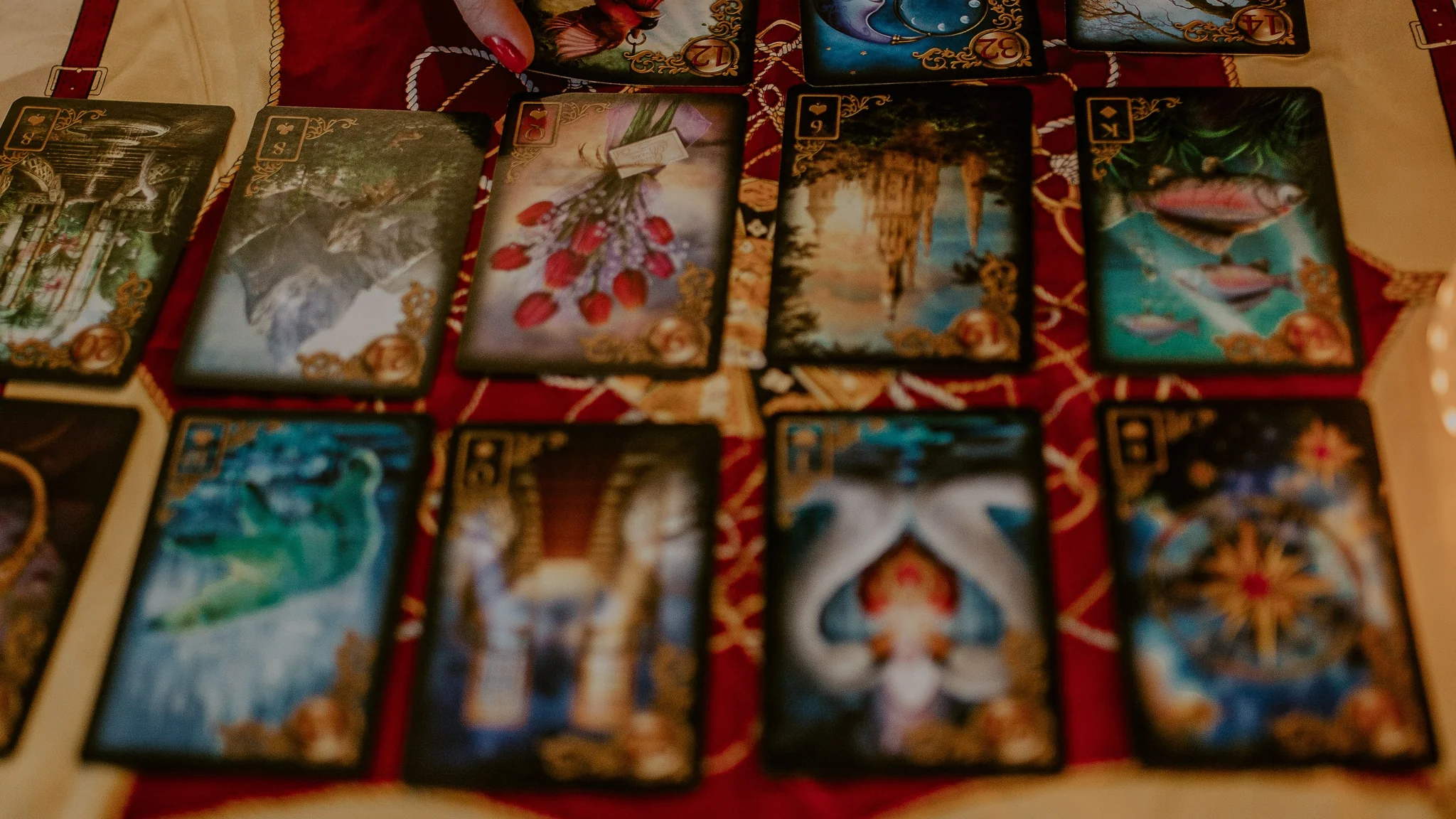
A reading has four parts: a question, a shuffle, a layout, and an interpretation. A clear question, such as what is blocking progress in a relationship, gives the reader something concrete to work with. A vague question gives the cards too much room, and the reading drifts into general statements. The shuffle mixes the deck. The reader draws cards and places them face up in the spread, where each position has a role, such as the present or the obstacle. Then the reader weaves the cards into one account, noting which cards support each other and which pull apart. The cards are visible to everyone, and the meanings come from a shared system any reader can study. What differs is judgment: which details to stress and how to turn separate images into one story. That judgment is the real craft, and the reason readings vary in quality.
The deck: 78 cards in two groups
A standard deck holds 78 cards in two groups. The Major Arcana holds 22 cards, numbered 0 to 21, from the Fool to the World, and stands for major themes: beginnings, choices, endings, and upheaval. Several Major Arcana cards in one reading point to a big chapter of life, not a passing detail. The Minor Arcana holds 56 cards in four suits of 14: Wands, Cups, Swords, and Pentacles. Each suit holds ten numbered cards, Ace through 10, plus Page, Knight, Queen, and King. In the tradition, Wands relate to action, Cups to feeling, Swords to thought, and Pentacles to work and money. See what is tarot for a plain introduction. A court card can stand for a person, a role, or a way of acting: Page for a message, Knight for movement, Queen for steadiness, King for authority. The Fool shows how much the pictures carry: a traveler near a cliff edge, read as a fresh start. See the Fool tarot card meaning.
The shuffle, the cut, and the spread
Shuffling mixes the deck and, in the tradition, lets the question settle into the cards. Some readers shuffle in silence while the questioner focuses on the question. Others ask the questioner to shuffle and cut, so their hands are part of the process. There is no single correct method. What matters is that the deck is well mixed and the draw is not steered. A spread is a layout where every position has a set meaning. One card answers a single question. A three card spread covers past, present, and future, or situation, obstacle, and advice. The best known large spread is the Celtic Cross, with ten cards: six form a cross covering the present, the challenge, the foundation, the past, the aim, and the near future, and four stand in a staff covering the self, outside influences, hopes and fears, and the outcome. See the Celtic Cross tarot spread. Bigger is not better: many experienced readers prefer a small spread with a sharp question. Try the free tarot one card tool.
How readers interpret the cards
Interpretation works on four layers. First, the card meaning: each card carries a traditional range built over a century of guides. Second, position: the same card means something different as an obstacle than as an outcome. Third, combination: cards change each other, and readers look for pairs and groups that repeat a theme, such as three Cups cards pointing to an emotional question. Fourth, intuition: the reader notices which detail draws the eye and which thread ties the spread together. Intuition here is pattern recognition built from study, not secret knowledge. Reversed cards add a fifth layer for readers who use them: an upside down card is read as the blocked or inward version of the upright meaning. Not every reader uses reversals; consistency within one reading is what matters. See how to read tarot for yourself for the practical side.
A short history: from card game to oracle
Tarot began as a game, not an oracle. The earliest cards were painted in northern Italy in the mid 15th century, in the courts of Milan and Ferrara, for wealthy families. The Visconti-Sforza decks are among the oldest survivors. The game, called trionfi and later tarocchi, was a trick taking game in which 21 trumps plus the Fool sat above four ordinary suits. For about three and a half centuries, that was all tarot was. The turn came in France in 1781, when the Swiss writer Antoine Court de Gebelin claimed in Le Monde primitif that the trumps preserved ancient Egyptian wisdom from the Book of Thoth. No evidence supports that claim, and no Egyptian deck has ever been found. Yet the idea caught on, and around 1783 Jean-Baptiste Alliette, writing as Etteilla, published the first manual for reading tarot as an oracle. The deck most readers use today dates from 1909, when the London publisher Rider issued a deck designed by A. E. Waite and painted by Pamela Colman Smith. For the first time, all 56 Minor Arcana cards carried full scenes, which made the deck far easier to read. Waite explained it in The Pictorial Key to the Tarot in 1910. The Rider-Waite deck remains the most widely used deck in the world. The meanings are a human tradition built over centuries, not a relic of ancient Egypt.
What readers say is happening, and what psychology says
Readers describe the process in different ways: a mirror for the unconscious, a channel for intuition, or simply rich images that aid clear thinking. None of these claims can be tested like a medical claim, and honest readers say so. See is tarot reading real for more. Psychology offers four mechanisms that explain why readings feel accurate. The Barnum effect, named by Paul Meehl in 1956: in 1949, Bertram Forer gave 39 students the same personality sketch, and the average rating was 4.26 out of 5, with 16 calling it a perfect match. Broad statements feel tailor made. Confirmation bias: people remember the hits and forget the misses. Cold reading: a reader shapes broad statements using dress, speech, tone, and reaction, often without conscious intent. Projection: the mind fills an open image with what it carries, so one picture means a lost job to one person and a lost love to another. These mechanisms do not prove a reading has no value. They set a fair test: judge a reading by whether it helps you think clearly, not by how accurate it feels.
What a good reading looks like, and what a bad one looks like
A good reading starts with a clear question, names the cards and positions as it goes, and links every claim to something visible on the table. The reader says which card is speaking and how it connects to the question. The language stays open: the cards point to a pause, the spread suggests patience. A good reader leaves room for disagreement and ends with something practical, such as a conversation to have or a decision to delay. A good reader never claims a fixed future, never asks for more money to remove a curse, and never pressures a decision. A bad reading leans on flattery, vague praise, and claims about other people that cannot be checked. It uses fear, warning of danger that only another paid session can prevent. It never names the cards and never invites a question. If a reading feels like a performance built around your reactions, step back.
What tarot cannot do
Tarot cannot tell you what will happen. It cannot diagnose illness, settle a legal question, replace financial advice, or tell you what another person is thinking. It cannot prove a partner is faithful, or pick a lottery number. What it can do is slow you down, give a question a shape, and bring forward feelings and options that urgency pushed aside. Used that way, a reading is closer to a guided conversation than to a forecast. The test is simple: after the session, do you understand your situation better, and do you know what to do next. If yes, the reading worked.
Tarot is a system of images, positions, and combinations, from a tradition that began as a 15th century Italian game and became an oracle in 18th century France. The deck holds 78 cards, the spreads give structure, and the reader turns structure into meaning. Hold that beside the value of a good session, and you have a fair picture of what tarot reading is and what it is not. First 3 minutes FREE — every time, for every reading, with all advisors.
Frequently Asked Questions
What is a tarot reading?
A tarot reading is a structured session in which a reader shuffles a 78 card deck, lays out cards in a pattern called a spread, and interprets the pictures, the positions, and the links between the cards in light of your question. It is an interpretation, not a printed verdict, and two readers can read the same cards in different ways.
How many cards are in a tarot deck?
A standard tarot deck holds 78 cards: 22 Major Arcana cards, numbered 0 to 21, and 56 Minor Arcana cards in four suits of 14. Each Minor Arcana suit holds ten numbered cards, Ace through 10, plus four court cards: Page, Knight, Queen, and King.
Do tarot cards predict the future?
There is no scientific evidence that tarot cards predict future events. In the tradition, the cards are read as a mirror for reflection and a prompt for clearer thinking, not as a forecast that is fixed. A good reading helps you see a situation more clearly; it does not decide what will happen.
What is the Celtic Cross spread?
The Celtic Cross is a ten card spread and the best known deep reading layout in tarot. Six cards form a cross that covers the present, the challenge, the foundation, the past, the aim, and the near future, while four cards in a staff beside it cover the self, outside influences, hopes and fears, and the outcome.
Can anyone learn to read tarot?
Yes. Reading tarot is a learned skill built on study of the card meanings, practice with spreads, and honest reflection on what works. Most readers start with one card a day or a simple three card spread, then build up to larger layouts such as the Celtic Cross over months of steady practice.
Last updated: November 17, 2026
