
Draconid Meteor Shower October 2026: Spiritual Meaning

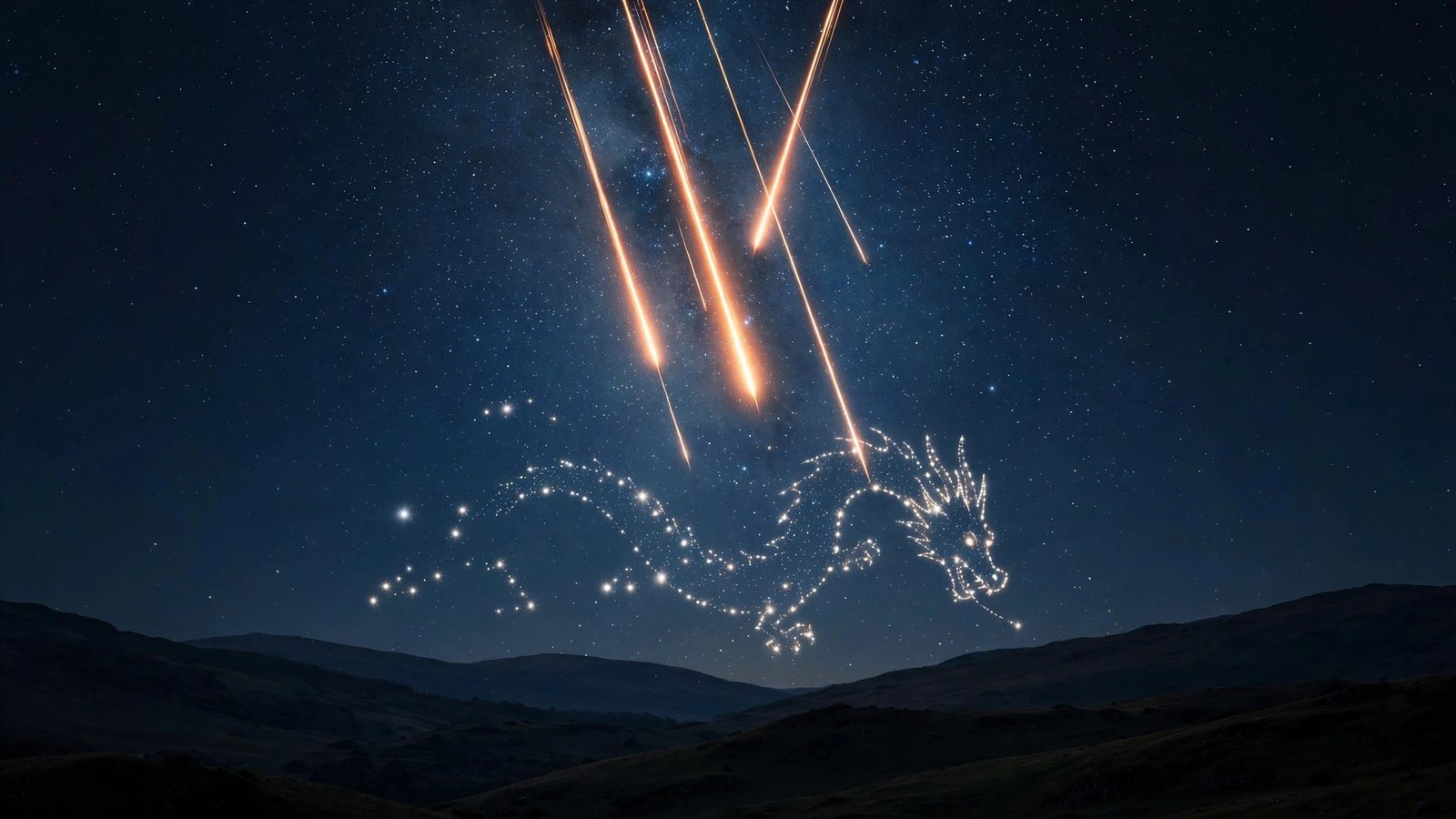
The Draconid meteor shower peaks tonight, the evening of October 8, 2026, into the early hours of October 9 and this year it's worth watching, not just for the meteors themselves, but for what this particular shower represents. Named after the constellation Draco (the Dragon), the Draconids are the wild cards of the meteor calendar: some years they explode into spectacular outbursts, and other years they barely whisper across the sky. Here's the practical and spiritual guide written for the night that's happening right now.
When Exactly to Watch the 2026 Draconids
Let's start with the facts, because timing is everything with this shower. The Draconids are active from October 6 to October 10, 2026, but the action concentrates on a single night. The International Meteor Organization predicts maximum activity at around 01:00 UTC on October 9 which means:
The shower peaks under dark skies thanks to the approaching New Moon in Libra. Later in October, the Full Moon in Taurus closes the month's skywatching.
North America: Thursday evening, October 8. For the East Coast that's around 9 PM Thursday night; on the West Coast, around 6 PM, just as darkness settles in. The UK gets its best window around 2 AM Friday.
Europe: Late evening October 8 into the small hours of October 9.
Everywhere in the Northern Hemisphere: The evening of October 8 is your night. Mark it.
Here's what makes the Draconids unusual among meteor showers: they're an evening show. Most famous showers the Perseids, the Geminids demand that you drag yourself out of bed at 2 or 3 AM, when the radiant point has climbed high. The Draconid radiant, in the constellation Draco, is highest right after sunset and sinks lower as the night wears on. So you don't need to set an alarm. Dinner, a jacket, a dark patch of sky that's the whole plan.
The moon is on your side this year
A new moon arrives on October 10, which means the peak night brings a thin waning crescent that rises only in the pre-dawn hours. Your evening sky will be essentially moonless dark, deep, and generous. Meteor watchers call these "favorable conditions," and they're right: faint meteors that a bright moon would wash out will be visible this year. If the weather cooperates where you are, this is genuinely one of the better Draconid setups in recent memory.
What the Draconids Actually Are
Every meteor shower is Earth's annual appointment with a comet's leftovers, and the Draconids are no exception. These meteors are debris from Comet 21P/Giacobini-Zinner, a small periodic comet that swings around the Sun roughly every 6.6 years. Each pass sheds dust and pebbles along its orbit, and once a year right now Earth plows through that stream. The particles hit our atmosphere at about 20 kilometers per second and burn up in streaks of light.
Twenty km/s sounds fast until you compare it: Perseid meteors scream in at nearly 60 km/s. Draconids are the slow dancers of the meteor world. They drift rather than dart, which gives them a distinctive lazy grace long, lingering trails that hang in the sky a beat longer than you'd expect. For wishing purposes, that's a genuine advantage: you actually have time to make one.
How many will you see?
Honest answer: probably not many. In an ordinary year, the Draconids produce a zenithal hourly rate (ZHR) of roughly 5 to 10 meteors per hour under perfect conditions and real-world counts from a light-polluted backyard will be lower. No surge or outburst is predicted for 2026. So set your expectations correctly: this is not the Perseids. You won't see a meteor every thirty seconds. You might see one every ten or fifteen minutes, or you might watch for an hour and catch three beautiful ones.
And that, strangely, is part of the appeal. More on that below.
Why This Shower Is So Unpredictable
The Draconids have a reputation that far exceeds their average performance, and the reputation is earned. Twice in the 20th century in 1933 and 1946, this quiet little shower erupted into genuine meteor storms, with rates in the thousands per hour. People who witnessed them described the sky as falling. There was another notable outburst in 2011 that lit up European skies.
Why does this happen? The debris stream from Comet Giacobini-Zinner is narrow and clumpy rather than smooth and even. Most years, Earth passes through the thin, sparse edges of the trail hence the modest handful of meteors. But every so often, our planet threads a denser knot of material, and the sky catches fire. Astronomers can't always predict which knot we'll hit, which is why every October carries a small, delicious uncertainty.
2026 is not forecast to be one of those years. But the forecast is a prediction, not a promise and part of the Draconid tradition is stepping outside just in case. The dragon doesn't perform on schedule. That's the whole point.
How to Watch Them Tonight: The Practical Guide
You don't need a telescope, binoculars, or any equipment at all. Meteor watching is the most democratic form of astronomy, it just asks for your eyes and your patience. Here's how to do it well:
Get away from lights
This is the single biggest factor. City streetlights and porch lights will erase all but the brightest meteors. Drive or walk to the darkest spot you can reasonably reach a park, a field, a rooftop away from direct lighting. Even twenty minutes from downtown makes a dramatic difference. Face generally north, toward Draco, but don't fixate: Draconid meteors can streak across any part of the sky.
Let your eyes adapt
Your eyes need 20 to 30 minutes in darkness to reach full night sensitivity. Every glance at your phone resets the clock. If you must check the time, use a red-light mode or the dimmest possible setting. Red light preserves night vision far better than white. Better yet, leave the phone in your pocket and let the sky be the entertainment.
Dress warmer than you think
October evenings cool fast, and you'll be sitting still which means you'll feel the cold sooner than you expect. Layer up: a warm jacket, a hat, gloves if you're in a cold region. Bring a reclining chair, a sleeping bag, or a thick blanket to lie on. Comfort is strategy here; the person who stays out for two hours sees more than the person who gives up shivering after twenty minutes.
Bring the right company (or none)
Meteor watching works beautifully in companionable silence a friend, a partner, someone you can nudge when a bright one streaks past. It also works beautifully alone. There's something about lying under a dark sky by yourself, watching for falling stars from a comet's ancient trail, that rearranges your sense of scale in the best possible way.
A note on photographing them
Phone cameras will struggle with the Draconids, they're faint and unpredictable, which is a bad combination for small sensors. If you have a DSLR or mirrorless camera, a tripod, a wide-angle lens, and a long exposure (15-30 seconds at high ISO) give you a real shot. But honestly? Consider leaving the camera bag at home this time. Some skies are better witnessed than captured.
What It Actually Feels Like Under a Slow Meteor Shower
There's a particular quality to watching a quiet shower that the big, famous ones can't give you. The Perseids are a fireworks show constant stimulation, oohs and aahs every minute. The Draconids are more like fishing. Long stretches of nothing but stars, and then a slow amber streak draws itself across the northern sky, hangs for a heartbeat, and fades. Your whole body reacts. You gasp, or you go completely still.
The slowness of Draconid meteors changes the experience. Fast meteors are gone before you've registered them; these give you time. Time to notice the color (often golden or reddish), time to trace the path with your eyes, time to actually form a thought a wish, a memory, a question before the light dies.
If you're watching tonight, give it at least an hour. The first twenty minutes are your eyes adjusting. The next forty are the shower doing its quiet work. Don't measure the night by meteor count. Measure it by how different you feel lying there at 10 PM versus how you felt rushing through your day at 6.
The Dragon: Why Draco Matters
The shower's name comes from its radiant, the point in the sky the meteors appear to stream from which sits in Draco, the Dragon, a constellation coiled around the north celestial pole. Draco's head is a small, distinctive pattern of four stars in the northwestern sky, with the bright stars Eltanin and Rastaban marking the dragon's eyes. You don't need to find it to see the meteors, but knowing the dragon is up there, watching over the show, adds something.
Dragons are among the oldest symbols in human culture, and they mean remarkably similar things across traditions that never met each other. In Chinese lore, the dragon is a benevolent force of transformation, wisdom, and hidden power a creature that guards treasures and brings rain. In Western myth, dragons hoard gold in caves and must be faced to prove one's courage. In both, the dragon represents power that has been buried, guarded, or feared and the transformation that comes from confronting it.
That symbolism is older than telescopes and outlasts every scientific explanation. When you watch meteors fall from the Dragon's head, you're participating in a sky-story humans have been telling for thousands of years. The astronomy tells you what's happening. The dragon tells you what it means.
The Spiritual Meaning of the Draconids
Let's be clear about the line here: the meteors are burning comet dust that's astronomy, and it's wonderful on its own terms. What follows is interpretation, not science. But humans have always read meaning in the sky, and there's nothing superstitious about using a beautiful natural event as a prompt for reflection. Here's how many people work with the Draconids spiritually:
Releasing old fears
The dragon guards a hoard, and in the inner life, the hoard is often fear, old anxieties you've been sitting on, guarding, feeding, the way a dragon guards gold. The Draconids arrive in October, the season of shedding and letting go, and their unpredictability carries its own message: you can't control when the sky will reward your patience. You can only show up, watch, and release your grip on the outcome. Many people use the shower as a ritual moment to name one fear they're done carrying, spoken aloud under the open sky, or written down and burned, or simply thought clearly as a meteor falls.
Reclaiming hidden power
Dragons don't just hoard gold; they are the power. In myth after myth, the hero who faces the dragon absorbs something of its strength. The spiritual reading of the Draconids follows the same arc: the qualities you've buried your ambition, your anger, your weirdness, your wanting aren't gone. They're coiled up, waiting. A meteor falling from the Dragon's head is a tidy symbol for power descending back to earth, back to you. Ask yourself what you've been keeping locked away, and whether it's still serving you to keep it there.
Courage as a practice, not a feeling
Here's the thing about watching a faint, unpredictable shower: it takes a small, real kind of courage. The courage to go outside on a cold night with no guarantee of a show. The courage to be patient, to be quiet, to want something without demanding it. The Draconids reward exactly the qualities that courage is made of showing up, waiting well, and staying open to surprise. If you've been avoiding something that scares you a conversation, a decision, a beginning, the dragon's shower is a good night to borrow some of its nerve.
Making Wishes and Setting Intentions Under Meteors
"Make a wish on a falling star" is one of humanity's most durable traditions, and the Draconids with their slow, generous meteors are built for it. Not because the wish magically comes true (let's be honest with each other), but because the act of wishing does something real: it forces you to articulate what you actually want. Most of us walk around with vague longings. A meteor gives you three seconds of urgency to get specific.
A simple intention ritual for tonight
You don't need candles, crystals, or equipment. Try this:
Before you go out, write down one thing you want to release and one thing you want to invite in. Keep them to a single sentence each. The constraint is the point. Fold the paper and put it in your pocket.
Under the sky, when you see a meteor, hold the "release" sentence in your mind as the light crosses the sky. Imagine it burning up with the meteor comet dust and old fear, both turning to light and gone.
For the "invite" sentence, wait for the next meteor. As it falls, say the sentence silently to yourself, as specifically as you can. Then let it go. You've named it; that's the work.
When you go inside, you can keep the paper, burn it safely, or throw it away. The paper was never the point. The clarity was.
Why specificity matters
"I wish for happiness" dissolves the moment the meteor fades. "I want to have the conversation with my sister that I've been avoiding for six months" sticks. The sky doesn't grant wishes but a person who has named what they want, out loud, under stars, is measurably more likely to act on it. That's not magic. That's just how attention works. The meteor is the deadline; the clarity is the gift. First 3 minutes FREE — every time, for every reading, with all advisors.
Frequently Asked Questions
Can I see the Draconids from the Southern Hemisphere?
Barely, if at all. The radiant in Draco sits near the north celestial pole, which means it never climbs far above the horizon for southern observers. This is a Northern Hemisphere shower, the farther north you are, the better your view. If you're in the south, the Orionids (peaking October 21-22) are your October shower instead.
What time is best on October 8?
As soon as it's fully dark. Unlike most showers, the Draconid radiant is highest in the early evening and sinks toward the horizon as the night goes on so the first few hours after sunset are prime time, and the pre-dawn hours (usually the best for other showers) are the worst for this one. Night owls, you get the evening off; early birds, this one's yours.
Will there be a meteor storm in 2026?
Not predicted. The Draconids produced legendary storms in 1933 and 1946 and a strong outburst in 2011, but 2026 is expected to be a quiet year roughly 5 to 10 meteors per hour under ideal conditions. That said, the shower's whole character is unpredictability, which is why longtime watchers go out every October regardless of the forecast.
Is it safe to watch with children?
Completely. And it's one of the best showers to share with kids, precisely because you don't have to keep them up until 3 AM. An early-evening meteor watch, hot chocolate, a blanket, and the story of the dragon in the sky: that's a core memory in the making. Let them make the wishes. Theirs are usually the most specific.
The sky made me feel something big now what?
That happens more often than people admit. A dark sky, a falling star, an hour of quiet it loosens things. If tonight's shower stirred up a question about your life, your relationships, or a decision you've been circling, it can help to talk it through with someone who reads patterns for a living. Sometimes an outside eye sees what the meteors were pointing at.
Last updated: November 12, 2026

